Apache Iceberg vs Snowflake: Key Differences Explained
14 min read
Teams comparing Apache Iceberg and Snowflake are usually comparing two different kinds of technology. Iceberg is an open table format, a specification for organizing data files and metadata on object storage so that many engines can read and write the same tables. Snowflake is a fully managed cloud data platform that bundles storage, compute, a SQL engine, security, and governance into a single service. The comparison still matters, because both answer the same practical question: where should analytical data live, and who should control it?
The line between the two has also blurred over the last few years. Snowflake now reads and writes Iceberg tables, exposes its own catalog through the Iceberg REST API, and can query an Iceberg lakehouse that Spark, Trino, or Flink also use. So the decision is rarely about picking one and rejecting the other. It is about deciding who owns your storage, your metadata, and your compute, and how much operational work your team is willing to take on in exchange for that ownership.
This guide walks through what each technology is, how their architectures differ, how they scale, how they work together, and when each one is the better fit.
What Is Apache Iceberg?
Apache Iceberg is an open table format for large analytic datasets. It started at Netflix, where engineers ran into the limits of Hive tables on petabyte-scale data, and it became a top-level Apache Software Foundation project in 2020. Iceberg does not store or process data by itself. Instead, it defines how a collection of Parquet, ORC, or Avro files should be tracked so that they behave like a reliable database table.
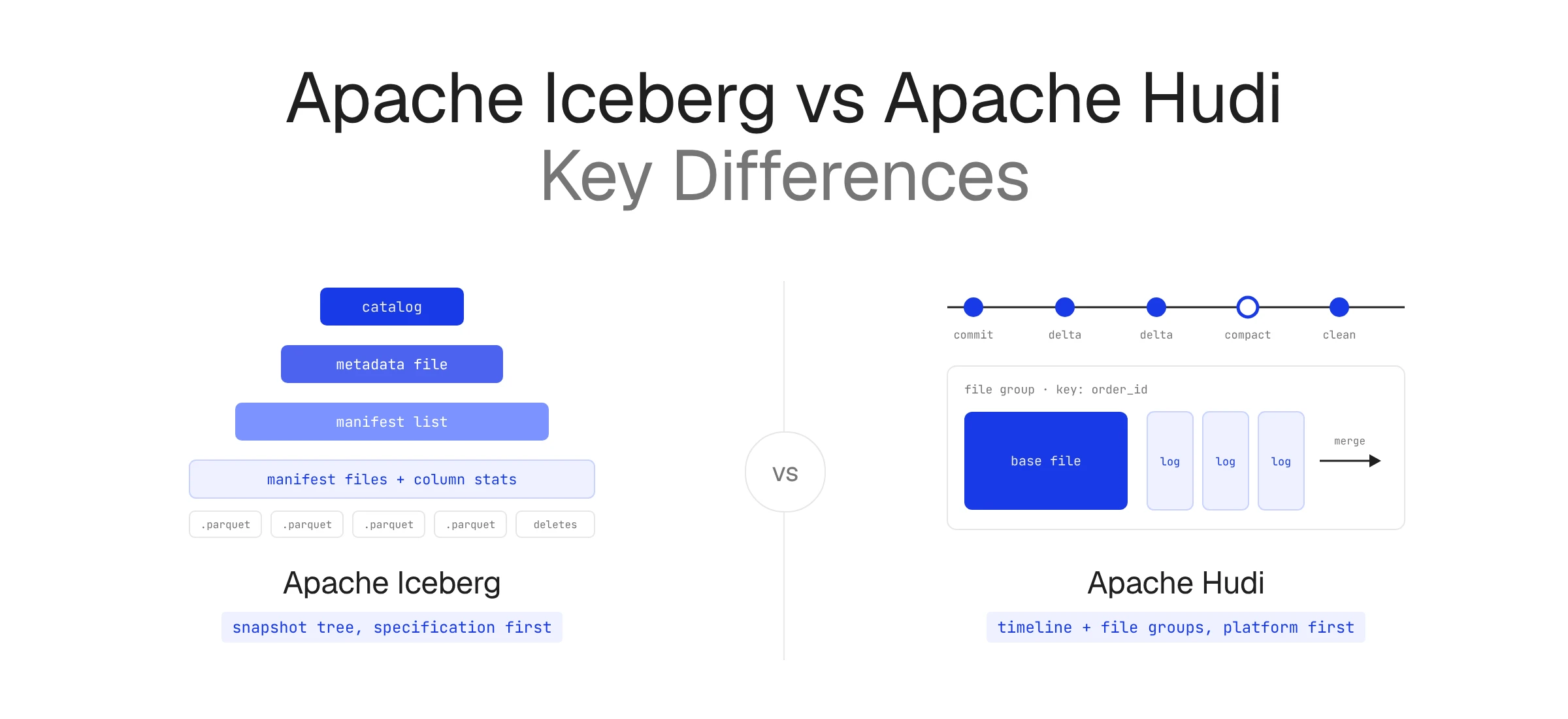
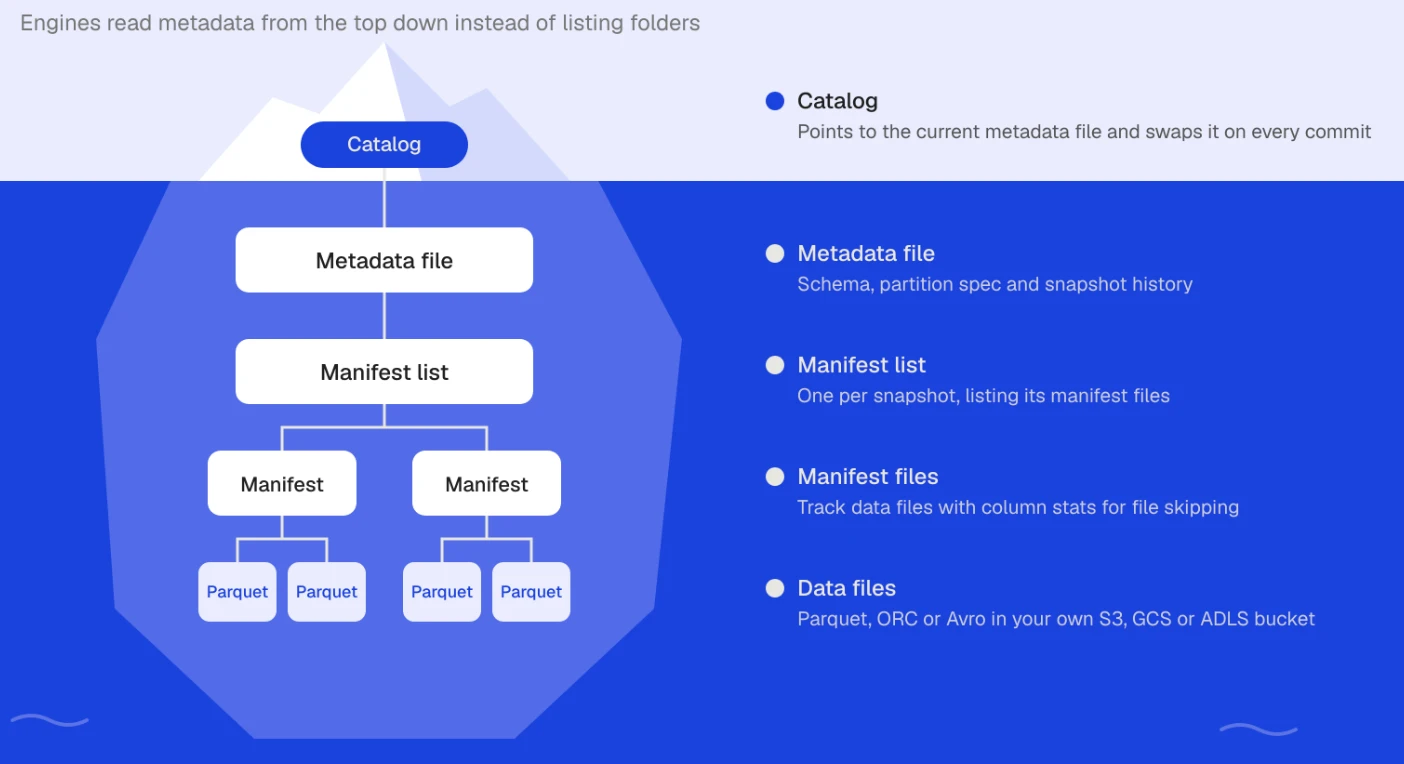
The core idea is that a table is described entirely by its metadata rather than by a directory layout. A catalog points to the current metadata file, which references a manifest list for each snapshot, and each manifest list points to manifest files that track individual data files along with column-level statistics. Because engines read this metadata tree instead of listing directories, they can plan queries quickly and skip files that cannot match a filter.
This design gives Iceberg several capabilities that plain data lakes lack:
- ACID transactions through optimistic concurrency, so multiple writers can commit safely without corrupting the table.
- Schema evolution that lets you add, drop, rename, or reorder columns without rewriting data files.
- Hidden partitioning and partition evolution, so queries do not need to know the partition scheme, and the scheme can change as data grows.
- Time travel and rollback through snapshots, which let you query a table as it existed at an earlier point.
- Row-level deletes and updates through position deletes, equality deletes, and, in format v3, deletion vectors.
The biggest reason teams adopt Iceberg is engine independence. The same table can be written by Spark or Flink and read by Trino, DuckDB, Dremio, StarRocks, Amazon Athena, BigQuery, or Snowflake. Data stays in your own object storage, in an open format, and no single vendor controls access to it.
What Is Snowflake?
Snowflake is a cloud data platform delivered as a fully managed service on AWS, Azure, and Google Cloud. It launched as a data warehouse built for the cloud, and it has since expanded into data engineering, data sharing, application development, and AI workloads. Users interact with it mostly through SQL, along with Snowpark for Python, Java, and Scala.
Snowflake's defining design choice is the separation of storage and compute. Data sits in a centralized storage layer, while queries run on independent compute clusters called virtual warehouses. A third layer, cloud services, handles authentication, metadata, query optimization, and transaction management. Because these layers are independent, a team can run heavy ETL on one warehouse and dashboards on another without the two competing for resources.
For its native tables, Snowflake stores data in a proprietary columnar format organized into micro-partitions. It manages compression, clustering metadata, statistics, and file layout automatically, so there are no indexes to tune and no files to compact. Features such as Time Travel, zero-copy cloning, secure data sharing, dynamic data masking, and row access policies come built in.
Snowflake prices compute in credits consumed by running warehouses, billed per second after the first minute, and storage at a flat rate per terabyte per month. Edition (Standard, Enterprise, Business Critical, or Virtual Private Snowflake) determines which security and governance features are available and the price per credit.
The main appeal of Snowflake is that it removes infrastructure work. Teams load data, write SQL, and let the platform handle tuning, scaling, and maintenance.
Apache Iceberg vs Snowflake: Key Differences
Since Iceberg is a table format and Snowflake is a platform, the clearest way to compare them is to look at who is responsible for each part of the stack.
| Dimension | Apache Iceberg | Snowflake |
|---|---|---|
| Category | Open table format specification | Fully managed cloud data platform |
| Storage | Your object storage (S3, GCS, ADLS) | Snowflake-managed storage for native tables; your storage for Iceberg tables |
| File format | Open (Parquet, ORC, Avro) | Proprietary for native tables; Parquet for Iceberg tables |
| Compute | Any compatible engine (Spark, Trino, Flink, DuckDB, and others) | Snowflake virtual warehouses |
| Catalog | Your choice: REST catalogs such as Apache Polaris, AWS Glue, Nessie, Hive, and others | Snowflake Horizon Catalog |
| Table maintenance | Your responsibility (compaction, snapshot expiration, orphan file cleanup) | Automatic for native and Snowflake-managed Iceberg tables |
| Governance | Depends on the catalog and engines you use | Built in: RBAC, masking, row access policies, lineage |
| Pricing | Open source; you pay for storage and the compute you run | Credits for compute, plus storage for native tables |
| Vendor lock-in | Low | Higher for native tables; lower when using Iceberg tables |
| Operational effort | Higher | Lower |
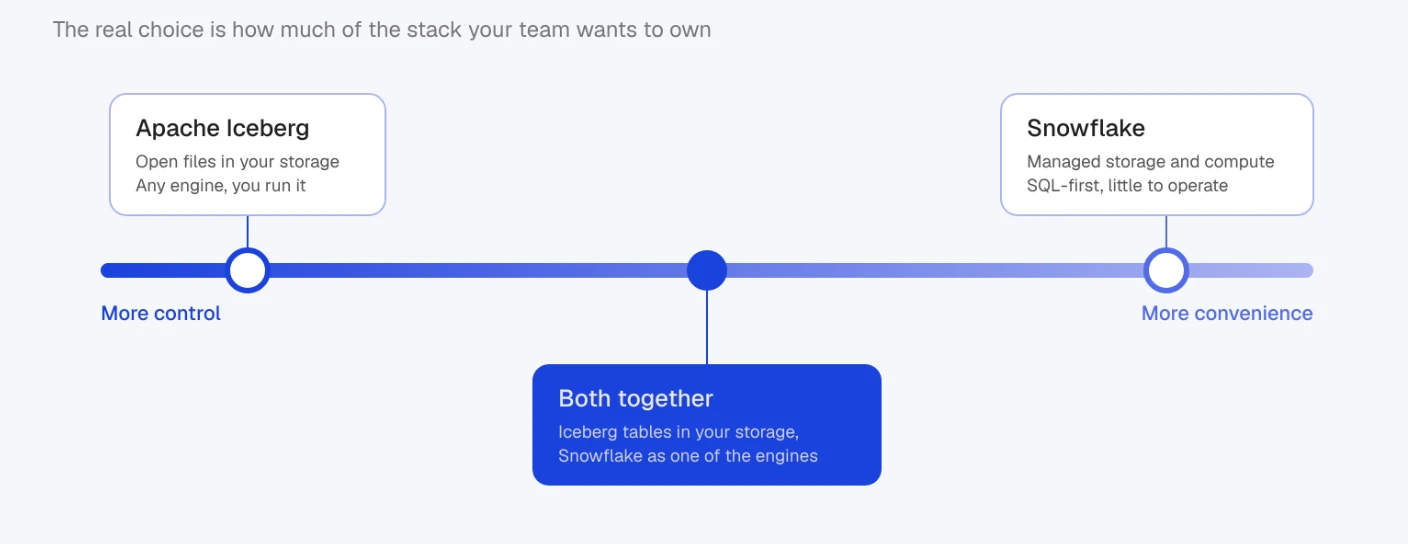
Ownership and lock-in. With Iceberg, data and metadata sit in your cloud account in open formats, so switching engines does not require migrating data. Snowflake native tables can only be read through Snowflake, which makes moving off the platform a larger project.
Features. Both support ACID transactions, schema evolution, and time travel. Snowflake adds a wide set of managed features on top, including data sharing, cloning, governance policies, and AI functions. Iceberg provides the table-level primitives and relies on the surrounding engines and catalog for everything else.
Performance. Snowflake tunes storage layout and query execution automatically, which gives consistent performance with little effort. Iceberg performance depends on the engine you pick and on how well the tables are maintained. A well-compacted Iceberg table with good partitioning and sort order performs very well, while a table full of small files and stale snapshots slows down every query that touches it.
Pricing. Iceberg has no license cost, but running Spark clusters, catalogs, and maintenance jobs carries infrastructure and engineering cost. Snowflake makes cost easy to understand per query but can grow quickly when warehouses run for long periods or are oversized.
Apache Iceberg vs Snowflake Architecture
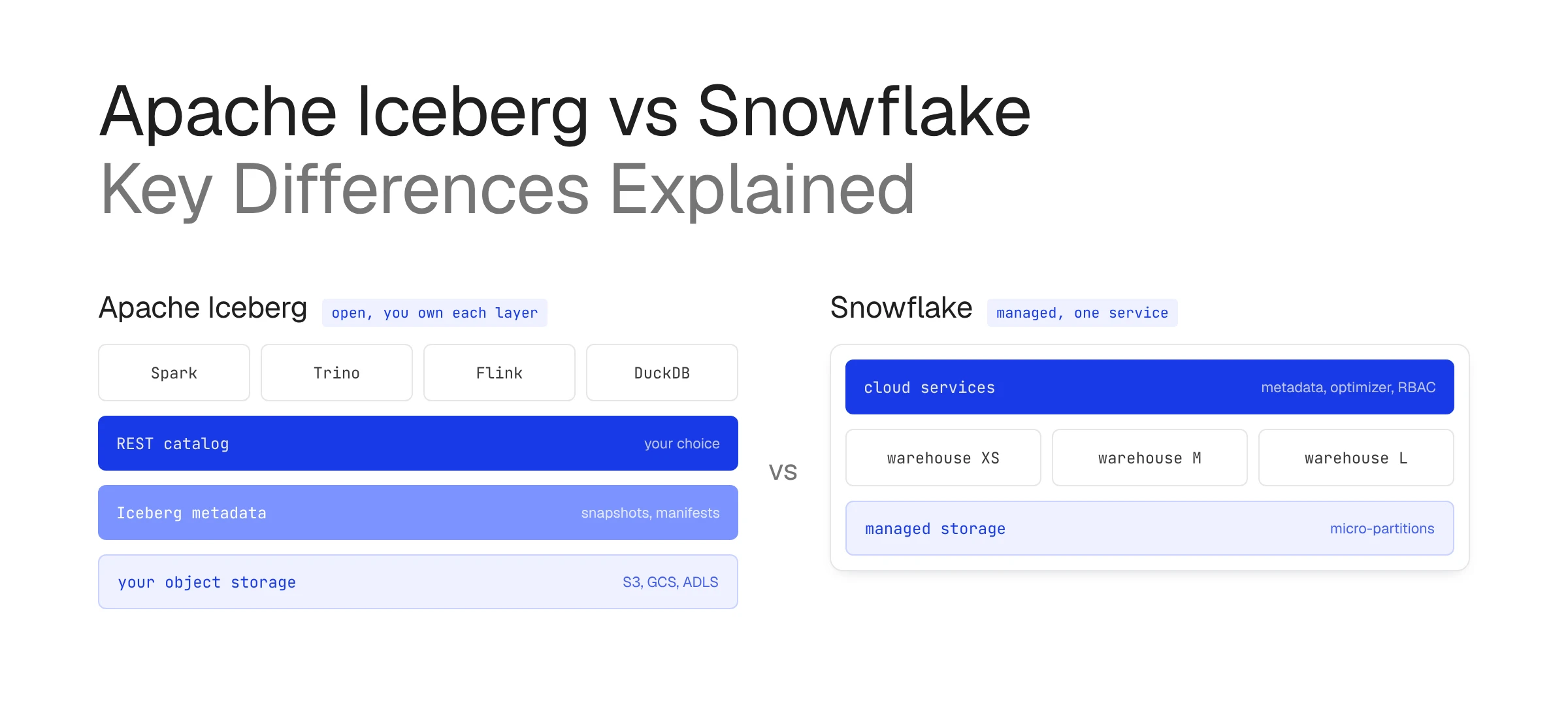
The architectural difference comes down to whether the layers of the stack are bundled or separate.
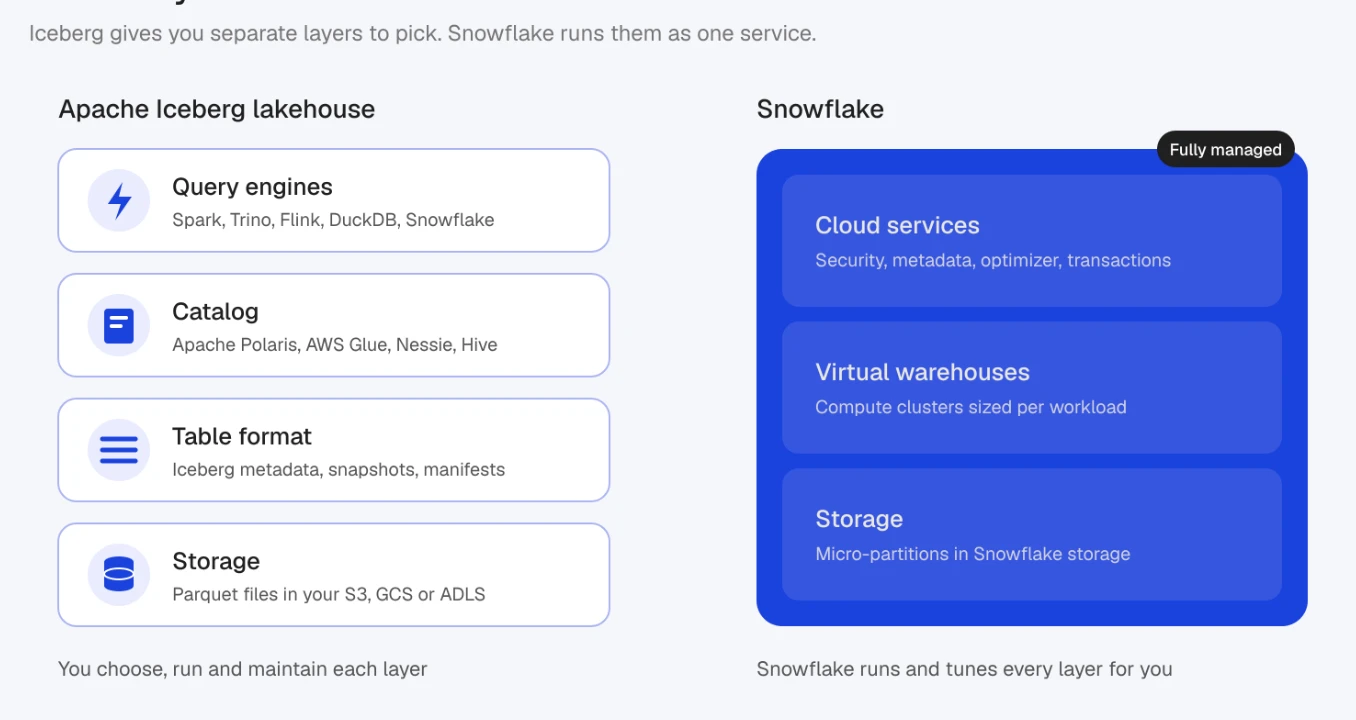
An Iceberg lakehouse is built from independent components. Data files live in object storage. Iceberg metadata files live next to them and describe tables, snapshots, and schemas. A catalog tracks the location of each table's current metadata file and handles atomic commits. On top of that, any number of engines connect to the catalog to read and write. Each of these layers can be swapped out separately, so a team might ingest with Flink, transform with Spark, serve dashboards from Trino, and run ad hoc analysis in DuckDB, all against the same tables.
That flexibility comes with responsibility. Someone has to choose and run the catalog, configure access control across engines, and schedule maintenance. Without regular compaction, streaming and CDC workloads produce many small files and delete files that slow down reads. Without snapshot expiration, metadata and storage grow without bound.
Snowflake's architecture bundles these layers into one service. The storage layer, the compute layer of virtual warehouses, and the cloud services layer all run under Snowflake's control. Metadata, optimization, and access control live in the cloud services layer, and users never manage files directly. That integration is what makes Snowflake easy to operate, and it is also why native Snowflake tables are not readable by outside engines.
Snowflake's support for Iceberg tables sits between these two models. Snowflake offers two kinds of Iceberg tables:
- Snowflake-managed Iceberg tables, where Snowflake acts as the catalog, writes Parquet data and Iceberg metadata to an external volume in your cloud storage, and handles maintenance.
- Externally managed Iceberg tables, where another catalog such as AWS Glue or an Iceberg REST catalog remains the source of truth, and Snowflake connects through a catalog integration or a catalog-linked database.
In both cases, data stays in your storage in an open format. Snowflake's Horizon Catalog, which integrates Apache Polaris, also exposes an Iceberg REST endpoint so that engines such as Spark can read from and write to Snowflake-managed Iceberg tables while Snowflake's access controls still apply.
Apache Iceberg vs Snowflake Scalability
Both technologies scale to petabytes, but they scale in different ways and put the effort in different places.
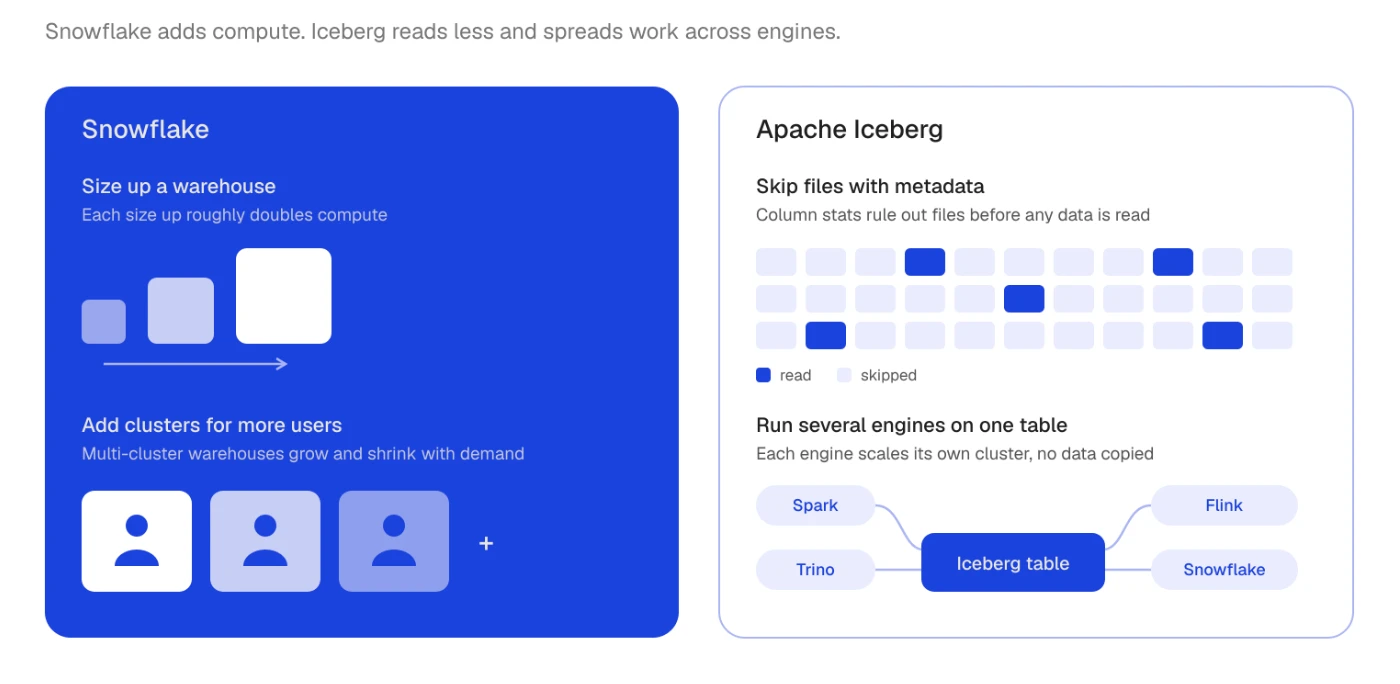
Snowflake scales compute through warehouse sizing and multi-cluster warehouses. Moving a warehouse up a size roughly doubles its compute for heavier queries, while multi-cluster warehouses add clusters automatically when many users run queries at the same time and remove them when demand drops. Storage scales without any action from the user. Concurrency and workload isolation are handled by giving each team or workload its own warehouse. The trade-off is cost, since every additional warehouse and every larger size consumes more credits.
Iceberg scales at the metadata layer. Because query planning reads manifest files and column statistics instead of listing directories, planning time stays manageable even when a table holds millions of files. Partition evolution lets a table change its layout as data volume grows without rewriting historical data. Compute scales according to the engine: Spark and Trino clusters can grow horizontally, and different engines can run against the same tables simultaneously without copying data.
In practice, Iceberg's scalability depends on discipline. Large tables need regular compaction to keep file counts under control, snapshot expiration to keep metadata small, and sensible partitioning and sort orders for the queries that run most often. Teams that automate this work get scalability comparable to managed warehouses with more control over cost. Teams that skip it often see queries slow down as tables age.
Can Apache Iceberg and Snowflake Work Together?
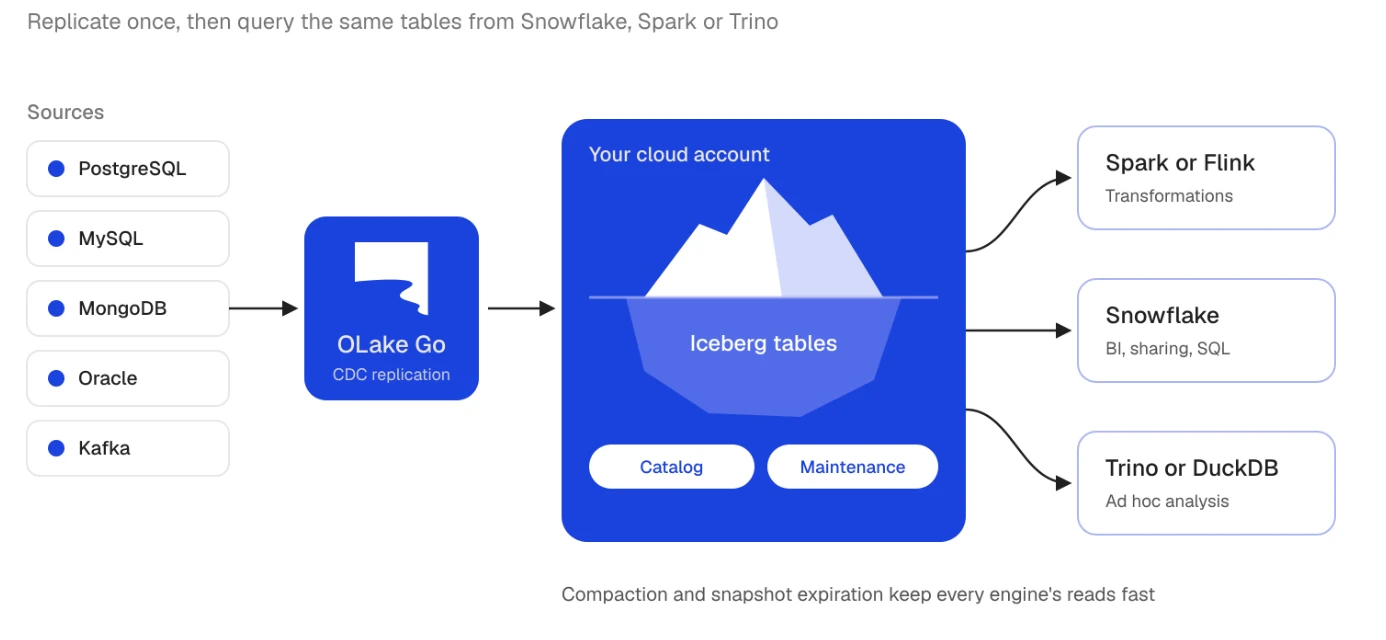
Yes, and for many organizations this is the most practical architecture. Rather than choosing between an open lakehouse and a managed warehouse, teams store data once in Iceberg and let Snowflake be one of several engines that use it.
Snowflake supports this in both directions. As a catalog consumer, Snowflake connects to external Iceberg REST catalogs through catalog-linked databases, discovers tables automatically, and can read and write tables that another catalog manages. As a catalog provider, Horizon Catalog exposes an Iceberg REST API so external engines can read and write Snowflake-managed Iceberg tables using vended credentials. Snowflake has also announced support for Iceberg format v3 features through these interfaces.
A common pattern looks like this:
- Operational data from databases such as PostgreSQL, MySQL, MongoDB, or Oracle is replicated into Iceberg tables on object storage through CDC.
- A shared catalog, such as an Iceberg REST catalog or AWS Glue, tracks those tables.
- Spark or Flink handles heavy transformation, while Snowflake connects to the same catalog for BI, governed sharing, and SQL analytics.
- A maintenance layer compacts files and expires snapshots so every engine reads well-organized tables.
This setup avoids loading the same data into a proprietary warehouse format, which removes a copy and the pipeline that keeps it in sync. It also means Snowflake compute is only spent on the workloads where it adds value.
The ingestion step is often the hardest part to get right. OLake is an open-source tool built for it: OLake Go replicates data from databases and Kafka directly into Apache Iceberg tables with CDC, and its table maintenance handles compaction and snapshot expiration. Once the data lands in Iceberg, Snowflake can query it through a catalog integration or catalog-linked database without a separate load into native tables. The MySQL to Snowflake integration guide walks through one such pipeline end to end.
There are a few points to plan for when combining the two. Snowflake handles maintenance for Snowflake-managed Iceberg tables, but externally managed tables still need maintenance from whichever system owns them. Feature support can also differ across engines, especially for newer v3 features such as deletion vectors and row lineage, so it is worth checking which engines can read what a writer produces before adopting a feature.
When Should You Choose Apache Iceberg?
Iceberg is the better foundation when control, openness, and multi-engine access matter more than convenience. It fits well when:
- Multiple engines need the same data. Data engineering runs on Spark, analysts use Trino or Snowflake, and data scientists query with DuckDB or Python, all against one copy.
- Avoiding lock-in is a priority. Data stays in your cloud account in open formats, so changing engines or vendors does not require a migration.
- Data volumes are very large. Storing petabytes in object storage at cloud provider rates and choosing compute per workload often costs less than keeping everything in a managed warehouse.
- Streaming and CDC are central. Iceberg works well as the landing layer for continuous replication from operational databases and event streams.
- The team has data engineering capacity. Someone needs to own the catalog, access control, and table maintenance, or use tools that automate them.
When Should You Choose Snowflake?
Snowflake is the better choice when speed of delivery and low operational overhead matter most. It fits well when:
- The team is SQL-first and small. Analysts and analytics engineers can build and run pipelines without managing clusters, catalogs, or file layouts.
- Consistent performance is required with little tuning. Automatic optimization and workload isolation keep dashboards and reports predictable.
- Governance and compliance need to be built in. Role-based access control, masking policies, row access policies, and lineage are available out of the box.
- Data sharing is part of the business. Secure sharing and the Snowflake Marketplace make it easy to exchange data with partners and customers without copying it.
- Workloads are concurrent and spiky. Multi-cluster warehouses absorb bursts of users without manual capacity planning.
Teams that start with Snowflake can still keep their options open by storing large or shared datasets as Iceberg tables in their own storage while using native tables for the rest.
Conclusion
Apache Iceberg and Snowflake solve different problems. Iceberg is an open table format that gives you ownership of your data and the freedom to use any engine, at the cost of running more of the stack yourself. Snowflake is a managed platform that removes infrastructure work and delivers strong performance and governance, at the cost of tighter coupling to one vendor for native tables.
For many teams, the strongest option is to use both. Storing data in Iceberg on your own object storage keeps it open and portable, while connecting Snowflake through Horizon Catalog or catalog-linked databases gives analysts a managed SQL experience on the same tables. The right balance depends on your team's engineering capacity, how many engines need access to the data, and how much weight you place on long-term flexibility compared with short-term simplicity.