Apache Spark Alternatives in 2026
14 min read
Spark has been the default answer to the question of how to process a lot of data for well over a decade. That does not make it the right answer for every team in 2026. Cluster costs add up, JVM tuning eats engineering weeks, and a lot of workloads that used to need a cluster now fit comfortably on one large machine.
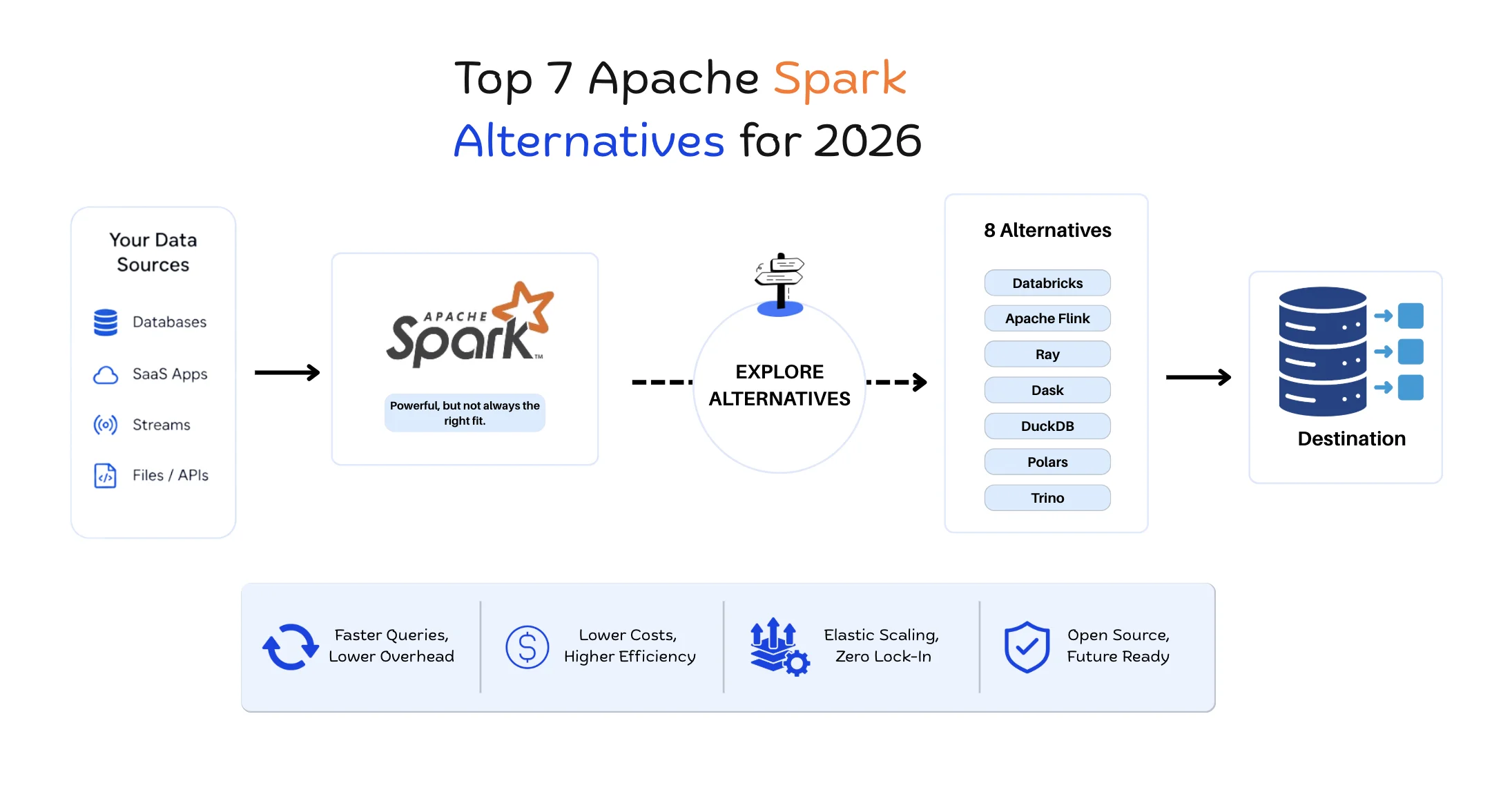
This post walks through what Spark actually is, why teams start shopping around, and seven alternatives that solve real problems. Spark does not solve well.
What Is Apache Spark?
Apache Spark is an open-source distributed processing engine for large-scale data. It started as a research project by Matei Zaharia at UC Berkeley's AMPLab in 2009, was open sourced in 2010, donated to the Apache Software Foundation in 2013, and became a top-level Apache project in February 2014.
The original pitch was speed. MapReduce forced every stage of a job to write results back to disk. Spark introduced Resilient Distributed Datasets, which let intermediate results stay in memory across stages, and that alone made iterative workloads dramatically faster.
Today Spark is much more than Resilient Distributed Datasets (RDDs). Most people write DataFrame or SQL code, and the Catalyst optimizer turns that into a physical plan. The engine ships with Structured Streaming, MLlib for machine learning, and GraphX for graph processing, all sharing one runtime. It runs on YARN, Kubernetes, or standalone, and every major cloud sells a managed version.
The project is still moving fast. Spark 4.0.0 landed in May 2025 with American National Standards Institute Structured Query Language (ANSI SQL) mode on by default, a VARIANT type for semi-structured data, and a hard cut to JDK 17 and Scala 2.13. Spark 4.1.0 followed in December 2025 with Spark Declarative Pipelines and the first official real-time mode for Structured Streaming, closing more than 1,800 tickets with over 230 contributors. Spark 4.2.0 arrived on July 14, 2026 with native GEOMETRY and GEOGRAPHY types, a SQL CHANGES clause for change data capture, Arrow-optimized Python UDFs enabled by default, and Java 25 support.
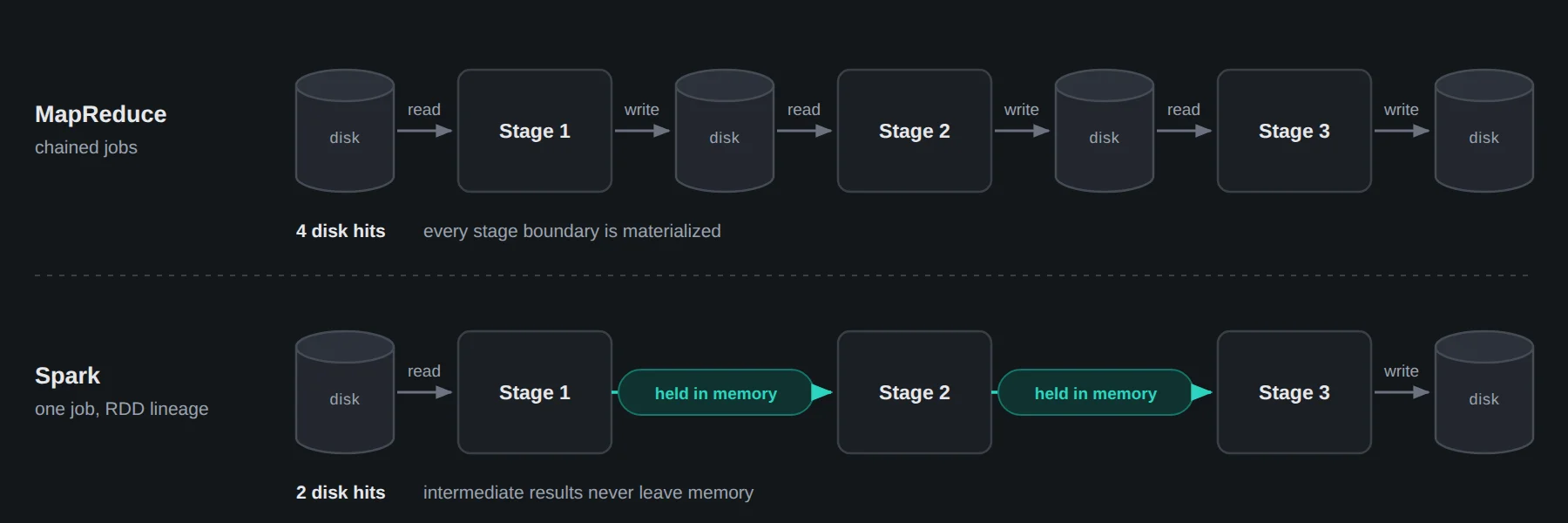
So Spark is not standing still. The question is whether the workload in front of you actually needs it.
Why Look for Apache Spark Alternatives?
Your data probably got smaller than you think. A single cloud VM can now carry a terabyte of RAM and over a hundred cores. A large share of pipelines that were sized for a cluster in 2018 fit on one node in 2026. When they do, the cluster is not buying speed. It is buying network shuffles, serialization overhead, and a scheduler.
Startup latency is real. Spinning up executors, negotiating resources, and warming the JVM takes time before a single row is read. For a dashboard query or a five-minute transform, that overhead can be most of the runtime.
Tuning is a job, not a setting. Executor memory, shuffle partitions, broadcast thresholds, skew handling, and garbage collection. Teams end up with someone who is unofficially the Spark person, and things break when that person is on leave.
Upgrades are not free. Spark 4.0 dropped JDK 8 and 11, dropped Scala 2.12, removed Mesos support, and deprecated SparkR. ANSI mode by default is the right call, but it changes how existing queries behave on bad data. Any of these can turn a version bump into a quarter of work.
Streaming latency has a floor. Structured Streaming is built on micro-batches, which means latency is roughly equal to the batch interval. Spark 4.1 added a real-time mode with sub-second latency and single-digit millisecond handling for stateless tasks, but engines designed around event-at-a-time processing still have an architectural head start here.
Spark is a compute engine, not a pipeline. This one trips people up. Teams write Spark jobs to move data out of Postgres or MongoDB into a lakehouse, then maintain that code forever. Ingestion is a solved problem with purpose-built tooling. OLake, for example, handles full load plus CDC from Postgres, MySQL, MongoDB and MSSQL straight into Apache Iceberg, and it does compaction on those tables too. Once the raw data lands as Iceberg, you are free to pick whatever query engine suits each workload rather than routing everything through one cluster.
Cost is hard to attribute. A shared Spark cluster running dozens of jobs makes it difficult to answer which pipeline is expensive. Teams end up over-provisioning because nobody wants to be the person whose right-sizing broke the nightly load. Engines that run per-query or per-process make that accounting a lot more obvious.
Open table formats are what make swapping engines possible at all. If your data is locked inside a proprietary warehouse, none of these alternatives are actually available to you.
Best Apache Spark Alternatives in 2026
1. Databricks (Spark plus Photon)
This is the path of least resistance. Databricks runs your existing Spark code and swaps the execution layer underneath for Photon, a vectorized engine written in C++ instead of the JVM. Columnar batches, SIMD instructions, no garbage collection pauses.
What you get: No code changes. SQL and DataFrame APIs across Python, Scala, Java, and R work as-is. Databricks claims up to 5x better price/performance for analytics workloads, which is a vendor number, so treat it as a ceiling rather than an expectation.
What to watch for: Photon does not support UDFs, the RDD API, or the Dataset API, and unsupported operations silently fall back to the Spark runtime. Stateful streaming is not covered. Queries finishing in under two seconds see little benefit. If your codebase is heavy on Python UDFs, you may pay for Photon and get very little of it.
The wider platform has also absorbed the declarative pipeline work that went into Spark 4.1, packaged as Lakeflow pipelines, which means the open-source and commercial versions have converged more than they used to.
Pick it when: you have significant Spark investment, want faster SQL and ETL without a rewrite, and are fine with proprietary lock-in.
2. Apache Flink
If your latency requirement is measured in milliseconds, Flink is the serious answer. It treats streaming as the primary abstraction and batch as a bounded special case, which is the inverse of Spark's design.
What you get: True event-at-a-time processing, exactly-once state, event-time windows with watermarks, and mature SQL. Flink 2.0 shipped in March 2025 with disaggregated state storage that puts state on distributed file systems instead of local disk, which makes rescaling large-state jobs far less painful in Kubernetes. Flink 2.2.0 in December 2025 added ML_PREDICT for model inference in Table API and a VECTOR_SEARCH SQL function for retrieval inside a pipeline.
What to watch: Flink 2.0 removed the DataSet API outright and raised the minimum to Java 11, so migration from 1.x is real work. Operating stateful Flink jobs is harder than operating Spark batch jobs, and the talent pool is smaller.
Pick it when: fraud detection, real-time personalization, alerting, anything where a thirty-second delay is a business problem.
3. Ray
Ray is the answer when your pipeline is mostly Python and increasingly involves GPUs. It scales arbitrary Python functions and classes across a cluster, and its libraries cover data loading, training, tuning, and serving in one runtime.
What you get: Ray Data, Train, Tune, Serve, and RLlib under one scheduler, with heterogeneous CPU and GPU stages in the same pipeline. Ray Data handles ingest and preprocessing for large batch inference jobs, which is exactly where Spark struggles because it was built around CPU-bound relational work.
What to watch: Anyscale, the company behind Ray, frames the split as "Ray is for GPUs, Spark is for CPUs", and even quotes a customer saying Spark remains their choice for BI and structured data. That is a vendor page, but the framing is honest. Ray has no SQL layer and no Catalyst-style optimizer, so classic joins and aggregations are not its strength.
Pick it when: batch inference over images, video, audio, or text; distributed training; anything where GPU utilization is the metric that matters.
4. Dask
Dask is the low-friction option for Python teams. It mirrors the pandas, NumPy, and scikit-learn APIs, so scaling out often means changing an import rather than learning a new mental model.
What you get: Familiar syntax, no JVM anywhere in the stack, and readable stack traces when things fail. The dataframe layer picked up a real query optimizer that does column projection and filter pushdown, which closed a lot of the historical performance gap. Releases are frequent, with 2026.7.0 among the recent ones.
What to watch: Shuffle-heavy joins are still where Dask works hardest, and there is no built-in SQL interface. The ecosystem of connectors and enterprise governance tooling is thinner than Spark's.
Pick it when: your team already writes pandas, the workload is scientific or numerical, and you would rather scale existing code than rewrite it. Dask also earns its place as an intermediate step, since scaling from a laptop to a small cluster does not require a different codebase.
5. DuckDB
DuckDB is the reason a lot of Spark clusters have been switched off. It is an embedded analytical database that runs in-process, reads Parquet and Iceberg directly from object storage, and needs no server, no cluster, and no configuration.
What you get: Full SQL, vectorized execution, and larger-than-memory processing on a single machine. Iceberg support has become genuinely useful rather than read-only: DuckDB 1.5.3, released in May 2026, added MERGE INTO against Iceberg tables, ALTER TABLE schema evolution, bucket and truncate partition transforms, and Iceberg v3 features including binary deletion vectors and row lineage. It works against REST catalogs, Polaris, Lakekeeper, and S3 Tables. DuckDB 2.0, previewed in August 2026, adds a client/server mode, asynchronous I/O for S3, and a new SQL parser.
What to watch: One machine is one machine. There is no distributed execution, and no fault tolerance if that node dies mid-query. Concurrent multi-user access is not what it was designed for, though the 2.0 server mode moves in that direction.
Pick it when: datasets in the tens or hundreds of gigabytes, local development against production Iceberg tables, dbt transformations, or replacing a small always-on cluster with a single job. It is also a good sanity check before committing to a cluster: try the query on one big machine first and see whether it finishes.
6. Polars
Polars is a dataframe library written in Rust with a lazy API and a query optimizer, aimed squarely at the space between pandas and PySpark.
What you get: Multi-threaded execution by default, an expression API that reads well once it clicks, and a streaming engine for data larger than memory. Polars Cloud went generally available on AWS in September 2025, with a distributed engine in public beta that scales horizontally, vertically, or both, and falls back to single-node execution for operations it cannot distribute.
What to watch: The distributed side is younger than everything else on this list. The API is not pandas-compatible, so there is a learning curve. Integrations with catalogs and orchestration tools are still filling in.
Pick it when: single-node transformation work where pandas is too slow and Spark is too heavy, or feature engineering pipelines that need predictable performance.
7. Trino
Trino is a distributed SQL engine that queries data where it lives. It does not store anything. You point it at Iceberg, Delta, Hive, Postgres, MongoDB, Kafka, and more, and join across all of them in one query.
What you get: Fast interactive SQL over the lakehouse, a large connector library, and standard ANSI SQL that analysts can use without touching Python or Scala. The project has real lineage: Presto was built at Facebook in 2012 by Martin Traverso, Dain Sundstrom, David Phillips, and Eric Hwang, who later left, forked, and renamed the project Trino in December 2020. Release cadence is steady, with release 483 shipping in July 2026.
What to watch: Trino was not built for OLTP, and it is not a general-purpose ETL engine either. Long-running transformation jobs with heavy shuffles are not its comfort zone, and failure recovery mid-query is weaker than Spark's.
Pick it when: analysts need interactive SQL across the lakehouse and other systems, and you want a query layer that is separate from your ingestion layer. This pairs well with a setup where something like OLake keeps Iceberg tables fresh and compacted while Trino serves the reads.
When Should You Choose Apache Spark Instead?
Plenty of situations still point back to Spark.
Genuinely large batch jobs. Multi-terabyte joins with heavy shuffles, running for hours, where a lost executor should not restart the whole job. Spark's fault tolerance and shuffle machinery were built for exactly this, and none of the single-node engines compete.
One engine for batch, streaming, and ML. If you want SQL, Structured Streaming, and MLlib sharing a runtime and a security model, Spark is still the only mature option that covers all three. Running Flink, Ray, and Trino side by side means three sets of operational knowledge.
The Iceberg and Delta write path. Spark remains the most complete engine for table maintenance operations across open table formats, and Spark 4.2's CHANGES clause and Auto CDC in declarative pipelines make incremental patterns easier to express.
Hiring and ecosystem. Every cloud has a managed Spark. Every orchestrator has a Spark operator. Finding engineers who know Spark takes a week, not a quarter. That is worth real money.
You already run it well. If your Spark platform is stable, tuned, and understood, migrating for a benchmark number is usually a bad trade. Photon, or a version upgrade, is cheaper than a rewrite.
Conclusion
There is no one replacement for Spark, and that's the point. Spark had the advantage of being one engine for everything when it was not possible to run several engines. That was changed by open table formats. You have Iceberg holding the data and a catalog holding the metadata, and DuckDB, Trino, Flink, Polars, and Spark can all read the same tables, and you choose per workload instead of per platform.
A reasonable default for 2026 looks like this: if you're working with less than a terabyte, start with DuckDB or Polars and only go for a cluster if you hit a wall. Use Flink if you want sub-second. Use Ray for GPU and multimodal work. Run interactive SQL on Trino. Retain Spark for large batch and mixed workloads. If you have Spark code you don't want to touch, Databricks with Photon gives you speed without a rewrite.
The part worth separating first is ingestion. The most common source of maintenance pain, and the easiest piece to replace, are hand-written Spark jobs that pull from operational databases into the lake. That moves the compute question to a dedicated tool such as OLake, which handles CDC into Iceberg, as well as compaction and cleanup. Then, whatever engine wins for a given workload, the data is already sitting in a format all of them can read.