10 Best Confluent Alternatives in 2026
20 min read
The data streaming market changed shape on March 17, 2026, when IBM closed its acquisition of Confluent in an all-cash deal worth roughly $11 billion, or $31 per share. IBM's stated plan is to fold Confluent into watsonx.data, IBM MQ, IBM webMethods, and IBM Z, which is a coherent strategy for enterprises already standardized on IBM and a reason to re-evaluate for everyone else.
Acquisition news alone rarely justifies migrating a streaming backbone, since Kafka clusters tend to sit underneath everything else a company runs, but it does justify a serious look at the market. The reasons teams were already questioning Confluent (consumption pricing that scales faster than the workload does, connector and networking charges that arrive outside the cluster line item, and a widening gap between Confluent's proprietary layers and open-source Apache Kafka) has not gone away, and the alternatives have gotten considerably stronger since the last time most teams ran a bake-off.
This guide covers what Confluent provides, why teams look elsewhere, the criteria that matter when comparing options, and ten alternatives worth evaluating in 2026.
What Is Confluent?
Confluent is a commercial data streaming platform built on Apache Kafka, founded in 2014 by the engineers who created Kafka at LinkedIn. It ships in two forms: Confluent Platform is a self-managed distribution that runs in your own data centers or cloud accounts, and Confluent Cloud is a fully managed service available on AWS, Google Cloud, and Azure.
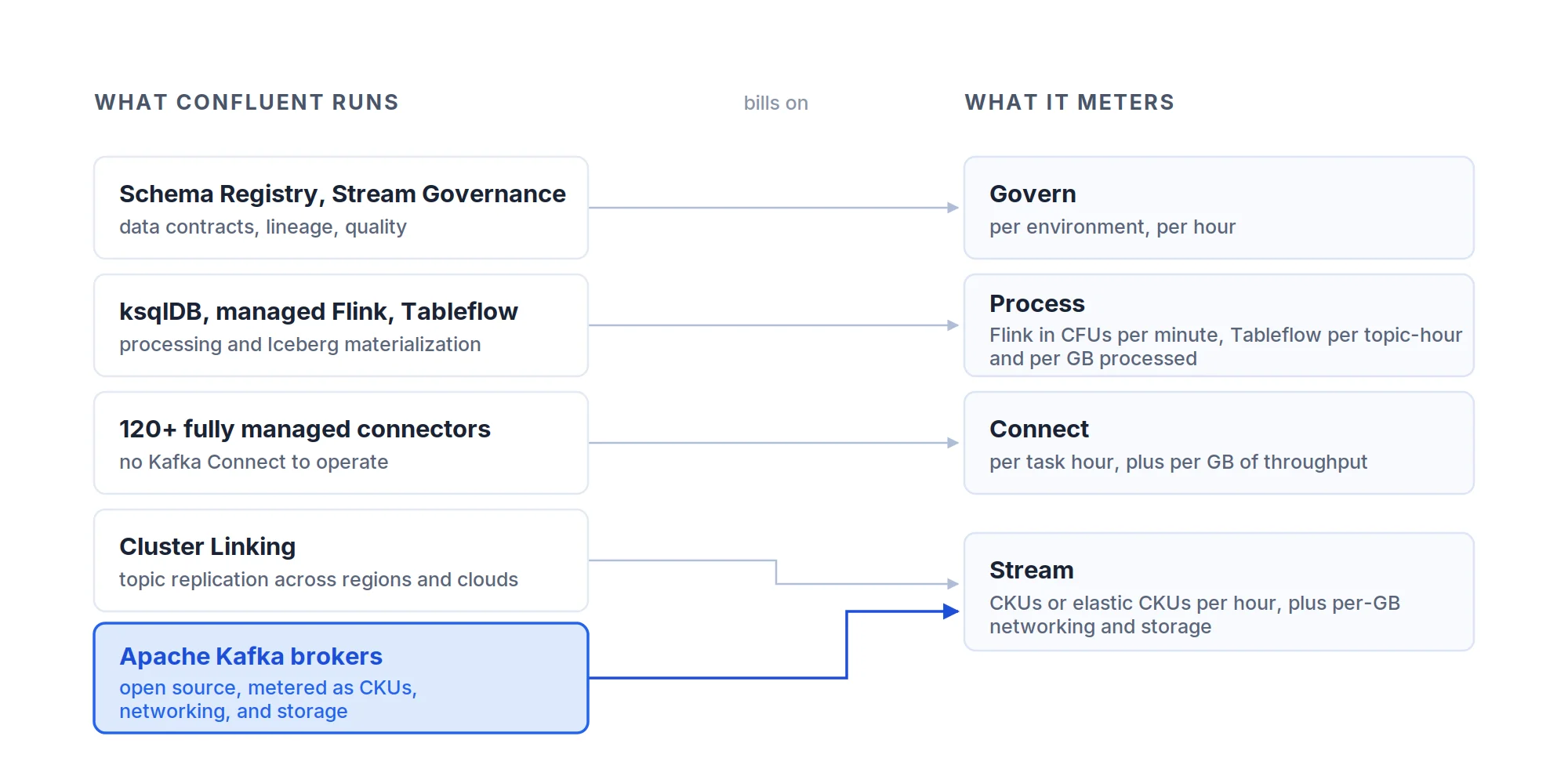
The value Confluent adds sits on top of the open-source broker. Schema Registry enforces data contracts across producers and consumers, ksqlDB and managed Apache Flink handle stream processing, Stream Governance provides lineage and quality controls, and a catalog of more than 100 fully managed connectors moves data in and out of Kafka without anyone operating Kafka Connect. Cluster Linking replicates topics across regions and clouds, and Tableflow materializes Kafka topics as Apache Iceberg tables for analytics engines.
Confluent Cloud bills across four dimensions rather than one: Stream covers Kafka clusters in CKUs or elastic CKUs per hour plus per-GB networking and storage, Connect covers managed connectors per task hour plus per GB of throughput, Process covers Flink in CFUs per minute, and Govern covers governance features per environment per hour. Cluster types run from Basic for development through Standard, Enterprise, Freight, and Dedicated, with third-party estimates putting Standard clusters in the low thousands per month and Dedicated deployments anywhere from $10,000 to past $200,000 depending on scale.
That breadth is real, and for organizations that use most of it, Confluent remains the most complete streaming platform available. The question is how many organizations use most of it.
Why Look for Confluent Alternatives?
Acquisition uncertainty
Product velocity has not visibly slowed, and the Q3 2026 Confluent Cloud launch shipped more than 70 features across Kafka clusters, Connect, Flink, Tableflow, and WarpStream. What the close did not come with is any public commitment about Confluent Platform's long-term release cadence or the company's future contributions to Apache Kafka. None of that means the products are going away, and IBM has a long record of maintaining acquired infrastructure software, but it does mean procurement teams renewing multi-year contracts in 2026 are negotiating with a different counterparty than the one they signed with, and competitors have moved quickly to court accounts that feel unsettled by the change.
Consumption pricing that compounds
Confluent Cloud's billing model is transparent in the sense that every dimension is documented and expensive in the sense that a single workload touches several of them at once. A CDC pipeline from Postgres into a warehouse consumes cluster hours, per-GB ingress and egress, storage billed after triple replication, connector task hours in the premium band of $0.104 to $0.21, and $0.025 per GB of connector throughput before compression. Add PrivateLink at $0.03 per task hour and a dedicated Connect cluster at roughly $0.28 per hour, and the connector line item can rival the cluster it feeds.
The storage and networking tax
Classic Kafka architecture replicates every partition three times across availability zones, which means paying for three copies of the data and for the cross-AZ traffic that keeps them in sync. Confluent's Freight clusters address this with object storage backing, but the default Standard and Dedicated experience still carries the replication multiplier, and a generation of newer platforms was built specifically to remove that cost.
Divergence from open-source Kafka
Schema Registry, ksqlDB, Tableflow, and Stream Governance are Confluent properties rather than Apache projects, so pipelines built around them are portable at the protocol layer and much less portable everywhere else. Apache Kafka has meanwhile closed gaps on its own: 4.0 removed ZooKeeper entirely in favor of KRaft in March 2025, the project shipped 4.2.0 in February 2026 and reached 4.3.1 in June 2026, and KIP-1150, which brings object-storage-backed diskless topics into Kafka proper, was accepted on March 2, 2026 with implementation continuing through dependent KIPs. The functional argument for paying a premium over open-source Kafka is narrower than it was two years ago.
Paying for streaming when the requirement is replication
A large share of Kafka deployments exist to move rows from operational databases into analytical storage, and that workload does not inherently need a durable, ordered, multi-consumer log with a week of retention. Teams that built it on a managed streaming platform are often paying streaming platform prices for what amounts to change data capture, and recognizing this before shortlisting vendors prevents an expensive like-for-like migration that solves nothing.
What to Look for in a Confluent Alternative
Kafka protocol compatibility: Wire-level compatibility determines migration cost more than any other factor, since platforms that speak the Kafka protocol natively let existing producers, consumers, and Kafka Connect plugins keep working without code changes, while platforms with their own protocols require rewriting clients and re-testing delivery semantics.
Deployment model: Fully managed SaaS removes operational burden and places data in the vendor's account; your own cloud keeps the data plane inside your VPC while the vendor operates the control plane; and self-managed keeps everything in-house at the cost of running it. Most credible alternatives now offer at least two of the three, and BYOC is the option that matters most for regulated data and egress economics.
Pricing structure, not headline price: Per-hour capacity pricing is predictable and wasteful at low utilization, per-GB consumption pricing tracks the workload and gets uncomfortable during spikes, and object-storage-backed platforms shift most of the cost to storage that runs cents per GB. Model your actual retention, replication factor, cross-AZ traffic, and connector count rather than comparing list prices.
Storage architecture: Whether a platform replicates to local disks or writes to S3, GCS, or Azure Blob Storage drives both the cost curve and the latency floor, because diskless designs typically trade a few hundred milliseconds of write latency for large cost reductions, which is the right trade for analytics pipelines and the wrong one for synchronous request paths.
Ecosystem and lakehouse landing: Confluent's connector catalog is large and few alternatives match it one for one, so check whether your specific sources and destinations are covered natively, by open-source Kafka Connect plugins, or by a separate ingestion tool. Where the destination is a lakehouse, treat direct Iceberg or Delta writing as a first-class requirement, since it removes a hop and a set of connector charges from the pipeline.
Governance and security: Schema management, RBAC, audit logging, encryption with customer-managed keys, and private networking are table stakes for production, so confirm they exist in the tier you can afford rather than the tier in the marketing comparison.
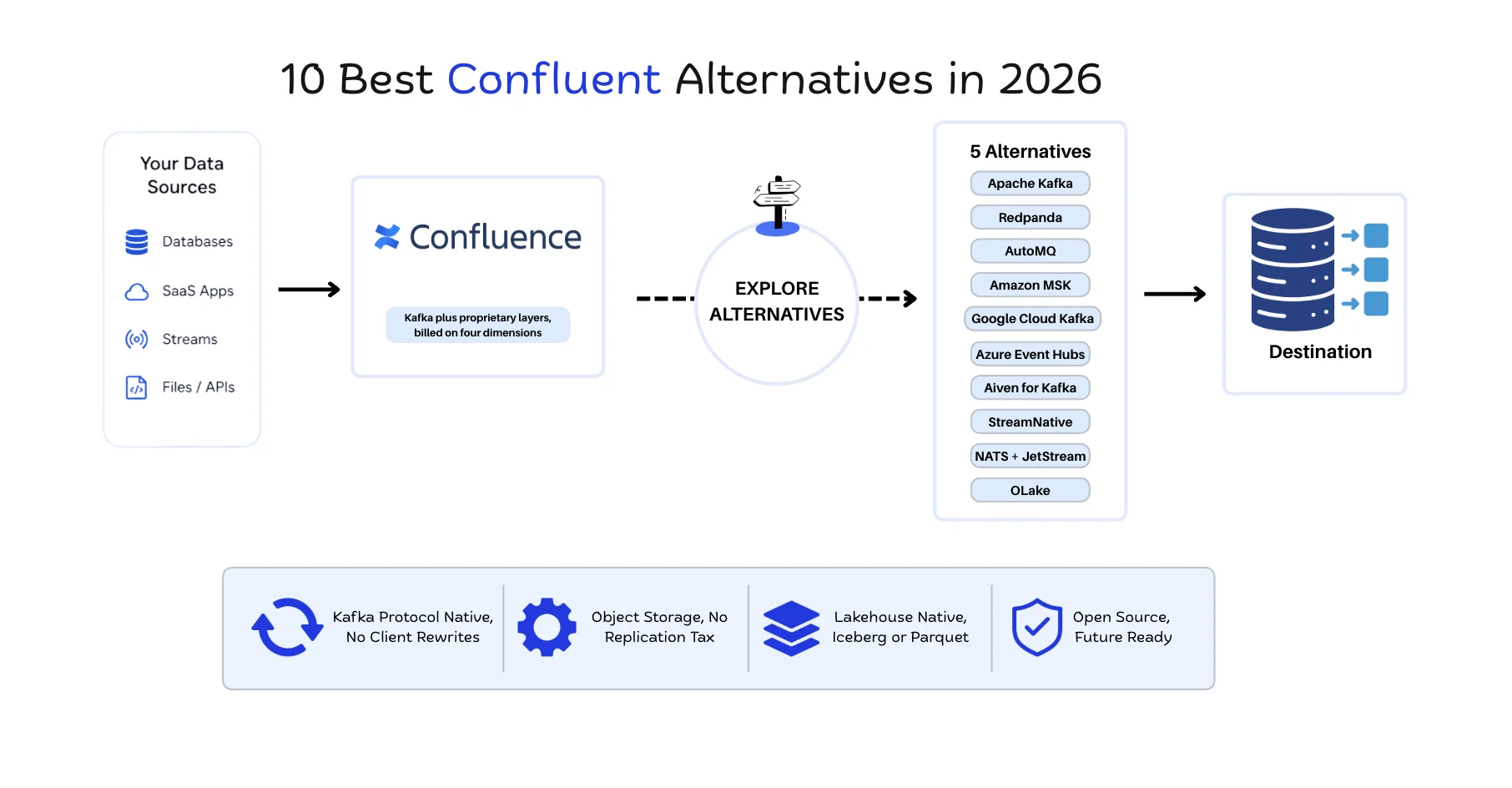
10 Best Confluent Alternatives
1. Apache Kafka (self-managed)
The open-source project remains the most direct alternative to the company built around it. Since 4.0, Kafka runs on KRaft with no ZooKeeper dependency, which removed the largest operational complaint about self-hosting, and the 4.3 line released in 2026 continues that consolidation, while the accepted KIP-1150 will bring object-storage-backed topics into the project itself.
Self-managing means owning upgrades, rebalancing, capacity planning, and incident response, and assembling schema registry, connectors, and processing from the open-source ecosystem rather than buying them as a bundle. In exchange there is no per-GB bill and no vendor relationship to renegotiate.
Best for: teams with existing platform engineering capacity and predictable, high-volume workloads where infrastructure cost dominates.
Pricing: free under Apache 2.0, plus infrastructure and staff.
Watch out for: the total cost of self-managing is real, and it is mostly headcount.
2. Redpanda
Redpanda rewrote the Kafka broker in C++ with a thread-per-core architecture and no JVM or ZooKeeper, producing lower tail latency on less hardware. It is Kafka API compatible, so existing clients connect without modification, and it has leaned hard into the post-acquisition moment with messaging aimed directly at Confluent accounts.
Deployment spans Serverless (up to 100 MB/s write and 300 MB/s read, 5,000 partitions, 99.9% SLA), BYOC in your own VPC on AWS, GCP, or Azure (up to 2 GB/s write, 112,500 partitions, 99.99% SLA), self-hosted Enterprise Edition, and a free Community Edition. Cloud Topics offload to object storage for long retention, and Iceberg Topics expose streams as Iceberg tables readable from Snowflake, Databricks, and Trino.
Best for: latency-sensitive workloads and teams that want a single binary to operate.
Pricing: free Community Edition, pay-as-you-go Serverless, and annual commit for BYOC and Enterprise.
Watch out for: the Community Edition is source available rather than Apache 2.0, so review licensing before standardizing on it.
3. AutoMQ
AutoMQ takes the diskless idea furthest among open-source options, reimplementing Kafka's storage layer on top of S3, Google Cloud Storage, or Azure Blob Storage while keeping 100% Kafka protocol compatibility as a drop-in replacement. Brokers become stateless, so scaling and failover no longer require moving partition data, and a write-ahead log plus memory cache keeps latency in the single-digit to low-double-digit millisecond range.
The company cites up to 74% savings against Amazon MSK and roughly 21x lower storage costs by replacing triple-replicated EBS volumes with object storage, plus the elimination of cross-AZ transfer fees, which is often the larger saving. Deployment covers BYOC inside your VPC, self-managed on Kubernetes, and marketplace subscriptions on AWS, GCP, Azure, and Oracle.
Best for: high-throughput Kafka workloads where storage and network transfer dominate the bill.
Pricing: open-source core, commercial BYOC, and marketplace plans.
Watch out for: object storage introduces a latency floor, so validate against your p99 requirements rather than the average.
4. Amazon MSK
For teams already deep in AWS, Managed Streaming for Apache Kafka is the path of least resistance. It runs actual Apache Kafka rather than a reimplementation, integrates with IAM, VPC, CloudWatch, and KMS, and comes in three shapes: Provisioned with standard brokers, Provisioned with Express brokers for faster scaling and recovery, and Serverless for variable workloads.
Standard brokers run from roughly $0.20 per hour for kafka.m7g.large plus $0.10 per GB-month of storage, Express brokers list around $0.41 per hour plus $0.01 per GB ingested, and Serverless charges $0.75 per cluster-hour, $0.0015 per partition-hour, $0.10 per GB in, and $0.05 per GB out. MSK Connect adds $0.11 per MCU-hour, and S3 delivery writes to Iceberg-backed S3 Tables at $10 per TB.
Best for: AWS-native organizations that want managed Kafka without a second vendor relationship.
Pricing: consumption-based, generally below Confluent Cloud for equivalent throughput.
Watch out for: governance and stream processing are separate AWS services, so the bundle Confluent sells has to be assembled.
5. Google Cloud Managed Service for Apache Kafka
Google's managed Kafka offering prices compute in Data Compute Units, where one DCU equals one vCPU plus 4 GiB of RAM, at $0.09 per DCU-hour in us-central1, dropping to $0.072 with a one-year committed use discount and $0.054 with three years. Local storage runs about $1.71 per GiB-month, and long-term storage is about $1.01, with 100 GB billed per provisioned vCPU.
Kafka Connect is available as a managed capability at $0.12 per DCU-hour with no storage charge, since connectors are stateless, though committed use discounts do not apply to Connect clusters. Inter-zone replication traffic is charged at $0.01 per GiB, which is worth modeling carefully because it is the same cross-AZ cost that diskless platforms exist to remove.
Best for: Google Cloud shops feeding BigQuery, Dataflow, or Vertex AI.
Pricing: DCU-hour compute plus storage and network, with meaningful committed use discounts.
Watch out for: it is a younger service than MSK, so verify that the specific Kafka features and versions you depend on are supported.
6. Azure Event Hubs
Event Hubs is not Kafka, but it speaks the Kafka protocol on the Standard tier and above, which lets Kafka clients connect to a fully managed Azure service with no cluster to operate. Basic offers one day of retention and no Kafka support; Standard adds seven-day retention plus Kafka and Schema Registry; Premium moves to processing units with 90-day retention and 1 TB of storage per PU; and Dedicated scales to capacity units with 10 TB per CU.
Basic and Standard charge per throughput unit-hour plus a per-million-events ingestion fee, while Premium and Dedicated include ingress in the hourly rate, which makes cost far more predictable at scale. Capture writes events to Blob Storage or Data Lake at no extra charge on Premium and Dedicated.
Best for: Azure-centric enterprises that need Kafka-compatible ingestion rather than a full Kafka platform.
Pricing: throughput units on lower tiers, processing or capacity units above.
Watch out for: it implements a subset of the Kafka protocol, so compacted topics are absent, transactions are limited to Premium and Dedicated in public preview, and some admin operations behave differently.
7. Aiven for Apache Kafka
Aiven runs open-source Apache Kafka as a managed service across AWS, Azure, and Google Cloud, with a deliberate position of not forking or proprietizing the upstream project. Aiven engineers also authored KIP-1150, the diskless topics proposal accepted into Apache Kafka in March 2026, which is a reasonable signal about where the company's incentives sit.
Aiven replaced its named plan tiers with consumption pricing on August 26, 2026, so new customers on AWS, GCP, and Azure now specify throughput, retention, and topic type instead of picking a machine size. Compute starts at $235 per month and scales with throughput capacity, storage runs from $0.10 per GB-month, and network is metered at $0.02 per GB ingress and $0.04 per GB egress on classic topics, falling to $0.01 and $0.03 on diskless topics, with internal replication traffic not billed at all. Diskless topics are now a standard capability rather than a separate product, a free tier covering 250 KiB/s and five topics remains for evaluation, and existing customers keep their current contracts unless they choose to migrate. Schema Registry through Karapace and a REST proxy are included, alongside Kafka Connect and MirrorMaker 2, and BYOC is available for larger deployments through sales.
Best for: multi-cloud teams that want managed Kafka without proprietary extensions.
Pricing: consumption-based since August 2026, with compute from $235 per month plus metered storage and network, and no charge for replication traffic.
Watch out for: the connector catalog is smaller than Confluent's, premium CDC connectors may need to be self-managed, and the move to consumption pricing means new bills track traffic rather than sitting flat.
8. StreamNative
Built by the creators of Apache Pulsar, StreamNative now leads with Ursa, a lakehouse-native streaming engine that uses leaderless, stateless brokers writing directly to object storage in Apache Iceberg or Delta Lake format. The Lakestream architecture announced in April 2026 added a native Kafka service alongside Pulsar, so both protocols run on the same engine with no client code changes.
The company claims up to 10x lower cost than conventional Kafka deployments by removing inter-AZ transfer, disk management, and data duplication, and Ursa's design won the VLDB 2025 Best Industry Paper. Topics land as Iceberg tables and are compacted automatically, so data is queryable in Snowflake or Databricks without a separate ETL job, across serverless, dedicated, BYOC, and private cloud deployments, including Azure.
Best for: teams whose streams are destined for a lakehouse and who want multi-tenancy and geo-replication built in.
Pricing: consumption-based across cloud tiers, with private cloud licensing through sales.
Watch out for: Pulsar's operational model differs from Kafka's, so evaluate the Kafka path specifically if that is what you will use.
9. NATS with JetStream
NATS is worth considering when the honest answer is that the workload never needed Kafka. It is a CNCF project built for lightweight, high-fanout messaging, with JetStream adding persistence, replay, and at-least-once or exactly-once delivery on top of the core pub/sub layer, and a single dependency-free binary runs in a few megabytes of memory, which makes it viable at the edge and in IoT fleets where a Kafka cluster is impractical.
The trade is deliberate, since NATS does not speak the Kafka protocol and does not aim to match Kafka's throughput ceiling or its ecosystem of connectors and processing engines. For service-to-service messaging, command and control, request-reply patterns, and moderate-volume event distribution, it removes a large amount of operational surface area.
Best for: microservice messaging, edge and IoT deployments, and teams that adopted Kafka for patterns that simpler tooling handles better.
Pricing: free under Apache 2.0, with commercial support and managed service from Synadia.
Watch out for: migration is a rewrite, not a reconfiguration, so scope it as one.
10. OLake
OLake is not a broker, and it belongs on this list for the reason described earlier: a significant share of Confluent spend exists to move database changes into analytical storage, which is a replication problem rather than a streaming one. OLake is Apache 2.0 licensed and reads from PostgreSQL, MySQL, MongoDB, Oracle, MSSQL, DB2 LUW, S3, and Kafka, writing to Apache Iceberg or Parquet on object storage with support for AWS Glue, Hive Metastore, JDBC, and REST catalogs including Nessie, Polaris, Lakekeeper, and Unity.
Teams keeping Kafka for genuine event distribution can still use OLake at the tail of the pipeline, since Kafka topics become logical streams with inferred schemas, partitions are distributed across readers with a round robin balancer, and offsets are committed only after destination writes succeed, which gives exactly-once semantics into Iceberg. That replaces a managed sink connector billed per task hour and per GB with a self-hosted component running in your own infrastructure. Current Kafka-source support handles JSON messages with append-only writes and does not yet offer a continuous sync mode, so batch-oriented pipelines fit better than sub-second ones today.
Best for: database-to-lakehouse replication and Kafka-to-Iceberg landing where managed connector costs have become the problem.
Pricing: free and open source, self-hosted in your own cloud or on-premises.
Watch out for: it complements a broker rather than replacing one, so keep the streaming layer where real streaming is happening.
Also worth a look
WarpStream deserves a mention with an asterisk, since its diskless BYOC architecture is genuinely strong, but Confluent acquired it in 2024, which means it now sits inside IBM alongside the platform you may be leaving. Instaclustr, now part of NetApp, offers managed pure open-source Kafka with a similar no-fork philosophy to Aiven. Bufstream targets schema-enforced, Iceberg-native streaming for Protobuf-heavy environments, and Decodable and Ververica covers managed Apache Flink if stream processing rather than the broker is what you are actually buying from Confluent.
How to Choose the Right Confluent Alternative
Start by auditing what the Confluent bill is actually paying for, broken into cluster, connectors, processing, and governance, because teams routinely discover that connectors and cross-AZ networking outweigh the brokers, and a cheaper broker fixes nothing if the cost sits in Connect.
If the workload is genuine event streaming with multiple consumers, ordered replay, and low-latency delivery, stay on the Kafka protocol and choose the architecture and deployment model. Latency-critical paths point toward Redpanda or self-managed Kafka on local disks; cost-dominated high-throughput paths point toward AutoMQ, StreamNative Ursa, or Redpanda Cloud Topics; single-cloud organizations should price MSK, Google's managed Kafka, or Event Hubs first because the integration savings are real even when the sticker price is similar; and multi-cloud teams are usually best served by Aiven or Instaclustr running unmodified open source.
If the workload is really change data capture into a warehouse or lakehouse, replacing the broker is the wrong project. Point a dedicated replication tool at the source databases, write Iceberg directly, and let the streaming platform shrink to the topics that genuinely need it, which is where the largest savings usually appear because the pipeline stops paying for a durable log it never queries. If the workload is service-to-service messaging that grew into Kafka by default, NATS or a managed message queue will cut operational surface area at the cost of a client rewrite.
Whatever the shortlist, run a proof of concept against production-shaped traffic rather than a benchmark harness, using real partition counts, retention settings, consumer group behavior, and failure drills. Then model twelve months of cost at projected volume, including egress, replication, storage after replication factor, and support, and negotiate the Confluent renewal with those numbers in hand, since several teams find the best outcome is a better Confluent contract and a credible alternative is what produces it. Connector spend is the most negotiable line on the invoice, since Confluent now offers Connect Advantage packages, discounting it by 50% to 80% for committed customers, and those discounts are easier to obtain with a priced alternative on the table.
Conclusion
The IBM acquisition made 2026 a natural moment to re-examine streaming infrastructure, but it is not the reason to migrate. The reasons are architectural and financial: object storage has made triple replication across availability zones look like an expensive habit, Apache Kafka itself has absorbed KRaft and accepted diskless topics, and the connector and processing layers that justified a premium platform now have credible open-source and cloud-native substitutes.
Confluent remains the most complete platform in the category, and for organizations using Flink, Stream Governance, Tableflow, and the connector catalog together, replacing it piecemeal will cost more than it saves. For everyone else, the first step is to separate the streaming workload from the replication workload, price each on its own terms, and shortlist accordingly, because the shortlist that follows from that exercise usually looks nothing like the one drawn up by comparing brokers alone.