Top 5 Debezium Alternatives of 2026
11 min read
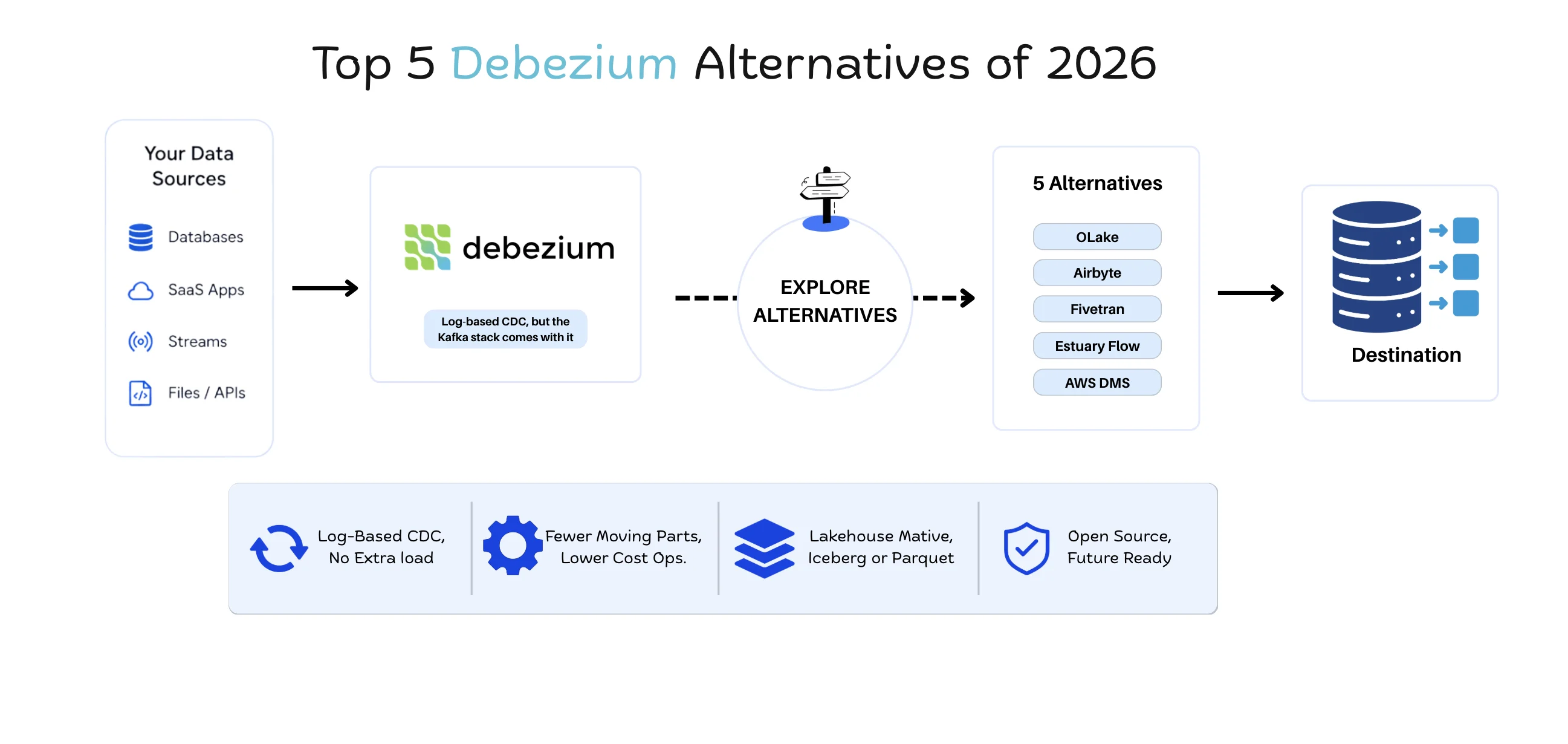
Change data capture is the default way to move data out of operational databases without hammering them with repeated full loads. About a decade ago, Debezium, an open-source CDC platform built on Kafka Connect, moved into that space. It reads the database log directly, turns each insert, update and delete into an event and passes it on to whatever sits downstream.
This design works. It has conditions too. Running Debezium in production usually means running Kafka, Kafka Connect, Schema Registry and a sink connector alongside. And then keeping all of that healthy. Teams who simply wanted replication into a lakehouse often find themselves maintaining a streaming stack. Snapshotting large tables, dealing with schema drift, and tuning connector memory all come with their own overhead.
So the question comes up a lot: what else is out there? There are plenty of options now, from managed SaaS pipelines to lakehouse-native engines that write Iceberg or Parquet without a broker in the middle.
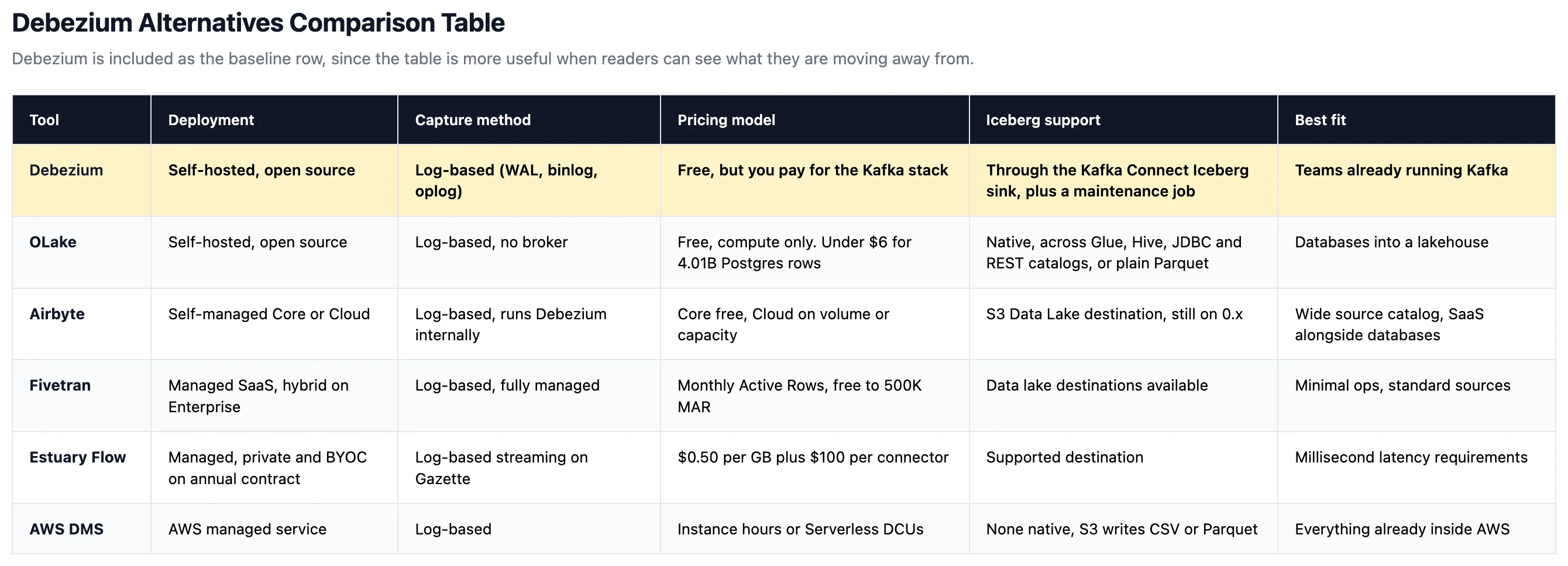
In this guide we show how Debezium works, where it starts to struggle, and 5 alternatives worth considering in 2026. First up is OLake. Finally, a side-by-side comparison table details the pricing model, deployment options, destinations and setup effort.
What are Debezium's Alternatives?
A Debezium alternative is any tool that captures row-level changes from a source database and delivers them somewhere else, without asking you to run the Kafka Connect stack that Debezium is usually deployed on. The job itself stays the same, which is reading inserts, updates, and deletes as they happen and keeping a downstream copy current, but the way each tool goes about that varies quite a bit, and the variation is usually what decides which one fits a given team.
Most of them fall into a few groups. There are managed SaaS pipelines like Fivetran and Airbyte Cloud, where the vendor runs the infrastructure and bills by rows or credits, so setup takes hours rather than weeks, although costs climb as volume grows.
Then there are streaming CDC platforms like Estuary Flow, which move changes continuously rather than on a schedule. Neither one gets rid of the streaming infrastructure, though, because Estuary runs on its own broker layer called Gazette, which ships as proprietary software with its own licensing, so what actually changes is who maintains that layer. Cloud providers offer native services in the same spirit, including AWS DMS and Google Datastream, and those work well when the source and the destination both sit inside the same cloud, but they get awkward as soon as a pipeline has to cross providers.
OLake takes a different route again. It is open source, runs on your own infrastructure, and needs no Spark, Flink, Kafka, or Debezium underneath it, so changes land straight in Apache Iceberg or Parquet on object storage with no broker anywhere in the path.
Grouping them this way matters because "alternative" does not mean "drop-in replacement," and in a few cases it does not even mean a different capture engine, since Airbyte's database CDC depends on Debezium internally and RisingWave runs the Debezium embedded engine. So the real comparison is less about feature checklists and more about what each tool assumes about your stack, how much of it you are prepared to operate, and where the data has to land.
How does Debezium work?
Debezium never queries your tables. It reads the log the database already writes for its own recovery, which is the write-ahead log in Postgres, the binlog in MySQL, and the oplog in MongoDB, so changes reach it without any extra load landing on production.
When a connector starts up it first takes a snapshot of the tables you pointed it at, so the destination begins with a full copy instead of only the changes that came after setup. After that it switches to reading the log and stays there, turning every insert, update, and delete into an event that carries the row before the change and the row after it. That shape is also why deletes survive the trip, since a tool that works by querying has nothing left to read once a row is gone.
The events go into Kafka from there, usually one topic per table, and a sink connector picks them up and writes them wherever the data needs to land. Debezium remembers how far it has read, so a restart continues from that point instead of starting over.
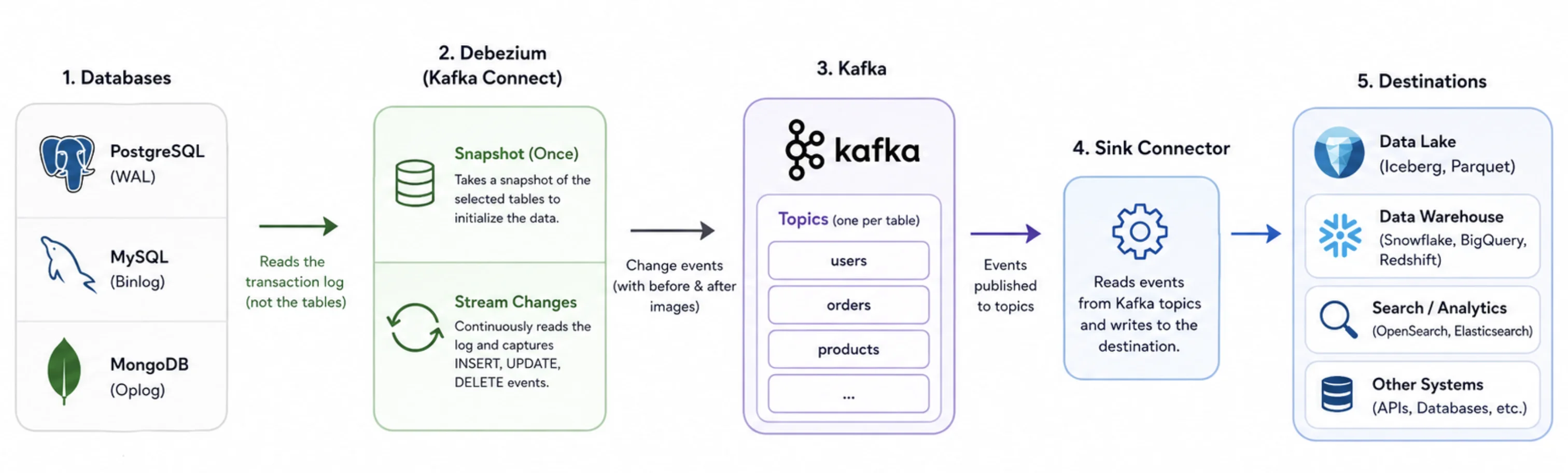
All of this runs as a plugin inside Kafka Connect, and that is where the weight sits, because the capture itself is rarely what gives teams trouble. Keeping the stack around it healthy is the harder job, and it is the reason most Debezium evaluations end up being about operations rather than features.
Why explore Debezium Alternatives?
Debezium is good at the job it was built for. The trouble usually starts around it.
-
You are not running one tool; you are running four: Kafka and Kafka Connect come with it, a sink connector is needed for wherever the data lands, and a Schema Registry joins the list if you use Avro. All of that has to be monitored, secured, and upgraded, when the actual requirement was to copy a database into a lakehouse.
-
The first snapshot does not forgive interruptions: On a large table it can run for hours, and if the connector dies partway through, it starts a fresh snapshot instead of picking up where it stopped. Incremental snapshots are resumable and fix this, though they need a signaling table in the source database and some setup first.
-
Schema changes cost you twice: A new column has to be handled by the connector and then handled again at the sink, so one change upstream turns into several small changes spread across the pipeline.
-
Iceberg is reachable, but not directly: An official Iceberg sink connector exists for Kafka Connect, and it works, but it is another component to configure, with transforms for CDC messages and a separate maintenance job to stop small files piling up.
-
Someone has to know Kafka at 2am: This is the cost that never makes it into a comparison table, and it is the one that decides things, because on plenty of teams that person simply does not exist.
Top 5 Debezium Alternatives
1. OLake
OLake is the closest thing on this list to a direct swap for a Debezium pipeline whose destination is a lakehouse, because it does the same log-based capture but drops everything Debezium leans on to get the data anywhere. There is no Spark, Flink, Kafka, or Debezium underneath it, so the pipeline is the connector and the table and nothing in between. On a 4.01 billion row Postgres to Iceberg full load it ran at 580,113 rows per second against Debezium's 14,839, and on 50 million CDC changes it finished in 15 minutes where Debezium took 60, with both Postgres workloads costing under $6 in compute. It reads from Postgres, MySQL, MongoDB, Oracle, MSSQL, DB2, Kafka, and S3, and writes Iceberg across Glue, Hive, JDBC, and REST catalogs, or plain Parquet.
The same tests cover MySQL, MongoDB, Oracle, MSSQL, and Kafka, and include runs against Fivetran, Estuary, and Airbyte, so the full numbers and the methodology behind them are worth a look on the OLake benchmarks page.
- When it is the right choice: When the destination is a lakehouse, the team wants to keep the pipeline on its own infrastructure, and the Kafka layer was never something anyone wanted to own.
- Limitations: The source list is short next to the managed platforms, since this is a replication engine rather than a 600 connector catalog, Oracle CDC is still in progress at the time of writing, and Iceberg or Parquet is where the data lands, so a pipeline pointed straight at Snowflake or BigQuery needs a different tool.
2. Airbyte
Airbyte solves a different problem than Debezium does, since Debezium is a capture engine and Airbyte is a platform with 600+ connectors wrapped around one. That distinction matters more than it sounds, because Airbyte's database CDC runs Debezium internally, so switching to it changes who runs the pipeline without changing what reads the write-ahead log. Self-Managed Core is free and open source, Cloud prices are on volume or capacity, and the official S3 Data Lake destination writes Iceberg through REST, Glue, Nessie, and Polaris catalogs.
- When it is the right choice: When the pipeline needs SaaS sources alongside databases, and the value is the connector catalog rather than raw throughput.
- Limitations: Throughput is the weak spot, since the same benchmark put Airbyte Cloud at 457 rows per second on the Postgres full load, and the Iceberg destination is still on a 0.x version. Debezium's operational quirks come along for the ride too.
3. Fivetran
Fivetran removes the operations question entirely, which is the trade at the center of every Debezium comparison. Nothing is self-hosted by default, connectors are managed and closed, and 700+ of them cover most sources a team will name. Pricing runs on Monthly Active Rows, so the bill follows how many distinct rows change rather than how much data moves, and there is a free tier up to 500,000 MAR.
- When it is the right choice: When engineering time costs more than the invoice, and the sources are standard enough that a managed connector already exists.
- Limitations: MAR pricing gets unpredictable when an upstream job rewrites a whole table, 1 minute syncs and hybrid deployment sit behind Enterprise while Standard stops at 15 minutes, and closed connectors leave little room to tune anything yourself.
4. Estuary Flow
Estuary is the option that keeps the streaming model instead of stepping away from it, so it suits teams who liked what Debezium did and disliked what it took to run. Latency runs in milliseconds, 200+ connectors are managed, and Iceberg is a supported destination. The streaming layer has not gone anywhere, though, since Flow is built on Gazette, a broker written by the same founding team, and the difference is that Estuary maintains it rather than you.
- When it is the right choice: When low latency is a real requirement rather than a nice-to-have, and streaming transformations belong in the pipeline itself.
- Limitations: Pricing at $0.50 per GB plus $100 per connector instance climbs fast across a wide source list, private and BYOC deployment needs an annual enterprise contract, and the benchmark had Estuary at 4.5 hours on 50 million CDC changes, so throughput and latency are not the same strength.
5. AWS DMS
DMS is the pragmatic answer when the whole estate already sits in AWS, because it removes the Kafka stack without introducing a new vendor. Pricing is replication instance hours or Serverless capacity units, so you pay for provisioned capacity rather than rows, which suits steady workloads better than spiky ones.
- When it is the right choice: When the source and target both live in AWS and the requirement is replication rather than a curated analytics pipeline.
- Limitations: S3 targets write CSV or Parquet with no native Iceberg output, so the table format has to come from elsewhere, schema drift handling is thinner than the dedicated CDC tools, and the whole thing gets awkward the moment a pipeline crosses cloud providers.
Conclusion
Debezium is not a bad tool, and nothing here argues for pulling it out on principle. It reads the log correctly, it has done so reliably for years, and if Kafka is already running and someone on the team knows it properly, there is little reason to move.
What pushes teams to look elsewhere is almost never the capture itself. It is everything stacked around it, which is the brokers, the connectors, the snapshot that starts over when it fails, and the person who gets paged when a sync stops overnight. Once that cost is visible, the question stops being which tool captures changes best and turns into which stack you are actually willing to operate.
That is where the five options above genuinely differ. Fivetran and Estuary hand the operations to a vendor and charge accordingly, with the bill following rows in one case and gigabytes in the other. Airbyte gives you the widest source catalog while still running Debezium underneath, so the operating model changes but the engine does not. AWS DMS is the shortest path when the estate already sits inside AWS. OLake removes the stack rather than relocating it, which is why it suits teams whose data is headed for a lakehouse and whose patience for running Kafka has run out.
If Iceberg is where you are headed, the OLake docs cover setup, and the benchmarks show the full runs behind the numbers above.