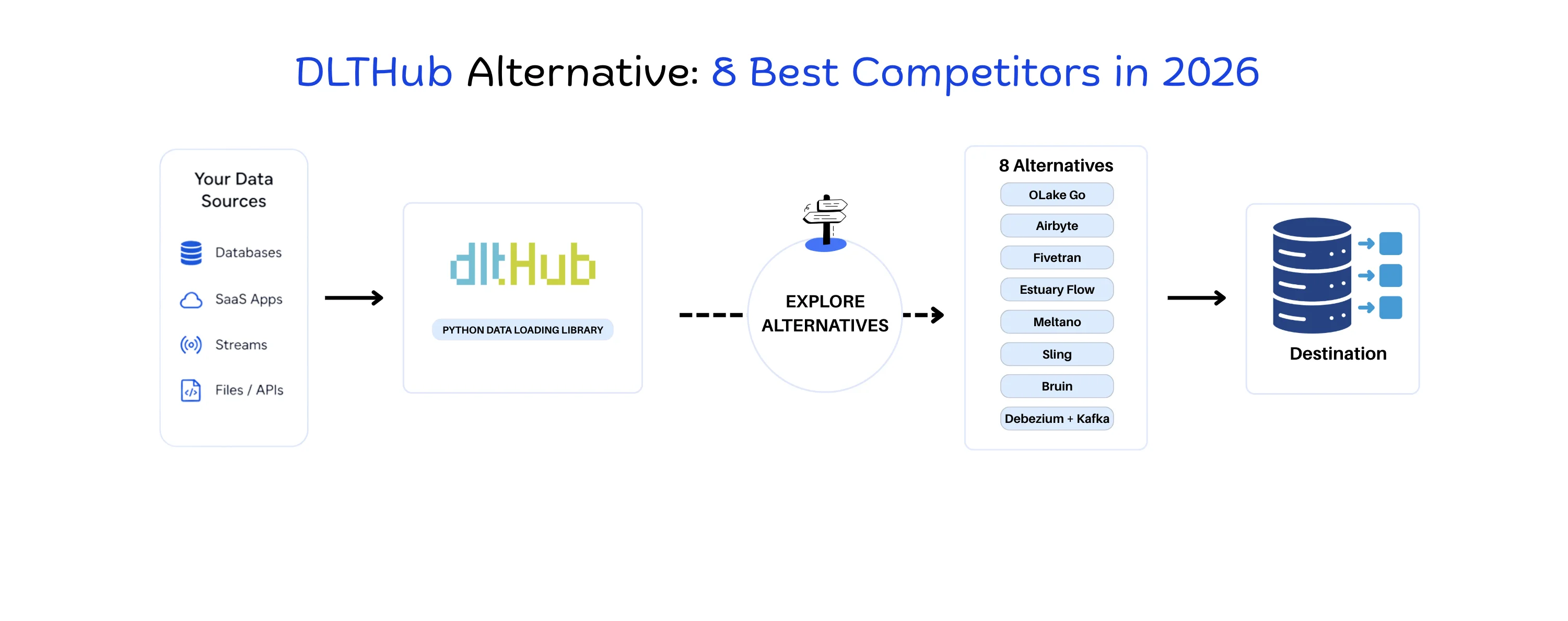
DLTHub Alternatives: 8 Best Competitors in 2026
14 min read
dlt solved a real problem. Before it, moving data into a warehouse with Python meant either writing a lot of boilerplate yourself or standing up an entire platform to do something fairly simple. dlt gave you schema inference, incremental loading, and state handling in a library you could just pip install. dltHub reports over 16,000 companies running it in production on more than 6 million monthly PyPI downloads.
But 2026 has been a year of change. dltHub Pro went generally available in May as an "agent-native" managed platform priced from $1,190/month, and the open-source library now sits inside a much larger commercial story than it did two years ago. The workloads teams care about have also moved on. More people are doing database CDC into Apache Iceberg, running petabyte-scale lakehouses, and looking for cost control that doesn't depend on a vendor's row counter.
This guide compares the ten strongest DLTHub alternatives in 2026: what each one does well, where each breaks down, and which workload it actually fits.
What Is DLTHub?
DLTHub is the company behind dlt (data load tool), an open-source Python library for building data pipelines, and dltHub, the commercial platform built on top of it.
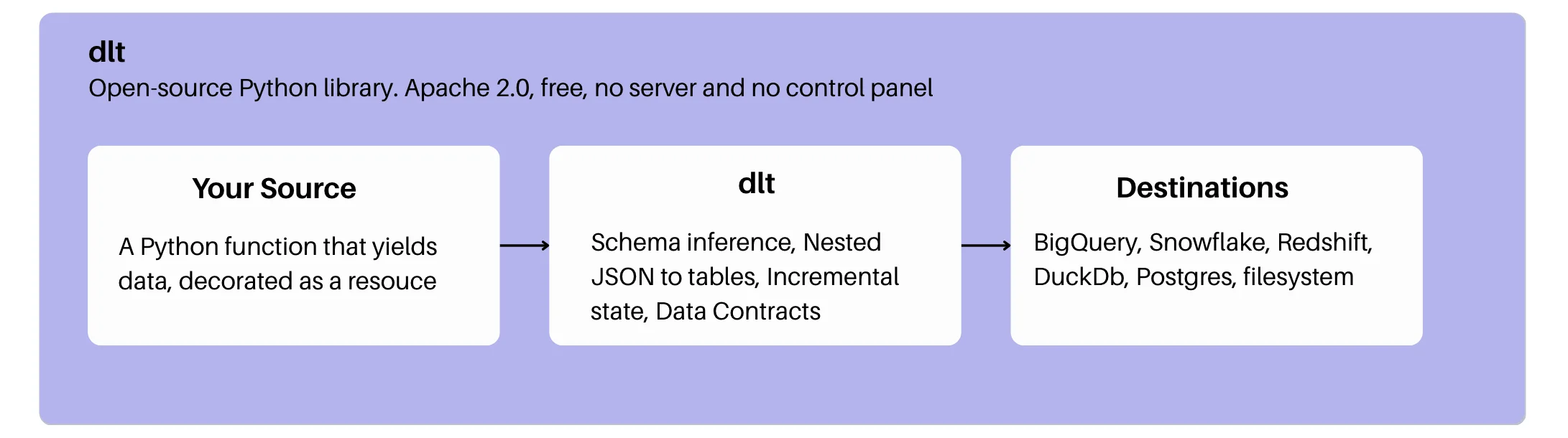
dlt: the open-source library dlt is an Apache 2.0 licensed Python library that turns extraction and loading into declarative code which means you write a Python function that yields data, decorate it as a resource, and dlt handles the rest: inferring the schema, normalizing nested JSON into relational tables, tracking incremental state, and loading into destinations like BigQuery, Snowflake, Redshift, DuckDB, Postgres, and filesystem targets.
The design is deliberately minimal. There's no server, no scheduler, and no control plane. dlt runs wherever Python runs, like a laptop, an Airflow task, a Dagster asset, a Lambda function, or a GitHub Action. For teams who already have orchestration and just need the "EL" part solved, that lightness is the whole appeal. Core capabilities include automatic schema evolution, data contracts, several incremental strategies, and helpers for REST APIs and SQL databases.
dltHub: the managed platform dltHub is the commercial layer. Following the May 2026 General Availability (GA) launch, it's positioned squarely around agentic data engineering, and the company says 91% of new dlt pipelines are now built by AI agents. The platform ships an "AI Harness" of 40 skills and MCP tools for Claude Code, Cursor, and Codex; a Context Catalog for lineage, schema governance, and run state; hosted Marimo notebooks; and a managed runtime with scheduling, observability, and secrets management.
Pricing runs in three tiers. The OSS library is free. dltHub managed starts at $1,190/month, including 500 credits, where one credit is roughly one hour of runtime. Enterprise is custom, with RBAC, audit logs, and SLAs. Worth noting: some of the newer capabilities, including the AI workbench, MSSQL change tracking, Iceberg support, and transformations, are source-available rather than Apache 2.0.
Why Look for DLTHub Alternatives?
dlt is a good library. The friction shows up when teams ask it to be a data platform.
It's a library, not a pipeline framework: dlt gives you extraction and loading. It does not give you asset boundaries, orchestration, quality gates, lineage, or environment promotion. Everything around the pipeline is yours to build and maintain: deployment, scheduling, secrets, alerting, retries, and monitoring. That's a feature if you already run Dagster or Airflow. It's weeks of undifferentiated work if you don't.
Python is the floor and the ceiling: Every source, every custom connector, and every debugging session is Python. Analytics engineers who live in SQL and dbt can't contribute, and non-engineers can't set up a HubSpot sync themselves the way they can in a UI-driven tool.
Database CDC to a lakehouse isn't its strong suit: dlt's SQL database source is competent for batch and incremental extraction. But high-throughput log-based CDC from Postgres, MySQL, MongoDB, or Oracle into Apache Iceberg, with parallel chunking, exactly-once delivery, and table maintenance, is a different engineering problem. Teams building an open lakehouse in 2026 usually end up bolting Debezium, Kafka, Spark, and a compaction job onto dlt, at which point the library isn't saving much.
Runtime performance at scale: dlt has been measured to be meaningfully slower than Go-based movers on large loads. Bruin's testing found ingestr up to 12x faster on 1M-row tables, with a MongoDB to Postgres sync finishing in 2.86 seconds against dlt's 12.55. Python's per-row overhead is real once you're moving billions of rows.
Operational surface from internal state: dlt writes tracking tables like _dlt_pipeline_state and _dlt_loads into your destination. They're necessary, but they leak into downstream schemas and confuse analysts and governance reviewers.
The pricing step is steep: Going from free OSS to $1,190/month before usage is a hard jump to justify for a team that just wanted managed scheduling and alerting, especially against alternatives that start near $10 to $300/month or run self-hosted for nothing.
Connector breadth: dlt's verified source catalog is small next to Airbyte's 600+ or Fivetran's 700+. If you need Zendesk, NetSuite, Marketo, and eleven ad platforms by next week, you'll be writing them.
Best DLTHub Alternatives in 2026
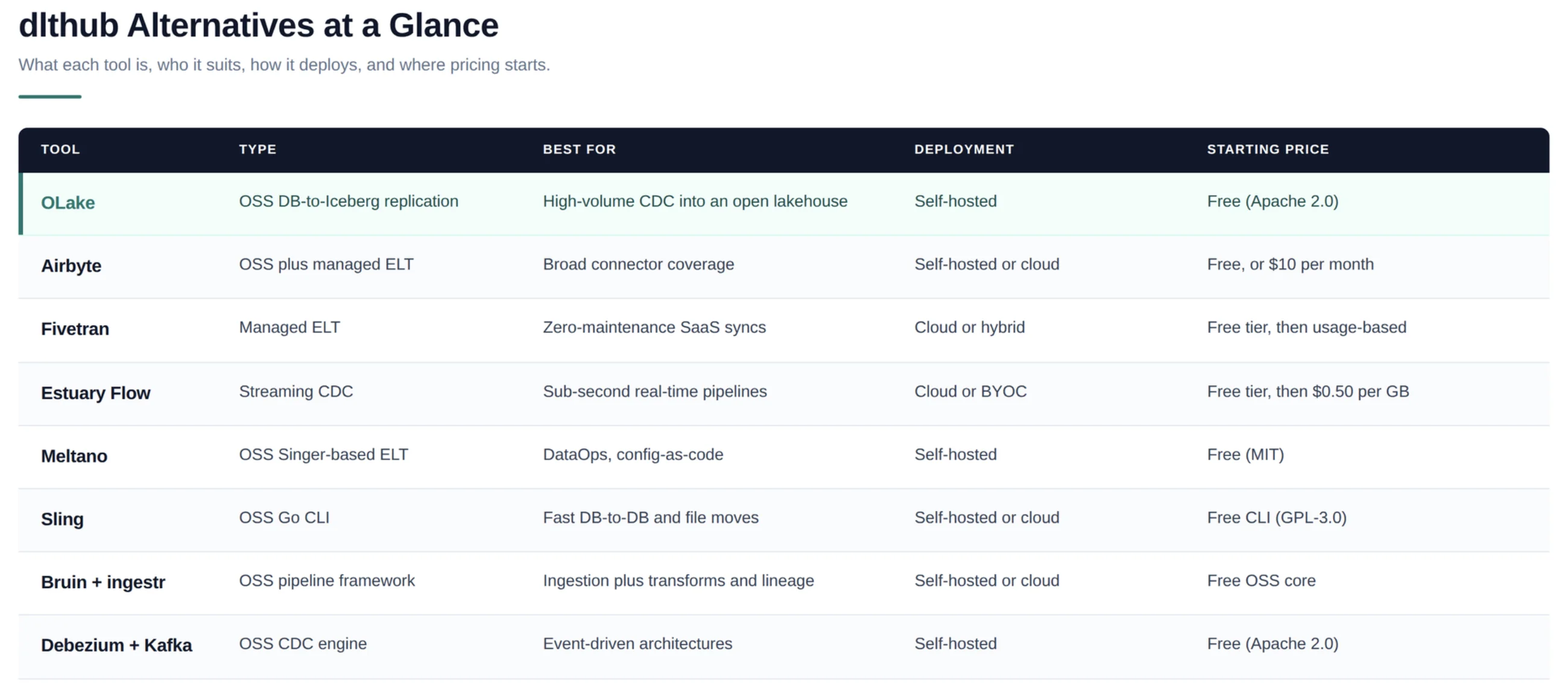
1. OLake Go: best for database CDC into Apache Iceberg
OLake is an Apache 2.0 open-source replication engine built by Datazip for one job: moving databases into an open lakehouse fast. Where dlt is a general-purpose Python loader, OLake is a Go-based engine built specifically for high-throughput CDC and full loads into Apache Iceberg and Parquet.
Sources include PostgreSQL, MySQL, MongoDB, Oracle, MSSQL, DB2 LUW, Apache Kafka, and S3. Destinations are Iceberg via AWS Glue, Hive Metastore, JDBC, and REST catalogs (Nessie, Polaris, Unity, Lakekeeper), or Parquet on S3, GCS, and MinIO.
The engineering that matters is under the hood: parallelized chunking so one large table splits across workers, stateful resumable syncs that pick up from checkpoints instead of restarting, exactly-once delivery with two-phase commit, Arrow-based writes, and automatic schema discovery and evolution. OLake Fusion adds the piece most ingestion tools skip, which is table maintenance, compaction, and cleanup, so your Iceberg tables don't degrade into a small-files problem three months in.
Published benchmarks put Postgres to Iceberg at 580K rows/sec (12.5x faster than Fivetran), MSSQL at 345.9K rows/sec (4.32x Fivetran), MySQL at 139.8K rows/sec, and MongoDB at 37.9K rows/sec. A self-serve web UI deploys via Docker Compose, so you're not writing Python to configure a sync.
Strengths: built for lakehouse CDC specifically, no per-row pricing, runs entirely on your infrastructure, open table formats mean no warehouse lock-in, and table maintenance is included.
Trade-offs: it's an EL tool for databases and streams, not a SaaS API connector catalog. If your primary need is 400 marketing APIs, pair it with something else. Self-hosting also means you own the infrastructure.
Pricing: free and open source, with enterprise support available.
2. Airbyte: best for connector breadth
Airbyte is the default answer when the question is "how many sources?" Its catalog spans 600+ connectors across all tiers, with a Connector Development Kit and low-code builder for the ones it lacks.
Core is always free and self-managed, and it's the tier with the tightest sync intervals at under five minutes. Cloud Standard starts at $10/month on hourly syncs, Pro tightens that to 15 minutes on pricing Airbyte doesn't publish, and Enterprise Flex is custom for on-premises or multi-region deployments. Airbyte also sells a separate line of agent products, running from $29/month for an individual to $299/month for a team.
Strengths: unmatched connector coverage, UI-driven so non-engineers can self-serve, a genuine open-source option, and a strong community.
Trade-offs: self-hosting Airbyte is a real infrastructure commitment. It's a distributed platform, not a binary. Community connector quality varies widely, and sync performance on very large database tables lags dedicated replication engines.
3. Fivetran: best for zero-maintenance managed ELT
Fivetran remains the benchmark for "I never want to think about this pipeline again," with 700+ fully managed connectors, automatic schema drift handling, and 200+ activation destinations.
Pricing: is based on Monthly Active Rows. Inserts and updates count; unchanged rows and initial historical loads don't. A free plan covers 500,000 MAR. Standard, Enterprise (1-minute syncs, VPN tunnels, hybrid deployment), and Business Critical (customer-managed encryption keys, PCI DSS Level 1) scale up from there, with up to 22% off on annual contracts.
Strengths: reliability, breadth, genuinely hands-off operation, and an excellent enterprise compliance posture.
Trade-offs: MAR pricing is famously hard to forecast, and high-change-rate tables get expensive fast. You get limited control over sync internals. This is the opposite end of the spectrum from dlt's control-first philosophy.
4. Estuary Flow: best for real-time streaming CDC
Estuary Flow is built for latency, delivering sub-100ms CDC with exactly-once semantics across 200+ managed connectors. It streams and materializes continuously rather than running scheduled batches, which makes it the right tool for operational analytics, fraud detection, and ML feature pipelines.
Pricing: a free developer tier at 10 GB/month with 2 concurrent connectors, Cloud at $0.50/GB plus $100 per connector with a 50% discount once you're running six or more, and custom Enterprise pricing that adds SOC 2, HIPAA, SSO, and BYOC deployment.
Strengths: far simpler than assembling Debezium plus Kafka yourself, strong CDC correctness guarantees, and support for both streaming and batch destinations.
Trade-offs: per-connector and per-GB costs climb quickly at volume, and the real-time premium is wasted if your dashboards refresh hourly.
5. Meltano: best for config-as-code DataOps
Meltano is dlt's closest philosophical sibling: open source (MIT), CLI-first, self-hosted, version-controlled. The difference is the abstraction. Meltano uses declarative YAML over the Singer tap and target ecosystem instead of Python code, which buys access to 600+ connectors without writing any. It fits naturally into infrastructure-as-code workflows and includes built-in PII filtering with real-time hashing for compliance-heavy pipelines.
Strengths: a large connector ecosystem, no vendor lock-in, configs that diff cleanly in Git, and low cost.
Trade-offs: Singer tap quality is inconsistent. Some are excellent, some are abandoned. Self-hosting takes DevOps capacity, though Meltano now sells managed tiers metered by compute hours, starting at 200 hours a month and running up to a custom Enterprise plan. Best for teams that want connector breadth without a per-row bill and have the appetite to run it themselves.
6. Sling: best lightweight CLI for database moves
Sling is a Go-based ELT CLI and library covering 40+ databases, file systems, and APIs. It's a single binary with YAML configuration, a streaming architecture, and a small memory footprint. It handles full-refresh, truncate, incremental, snapshot, and backfill modes, plus in-flight transformations, quality alerts on schema deviations, parallel streams with retries, and hooks for HTTP and SQL. There's a free CLI, a paid CLI Pro, and a Platform tier with a web UI, alerting, and self-hosted agents.
Strengths: dramatically simpler than dlt for straightforward database-to-database or database-to-file movement, with no Python environment to manage.
Trade-offs: limited SaaS API coverage, and it isn't a governance or orchestration layer.
7. Bruin (with ingestr): best for ingestion plus transformation in one framework
Bruin addresses the exact complaint most dlt users voice, which is that a library isn't a pipeline. It bundles ingestion (via the open-source ingestr CLI, covering 22 databases and 40+ SaaS sources), SQL and Python transformations, quality checks, column-level lineage, environment management, and data diffing into one framework, with MCP integration for AI agents. Six incremental strategies including SCD Type 2 ship out of the box.
Strengths: the missing platform layer around ingestion, without adopting a full orchestrator. ingestr works standalone if you only want the loading piece.
Trade-offs: more opinionated than a plain library, with a smaller ecosystem than Airbyte or Meltano.
8. Debezium + Kafka Connect: best for event-driven architectures
Debezium is the reference implementation of log-based CDC. It reads write-ahead logs from Postgres, MySQL, MongoDB, SQL Server, Oracle, and Db2 and emits change events through Kafka Connect. If you already run Kafka and want change events available to many consumers rather than just a warehouse, it's the correct architectural answer.
Strengths: battle-tested, maximum flexibility, no vendor, a mature connector set, and a huge community.
Trade-offs: this is infrastructure, not a product. You operate Kafka, Connect workers, schema registry, offset management, and whatever writes to your destination. Snapshotting large tables and handling schema changes take real expertise. OLake Go and Estuary deliver comparable CDC guarantees without the cluster.
When Should You Choose DLTHub Instead?
dlt is still the right answer in several situations, and it's worth being honest about them.
You're a Python-first team with orchestration already in place. If Dagster or Airflow is your control plane and you want a well-designed loading library inside your assets, dlt fits perfectly. Adding a second platform would be redundant.
Your sources are messy, custom, and API-shaped. dlt's REST API helper plus schema inference over deeply nested JSON is excellent. Internal microservice APIs, obscure vendor endpoints, and paginated feeds nobody has built a connector for are where dlt beats catalog-driven tools. You write forty lines of Python instead of waiting on a connector request.
You want ingestion in version control with no infrastructure, at a modest volume. Run pip install dlt and your pipeline is a file in a repo. Under a few hundred million rows a month, Python's per-row overhead doesn't matter, and the ergonomics win.
You're building agent-driven pipelines. dltHub has invested more heavily than almost anyone in making pipelines agent-buildable through MCP tooling and its context catalog. If Claude Code or Cursor is your team's primary interface for data engineering, that's a real advantage.
Your destination is Snowflake, BigQuery, or Databricks. dlt's warehouse loading is mature. Lakehouse-first tools optimize for Iceberg, which isn't where every team is.
Final Verdict
There's no single best DLTHub alternative. There's a best one for your workload.
If you're replicating databases into an open lakehouse, OLake Go is the strongest fit in 2026. It's built for exactly that path, benchmarked at 12.5x Fivetran on Postgres to Iceberg, and it includes table maintenance most tools omit. It runs on your own infrastructure with no per-row billing and keeps your data in Apache Iceberg rather than a proprietary format.
Beyond that, the choice mostly follows the workload. Go with Airbyte if you need maximum connector coverage, or Fivetran if you want someone else to own reliability entirely. Estuary Flow makes sense when sub-second latency is an actual product requirement. Meltano is the pick for config-as-code with a big connector ecosystem, and Bruin covers you if you want ingestion, transformation, lineage, and quality checks in one framework.
And if you're a Python team with orchestration in place, modest volumes, and custom API sources, stay on dlt. It's a good library. Just be clear-eyed that the managed platform's $1,190/month floor buys a runtime and an agent workbench, not a lakehouse ingestion engine.
The honest test is simple. Write down your top three sources, your destination format, your monthly row volume, and your latency requirement. Two or three tools will survive that filter. Run a proof of concept on both.