How OLake Go Guarantees Exactly-Once Delivery to Apache Iceberg
16 min read
OLake Go is an open-source tool for replicating databases into Apache Iceberg and S3 compaitable destinations, built for fast, reliable Full Refresh, Incremental, and CDC syncs. To know more about how OLake Go works read, deep dive into OLake Go's architecture.
TL;DR
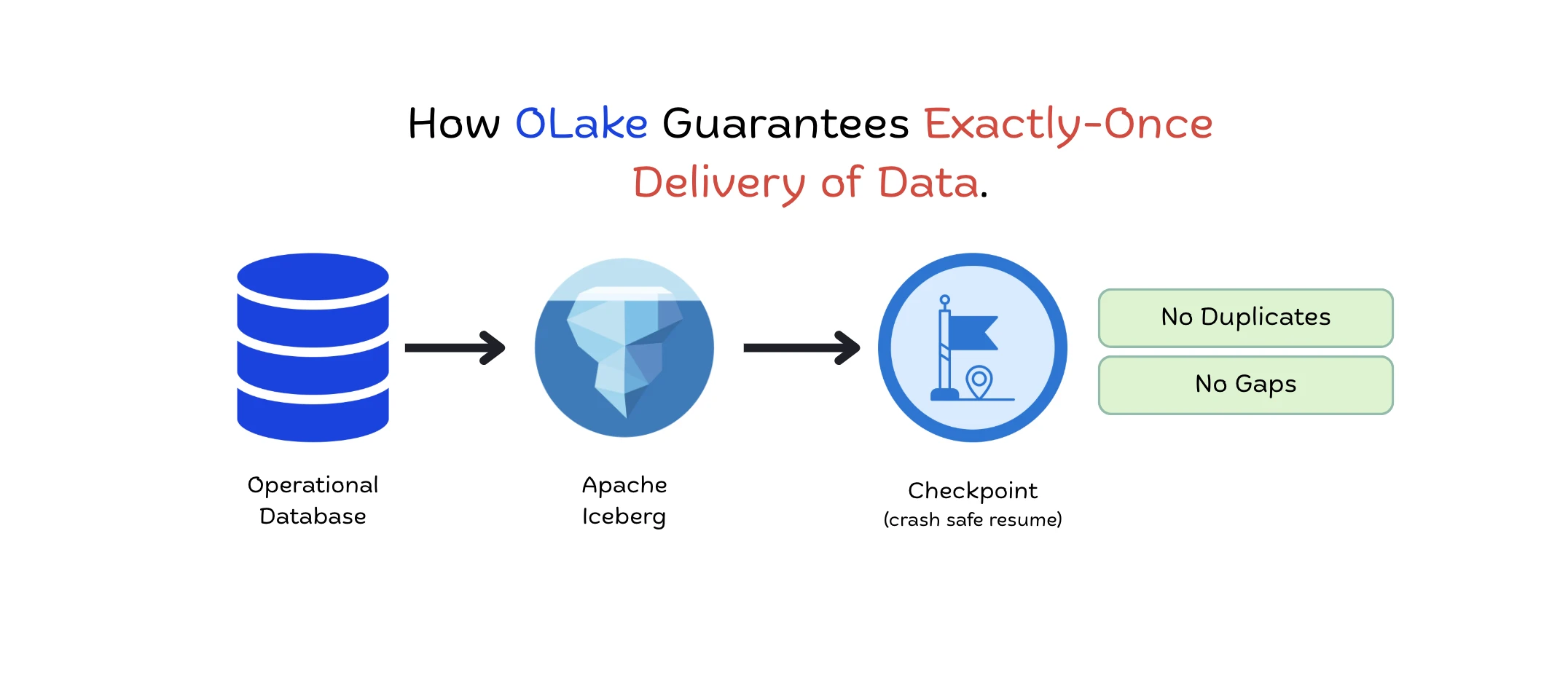
Every OLake Go sync makes two writes that are not atomic with each other: the data commit into Apache Iceberg and the checkpoint save to state.json. A crash between the two leaves the destination ahead of the checkpoint, which historically meant duplicated rows on retry or, worse, a recovery that misread the gap as corruption.
OLake Go closes this gap by committing data files and a progress marker to Iceberg in a single atomic operation, then comparing that marker against state.json on every restart. If the checkpoint matches, the sync runs normally. If Iceberg is ahead, the data already landed, so OLake Go skips the work and repairs the checkpoint without re-reading the source or re-writing the destination.
The same comparison runs across Full Refresh, Incremental, and CDC on every driver. No coordinator, no transaction log, no locks: whenever a sync dies, the table ends up correct, with nothing duplicated and nothing missing.
Why Exactly-Once Delivery Matters for Iceberg Pipelines
OLake Go transfers data from various sources into an Iceberg table that everything downstream treats as ground truth. And long-running syncs might get interrupted at times due to various reasons such as a pod eviction, a dropped connection, an OOM kill, a manual restart. What actually matters is what happens the next time the sync starts up.
The tricky part is that every sync does two writes that aren't atomic with each other. It commits data into the destination, and separately it updates a checkpoint file that records how far it got, so the next run knows where to resume.
If the process dies between those two writes, the destination is ahead of what the checkpoint knows about. Resume blindly from the checkpoint and it re-reads data that already landed, adding duplicate records. Skip ahead without checking and it misses records that never got written. And because nothing actually failed, no error ever warns you it happened, you only find out when you go digging through the data yourself.
This isn't hypothetical, it's what used to happen. Some cases might be: A writer would commit a chunk to Iceberg and then die before the checkpoint was saved, so the retry reprocessed the same chunk and duplicated rows. On the CDC side, a Postgres slot would get acknowledged, the process would crash before the checkpoint caught up, and recovery would misread the gap as corruption and ask the user to wipe the destination and start over.
Exactly-once delivery fixes both. It adds one check that runs across all sync modes, Full Refresh, Incremental, and CDC, and behaves the same on every driver. Here is how it works.
How OLake Go's Exactly-Once Delivery Mechanism Works
Every mode and every driver follows the same underlying pattern. Here is the brief idea before we move into the depth of each mode.
Before a writer commits, OLake Go generates a deterministic thread ID for what it's about to write. It's the stream ID combined with something specific to the mode: the chunk bounds for a backfill, the cursor value for an incremental window (CDC doesn't require deterministic thread id).
When the write happens, the data files and a progress marker are committed to Iceberg together, in one operation. The marker sits in the table's olake_2pc property and carries the thread ID plus the mode's progress: committed chunk IDs, a WAL or binlog position, a resume token, or a cursor value.
Only after that commit succeeds, OLake Go saves the same progress to state.json.
The commit and the checkpoint aren't atomic with each other, so a crash can land in between, leaving Iceberg with a marker that state.json hasn't caught up to. That's what recovery handles. On the next run, before reading anything from the source, OLake Go reads each stream's marker back from Iceberg and compares it to state.json:
state.jsonmatches or is ahead: nothing to recover, the sync runs normally.- Iceberg metadata file is ahead: that data already committed, so OLake Go skips it and fixes
state.jsonto match, without re-reading the source or re-writing the destination. - No marker: a fresh stream, nothing to compare.
The middle case is the only one where recovery does real work, and every mode comes down to it. The rest just changes what the marker holds (chunk IDs, a cursor value, or a log position or token) and how many run at once: one table split into chunks, one stream with one cursor, or several CDC streams sharing a single log. The sections below walk through each mode with real payloads.
The Commit Itself: How OLake Go Writes to Iceberg
OLake Go writes to Iceberg through a Java process it runs over gRPC, which owns all catalog operations. A finishing writer sends a COMMIT carrying its MetadataState payload, and Iceberg applies the new Parquet files and the metadata update as a single atomic operation. There's no window where the data exists without its marker, or the reverse, and that guarantee is exactly what lets recovery trust the comparison above, no external coordinator needed.
Closing a writer also takes a per-stream lock on the Go side, so when several backfill chunks for the same stream finish at once, their metadata commits are serialized instead of racing on the same table. Once the commit lands, OLake Go writes the same progress into state.json, the checkpoint.
Full Refresh
How It Runs
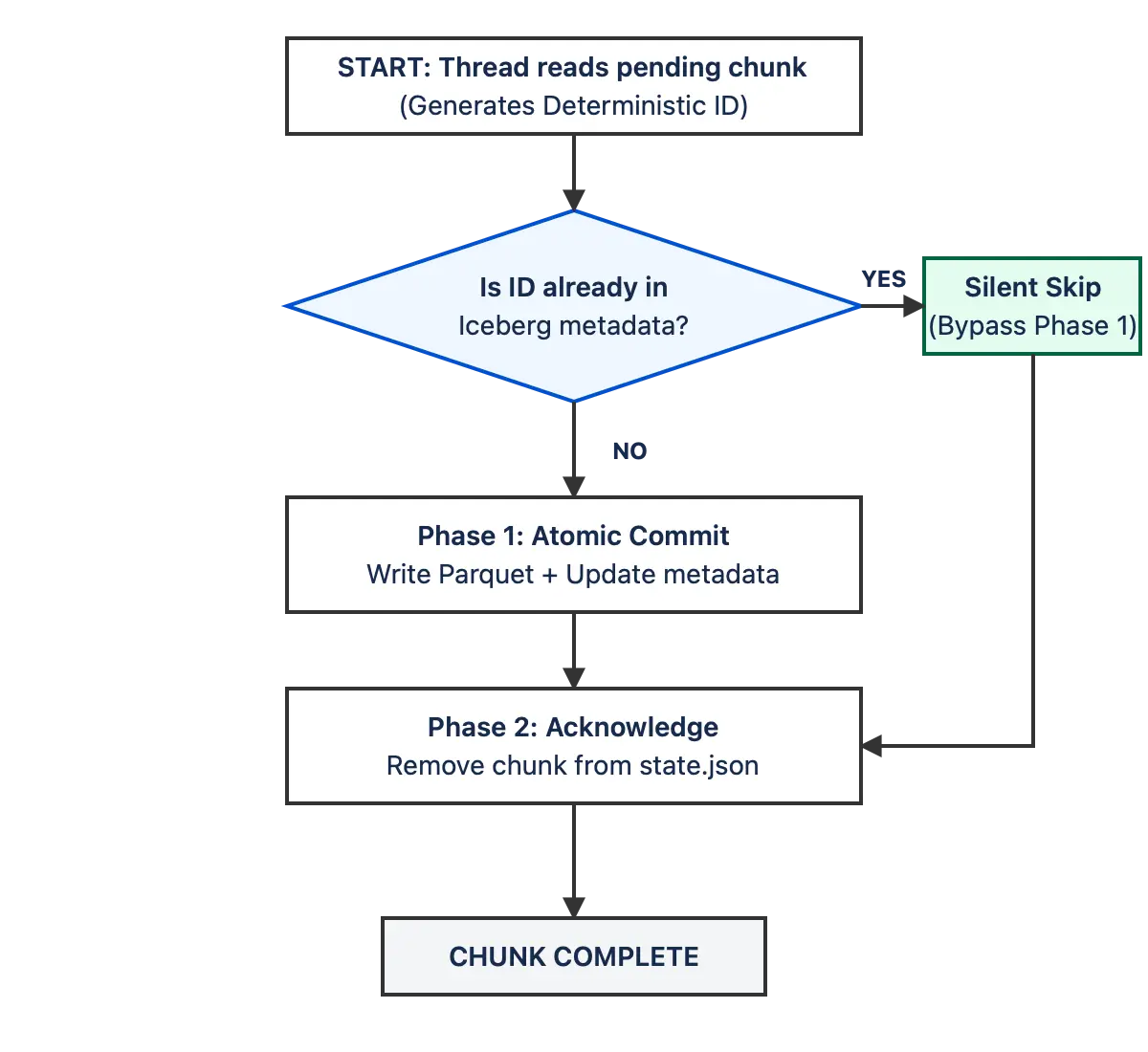
OLake Go splits large tables into chunks for parallel processing and fast transfer. Each chunk is assigned a deterministic thread ID built from the stream ID and the chunk's min and max bounds. Because the ID is derived from the chunk's content rather than a random value, the same chunk always gets the same thread ID across runs, this is the foundation of Full Refresh recovery.
Chunks are processed concurrently across the configured thread pool. When a chunk finishes:
- Commit step: The writer sends a
COMMITto the Iceberg Java server. The Java server atomically writes the chunk's Parquet files and updates the metadata file. Inside theolake_2pcproperty, thefull_refresh_committed_idsarray is extended with the current thread's ID. This is the durable record that this chunk's data is in the table. - Checkpoint step: The chunk is removed from the
chunksarray insidestate.json.
What Happens on Failure
If the process crashes after the commit step but before the checkpoint step, state.json still lists that chunk as pending. On the next run, OLake Go starts fresh from state.json, queues the same chunks, and creates writer threads for them. But before doing any reading, each thread checks the full_refresh_committed_ids list read from the Iceberg table's metadata file. If the current thread's deterministic ID is already present in that list, the chunk is silently skipped as the data is already in the table.
This way, a crash between the commit step and the checkpoint step causes zero data loss and zero duplication. Chunks that fully committed are never re-processed. Chunks where the commit itself failed are re-processed from scratch.
Example: Postgres Table public.users
Say OLake Go splits the table into two chunks. After chunk 1 commits (commit succeeds, process crashes before the checkpoint):
Iceberg metadata file olake_2pc property:
{
  "full_refresh_committed_ids": [
    "public.users_min[1]-max[10000]"
  ]
}
On the next run, OLake Go finds unprocessed chunks saved in state.json and creates writer for these chunks.
When a writer is created for [1, 10000], it generates the same thread ID public.users_min[1]-max[10000], finds it in full_refresh_committed_ids, and skips the chunk. As the thread ID created for the second chunk is not present in the full_refresh_committed_ids, only [10001, 20000] is read and written.
CDC
Global LSN Sources: Postgres and MySQL
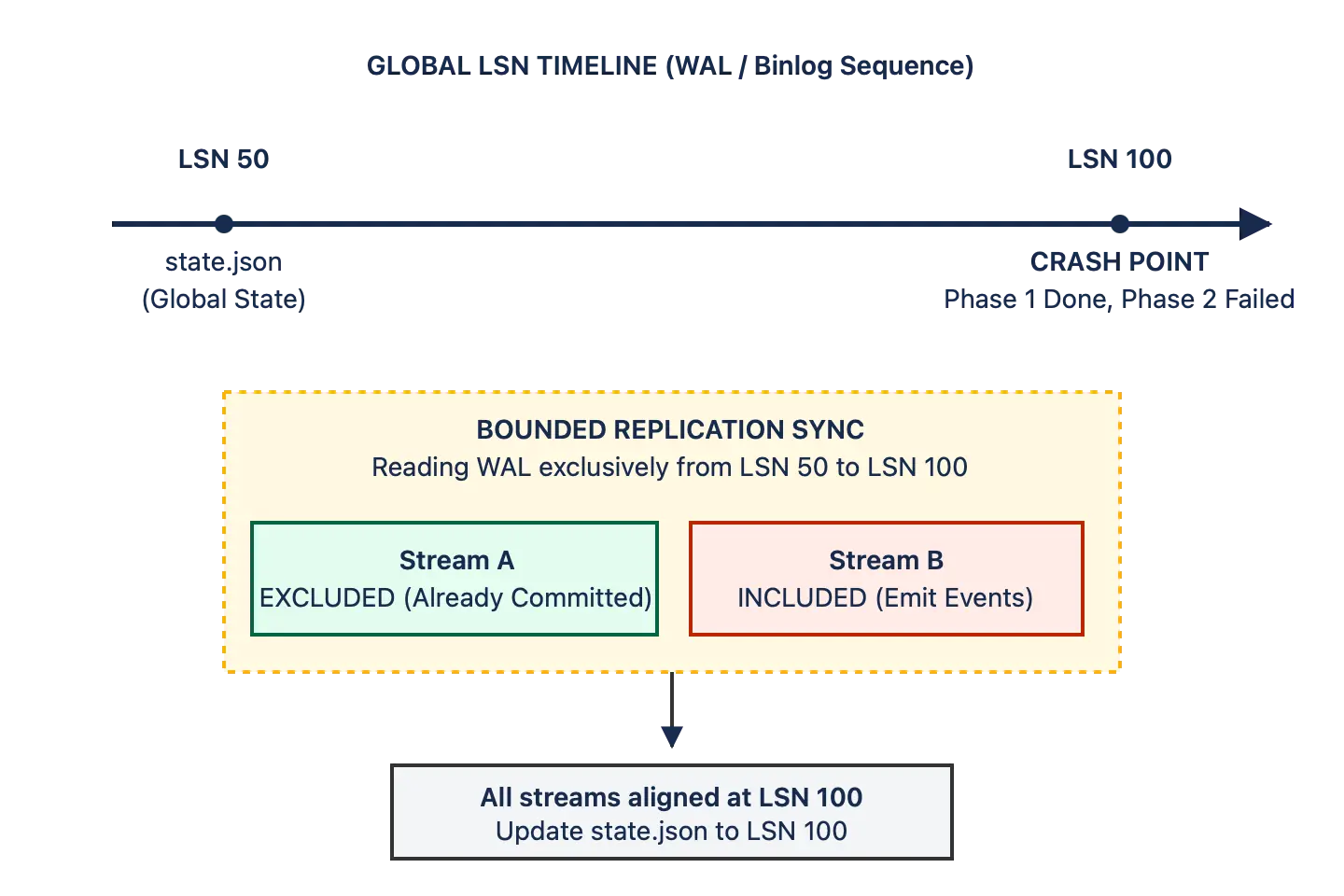
Postgres and MySQL represent all change events from a single, ordered stream, the WAL replication slot (Postgres) or binlog (MySQL). Every change, regardless of which table it affects, has a position in this global sequence. OLake Go reads this stream sequentially: one replication connection covers all selected streams in a single pass.
The Commit Sequence
A writer thread is created per selected stream at the start of CDC. As the replication stream is consumed, change records are routed to the appropriate writer. When the sync window closes:
- Commit Step: Each stream's writer sends a
COMMITto the Iceberg Java server. The commit payload carries the final WAL LSN (Postgres) or binlog file-and-position (MySQL) as theMetadataState. The Java server atomically writes data files and embeds this position in the stream'solake_2pctable property. - Checkpoint Step: For Postgres, PostCDC first acknowledges the replication slot to inform the server it can reclaim WAL space, then saves the final LSN to
state.json. For MySQL, PostCDC saves the final binlog position tostate.json.
What Happens on Failure
Consider this scenario: Stream A commits to Iceberg (Commit succeeds), but the process crashes before PostCDC runs Checkpointing. Now state.json still holds the old LSN, but Stream A's Iceberg table has metadata that records the newer LSN it committed.
On the next run, before reading a single event from the replication stream, OLake Go compares each stream's metadata LSN against the global state LSN:
- If a stream's metadata LSN is ahead of the state LSN, that stream has already committed its data and does not need to re-read those WAL events. It is excluded from the replication session.
- The remaining streams, those whose metadata LSN matches the state LSN, need to catch up. OLake Go starts a bounded replication sync: reading from the current state LSN up to the metadata LSN, but only emitting events for those remaining streams. Once this bounded sync completes, all streams are at the same LSN and
state.jsonis updated normally.
This guarantees that no stream misses events that fell in the gap between the last committed LSN and where the process crashed.
Example: Postgres with Two Streams: public.orders and public.users
state.json before CDC sync (global position):
{
  "type": "GLOBAL",
  "global": {
    "state": { "lsn": "0/1A2B3C4D" },
    "streams": ["public.orders", "public.users"]
  }
}
CDC runs. public.orders commits first (Commit phase succeeds). Process crashes before Checkpoint phase runs.
public.orders Iceberg metadata file olake_2pc after Committing:
{
  "id": "public.orders_<thread>",
  "state": "{\"lsn\":\"0/2B3C4D5E\"}"
}
public.users Iceberg metadata file olake_2pc (unchanged - crash happened before its commit):
{
  "id": "public.users_<thread>",
  "state": "{\"lsn\":\"0/1A2B3C4D\"}"
}
On the next run, OLake Go reads both metadata files:
- orders metadata LSN
0/2B3C4D5E> state LSN0/1A2B3C4D→ skip orders, it is already committed - users metadata LSN
0/1A2B3C4D= state LSN → include users in a bounded replay up to0/2B3C4D5E
After the bounded sync and Checkpoint step:
state.json updated:
{
  "type": "GLOBAL",
  "global": {
    "state": { "lsn": "0/2B3C4D5E" },
    "streams": ["public.orders", "public.users"]
  }
}
Per-Stream LSN Sources: MSSQL and MongoDB
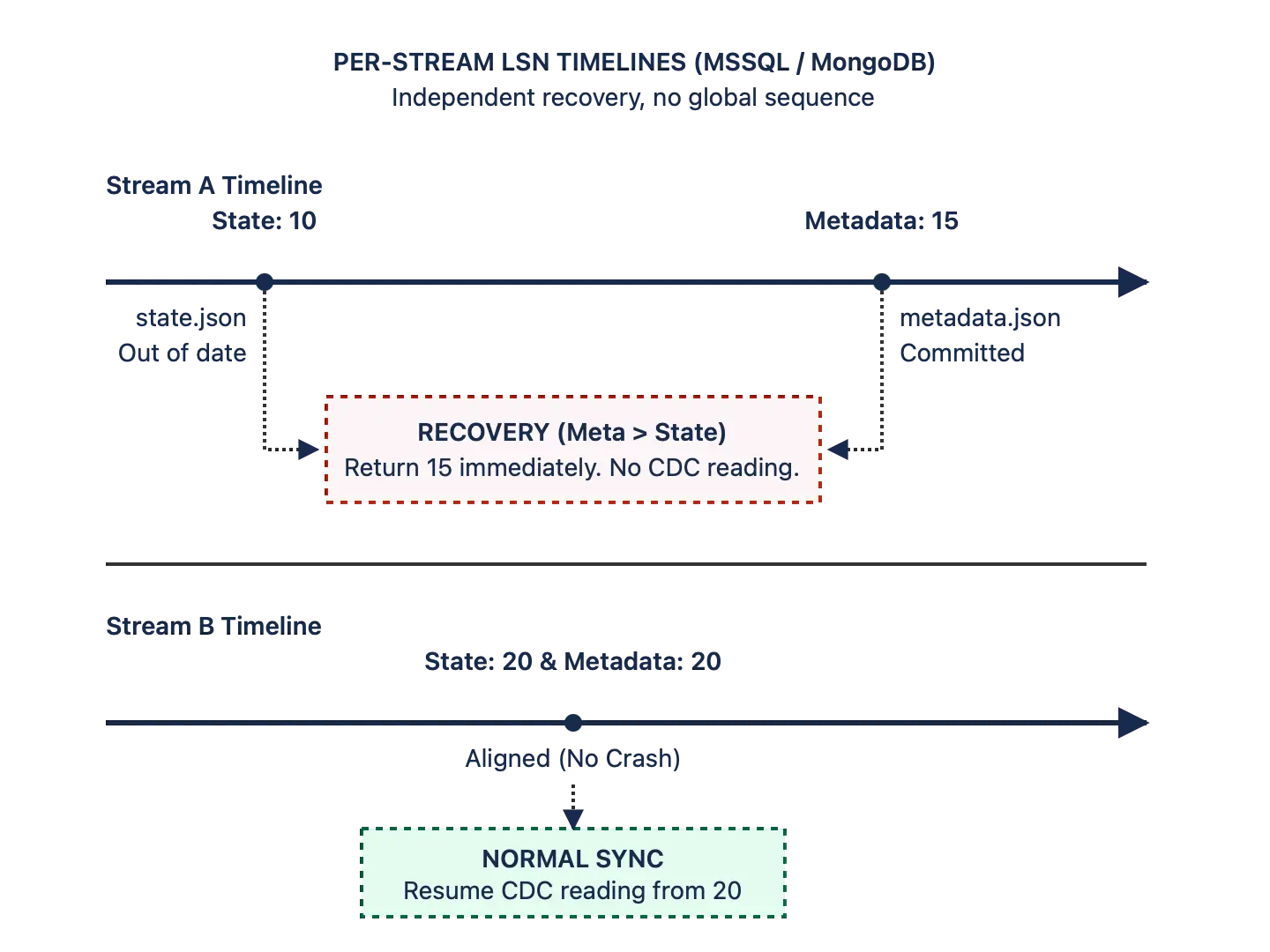
MSSQL and MongoDB do not share a global change position across tables. Each collection or table has its own independent LSN or resume token. OLake Go runs a concurrent change stream per selected stream, each stream is processed independently and in parallel.
Because there is no shared global position, recovery is handled per-stream. At the start of StreamChanges for a given stream, the code compares the stream's position stored in state.json against the position stored in that stream's Iceberg metadata file. If the metadata position is strictly ahead, meaning Commit Step committed but Checkpoint Step (state save) did not, the stream returns immediately with the metadata position as its result. No CDC log reading occurs. PostCDC then saves this position to state.json, completing the recovery in Checkpoint Step. The next regular sync picks up from that position onwards.
Example: MongoDB Collection mydb.orders
state.json before CDC sync:
{
  "type": "STREAM",
  "streams": [
    {
      "stream": "orders",
      "namespace": "mydb",
      "state": { "_cdc_resume_token": "826A7B3C..." }
    }
  ]
}
CDC runs. mydb.orders commits to Iceberg (Commit Step succeeds). Process crashes before Checkpoint Step.
mydb.orders Iceberg metadata file olake_2pc after Commit Step:
{
  "state": "826B8C4D..."
}
On the next run, OLake Go compares state token 826A7B3C... against metadata token 826B8C4D.... Metadata is ahead, Commit Step committed but Checkpoint Step did not. The stream returns immediately without reading any change events. PostCDC writes the metadata token to state.json.
state.json after recovery (Checkpoint Step):
{
  "type": "STREAM",
  "streams": [
    {
      "stream": "orders",
      "namespace": "mydb",
      "state": { "_cdc_resume_token": "826B8C4D..." }
    }
  ]
}
The next sync then reads change events starting after 826B8C4D....
Incremental
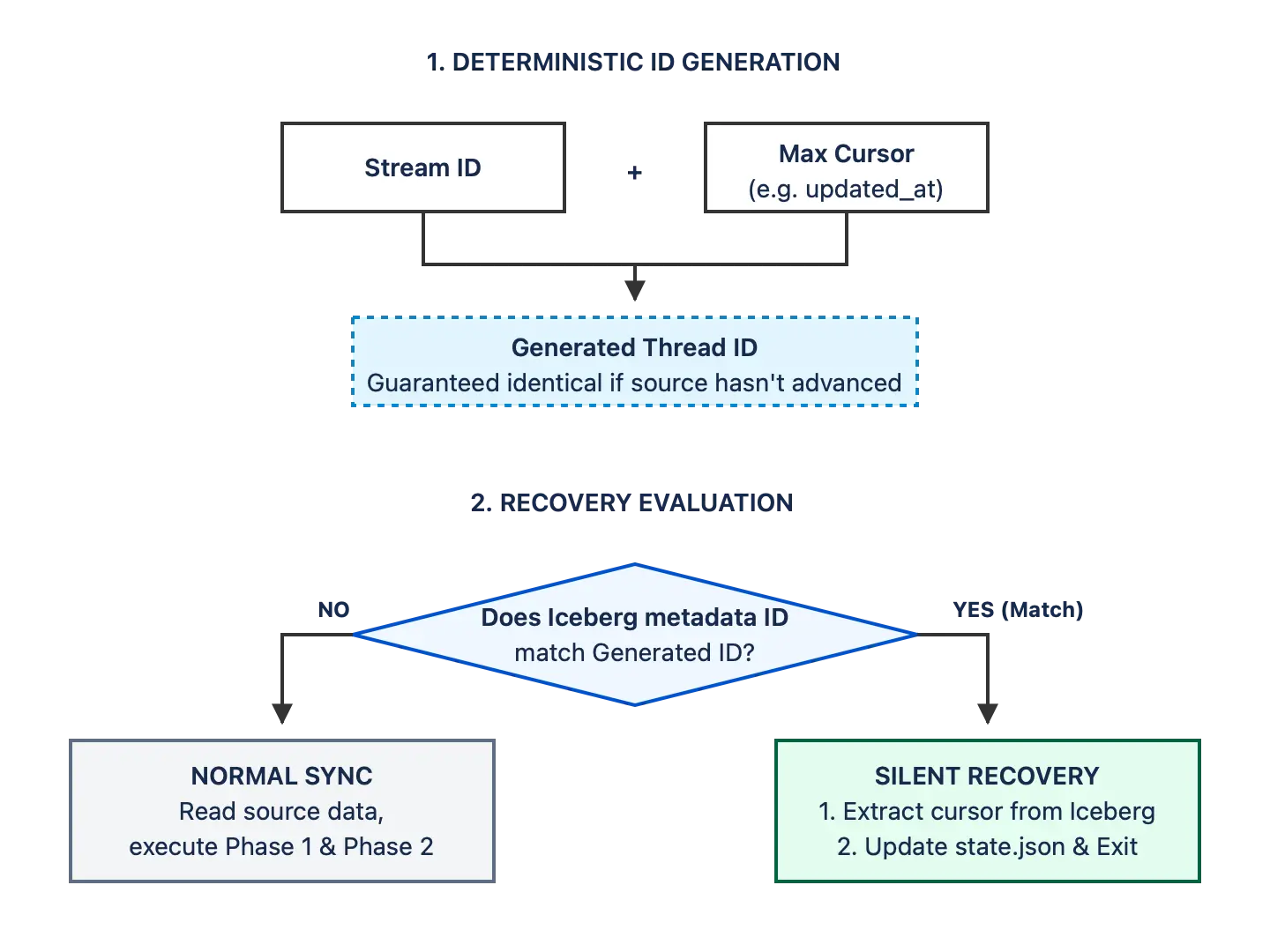
Incremental syncs advance a cursor column (such as updated_at) forward with each run. OLake Go records the maximum cursor value seen at the start of the sync, reads all rows up to that value, and then saves the new high bookmark.
The Commit Sequence
Before reading any data, OLake Go captures the maximum cursor value currently in the source table. A deterministic thread ID is generated from the stream ID combined with that maximum cursor value. Because the cursor value is baked into the thread ID, the same sync window always produces the same thread ID.
- Commit Step: When the sync completes, the writer commits to Iceberg, carrying the cursor values as the
MetadataState. The Java server atomically writes data files and embeds the cursor values in theolake_2pctable property. - Checkpoint Step: The new cursor value is written to
state.json.
What Happens on Failure
If the process crashes after Commit Step but before Checkpoint Step, state.json still holds the old cursor value. On the next run, OLake Go fetches the same maximum cursor value from the source (since nothing has changed), generates the same thread ID, and creates a writer thread.
Before reading data, it reads prevMetadataState from the Iceberg table. If the stored metadata ID matches the current thread ID, confirming this is the same sync window that already committed, OLake Go reads the cursor values out of the metadata, updates state.json to reflect the committed position, and exits without re-reading any source data.
The result: the committed data stays in Iceberg exactly once, and state.json is corrected to match, ready for the next run to advance the cursor further.
Example: Postgres Table public.orders with Cursor updated_at
state.json before incremental sync:
{
  "type": "STREAM",
  "streams": [
    {
      "stream": "orders",
      "namespace": "public",
      "state": { "updated_at": "2024-06-01T00:00:00Z" }
    }
  ]
}
Thread ID is generated from this state.json cursor value: public.orders_2024-06-01T00:00:00Z_.... Incremental reads all rows with updated_at > 2024-06-01T00:00:00Z, stores the max seen value of updated at for that sync 2024-06-01T05:00:00Z and commits to Iceberg. Commit Step succeeds. Process crashes before Checkpoint Step.
public.orders Iceberg metadata file olake_2pc after Commit Step:
{
  "id": "public.orders_2024-06-01T00:00:00Z_...",
  "state": "{\"updated_at\":\"2024-06-01T05:00:00Z\"}"
}
On the next run, OLake Go reads the cursor from state.json, fetches updated_at still 2024-06-01T00:00:00Z. The same thread ID is generated. OLake Go reads the metadata file, sees the ID matches, reads the cursor out of the metadata, and exits without reading the source again and updates the state.json value to 2024-06-01T05:00:00Z. Checkpoint Step confirms state.json is consistent.
state.json after recovery:
{
  "type": "STREAM",
  "streams": [
    {
      "stream": "orders",
      "namespace": "public",
      "state": { "updated_at": "2024-06-01T05:00:00Z" }
    }
  ]
}
Conclusion
Every mode comes down to one comparison: the position saved in state.json against the position committed to Iceberg. When they agree, or state.json is ahead, OLake Go just moves forward. When Iceberg is ahead, a crash landed between the commit and the checkpoint, so OLake Go reads the committed position back out of the metadata and repairs state.json, without re-reading or re-writing any data. No coordinator, no transaction log, no locks, just Iceberg's atomic commit and few comparison logics.
Whenever a sync dies, the table always ends up correct, with nothing duplicated and nothing missing. And that is what really counts: you might be running your dashboards, reports, and models straight off this Iceberg table, and with exactly-once delivery you can trust those numbers are right, every single time.
FAQ
Q1. Does OLake Go guarantee exactly-once delivery to Apache Iceberg?
Yes, across all three sync modes: Full Refresh, Incremental, and CDC. OLake Go commits data files and a progress marker to Iceberg in a single atomic operation, then compares that marker against its state.json checkpoint on every restart, so a crashed sync resumes without duplicating or skipping records.
Q2. What happens if a sync crashes between the Iceberg commit and the checkpoint save?
On the next run, before reading anything from the source, OLake Go reads the progress marker back from the Iceberg table's metadata and compares it to state.json. If the metadata is ahead, that data already committed, so OLake Go skips re-reading and re-writing it and just repairs state.json to match. If they already agree, the sync runs normally.
Q3. How does OLake Go make the data write and progress marker atomic?
OLake Go writes to Iceberg through a Java process that owns all catalog operations. A finishing writer sends a commit carrying its progress payload, and Iceberg applies the new Parquet files and the metadata update as a single atomic operation. There is no window where the data exists without its marker or the marker without its data, which is what lets recovery trust the comparison against state.json after a crash.
Q4. Does OLake Go need an external coordinator or transaction log for this?
No. The guarantee comes entirely from Iceberg's atomic commit plus the comparison between the committed metadata and state.json. No coordinator, no transaction log, no locks.
Q5. Does exactly-once delivery work the same way across all sources?
Yes, broadly. Every source runs the same core check, comparing the committed marker in metadata file against state.json before doing any work. The differences are in how each sync mode saves and recovers that marker, and CDC in particular parses and stores it a bit differently across drivers. See the Full Refresh, Incremental, and CDC sections above for the exact mechanics per mode.