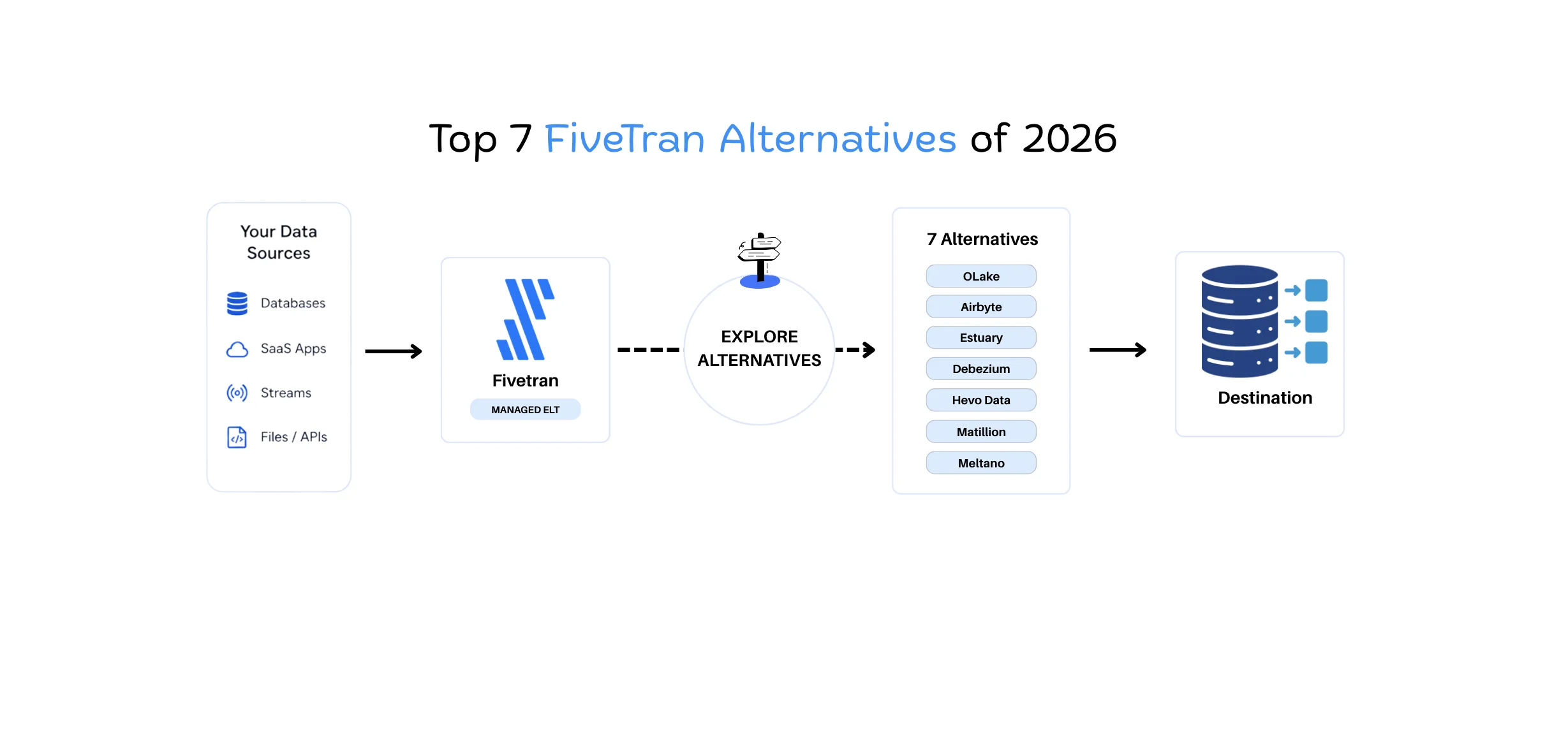
Top 7 FiveTran Alternatives of 2026
12 min read
Let's be honest about why you're reading this. Fivetran's bill stopped making any sense.
Not throwing shade. Fivetran is genuinely good at what it does, and for most of the decade "just use Fivetran" was the right call for almost everyone. You hand over your ingestion layer, get your engineering time back, and stop thinking about connectors.
So what changed?
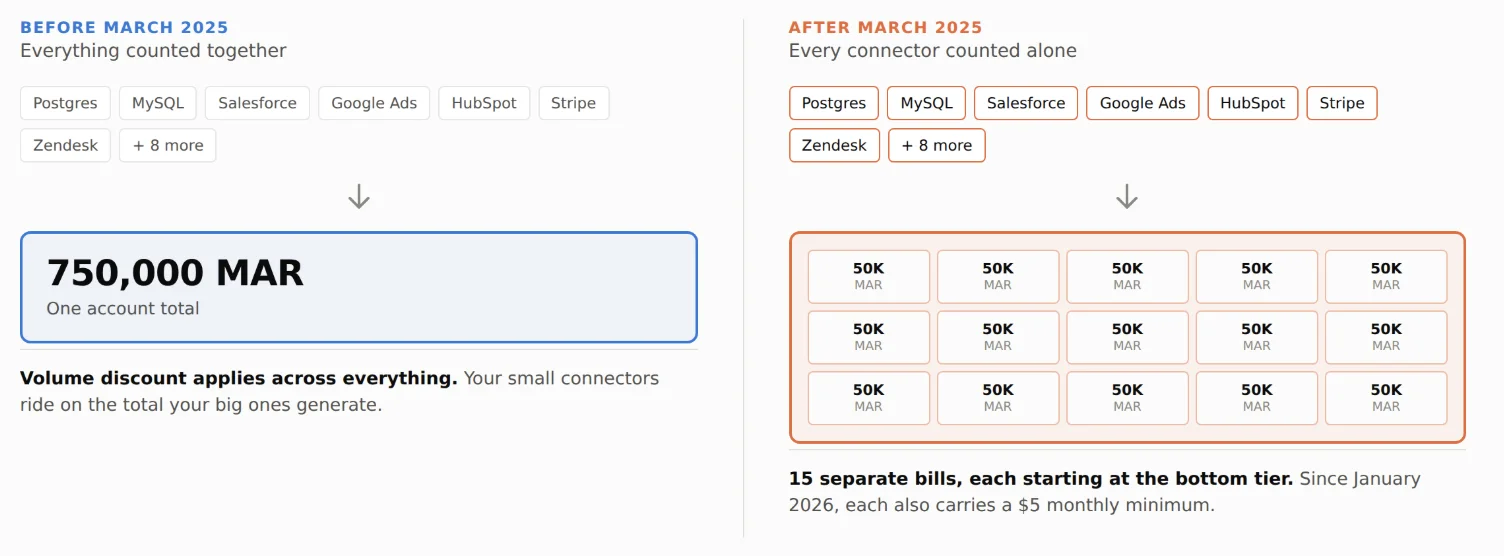
In March 2025, Fivetran stopped counting Monthly Active Rows (MAR) across your whole account and started counting each connector on its own. The bulk discount went with it. Fivetran says the change is neutral for a typical user, but plenty of teams reported bills jumping 40–70%, because small connectors like ad platforms and logging tools no longer ride on the volume your big ones generate.
January 2026 added two more. Every active connector now carries a $5 monthly minimum, and deleted rows and History Mode changes started counting as billable.
Then there's the bigger shift. The warehouse isn't the only destination anymore. Plenty of teams now write to Apache Iceberg in their own storage and query it with Trino or Spark, which makes a warehouse-first tool an awkward fit. And with Fivetran and dbt Labs merging in June 2026, people are asking whether one vendor should own both moving and transforming data.
What is Fivetran?
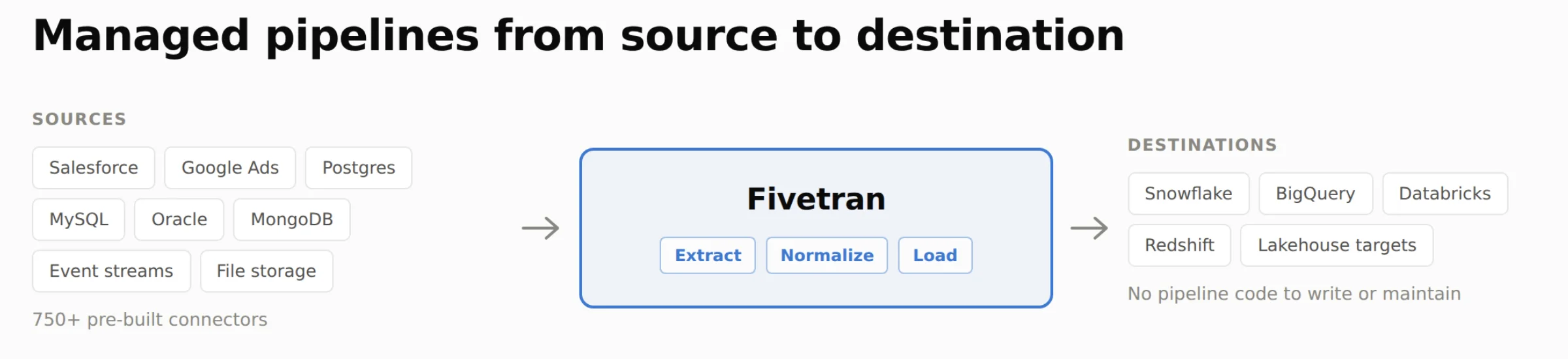
Fivetran is a managed ELT. You point it at a source and the destination where your data should land and it handles extraction, schema management, normalization and loading. You don't have to write pipeline code or maintain it.
Fivetran provides 750+ pre-built connectors ranging from SaaS apps like Salesforce and Google Ads to product databases like Postgres, MySQL, Oracle and MongoDB, and also event streams and file storages. Destinations are usually warehouse suspects such as Snowflake, BigQuery, Databricks, Redshift with a growing set of lakehouse targets.
Besides connectors, Fivetran provides three more features:
-
Transformations: it runs your dbt models on a schedule after the data lands, cleaning the raw tables. Billing is done per model run.
-
Activation: this works like reverse ETL, by pushing data from the warehouse back out into the business tools your teams work in day to day.
-
Managed Data Lake Service: writes to Iceberg and Delta Lake in your own storage instead of a warehouse, so you own the files, and any engine can query them.
How does Fivetran work
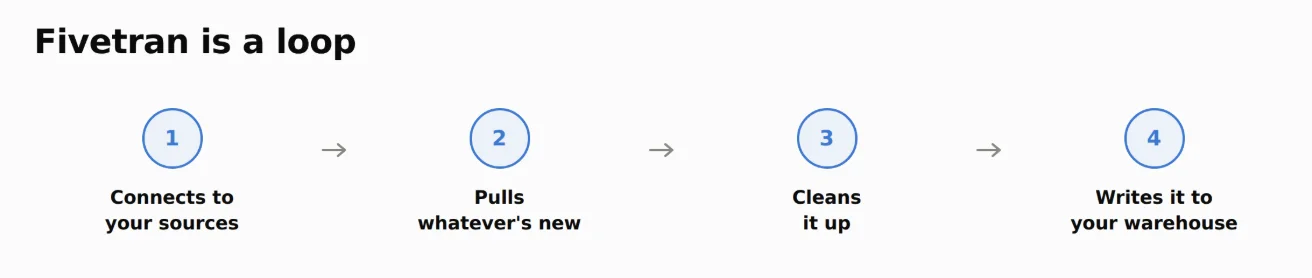
The basic idea of Fivetran is a loop. Fivetran connects to your sources, pulls whatever's new, cleans it up, writes it to your warehouse, and does the whole again on a schedule. Configure it once and it runs automatically.
The first sync is the big one. Once a source is connected, Fivetran runs an initial sync that copies everything, including your full history. This takes a while depending on how much data you have. After that. it switches to incremental mode and only pulls what's changed since the last sync. This is why the first sync looks very different from every sync after.
How it spots changes depends on the source. Databases keep their own records of every change; for example, MySQL calls it the binary log, Postgres has the write-ahead log, and similarly MongoDB uses change streams. Fivetran reads that log instead of scanning your tables; this is what keeps the load off your production databases. Fivetran has a fallback method that works over a plain read-only connection if a database can't offer logs.
SaaS tools like Salesforce or Hubspot don't contain logs; therefore, Fivetran talks to their APIs instead of handling the rate limits and expiring credentials, which makes those ingestions annoying to build yourself.
This cleans the data up. The raw data from the source isn't analysis-ready. For databases, Fivetran tries to mirror the source schema. In the case of SaaS sources, it does more work, reorganizing messy API responses into proper tables that reflect how data actually relates.
Why explore Fivetran alternatives?
-
Busy tables cost more than useful ones: MAR counts how often your data changes and not whether anyone actually looks at the data. So the table tracking inventory levels or order status updating constantly, watched by nobody, can quietly become your most expensive connector, while the tidy summary table your entire dashboard runs on costs you almost nothing. That's the strange thing to be paying for
-
Your bill can jump without you changing anything: The meter runs on the rows that change, so anything that makes your data change more makes your bill go up, even when nobody on your team touched a single setting.
-
It's built for warehouses, not lakes: If your data goes to Snowflake, Fivetran might be a perfect fit that's what it's made for. But plenty of teams now write to Apache Iceberg in their own S3 and query it with Trino or Spark. Fivetran does offer a managed lake service, but it's an extra on a warehouse product, not the main design.
-
You can't look under the hood: Fivetran hides the details on purpose. That's the appeal but also the limit. If a connector starts acting up, you file a ticket and wait. You can't change how it handles a big table. Your data also passes through Fivetran's servers. For teams with strict compliance rules, that alone rules it out
-
One company now owns most of your stack: Since the dbt Labs merger, a single vendor handles your data movement, your transformations, and now your AI data layer too. Which can be convenient but also a lot riding on one relationship, and some teams would rather keep those parts separate.
Top 7 Fivetran Alternatives
1. OLake (best for moving databases into Apache Iceberg and table maintenance)
OLake is open source and built for moving data from databases, object storage and streams into Apache Iceberg.
Two parts: OLake Go moves the data through full loads, incremental syncs and CDC, splitting large tables across workers rather than crawling through them. OLake Fusion handles the maintenance Iceberg needs, compacting small files so queries don't slow down over time.
- Sources: Postgres, MySQL, MongoDB, Oracle, MSSQL, DB2, Kafka, S3 → Iceberg and Parquet
- Pricing: free and Apache 2.0, self-hosted, so you pay for infrastructure only
In our benchmarks, replicating 50 million Postgres changes took 15 minutes and about $6 on OLake, against roughly $2,375 on Fivetran. Full results here.
- Where it wins: no row-based pricing, real speed on large tables, and your data never leaves your own infrastructure
- Where it falls short: as of now there are no SaaS sources, so you'll still need something else for Salesforce or HubSpot
2. Airbyte (best for connector variety)
Airbyte is the closest open-source answer to Fivetran's catalogue, with 600+ connectors and a kit for building your own when one doesn't exist.
You can self-host it for free, or use their cloud from around $10 a month on volume-based pricing, where extra credits run $2.50 each. Bigger teams move to capacity pricing and buy Data Workers instead of paying per row. Each Data Worker handles roughly three concurrent syncs, so you're sizing for throughput rather than volume. Airbyte doesn't cap connectors or connections on any plan, so in practice your ceiling is credits on Standard and Data Workers above it.
- Where it wins: the widest open-source catalogue, and self-hosting is a real option rather than a token one
- Where it falls short: connector quality varies a lot outside the official ones, and running it yourself at scale is genuine work. On Cloud, Airbyte wraps data in its own internal format before sending it, so the GBs you're billed for run higher than the GBs sitting in your source
3. Estuary Flow (best for real time)
Estuary Flow is built for streaming instead of scheduled batches, so your data arrives in milliseconds rather than every 15 minutes. It doesn't charge extra for that speed.
Pricing is refreshingly simple. The free tier covers 10GB a month across two concurrent connectors. Above that it's $0.50 per GB plus $100 per connector, with 50% off once you're running six or more, and there's no cap on how many you can have. Since it bills on volume and not rows, high-churn tables cost far less here than they do under MAR. One thing to watch is how connectors are counted: Estuary counts every connection to a source or a destination, so a single pipeline uses two of them.
- Where it wins: genuine real time, and pricing you can actually forecast
- Where it falls short: around 200 connectors, and the per-connector fee adds up if you have lots of small sources
4. Debezium (best if you want total control)
Debezium is the open-source engine that quietly powers a lot of the commercial tools in this space. It's a component and not a product, which is exactly the point.
One common myth is that it needs Kafka. It doesn't. It can stream straight to Kinesis, Pub/Sub or RabbitMQ, or run inside your own application.
- Where it wins: free at any scale, endlessly flexible, and proven in very large deployments
- Where it falls short: everything around the engine. No dashboard, no scheduling, no support. You build all of that yourself
5. Hevo Data (best for small teams)
Hevo is aimed at teams without a dedicated data engineer. It's quick to set up, easy to use, and easier to reason about than MAR.
It's still usage-based, though. You pick an events tier when you subscribe, either 5M, 20M or 50M events a month, and the price moves with the tier you choose. Starter begins at $265 a month on annual billing and Professional at $750, with around 150 connectors. The free plan covers 1M events. Go over your quota, and the extra events get billed on top as on-demand usage rather than bumping you up a plan.
- Where it wins: a fast start and a bill you can predict as long as your volumes stay inside the tier you picked
- Where it falls short: a smaller catalogue, no self-hosting, and overage charges once you outgrow your tier
6. Matillion (best when transformation is the hard part)
Matillion is less an ingestion tool and more a full pipeline platform, with a visual canvas where moving and transforming data get designed together.
There are three tiers, billed on credits that burn as your pipelines run.
- Where it wins: one governed workflow for the whole pipeline, with version control built in
- Where it falls short: credit spend is hard to forecast until you've run real workloads, and streaming CDC only comes with Scale, their top tier
7. Meltano (best for teams who want pipelines in Git)
Meltano treats pipelines as code. Your setup lives in a file in your repo, runs through CI/CD, and gets reviewed like anything else your team ships.
- Where it wins: free and a natural fit when engineers own the pipelines
- Where it falls short: everything runs through the CLI and config files, from setup to monitoring to debugging. That's fine when engineers own the pipelines, but it rules out analysts and anyone else who might want to set up their own sync. You also build the orchestration and monitoring around it yourself, so there's real setup work before anything runs in production
| Tool | Model | Pricing basis | Connectors | Self-host | Best fit |
|---|---|---|---|---|---|
| OLake | Open source (Apache 2.0) | Free / infra cost | 8 DB & stream sources → Iceberg and Parquet S3 | Yes | High-volume DB CDC to Iceberg |
| Airbyte | Open core | Volume or capacity (Data Workers) | 600+ | Yes | Broad coverage, self-hosted option |
| Estuary Flow | Managed + BYOC | $0.50/GB + $100/connector | 200+ | Enterprise | Real-time streaming CDC |
| Debezium | Open source | Free / infra cost | Major databases | Yes | Full-control CDC engineering |
| Hevo Data | Managed SaaS | Tiered by events, from $265/mo | 150+ | No | Small teams, predictable billing |
| Matillion | Managed + hybrid | Credits (task hours + seats) | Broad | Scale tier | Transformation-heavy pipelines |
| Meltano | Open source | Free / infra cost | Singer ecosystem | Yes | Pipelines-as-code |
| Fivetran | Managed SaaS | Per-connector MAR + $5/connector minimum | 750+ | No | Wide SaaS coverage, hands-off |
Conclusion
Fivetran is still good at what it does. If your headache is keeping SaaS connectors alive, it's still the fastest way to a working warehouse.
But "just use Fivetran" isn't the automatic answer anymore. It's a decision now, and it's worth actually making instead of renewing by default.
For most teams the answer isn't one tool either. Pull up your invoice, find the two or three connectors doing the real damage, and move those somewhere you control the cost. Let a vendor keep the SaaS long tail, since that's the part nobody wants to maintain.
If your data needs to land in Iceberg, and your Postgres or Mongo bill is what started all this, OLake is a good place to start.