RisingWave Alternatives: 10 Best Streaming Databases
15 min read
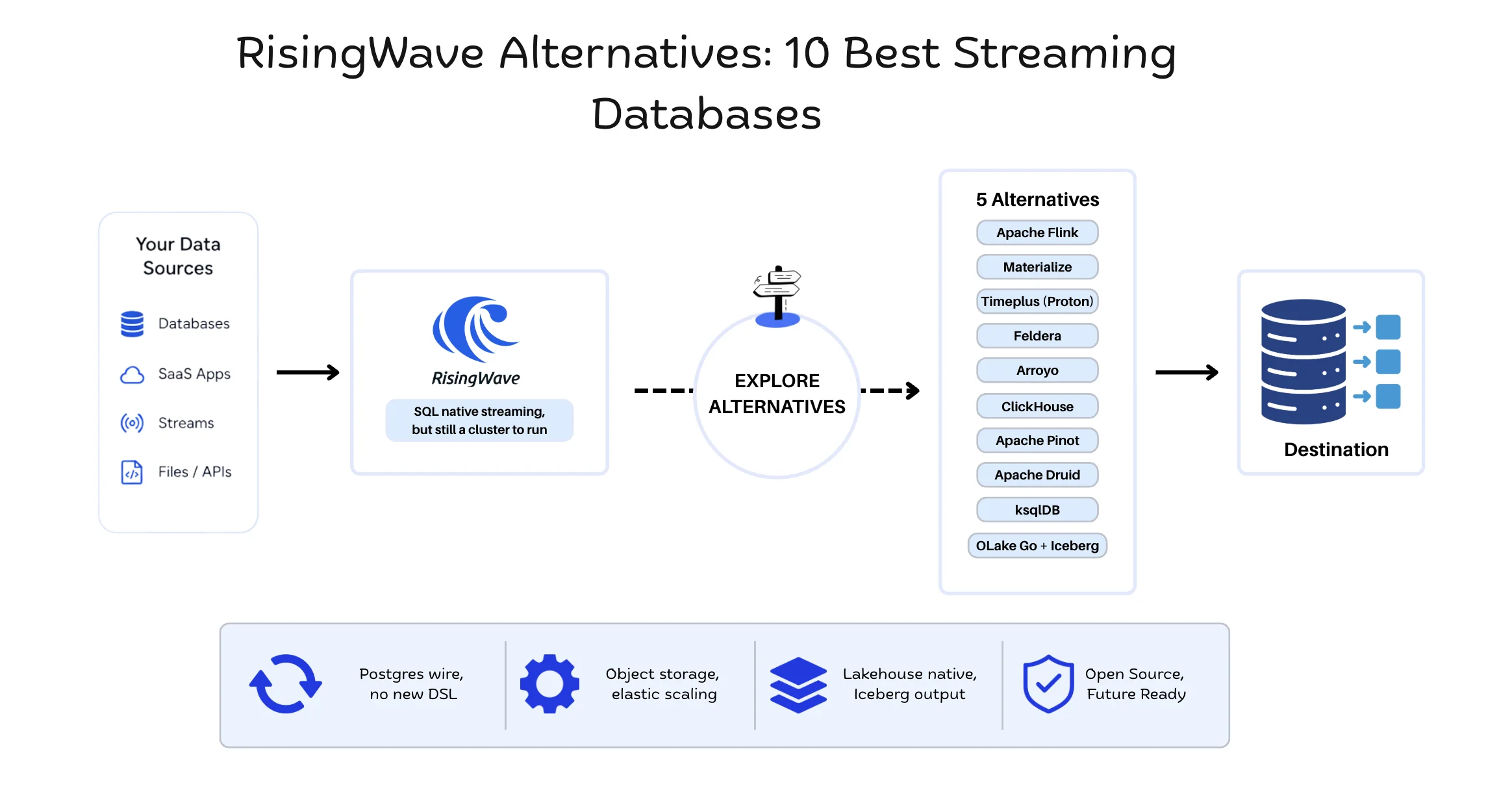
Streaming databases have a simple deal: write a materialized view in SQL, and the system will keep it fresh as new events roll in. RisingWave does a good enough job of fulfilling that promise to be a default point of reference in the category, but teams evaluating it often find that their real bottleneck is somewhere that the tool was never designed to address. In this guide, we will explore what RisingWave does, why teams skip it, and ten alternatives in the streaming database, stream processor, real-time OLAP engine, and lakehouse ingestion categories.
What Is RisingWave?
RisingWave is an open-source streaming database implemented in Rust and released under the Apache 2.0 license. It is Postgres wire compatible, so most existing drivers, BI tools, and Postgres clients connect without modification, and queries are written in SQL rather than a JVM data flow API.
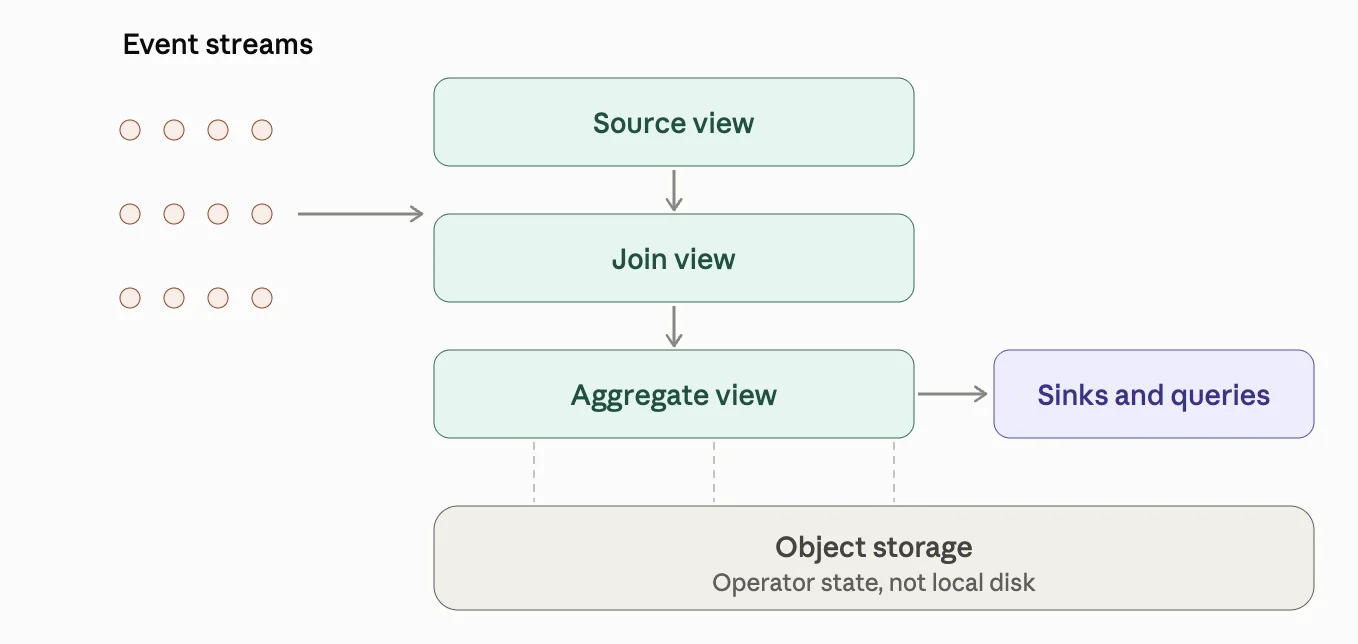
The main abstraction is the incrementally maintained materialized view. Data is ingested from Kafka, Pulsar, Kinesis, or CDC streams from PostgreSQL and MySQL, and views defined over those sources are updated continuously as events land, not recomputed on a schedule. Views can be cascaded i.e. one view can be fed into another. This allows the construction of layered transformation logic completely in SQL.
The most important architectural decision is what to do with state. RisingWave stores operator state on object storage like S3, not on attached SSDs. This decouples compute from state, keeps storage costs low at large state sizes, and allows clusters to scale without rebalancing terabytes of local disk. Results can be served directly from the database or sunk downstream, including to Apache Iceberg tables.
RisingWave can be deployed as self-hosted open source or RisingWave Cloud, a managed service. Vendor-released benchmarks showed the engine beating Apache Flink on 22 of 27 Nexmark queries, but that was a comparison of Flink 1.16 and RisingWave 0.19, and the shape of the workload is more important than any headline number.
Why Look for RisingWave Alternatives?
None of the reasons below amount to a defect. They are mismatches between what the tool optimizes for and what a given team needs.
Analytical serving, not incremental computation
The workload is analytical serving, not incremental computation. Streaming databases maintain a defined set of views cheaply, but they are not built for ad hoc queries across historical data with unpredictable filters and group-bys. Teams whose dashboards need slice-and-dice freedom across months of history are usually describing a real-time OLAP problem, which ClickHouse, Pinot, or Druid address more directly.
Standing compute for every view
Every view costs standing compute. Incremental maintenance is efficient per event, but each view holds state and consumes resources whether or not anyone queries it, so organizations with hundreds of rarely read views can find that always-on maintenance costs more than periodic recomputation.
Processing logic that exceeds SQL
The processing logic exceeds what SQL expresses comfortably. Complex event processing, custom windowing, machine learning inference in the pipeline, or stateful logic with intricate branching are easier to write against a programmatic API. Apache Flink's DataStream API exists precisely for this.
The destination is a lakehouse, not a serving database
The destination is a lakehouse, not a serving database. Many RisingWave evaluations start with a goal that has nothing to do with streaming SQL: getting operational database changes into Apache Iceberg reliably and quickly. Running a full stream processing engine to move CDC data into tables adds an engine to operate, along with its state, scaling behavior, and failure modes.
Operational and ecosystem maturity
Operational and ecosystem maturity. Compared with Flink, which has a decade of production deployments and a large hiring pool, newer engines have thinner operational literature and fewer engineers who have run them at scale.
Consistency requirements are strict
Consistency requirements are strict. RisingWave provides snapshot consistency tied to its checkpoint interval, which defaults to one second, rather than strict serializability, so workloads in finance or regulatory reporting, where a join must never expose an intermediate state, may need the stronger guarantees Materialize was designed around.
10 Best RisingWave Alternatives
1. Apache Flink
Apache Flink is the reference implementation of distributed stream processing and the engine most other systems are benchmarked against. It offers layered APIs, from the DataStream API for custom stateful logic up to Flink SQL for declarative pipelines, along with event-time semantics, watermarks, exactly-once processing through distributed checkpointing, and the broadest connector ecosystem in the category.
The trade-off is operational weight, since Flink is a JVM system with real tuning demands around checkpoint intervals, state backends, and memory configuration. Managed offerings from Confluent, AWS, and Ververica remove much of that burden at a cost. Choose Flink when processing logic outgrows SQL or when ecosystem maturity and hiring depth are decisive.
2. Materialize
Materialize is the closest architectural peer to RisingWave and the strongest option when correctness guarantees drive the decision. Built on Timely Dataflow and Differential Dataflow, it is PostgreSQL wire compatible and provides strict serializable consistency, meaning every query result reflects a consistent point-in-time view across all sources and CDC transactions apply atomically. It also supports recursive queries, which few systems in this category handle, and which are useful for graph-shaped computations.
Licensing differs meaningfully, since the Materialize source is available under the Business Source License 1.1, which converts to Apache 2.0 after four years, and the free self-managed community edition carries resource limits. Choose Materialize for financial systems, regulatory reporting, or any workload where an intermediate join result reaching a user is unacceptable.
3. Timeplus (Proton)
Timeplus Proton is the open-source streaming SQL engine underneath Timeplus Enterprise, built in C++ on ClickHouse libraries and shipped as a single binary with no JVM and no external dependencies. It handles streaming and historical queries in one system, which suits teams that want live and past data without operating two engines.
The ClickHouse foundation brings strong columnar analytics for historical scans, while distributed operation and the largest state workloads are where more mature systems still hold the advantage. Choose Timeplus for observability pipelines, IoT telemetry, and edge deployments where footprint and setup time matter.
4. Feldera
Feldera takes the most rigorous approach to incremental computation in this list. It is built on DBSP, a formal model of incremental view maintenance that won a best paper award at VLDB 2023, and the vendor's claim is that Feldera incrementalizes arbitrary SQL, including nested views, recursive queries, and complex multi-join programs, updating results in time proportional to the change rather than the size of the data.
That generality is the reason to pick it, since pipelines that other engines reject or force teams to restructure often compile without modification, though the project is younger than Flink or ClickHouse and the operational literature is thinner. Choose Feldera when the SQL is genuinely complex and rewriting it to fit an engine's supported subset is not acceptable.
5. Arroyo
Arroyo is a distributed stream processing engine written in Rust, licensed under Apache 2.0, and designed around SQL as the primary interface. It targets sub-second latency with a cloud-native architecture that autoscales and checkpoints state efficiently, and the decision not to build on Flink means it avoids JVM tuning and garbage collection pauses.
It is a stream processor rather than a database, so results are written to a downstream sink instead of being served from the engine. Choose Arroyo for SQL transformations on streams with low operational overhead and a permissive license, rather than a queryable store. Arroyo was acquired by Cloudflare in April 2025 and now powers Cloudflare Pipelines. The engine remains Apache 2.0 and self-hostable, though the project is still pre-1.0 and roadmap priorities now sit with a platform vendor.
6. ClickHouse
ClickHouse is a columnar OLAP database that answers a question streaming databases handle awkwardly: fast ad hoc analytics over large volumes of fresh and historical data. It ingests continuously from Kafka, supports materialized views that transform data on insert, and scans billions of rows in the sub-second range on suitable hardware, which makes it a common serving layer behind real-time dashboards.
The distinction to keep clear is that ClickHouse materialized views are insert triggers rather than fully incremental view maintenance, so complex streaming joins across multiple sources are not its strength. It reads Apache Iceberg tables directly through the iceberg() table function, which makes it a natural query engine on a lakehouse. Choose ClickHouse when the workload is unpredictable analytical queries rather than a fixed set of maintained views.
7. Apache Pinot
Apache Pinot was built for user-facing analytics, meaning dashboards and in-product features that thousands of concurrent users query at once under strict latency budgets. It ingests from Kafka in real time, supports upserts for mutable records, and uses indexing strategies, including star-tree indexes, to hold latency down as concurrency climbs.
The cost is operational complexity, since a Pinot cluster involves controllers, brokers, and servers alongside its dependencies. Choose Pinot when high query concurrency at low latency is the defining requirement and the team has capacity to run the cluster properly.
8. Apache Druid
Apache Druid handles real-time and historical time-series analytics with continuous ingestion from Kafka and Kinesis, sub-second aggregations at very large scale, and a segment-based storage layout tuned for time-bounded slicing. It has run in production at large organizations for over a decade, so its operational patterns are well documented.
Druid is weaker on complex joins and works best on denormalized, time-oriented data, so upstream modeling matters. Choose Druid for operational monitoring, clickstream analysis, and metrics platforms where the query pattern is time-range filtering with aggregation.
9. ksqlDB
ksqlDB provides SQL over Kafka topics, compiling each statement into a Kafka Streams topology that runs on the Kafka Streams runtime. For teams already committed to the Confluent Platform or Confluent Cloud, it integrates with Schema Registry, security, and monitoring and runs as ksqlDB server nodes against an existing Kafka cluster rather than as a separate engine with its own state backend. It is released under the Confluent Community License, not Apache 2.0, which permits self-hosting but not offering it as a competing managed service.
The status caveat matters. ksqlDB is not formally deprecated and still ships security and maintenance releases, but Confluent, acquired by IBM in March 2026, has moved its streaming SQL investment to Flink SQL, and ksqlDB is widely described as effectively in maintenance mode. Choose it to extend existing deployments, and weigh it carefully before starting new projects on it.
10. OLake Go and Apache Iceberg
For many teams, the reason RisingWave entered the evaluation was never streaming SQL. It was moving change data from operational databases into a lakehouse continuously and reliably, at which point a full stream processing engine is more machinery than the job requires.
OLake Go is an open-source replication engine that writes directly into Apache Iceberg or Parquet on object storage, with full refresh, incremental, and CDC sync modes across PostgreSQL, MySQL, MongoDB, Oracle, MSSQL, and DB2, plus ingestion from Kafka and S3. Parallel chunking splits large tables into virtual chunks read concurrently, which cuts backfill time substantially, while stateful checkpointing resumes interrupted syncs from the last committed position. Schema evolution is handled automatically, and Iceberg destinations work with Glue, Hive, JDBC, and REST catalogs, including Nessie, Polaris, and Unity.
The companion piece addresses a problem CDC pipelines create rather than solve, because continuous writes generate small files and delete files that degrade Iceberg query performance over time, and OLake Fusion automates compaction and delete-file cleanup on a schedule to keep tables fast as they grow. Once data lands in Iceberg, any engine can query it, whether that is ClickHouse, Trino, Spark, DuckDB, Snowflake, or Databricks.
Choose this path when the requirement is durable, vendor-neutral tables rather than millisecond-fresh materialized views, and pair it with a streaming engine only for pipelines that genuinely need sub-second computation.
Also worth a look
Beyond these ten, DeltaStream, Decodable, and Estuary Flow suit teams that want fully managed streaming without operating infrastructure, though deployment models differ. Estuary Flow is source-available under the Business Source License and offers private and bring-your-own-cloud deployments alongside its SaaS, so confirm the current options for each rather than assuming cloud only.
How to Choose the Right RisingWave Alternative
Start by naming the problem precisely, because most poor choices in this category come from solving the wrong one.
If the requirement is a fixed set of continuously fresh results with strong correctness guarantees, the choice narrows to Materialize when consistency is non-negotiable, Feldera when the SQL is complex enough that engine limitations become the blocker, and Timeplus when a small footprint matters more than scale.
If the requirement is transforming events in flight and writing them somewhere else, the choice is a stream processor. Flink wins on ecosystem breadth, connector coverage, and the ability to drop into a programmatic API when SQL runs out, while Arroyo wins on operational simplicity and a permissive license for teams that can stay within SQL.
If the requirement is analytical queries over fresh data with unpredictable filters and high concurrency, the answer is real-time OLAP rather than a streaming database. ClickHouse fits ad hoc exploration, Pinot fits user-facing features with heavy concurrency, and Druid fits time-series monitoring.
If the requirement is getting operational data into open table formats reliably, the answer is a purpose-built replication tool. OLake Go handles ingestion into Iceberg with CDC and schema evolution, OLake Fusion keeps the resulting tables performant through compaction, and query engines can be chosen separately and swapped later without re-ingesting anything.
Then apply three practical filters: confirm the license permits the intended deployment model, count the operational components honestly against the team that will carry the pager, and test with production-shaped data rather than a synthetic benchmark, because state size, key cardinality, and schema change frequency reveal problems a clean demo never surfaces.
One pattern worth considering is to land everything in Iceberg as the durable layer, query it with whichever engine suits each workload, and add a streaming engine only for the pipelines that need sub-second freshness, which keeps the expensive always-on component scoped to the cases that justify it.
Frequently Asked Questions About RisingWave Alternatives
Is RisingWave open source?
Yes. The RisingWave core engine is available on GitHub under the Apache 2.0 license and can be self-hosted without restriction. RisingWave Cloud is the separate managed offering, which adds enterprise features and compliance certifications.
What is the difference between a streaming database and a stream processor?
A streaming database stores results and serves queries against them, so a materialized view is both maintained and readable from the same system, while a stream processor transforms events and writes output to an external sink with no query layer of its own. RisingWave, Materialize, and Timeplus fall in the first category, Flink and Arroyo in the second.
Can ClickHouse replace RisingWave?
For analytical serving, often yes, but not for incremental view maintenance across multiple joined streams, because ClickHouse materialized views execute on insert rather than maintaining a fully incremental result. Teams needing both commonly run a stream processor for the joins and ClickHouse for the serving layer.
Is ksqlDB still a reasonable choice in 2026?
For existing deployments, yes, since it still receives maintenance and security releases. For new projects it warrants caution, because Confluent has shifted its streaming SQL roadmap to Flink SQL and ksqlDB is generally treated as being in maintenance mode.
Which RisingWave alternative is best for Apache Iceberg pipelines?
It depends on the pipeline. For replicating databases and event streams into Iceberg with CDC, schema evolution, and resumable syncs, a dedicated ingestion engine such as OLake Go is a closer fit than a stream processor, while Flink and RisingWave both sink to Iceberg natively for transformations that need computing first. Confirm how each option handles table maintenance, since RisingWave now runs Iceberg compaction inside the engine while Flink requires separate compaction jobs, and CDC writes accumulate small files and delete files either way.
What licensing differences matter most?
RisingWave, Flink, Arroyo, ClickHouse, Pinot, and Druid are Apache 2.0, which permits self-hosting and commercial use without restriction, while Materialize uses the Business Source License 1.1, under which each version converts to Apache 2.0 four years after release, with production use before then limited to the vendor's Additional Use Grant, which covers single-node deployments. Verify the current license before building a commercial product on any of them.
Conclusion
RisingWave is a strong streaming database, and teams that need PostgreSQL-compatible incremental materialized views with object-storage-backed state will find it holds up well. The alternatives here matter because the category label hides real differences in processing model, and a workload that looks like streaming SQL is often an OLAP serving problem, a custom stateful processing problem, or a lakehouse ingestion problem in disguise.
The most reliable way to decide is to describe the requirement without naming a tool. Fixed views that must always be correct point toward Materialize or Feldera, arbitrary analytical queries toward ClickHouse, Pinot, or Druid, custom stateful logic toward Flink, and continuous replication into open tables toward a dedicated engine such as OLake Go with maintenance handled by OLake Fusion. Match the architecture to the problem, and the shortlist usually reduces to two candidates worth testing properly.