Airbyte Pricing Explained: What You Will Pay (2026)
22 min read
Key takeaways
Airbyte pricing has four parts. Airbyte Core is free software, but you pay for the servers and the people who run it. Cloud Standard is $20 a month with 5 credits and $5 per extra credit, double its $10 base price before September 21, 2026.
Plus starts at $189 a month for 40 credits. Pro and Enterprise Flex have no public price. The $20 and $189 starting prices come from Airbyte's pricing page and the $5 extra-credit rate from its Cloud release note (checked Nov 2026).
By our arithmetic, Plus costs less than Standard above about 39 credits a month. For databases into Iceberg, OLake Go is open-source software with no credit meter.
- There are four ways to pay Airbyte: free self-hosting (Core), credit plans (Standard and Plus), capacity plans (Pro and Enterprise Flex), and a separate Agents product that is not data replication.
- Your bill can be bigger than your tables look, because database data is billed in Airbyte's own serialized size.
- Pro and Enterprise Flex prices are not published. You have to ask for a quote.
- If your job is copying databases into Iceberg, OLake Go is free open-source software with no credit meter. You pay only for your own servers.
Every Airbyte figure below comes from Airbyte's own pricing page, billing documentation and Cloud release notes. All three were checked in Nov 2026, as were the deployment, licence and source-connector pages we cite.
Where Airbyte publishes no price, we say so instead of guessing. The worked examples are our own arithmetic on Airbyte's published rates.
Airbyte pricing, and what Airbyte actually sells
Airbyte is an ELT (extract, load, transform) tool. It copies data from sources such as databases and software-as-a-service (SaaS) apps into a warehouse or lake, and you transform it there. Airbyte's pricing page lists 700+ connectors on every plan, while its docs say over 600, so the exact count depends on which page you read.
The same product comes in several packages, and each one bills a different way.
| Package | How you pay | Published price (pricing page and release note, checked Nov 2026) |
|---|---|---|
| Core (self-managed) | Your own servers and staff | Free software |
| Cloud Standard | Credits | $20 a month with 5 credits; $5 per extra credit |
| Cloud Plus | Credits, tiered | From $189 a month for 40 credits; $5.00 per extra credit on that tier |
| Cloud Pro | Capacity (Data Workers) | Custom, talk to sales |
| Enterprise Flex | Capacity, hybrid deployment | Custom, talk to sales |
Airbyte also sells a separate Agents product. It is not data replication, and its prices are not on the replication pricing page, so we leave it out of this guide.
So, what's a credit?
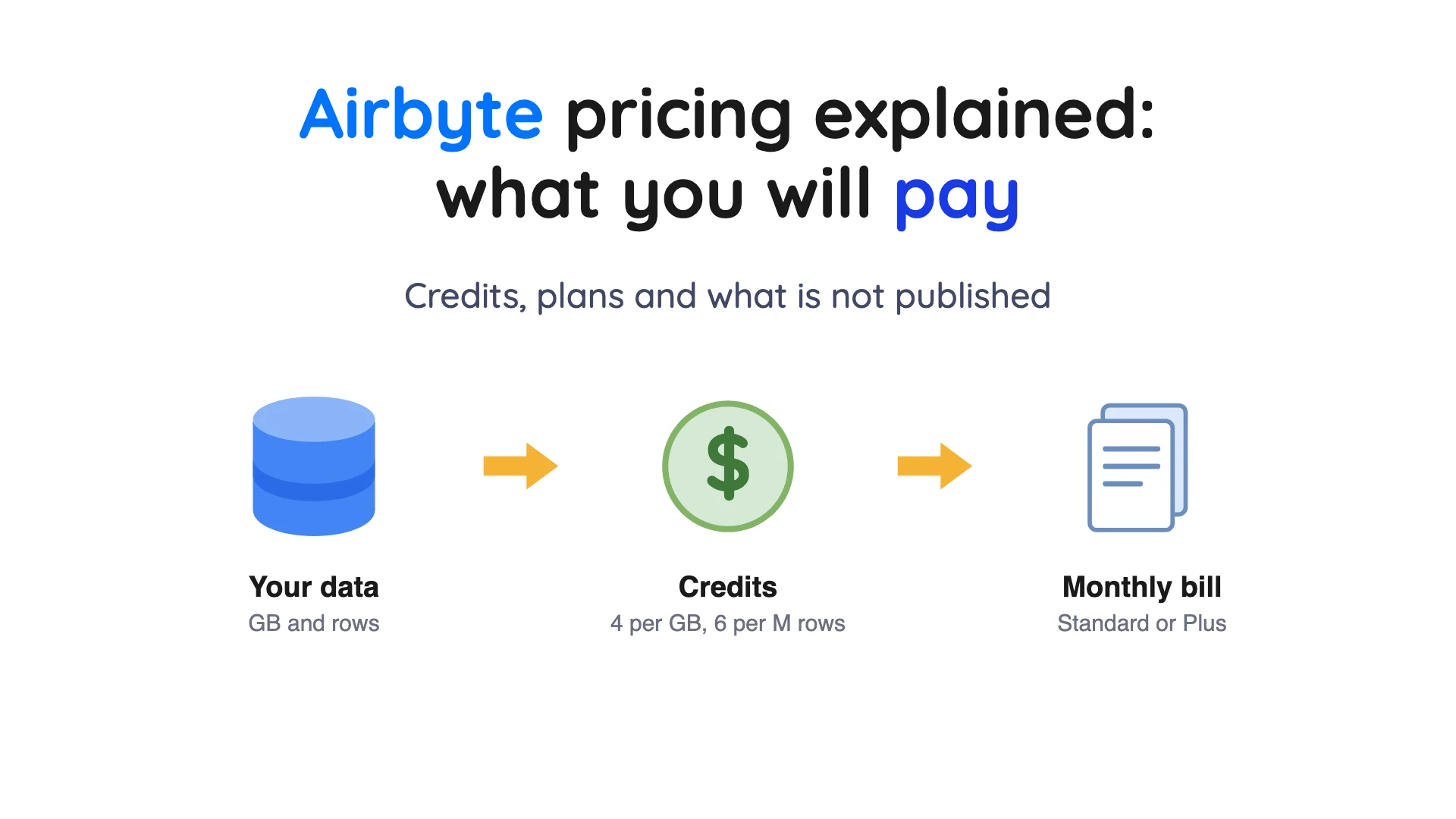
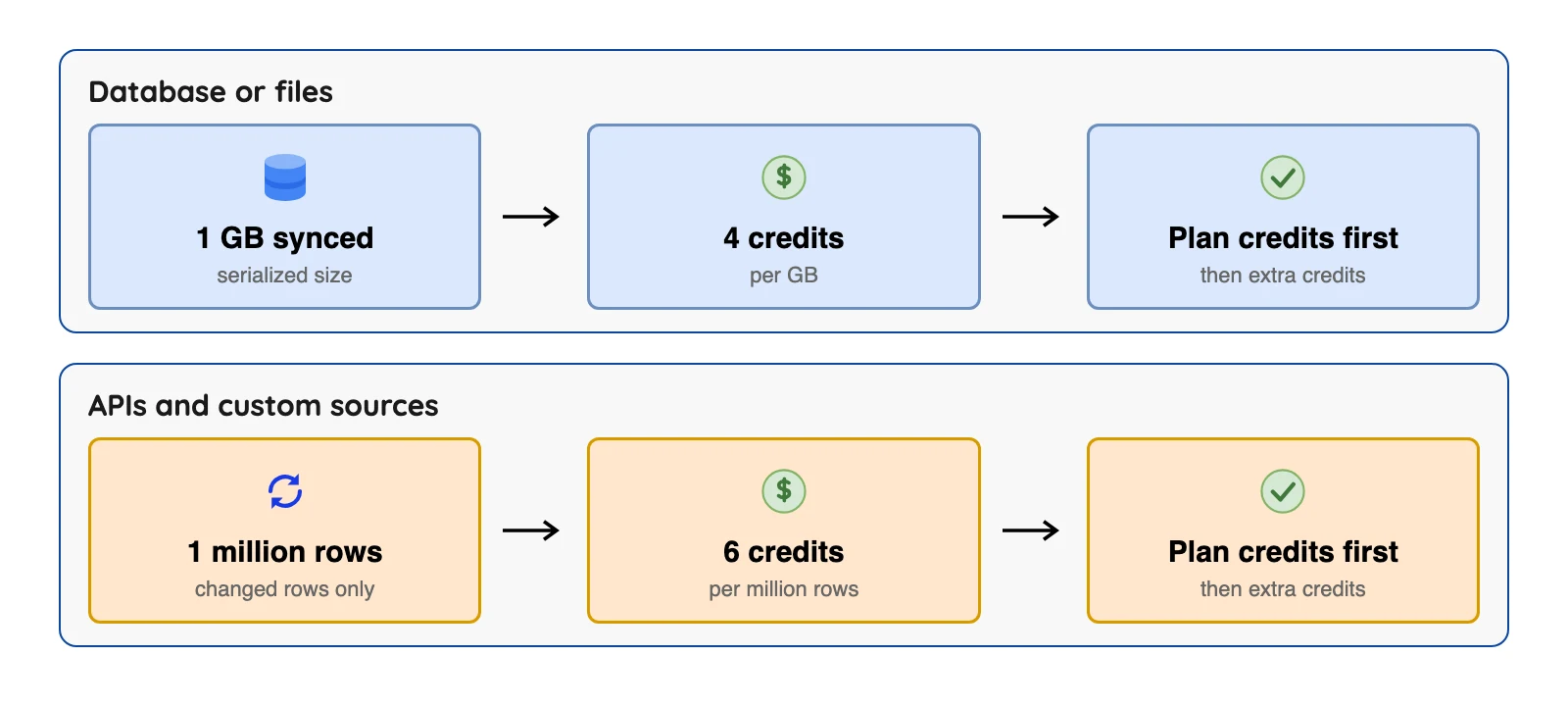
Airbyte Cloud Standard and Plus bill in credits. A credit is one currency for every kind of source, and Airbyte's billing docs give a fixed rate for each type.
| Source type | What is counted | Credits |
|---|---|---|
| APIs | Million rows | 6 |
| Custom sources | Million rows | 6 |
| Databases | 1 GB | 4 |
| Files | 1 GB | 4 |
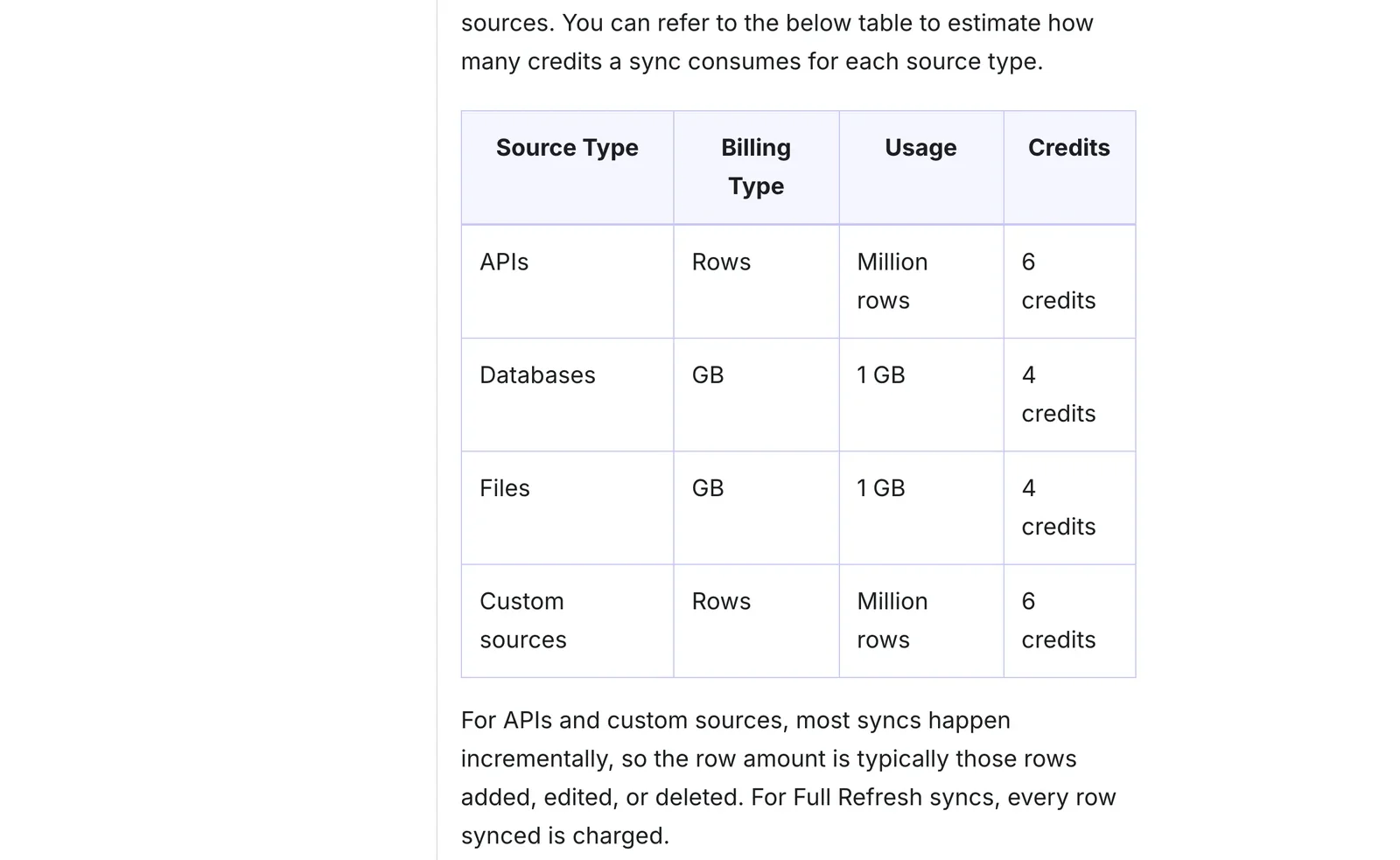
For API sources, most syncs are incremental, so you are charged for the rows that were added, edited or deleted. A full refresh sync is different: the docs say every row synced is charged.
For databases and files, Airbyte measures the data while the sync runs. By then each row has been serialized, meaning converted into Airbyte's own record format. The docs say this is likely a larger representation than what you would see by querying your database directly.
So your tables and your bill may not match. Airbyte publishes no example of the size difference, and neither do we.
The pricing page offers a 14-day free trial with 400 credits, which it says is about 100 GB of syncs. Per the billing docs, a trial ends after 14 days or when you use the 400 trial credits, whichever comes first. At the rates above, 400 credits is about 100 GB of database data or about 67 million API rows, by our arithmetic.
For a sense of scale, 40 credits is 10 GB of database data or about 6.67 million API rows, by our arithmetic. That costs $195 a month on Standard ($20 plus 35 credits at $5) and $189 on Plus. The pricing page labels Plus "best value after 10 GB".
Standard and Plus, plan by plan
Standard is the pay-as-you-go plan. Plus is the self-serve plan where you pick how many credits you buy each month.
The table also lists single sign-on (SSO), which lets staff log in with a company account.
| Standard | Plus (40-credit tier) | |
|---|---|---|
| Price | $20 a month | $189 a month |
| Credits included | 5 | 40 |
| Extra credits | $5 each | $5.00 each |
| Fastest sync | Every hour | Every 15 minutes |
| Support | Portal, 7am to 7pm EST, no first-response SLA listed | Portal, 7am to 7pm EST, 24-hour first-response SLA |
| Workspaces | Not listed on the pages we read | 2 |
| SSO | Removed in the September 2026 change, existing users may continue | Included |
Both plans are listed on Airbyte's pricing page (checked Nov 2026). Plus also lists field renaming. Airbyte's release note says unused credits roll over for three months.
Six Plus tiers are listed in Airbyte's September 15, 2026 release note. The per-GB and per-row columns below are our arithmetic: monthly price divided by credits, times 4 for databases or times 6 for API rows. Airbyte's stated per-credit rates are rounded, so we use the exact monthly price divided by credits.
At the 40-credit tier, the stated $4.75 would give $19.00 per GB, which is $0.10 more than the exact $18.90.
| Plus tier (credits a month) | Monthly price | Airbyte's stated price per credit | Price per extra credit | Per GB of database data, tier fully used | Per million API rows, tier fully used |
|---|---|---|---|---|---|
| 40 | $189 | $4.75 | $5.00 | $18.90 | $28.35 |
| 100 | $449 | $4.50 | $5.00 | $17.96 | $26.94 |
| 250 | $999 | $4.00 | $4.50 | $15.98 | $23.98 |
| 500 | $1,799 | $3.60 | $4.15 | $14.39 | $21.59 |
| 1,000 | $3,199 | $3.20 | $3.75 | $12.80 | $19.19 |
| 2,000 | $4,999 | $2.50 | $2.50 | $10.00 | $15.00 |
On Standard, each extra GB of database data costs $20 (4 credits at $5), and each extra million API rows costs $30 (6 credits at $5).
Which plan is cheapest at your volume?
Find your monthly credits, then read across. The totals are our arithmetic on Airbyte's rates, for database data in Airbyte's serialized size. Each total adds the tier price to the overage on any credits above the tier.
| Database data a month | Credits | Standard | Cheapest self-serve option | Its total |
|---|---|---|---|---|
| 1 GB | 4 | $20 | Standard | $20 |
| 10 GB | 40 | $195 | Plus 40 | $189 |
| 20 GB | 80 | $395 | Plus 40 plus 40 extra | $389 |
| 25 GB | 100 | $495 | Plus 100 | $449 |
| 62.5 GB | 250 | $1,245 | Plus 250 | $999 |
| 125 GB | 500 | $2,495 | Plus 500 | $1,799 |
| 250 GB | 1,000 | $4,995 | Plus 1,000 | $3,199 |
| 500 GB | 2,000 | $9,995 | Plus 2,000 | $4,999 |
Break-even is about 39 credits. Standard costs $20 plus $5 for every credit above 5, which is $5 times the credits minus $5. The 40-credit Plus tier costs $189 plus $5 for every credit above 40, which is $5 times the credits minus $11, so from 40 credits upward it is $6 cheaper.
Below 40 credits, Plus still costs its $189 minimum. Standard is cheaper until its cost reaches $189 at about 38.8 credits. At 2,000 credits the cheapest option costs about half of Standard.
Adjacent Plus tiers have crossover points too. Our arithmetic, using each tier's overage price, shows when the next tier gets cheaper than the one below it plus overage:
| Move up to | When monthly credits pass | Check |
|---|---|---|
| Plus 100 | 92 | $189 + 52 x $5 = $449 |
| Plus 250 | 210 | $449 + 110 x $5 = $999 |
| Plus 500 | about 428 | $999 + 177.8 x $4.50 is about $1,799 |
| Plus 1,000 | about 838 | $1,799 + 337.3 x $4.15 is about $3,199 |
| Plus 2,000 | 1,480 | $3,199 + 480 x $3.75 = $4,999 |
This assumes you can pick a new tier each month, and Airbyte's pages do not say you can.
All of these are single-month comparisons with no opening balance of rolled-over credits. Carried credits, unused tier credits and any limit on changing tiers can change the cheapest choice over several months.
Which Airbyte plan fits your team
- A small team, a few sources, low volume: Standard, until you pass about 39 credits a month.
- A team above that: Plus. Pick the tier with the lowest total of tier price plus overage for your credits.
- A team with many parallel syncs and strict governance: ask about Pro.
- A team that must keep data inside its own network: ask about Enterprise Flex, or self-host Core.
- A team with engineers who want to run it: Core. Budget for the on-call part.
If you need database change data capture (CDC), ask Airbyte in writing which plan includes it for your source.
Airbyte's pitch is breadth: it lists connectors in the hundreds (the count differs between its pages), including SaaS apps, and it offers a hosted option with no servers for you to run. We have not tested its connector quality. If your main job is copying Postgres, MySQL, MongoDB or SQL Server changes into Apache Iceberg tables you own, OLake Go is open-source software (Apache 2.0) built for that.
OLake Go runs a full load and then change capture, with no credit meter. It writes Iceberg or Parquet to storage you choose, supports catalogs such as AWS Glue and REST (catalogs page), and pairs with OLake Fusion for compaction.
Want a quick answer? Try these five questions.
Which Airbyte plan fits you?
Question 1 of 5
Who should run Airbyte?
Free software still has a bill: servers, upgrades and people on call.
What changed in September 2026
Airbyte's release note dated September 15, 2026 announced a new pricing model for self-serve plans. Pro and Enterprise Flex were not part of it. New Plus plans were available right away, and the Standard change took effect on September 21, 2026.
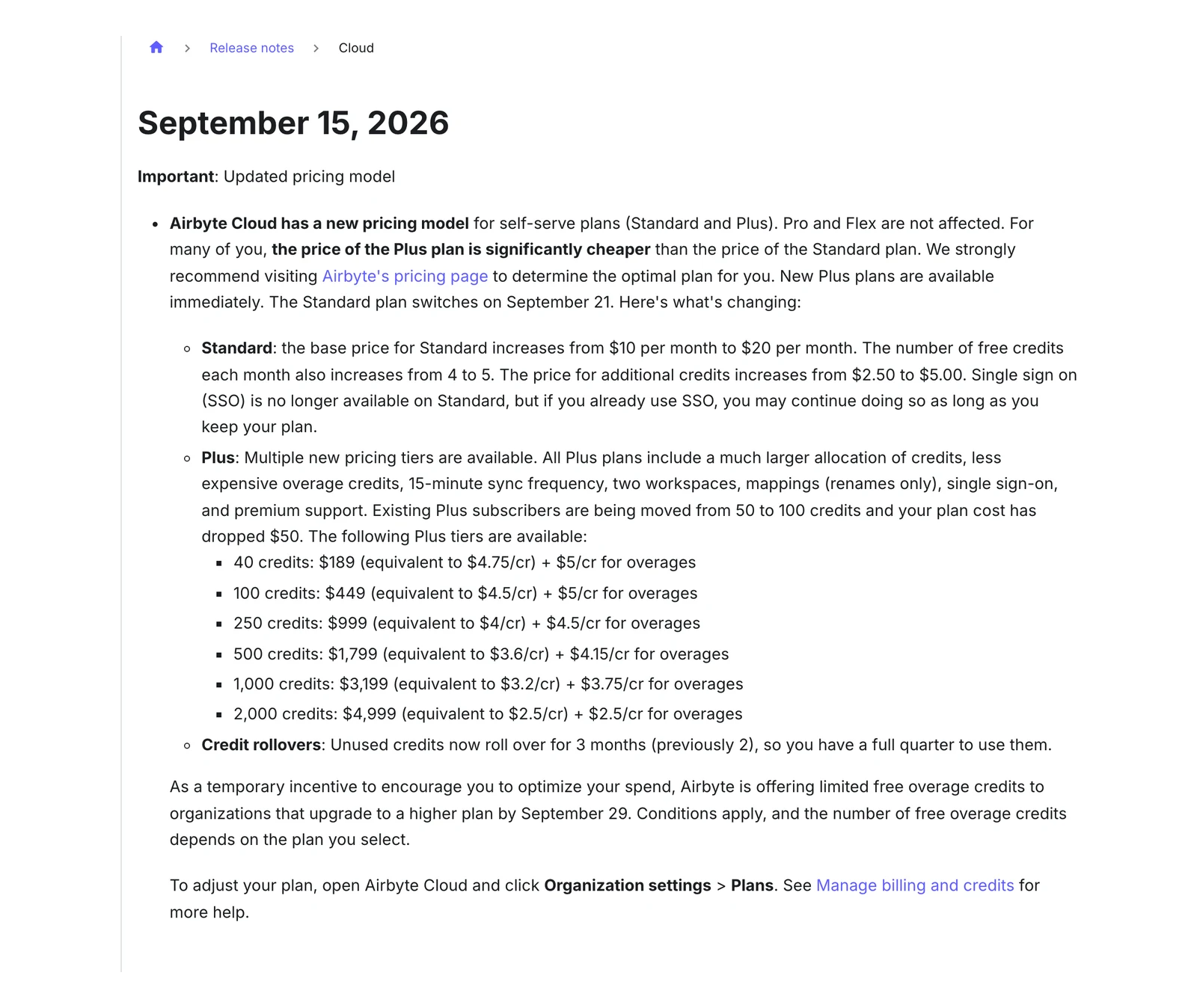
| Item | Before September 21, 2026 | After |
|---|---|---|
| Standard base price | $10 a month | $20 a month |
| Standard included credits | 4 | 5 |
| Standard extra credit | $2.50 | $5.00 |
| SSO on Standard | Included | Removed, existing users may continue |
| Plus tiers | Existing Plus plan had 50 credits | Six tiers, from 40 to 2,000 credits |
| Existing Plus subscribers | 50 credits | Moved to 100 credits, with a $50 cost reduction, per the note |
| Credit rollover | 2 months | 3 months |
A guide, cache or screenshot dated before September 21, 2026 may show the old Standard figures, so check the date before you budget. Airbyte's release note says it "strongly recommend[s]" checking its pricing page to find your best plan.
Worked examples (our arithmetic, not Airbyte's)
These are hypothetical workloads. The credit rates and plan prices come from Airbyte, but the data sizes are made up and assumed to be in Airbyte's serialized format. Prices are the figures above (checked Nov 2026).
- Standard: $20 plus $5 for every credit above 5.
- Plus: the tier price plus the tier's overage price for every credit above the tier.
10 million API rows a month. At 6 credits per million rows, that is 60 credits. Standard comes to $20 plus 55 credits at $5, or $295. The 40-credit Plus tier is $189 plus 20 credits at $5, or $289.
100 GB of database data a month. At 4 credits per GB, that is 400 credits. Standard comes to $20 plus 395 credits at $5, or $1,995. The 250-credit Plus tier is $999 plus 150 credits at $4.50 ($675 of overage), or $1,674 in total.
Two limits apply. These numbers cover credits only, so taxes, your own cloud costs and any custom discount you negotiate are out.
Also out are destination storage, object-store requests, network transfer and table-maintenance compute. Airbyte's credits do not cover those, and we do not price them. The credit count also depends on the serialized size, which we cannot see for your data.
Budget example: first load, monthly changes and a re-sync
An initial load, the monthly changes after it, and a re-sync after a failure are three different bills, so budget them separately. This is a hypothetical database source, and the sizes are made up.
- Initial load: 500 GB in serialized size is 2,000 credits. On Standard that is $20 plus 1,995 credits at $5, or $9,995. The 2,000-credit Plus tier is $4,999, but we have not confirmed that you can change tiers month to month.
- Monthly changes after that: 20 GB a month is 80 credits. On Standard that is $20 plus 75 credits at $5, or $395. The 40-credit Plus tier plus 40 extra credits is $189 plus $200, or $389.
- A full re-sync: the initial load is not always a one-off. Airbyte's MongoDB source docs say that choosing "Re-sync data" after an invalid change-log position (the spot in the database's change log where Airbyte left off) takes a new initial snapshot, which increases cost. Its Postgres source docs say that if Postgres invalidates the replication slot (the marker it keeps so a reader can resume from its change log), the connector fails the sync, and you drop and recreate the slot, then reset the connection for a full re-sync.
Here is a recovery month if the whole 500 GB loads again, by our arithmetic. That is 2,000 credits for the re-sync plus 80 for the normal changes, or 2,080 credits.
On Standard, that is $20 plus 2,075 credits at $5, or $10,395. On the 2,000-credit Plus tier, it is $4,999 plus 80 credits at $2.50, or $5,199.
The Standard total is above $10,000, which is the point where Airbyte's docs say it charges your saved payment method and issues an invoice. Whether a re-sync reloads every table depends on the source and the streams you choose, so treat 500 GB as the worst case.
To replace our made-up sizes with yours, run the 14-day trial on several tables with different row shapes, such as a narrow table, a wide table and a text-heavy one. Write down the rows and GB you loaded next to the credits Airbyte reports for each.
Do not scale one table's ratio up to the others, because the docs say serialized size can differ from your database size. We have not run a trial ourselves, so every example here is hypothetical arithmetic, not an observation.
Billing traps to plan for
- Billing in arrears. If you run out of credits, syncs keep running and Airbyte bills you afterwards. At $10,000 of usage in a billing period, Airbyte charges your saved card and sends an invoice.
- Two meters. API sources count rows and database sources count GB. A pipeline with both is billed on both.
What about self-hosting Airbyte Core?
Airbyte Core is free, self-managed software. Airbyte's deployment docs say you deploy it to Kubernetes with a Helm chart, or try it locally with a quickstart.
Free software is not free to run. You pay for the servers, storage, upgrades, monitoring and the people on call. Airbyte publishes no figure for this, and we will not guess one.
Here is what you take on, straight from Airbyte's own docs:
- Kubernetes for production. The deployment guide says "We highly recommend deploying Airbyte using Helm". The abctl quickstart runs a local Kubernetes cluster inside Docker and cannot install on an existing cluster, so it suits trials more than production.
- A database of your own. For production, Airbyte recommends a dedicated database instance, such as AWS RDS or GCP Cloud SQL, in place of the default internal Postgres, and requires Postgres 13 or later.
- Upgrades. The deployment guide says you will need to do periodic upgrades.
- Network charges. If your cluster sits in a private network on AWS, AWS's VPC pricing page gives a NAT gateway example at $0.045 an hour plus $0.045 per GB processed. Your region and design may differ.
Core's source is public, but the repository licence is the Elastic License 2.0, which bars offering the software to others as a hosted service. That is not an Open Source Initiative (OSI) approved licence, so we say self-hostable and not open source. Airbyte's licence FAQ says its connectors and its connector development kit remain open source.
A quick worksheet helps you compare. Count the hours a month your team would spend on Airbyte, multiply by what those hours cost, and add the cloud bill for the servers.
Add the same unpriced items to both sides (destination storage, requests, network transfer, table maintenance), then compare the total with the Plus tier that fits your credits.
What users say about Airbyte's cost
Price lists do not show how the bill feels in use. This is one person's opinion, with its date and link, not a measurement. It predates the September 21, 2026 price change.
| Source | What a user wrote | Mix |
|---|---|---|
| AWS Marketplace reviews, June 26, 2026 | Airbyte could improve its "subscription rigidity, particularly for small business owners". | Complaint about plan flexibility |
Pro and Enterprise Flex
Pro and Enterprise Flex use capacity pricing. You buy Data Workers, which are units of compute, and each worker runs about three syncs at once, per Airbyte's pricing page. The page says this means no charge by data volume.
Pro lists multiple workspaces, SSO, role-based access control (RBAC), syncs as often as every 5 minutes, custom mappings and premium support. Enterprise Flex lists in-boundary and hybrid deployment, where Airbyte runs the control plane and the data stays in your own boundary, plus all the Pro features.
The price for either one is custom. Airbyte's page says to talk to sales for a tailored quote.
How Airbyte billing compares with Fivetran's
The two tools meter different things, so you cannot compare unit prices on their own. Fivetran bills on Monthly Active Rows (MAR) counted per connection, and its pricing updates page says deletes count as paid MAR from January 1, 2026. We did not verify how it counts repeated changes to one row.
| Question | Airbyte Cloud (checked Nov 2026) | Fivetran (checked Nov 2026) |
|---|---|---|
| What is counted | Credits: API rows and database GB | Monthly Active Rows (MAR) per connection |
| Small-connection charge | None published on the pages we read | $5 per connection using 1 to 1M MAR, per Fivetran's pricing updates page |
| List rates | Standard $20 a month with 5 credits, then $5 per credit | Per connection in its Service Consumption Table, not on the pricing page: Standard from $495 per million MAR plus a $5 base |
| Capacity option | Pro and Flex, by Data Workers | Capacity Purchase Plan, an annual upfront purchase, per the Service Consumption Table |
| Self-hosted option | Core, free software | None (hybrid deployment on Enterprise or Business Critical plans) |
How to lower your Airbyte bill
- Use incremental syncs and pick streams. Sync only the tables and endpoints your reports need, and let API sources send only changed rows.
- Use the rollover. Airbyte's release note says unused credits roll over for three months.
- Set billing alerts. The billing docs say alerts email you when your usage or upcoming invoice crosses a limit you set, and they are available on Standard and Plus.
What Airbyte does not publish
These items are not published on the pricing page.
- Pro and Enterprise Flex prices. The pricing page describes the features and says to talk to sales.
- The price of a Data Worker, and how many workers a given workload needs.
- The price of enterprise connectors. Airbyte's support-levels page says they are available exclusively to Enterprise and Pro customers at extra cost, and no price is published.
- Discounts. We found no published discount rates.
- Real cost for your data. A credit count turns into a plan price, but nothing on the pricing page can see your serialized size, so use the trial credits to measure.
If a number matters to your decision, put the question in writing and ask for the answer in your quote.
Before you ask for a quote
Answer these yourself first, and your sales call will be shorter:
- How many GB does each database source send in a month, and how many rows does each API source send?
- Do you need syncs more often than hourly?
- Do you need SSO or more than one workspace?
- Does your security team need the data to stay in your own network?
- Can your team run Kubernetes, or do you need a hosted service?
Then ask Airbyte what a Data Worker costs, how many workers your syncs need, and what your contract says about renewal price changes.
Q1. How much does Airbyte cost?
Q2. Is Airbyte free?
Q3. What is an Airbyte credit?
Q4. What changed in Airbyte pricing in September 2026?
Q5. Should I choose Standard or Plus?
Q6. What happens if I use more credits than my plan includes?
Q7. Is Airbyte open source?
Q8. Does Airbyte Cloud have a free trial?
Q9. Why is my Airbyte bill bigger than my database?
Q10. What happened to existing Plus subscribers in September 2026?
What to do before you commit
Airbyte's price is easy to start and hard to forecast, because the bill depends on serialized data you cannot see until you run a sync. Measure credits on several tables in the trial, add a re-sync allowance, and compare Standard, the Plus tier that fits, the cost of running Core yourself and, for database-to-Iceberg jobs, OLake Go, which has no credit meter. For related reading, see Fivetran pricing explained and What is Airbyte.