AWS Glue Pricing Explained: What You Will Pay (2026)
21 min read
Key takeaways
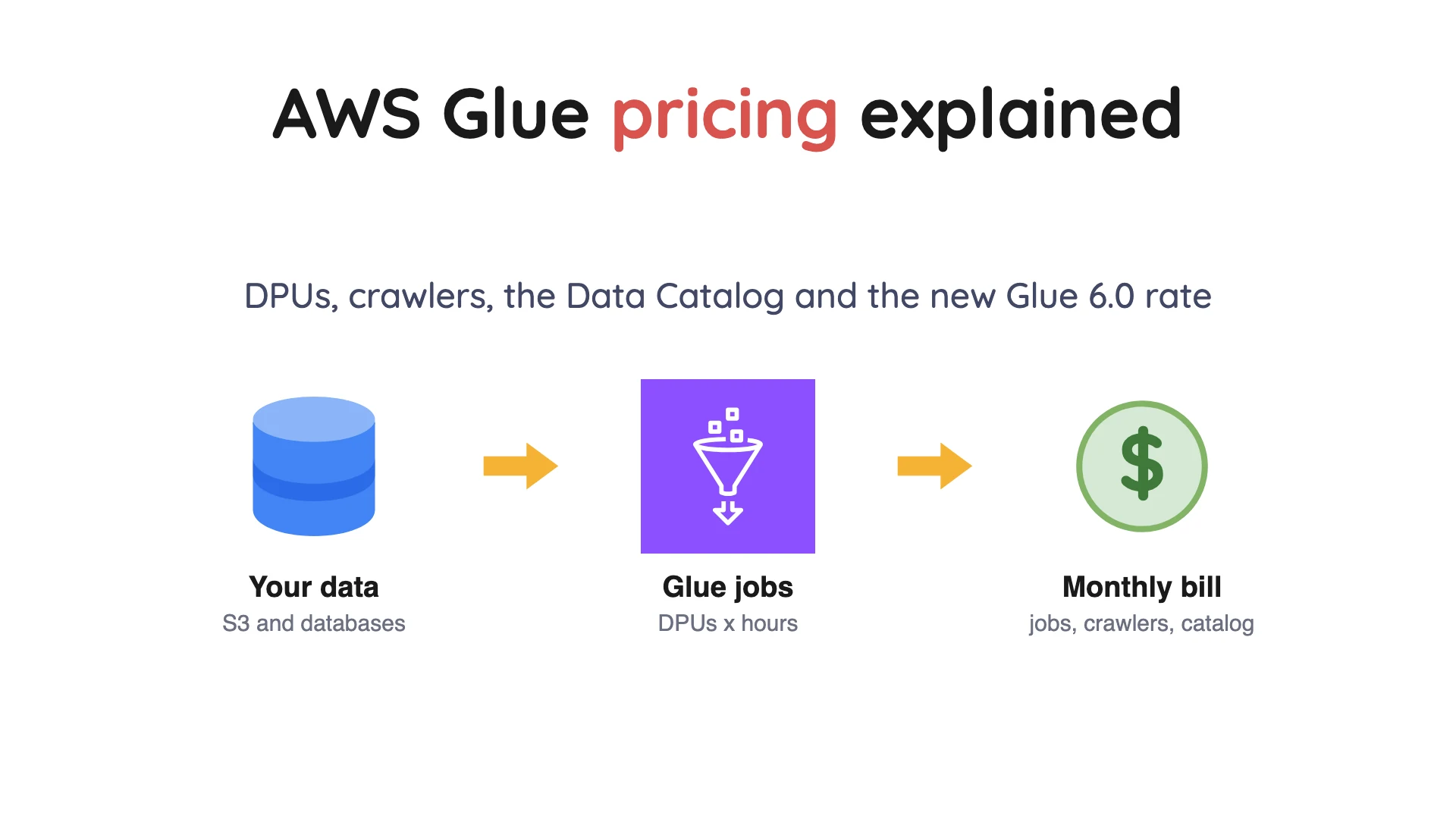
The short version: AWS Glue bills by the second for the computing power your job uses, counted in DPUs (data processing units). One DPU is 4 virtual CPUs and 16 GB of memory. For ETL (extract, transform, load) jobs in US East (Ohio), AWS's price list shows $0.44 per DPU-hour, and $0.308 on Glue 6.0 and above, which AWS says is 30% lower (checked Oct 2026).
Flex runs and memory-optimized workers have their own rates, listed below. Say you run a 10-DPU job for 30 minutes a day: that's about $66 a month on Glue 5.1 and $46.20 on 6.0 (our arithmetic).
Crawlers cost $0.44 per DPU-hour with a 10-minute minimum per run. The Data Catalog is free up to 1 million objects and 1 million requests a month (checked Oct 2026).
The usual surprises are the default of 10 DPUs per batch Spark job, short crawler runs billed for 10 minutes, and jobs left on an older Glue version.
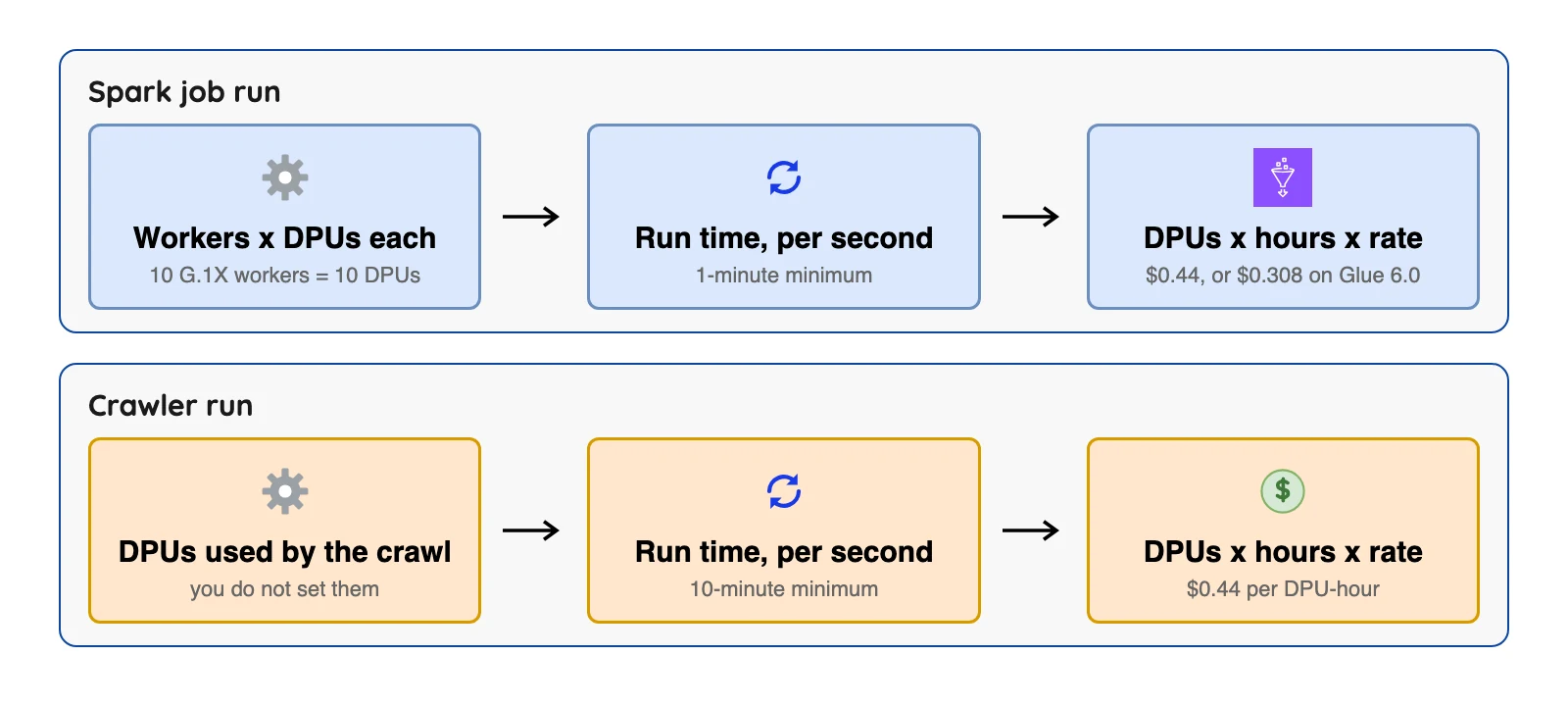
- Glue jobs for extract, transform, load (ETL), which copy and reshape data, are billed as DPUs times hours times a rate. A batch Spark job needs at least 2 DPUs, defaults to 10, and has a 1-minute minimum.
- On August 21, 2026, AWS announced Glue 6.0 with 30% lower pricing. The three independent guides we read came out before that date, so they quote only the older $0.44 rate.
- The Glue Data Catalog stores metadata about your tables. The first 1 million objects and 1 million requests a month are free, then $1 per 100,000 objects and $1 per million requests (checked Oct 2026).
- Crawlers (jobs that scan data to find tables) bill a 10-minute minimum per run. A crawl that takes seconds still costs you 10 minutes.
- There's no free tier for Glue ETL jobs in AWS's pricing text. Your S3 storage, shuffle files and other AWS services get billed on top.
- Python Shell jobs, Flex runs and auto scaling are the main levers AWS documents for bringing the bill down.
- If a Glue job only copies Postgres, MySQL, MongoDB or SQL Server tables into Iceberg, OLake Go is Apache 2.0 open source and free to run; you pay for your own infrastructure.
Every rate below comes straight from AWS's own Glue pricing page and AWS's published price file (dated September 11, 2026) (checked Oct 2026). Unless we say otherwise, rates are for US East (Ohio), and other Regions can differ.
The worked examples are our own arithmetic on AWS's published rates, with made-up job sizes. We didn't run any Glue jobs for this page, so treat the numbers as math, not a test.
AWS Glue pricing: what Glue charges for
Glue is a serverless data integration service, which here means AWS runs the servers and you pay only while your work runs. Each part of Glue has its own meter.
| Part | What it does | How it is billed |
|---|---|---|
| ETL jobs | Extract, transform and load data with Apache Spark or Python | DPU-hours, per second |
| Crawlers | Scan data to find tables and fill the catalog | DPU-hours, 10-minute minimum per run |
| Data Catalog | Stores table definitions (metadata) | Per object stored and per request, after a free amount |
| Interactive sessions | Notebooks for building jobs | DPU-hours, per second |
| DataBrew | Point-and-click data cleaning | Per session and per node-hour |
| Data Quality | Rules that check your data | DPU-hours |
| Zero-ETL | Managed copy from some sources | Per GB ingested, plus target compute |
Two small items carry no charge. Per the same page, Glue's Schema Registry and Lake Formation permissions carry no extra charge. AWS also says you aren't charged for job startup or shutdown time.
What a DPU is, in plain words
Every Glue price is quoted in DPUs. A DPU, or data processing unit, is a bundle of computing power. AWS defines one DPU as 4 vCPUs (virtual processor cores) and 16 GB of memory.
You don't buy DPUs directly. You pick a worker type and a number of workers, and the DPUs follow.
AWS's job properties documentation lists the worker types:
| Worker type | DPUs per worker | vCPU | Memory (GB) |
|---|---|---|---|
| G.025X (streaming only) | 0.25 | 2 | 4 |
| G.1X | 1 | 4 | 16 |
| G.2X | 2 | 8 | 32 |
| G.4X | 4 | 16 | 64 |
| G.8X | 8 | 32 | 128 |
Larger G types (G.12X and G.16X) and memory-optimized R types also exist. AWS says R workers suit jobs that often run out of memory.
The bill for one run is DPUs, times hours the job ran, times the rate. Ten G.1X workers are 10 DPUs. Let them run for 30 minutes at $0.44 and you get 10 x 0.5 x $0.44, or $2.20.
The rate card (US East (Ohio), October 2026)
AWS's pricing page loads rates by Region. The numbers below match what the page showed for US East (Ohio), and AWS's price list for that Region (checked Oct 2026).
| Item | Rate per DPU-hour | Minimum | Applies to |
|---|---|---|---|
| Spark or Spark Streaming job | $0.44 | 1 minute | Standard rate |
| Spark or Spark Streaming job | $0.308 | 1 minute | Glue 6.0 and above |
| Spark job, memory-optimized R workers | $0.52 | 1 minute | Standard rate |
| Spark job, memory-optimized R workers | $0.364 | 1 minute | Glue 6.0 and above |
| Spark job, Flex execution | $0.29 | 1 minute | Standard rate |
| Spark job, Flex execution | $0.203 | 1 minute | Glue 6.0 and above |
| Interactive session | $0.44 | 1 minute | Standard rate |
| Interactive session | $0.308 | 1 minute | Glue 6.0 and above |
| Development endpoint | $0.44 | 10 minutes | All versions |
| Crawler | $0.44 | 10 minutes | Per crawler run |
| Iceberg table compaction, catalog statistics | $0.44 | 1 minute | Data Catalog |
What changed in 2026: the Glue 6.0 price cut
On August 21, 2026, AWS announced Glue 6.0 and said it delivers 30% lower pricing than previous Glue versions. AWS's launch post says Glue 6.0 is "delivering 30% lower pricing than previous AWS Glue versions".
The rate card matches: $0.308 is 70% of $0.44, and $0.203 is 70% of $0.29. The same post also says 6.0 delivers faster performance, which is AWS's claim; we ran no job, so we cannot confirm it.
AWS's job properties documentation now says a job created without a Glue version defaults to Glue 6.0 (checked Nov 2026). The lower rate applies only when a job runs on 6.0 or later, so jobs you pinned to 5.1 or older keep paying $0.44.
Glue 6.0 uses Apache Spark 4.1.1 and Python 3.13. So test a 5.1 job before you move it.
Three independent Glue pricing guides we read, dated March to August 2026 (from Integrate.io, wring.co and Hevo), all predate the 6.0 announcement. They quote only the $0.44 rate. Check the date on any Glue price you find.
A cheaper rate isn't the whole story, because your bill is DPU-hours times the rate. If Glue 6.0 ran the same job with the same DPUs but its run time grew by more than about 43%, the lower rate would be used up (1 / 0.7 is about 1.43). So compare measured DPU-hours for the same job on both versions, not just the rate card.
The Data Catalog: free first, then small fees
The Data Catalog is Glue's store of table definitions. Amazon Athena (a SQL query service), Amazon Redshift (a data warehouse) and Amazon EMR (a service that runs Spark and other big data tools on clusters) can read it, according to AWS's pricing page.
AWS lists these Data Catalog charges (checked Oct 2026):
- Storage: the first 1 million metadata objects are free. After that it is $1.00 per 100,000 objects a month.
- Requests: the first 1 million requests a month are free. AWS's example shows $1 for each extra million.
- What counts as an object: a table, table version, partition, partition index, statistics, database or catalog.
- Iceberg compaction and statistics: $0.44 per DPU-hour, billed per second with a 1-minute minimum. Compaction joins many small files into fewer large ones for faster reads.
Table versions and partitions count toward the 1 million. So a table split into thousands of partitions can eat the free amount faster than you'd expect.
Worked examples (our arithmetic, not AWS's)
We use three made-up jobs. The rates come from the rate card above, and the job sizes are our own assumptions, so swap in yours.
Assumptions: US East (Ohio) rates, one run a day, 30 days a month, and run time unchanged on Glue 6.0. Real run times shift when the version or worker count changes, so treat these as rough estimates.
| Job | DPUs | Run time | Cost per run (Glue 5.1, $0.44) | Monthly (5.1) | Monthly (6.0, $0.308) | Monthly, Flex on 5.1 ($0.29) |
|---|---|---|---|---|---|---|
| Small nightly load | 2 | 10 minutes | $0.15 | $4.40 | $3.08 | $2.90 |
| Medium daily job | 10 (the Spark default) | 30 minutes | $2.20 | $66.00 | $46.20 | $43.50 |
| Large daily job | 50 | 2 hours | $44.00 | $1,320.00 | $924.00 | $870.00 |
Here's the middle row in full. 10 DPUs x 0.5 hours x $0.44 = $2.20 a run, and $2.20 x 30 runs = $66.00.
On 6.0 it is 10 x 0.5 x $0.308 = $1.54 a run, or $46.20 a month. Flex on 6.0 would be $0.203, which gives $30.45 a month, but Flex suits only jobs that can wait, as covered below.
The other meters add up too.
- A daily crawler: AWS's own example uses 2 DPUs. At the 10-minute minimum, that is 2 x (10/60) x $0.44, or about $0.15 a run, and $4.40 over 30 daily runs. Run the same crawler every hour and it is 720 runs, or $105.60 a month, even if each crawl finishes in seconds.
- Catalog overage: say you store 3 million objects and make 5 million requests in a month. Storage is 2 million objects over the free amount, which is 20 x $1.00 = $20. Requests are 4 million over, which is $4. The catalog adds $24.
- Iceberg compaction: AWS's example is 2 DPUs for 30 minutes, which costs $0.44. If compaction ran for an hour a day at those 2 DPUs, it would be 2 x 1 x $0.44 x 30 = $26.40 a month.
Putting a small team's month together, the medium job ($66.00) plus a daily crawler ($4.40) costs $70.40 on Glue 5.1. The same two on Glue 6.0 (job only, because the crawler rate has no 6.0 line on the page) cost $46.20 + $4.40 = $50.60.
Costs outside Glue aren't in these numbers. AWS says temporary files, shuffle files and data quality results are stored in S3 and billed at standard S3 rates.
Notebook, Data Quality and DataBrew examples
AWS's pricing page gives its own examples for the other meters. They use the older $0.44 rate, so where it applies we show the 6.0 figure as our own arithmetic.
| Meter | AWS's example | AWS's answer | Same on Glue 6.0 (our arithmetic) |
|---|---|---|---|
| Spark job | 6 DPUs, 15 minutes | 6 x 0.25 x $0.44 = $0.66 | 6 x 0.25 x $0.308 = $0.46 |
| Interactive session (notebook) | 5 DPUs, 24 minutes | 5 x 0.4 x $0.44 = $0.88 | 5 x 0.4 x $0.308 = $0.62 |
| Data Quality task (catalog) | 5 DPUs, 10 minutes | 5 x 1/6 x $0.44 = $0.37 | Not shown; the example is billed at $0.44 |
| DataBrew job | 5 nodes, 10 minutes | $0.40 | Not changed, DataBrew has its own rate |
| DataBrew interactive session | One 30-minute session | $1.00 | Not changed |
A notebook session starts at 5 DPUs, so a quick test costs more than the 2-DPU minimum suggests.
Costs that surprise people
This is the section to skim before your next invoice. Each item below is tied to an AWS page. We didn't find an independent survey of how often these happen, so we don't rank them.
- The 10-DPU default. AWS's Glue FAQ says an ETL job needs at least 2 DPUs and gets 10 by default. If a job needs 3 DPUs and runs on 10, you pay for 10.
- Old Glue versions. AWS's docs now default new jobs to Glue 6.0 (checked Nov 2026), so the higher $0.44 rate stays on jobs pinned to 5.1 or older, often with nobody having decided that.
- Crawler minimums. AWS bills at least 10 minutes per crawler run. AWS also says crawlers are optional and you can fill the catalog through the API.
- Long timeouts. AWS's jobs API reference says a blank timeout is 480 minutes on Glue 5.0 and later and 2,880 minutes on Glue 4.0 and earlier. A stuck 10-DPU job on 5.1 could run 8 hours, which is 10 x 8 x $0.44 (the Ohio rate on AWS's price list) = $35.20. On Glue 4.0 it could run 48 hours, or $211.20.
- Development endpoints. They do not time out, and have a 10-minute minimum. Forget one over a 48-hour weekend and a 5-DPU endpoint costs 5 x 48 x $0.44 = $105.60 by our arithmetic.
- Idle notebooks. AWS's interactive session page says a session defaults to 5 DPUs, and its magics reference gives the default idle timeout for Spark ETL sessions as 2880 minutes (48 hours). A forgotten session can stay open that long. By our arithmetic that is 5 x 48 x $0.44 = $105.60 on Glue 5.1. Setting a shorter idle timeout, for example 10 minutes, is the fix AWS shows.
- Zero-ETL ingestion. For application sources, AWS charges $1.50 per GB ingested, plus the target's compute (checked Oct 2026). Pulling 100 GB would be $150 before target costs.
- Data Quality inside jobs. AWS says rules placed inside an ETL job increase its runtime or DPU use, so quality checks raise the job cost.
- Memory-optimized workers. R workers cost $0.52 per DPU-hour before Glue 6.0's lower rate, against $0.44 for standard ones.
How to lower an AWS Glue bill
AWS documents several levers. They come from AWS's own pages, and savings depend on your jobs, so we give no percentage except where AWS does, and we tested none of them.
- Move to Glue 6.0 where it works. AWS says 30% less per DPU-hour. Test first, since the Spark and Python versions change.
- Use Flex for jobs that can wait. Flex runs on spare capacity at $0.29 (or $0.203 on 6.0), per AWS's published price file linked at the top (checked Oct 2026). AWS's Flex post says start and run times vary, capacity can be reclaimed, and Flex is not supported for Python Shell, streaming or ML jobs. AWS's cost monitoring post says Flex can cut costs "by up to 34%", which is AWS's figure and not one we tested.
- Turn on auto scaling. AWS's auto scaling documentation says Glue 3.0 and later can add and remove workers as the job needs, up to a maximum you set.
- Right-size workers. AWS's cost monitoring post says people tend to over-provision workers, so some DPUs go unused. Watch the DPU-hours that Cost Explorer reports.
- Set a timeout. The same post recommends a timeout based on your job's average run time, to stop surprise charges.
- Crawl less. Run crawlers when schemas change, not every hour, or skip them and write table definitions through the API.
Where Glue fits, and what to compare it to
On AWS's description, it fits scheduled extract, transform, load (ETL) jobs without running servers, for teams already on AWS storage and analytics. It also supplies the catalog that Athena, Redshift and EMR can read, according to AWS. Billing is per second with no upfront cost, so small and irregular jobs can cost little, as long as you set the DPUs and timeouts yourself, because the defaults above are not small.
We found no sourced job-for-job price comparison between Glue and its neighbours. So we compare how each one bills, not which is cheaper.
| Service | What it is for | How AWS bills it |
|---|---|---|
| AWS Glue | Scheduled ETL jobs, crawlers, the Data Catalog | DPU-hours, per second |
| Amazon Athena | SQL queries on data in S3 | Data scanned (AWS's example uses $5 per TB, checked Oct 2026) or compute used |
| Amazon EMR | Big data clusters you configure, or EMR Serverless | Per second with a 1-minute minimum, plus servers (EMR on EC2) |
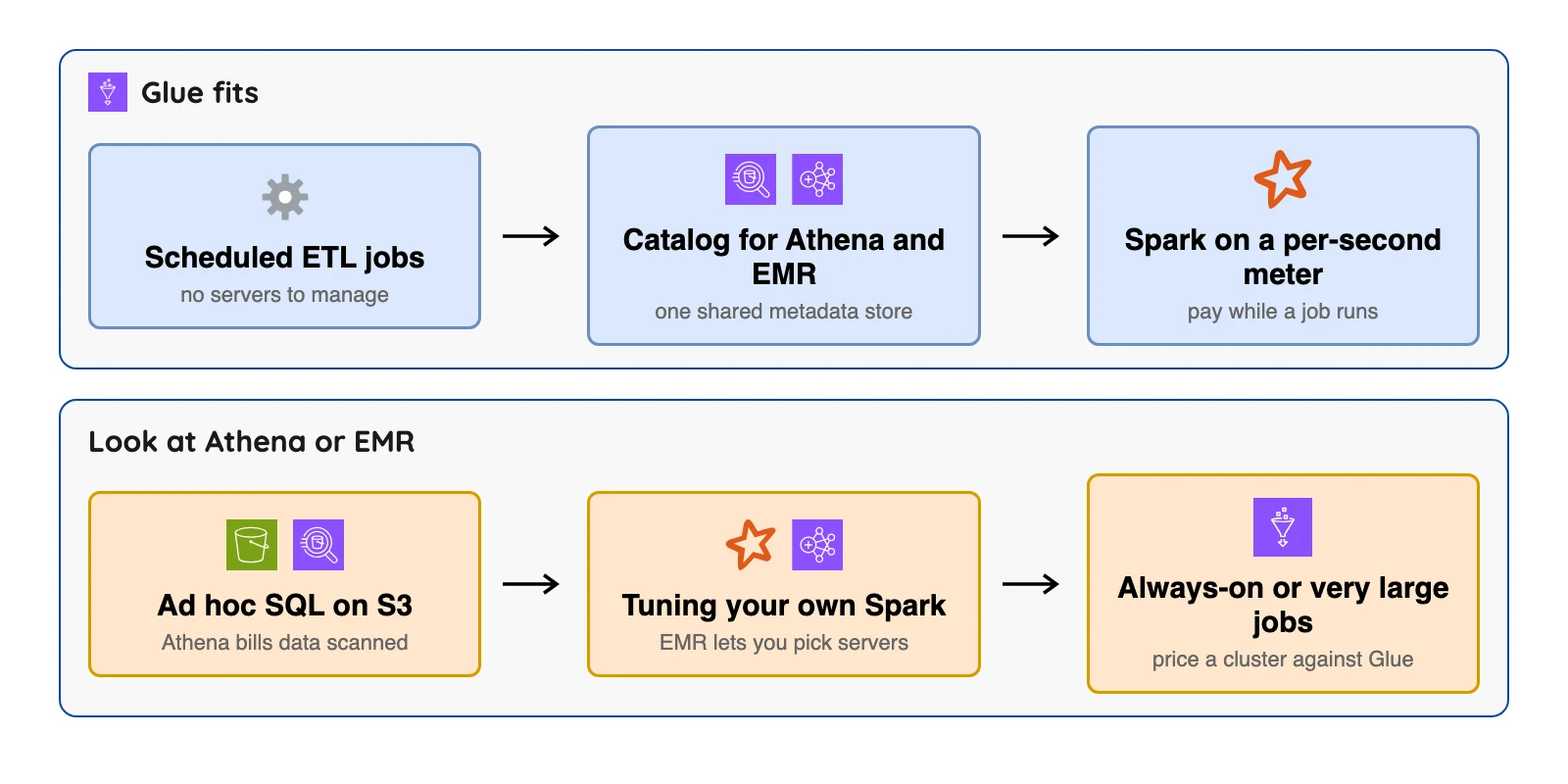
Athena may be the better pick when your job is really a SQL question on files already in S3. AWS's own example shows how much data layout matters. A 3 TB text file scan costs $15, while the same column read from compressed Parquet (a columnar file format) costs $1.25 (checked Oct 2026).
EMR may fit better when you want to pick the servers and tune Spark yourself. AWS says EMR on EC2 can use Spot Instances at up to a 90% discount against On-Demand prices. With Glue you choose worker types and counts, not the servers underneath.
Glue's zero-ETL page says self-managed database sources can replicate only to Amazon Redshift. So that feature won't land database changes in Iceberg tables. Our AWS tools list covers the options.
We found no Glue page that documents log-based change data capture (reading a database's change log) for self-managed databases. Glue jobs can still read databases over JDBC (Java Database Connectivity, a standard connection method) and track progress with job bookmarks.
What AWS's pricing page leaves open
- A flat monthly price. Glue has none, so you'll have to estimate from DPUs and run time.
- A free tier for ETL jobs. The pricing text lists none. The free items are the first 1 million catalog objects and requests.
- A runtime for your job. Nobody can guess that for you, so run a sample and read the DPU-hours.
AWS Cost Explorer has usage types such as ETL-DPU-Hour, ETL-Flex-DPU-Hour and GlueInteractiveSession-DPU-Hour, per AWS's cost post. For auto scaling and Flex runs, the job run API returns DPUSeconds, which you divide by 3,600 to get DPU-hours.
To compare versions or settings fairly, write down the Glue version, execution class, worker type and count, run time (or DPUSeconds), your Region rate and runs a month. For standard jobs, DPU-hours are seconds times DPUs, divided by 3,600.
What practitioners say about Athena pricing
Price is only part of the picture. These are individual opinions; one person's view, with its date and link.
A reviewer on PeerSpot (2025 to 2026, month not shown) writes: "Amazon Athena can become costly if analysts lack knowledge of partition keys and querying tables efficiently."
A commenter on Hacker News (thread "Apache iceberg the Hadoop of the modern-data-stack?", March 2025) wrote, "I never found Athena expensive."
So, which should you pick?
| If you are... | Start with | Why, per AWS's pages (checked Oct 2026) |
|---|---|---|
| Running scheduled ETL on AWS and want no servers | Glue on 6.0 | Per-second billing, no upfront cost, $0.308 per DPU-hour |
| Running jobs that can wait hours | Glue Flex | $0.29 ($0.203 on 6.0), but start times vary and capacity can be reclaimed |
| Asking SQL questions of files in S3 | Athena | Billed by data scanned, so Parquet cuts the cost |
| Wanting to pick servers and tune Spark yourself | EMR | You choose the cluster, and EMR on EC2 can use Spot Instances |
| Needing Glue to land database changes in Iceberg | OLake Go (our docs) or another tool | AWS documents zero-ETL for self-managed databases only into Redshift |
Which AWS option fits you?
Question 1 of 5
What is the main job?
Q1. How much does AWS Glue cost?
Q2. What is a DPU in AWS Glue?
Q3. Does AWS Glue have a free tier?
Q4. Did AWS Glue get cheaper in 2026?
Q5. Why are AWS Glue crawlers billed for 10 minutes?
Q6. What is the minimum cost of an AWS Glue job?
Q7. How do I reduce my AWS Glue bill?
Conclusion
Glue pricing is simple at the core and busy at the edges. The core is DPUs times hours times a rate. The edges are crawlers, the Data Catalog, interactive sessions, Data Quality and the AWS services around Glue.
The biggest recent change is the Glue 6.0 rate, and the three independent guides we read predate it. Jobs pinned to an older version keep paying the higher rate, so check which version each of yours runs on.
Before you budget, check your Region and your job's Glue version, then run one sample job and read its DPU-hours. Multiply by how often it runs, and you've got your number. If the job is database changes into Iceberg, OLake Go is a free open-source option to price beside it.