Azure Data Lake: Storage, Synapse, Fabric and Options
17 min read
Key takeaways
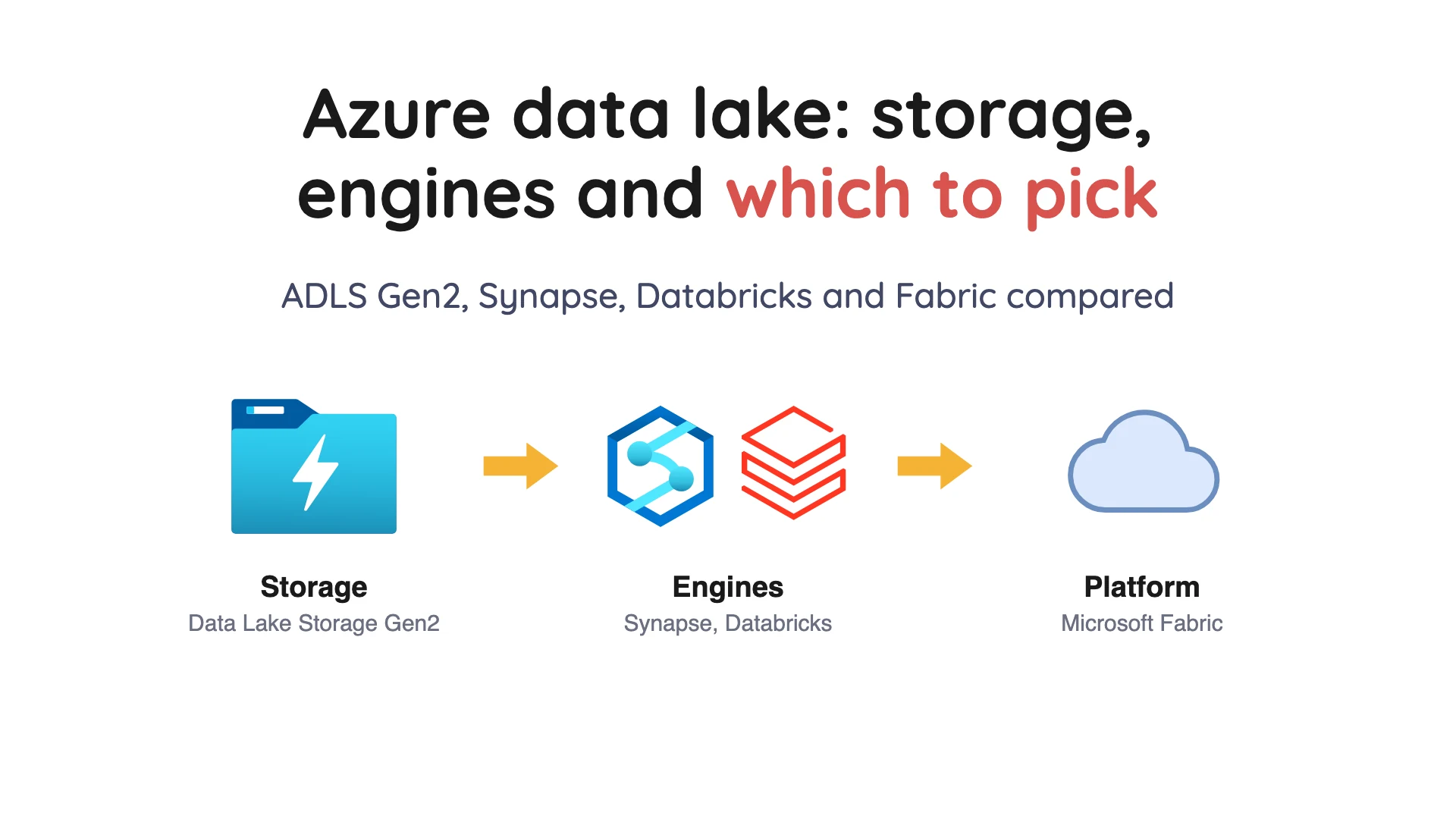
"Azure Data Lake" isn't one product you can buy. Today it means Azure Data Lake Storage Gen2 (ADLS Gen2), where the files live, plus an engine that reads them. That engine is usually Azure Synapse Analytics, Azure Databricks or Microsoft Fabric.
So is Azure a data warehouse or a data lake? Both. Azure is a cloud that sells lake and warehouse services side by side.
Our read: Fabric fits if you want less setup (Microsoft's pitch, untested by us) and your analysts use Microsoft's business intelligence (BI) tool, Power BI. Databricks fits if Spark and machine learning lead your work. For storage alone, use plain ADLS Gen2 with your own engine.
To load database data into the lake as Apache Iceberg or Parquet, OLake Go (ours) is open source and fits beside any of them.
- Azure Data Lake Storage is not a separate service. Microsoft says it is a set of capabilities on Blob Storage that you switch on with the hierarchical namespace setting.
- A lake is storage plus processing. Microsoft's architecture guide lists Data Lake Storage, Azure Databricks, Azure Data Factory and Fabric as the Azure technologies to consider.
- Azure has both lake and warehouse services. ADLS Gen2 and OneLake are lakes, while Synapse dedicated SQL pools and Fabric Data Warehouse are warehouses.
- Old advice is a trap, so watch the date. Data Lake Storage Gen1 and Azure Data Lake Analytics (the U-SQL service) are retired, and many guides still describe them.
- ADLS Gen2 hot storage lists at $0.021 per GB a month in East US with the folder setting on, per Microsoft's pricing page (checked Oct 2026). Operations and extras are billed on top.
- Fabric bills compute as capacity: $262.80 a month for the smallest size (F2) on Microsoft's Fabric pricing page (checked Oct 2026), with OneLake storage billed per GB on top.
Every fact below comes from Microsoft's own documentation or pricing pages, or from a vendor we name, read in October 2026. We didn't build or run any of the Azure setups (last reviewed October 2026).
What is an Azure data lake?
The name "Azure data lake" has meant different things over the years.
By Microsoft's definition, a data lake is a storage repository that holds large volumes of data in its native, raw format. Tables, JSON files, logs, images and video can all sit side by side.
On Azure, the storage part is Azure Data Lake Storage. Microsoft calls it "a cloud-based, enterprise data lake solution" built for big data analytics. The current version is called Gen2.
Microsoft's own page says Data Lake Storage "isn't a dedicated service or account type." It's a set of features on your normal Azure Storage account, unlocked by one setting.
That setting is the hierarchical namespace. In plain words, you get real folders and sub-folders, like on your laptop, instead of file names that only pretend to be paths.
Is Azure a data warehouse or a data lake?
Both. Azure has a service for each job.
Lakes keep raw data and decide the structure later (Microsoft calls this schema-on-read). Warehouses clean and shape data first, then store it in tables for fast reports (schema-on-write). Microsoft's comparison table says lakes cost less to store but add compute cost when you query, while warehouses cost more because of dedicated compute.
The main Azure services map like this.
| Azure service | What it is | Lake, warehouse or both |
|---|---|---|
| Azure Data Lake Storage Gen2 | File storage with folders, built on Blob Storage | Lake |
| OneLake (in Fabric) | One built-in lake per organisation, built on ADLS | Lake |
| Azure Synapse Analytics | Analytics service with SQL (serverless and dedicated) and Spark | Both: dedicated SQL pools act as a warehouse, serverless and Spark read the lake |
| Azure Databricks | Open analytics platform built around a data lakehouse | Both, as a lakehouse |
| Fabric Data Warehouse | SQL warehouse inside Fabric, stores data in Delta Lake format | Warehouse on top of the lake |
| Azure Data Factory | Moves and transforms data between systems | Neither: it's the plumbing |
A lakehouse is a lake with warehouse-style tables and queries on top.
What Azure Data Lake Storage Gen2 gives you
Five capabilities are listed by Microsoft: Hadoop-compatible access, a hierarchical directory structure, optimized cost and performance, a finer-grained security model, and massive scalability. Three matter most.
Folders that behave like folders. Renaming or deleting a directory becomes a single atomic metadata operation. Atomic just means it either fully happens or doesn't happen at all. Without folders, a rename would have to touch every file one by one.
Permissions down to a folder or file. Access control supports Azure role-based access control (RBAC) and Portable Operating System Interface (POSIX) style access control lists (ACLs, which are lists of who may read or write). You can set them at directory or file level. All data is encrypted at rest too, per the same page.
Spark and friends can read it directly. The Azure Blob File System (ABFS) driver lets Hadoop-style tools such as Apache Spark and Presto read the data directly. Microsoft's supported services list shows Data Factory, Databricks, Event Hubs, HDInsight, Power BI and Synapse as generally available.
Microsoft says most Blob Storage features are fully supported, but some are preview only and a handful aren't supported.
It also says some workloads, such as backups and image storage, might gain no benefit from the hierarchical namespace. Once you enable it, you can't switch it back to a flat namespace.
How an Azure data lake fits together
The easiest way to picture a lake is as two jobs. One layer stores the files. Another layer reads, shapes and serves them.
Microsoft's architecture guide says a modern lake has two core components, storage and processing. It adds that mature lakes need metadata management, security and governance too. Skip the cataloging and, it warns, you can end up with a "data swamp," where useful data exists but nobody can find or trust it.
The same page suggests organising the lake in three layers, called the medallion pattern. Raw (bronze) holds data as it arrived, cleansed (silver) holds checked and tidied data, and curated (gold) holds business-ready sets for reports.
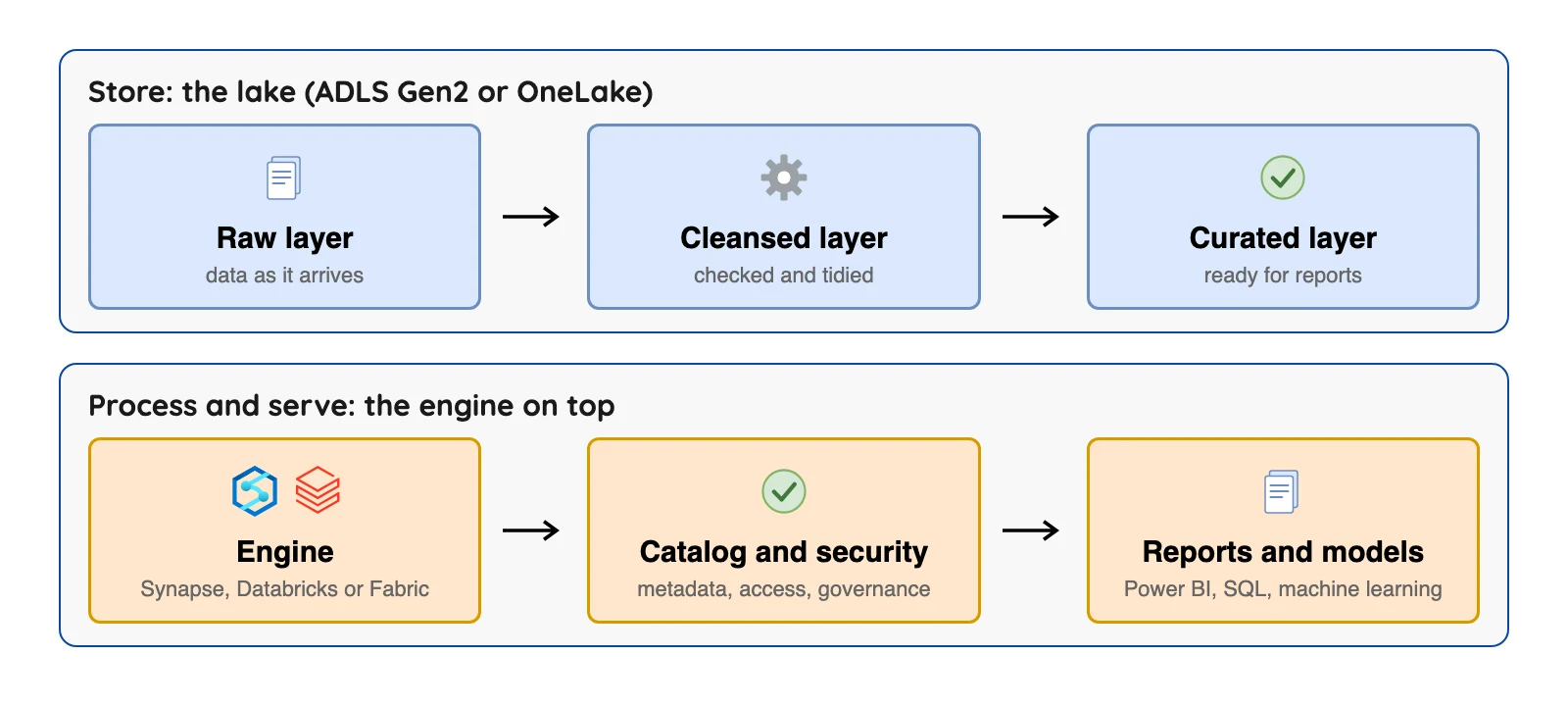
Everything in the next section is a choice about the bottom row of that picture: which engine, and who runs it.
Four ways to build an Azure data lake
You've got four common paths. All of them can sit on ADLS Gen2, and one of them (Fabric) brings its own lake built on the same technology.
| Option | Who runs it | Cost covered on this page | Fits if |
|---|---|---|---|
| ADLS Gen2 plus your own open engines | You | Storage and operations only; engines are on you | You want storage and nothing more |
| Azure Synapse Analytics | You, on Azure | Not quoted here | You already run it, or need Spark features Microsoft says Fabric lacks |
| Azure Databricks | Databricks, on Azure | Not quoted here | Spark, Delta Lake and machine learning lead your work |
| Microsoft Fabric with OneLake | Microsoft, as a service | Capacity per month plus OneLake storage per GB | You want least setup and live in Power BI |
1. ADLS Gen2 plus open engines
This is the bare-bones route. You create a storage account, switch on the hierarchical namespace, and point Spark, Presto or another Hadoop-style engine at it.
It's the most flexible option, and also the most work. You pick the engine, the catalog and the security setup yourself.
- Fits if: you already have engines or a platform team, and need only storage.
- Limit: nothing here queries, catalogs or governs the data for you. Storage is only one of the four items on Microsoft's own list of lake technologies.
2. Azure Synapse Analytics
Synapse is "an enterprise analytics service" that brings SQL, Spark, Data Explorer and pipelines under one roof. Its SQL comes in two flavours. Dedicated SQL pools reserve power for predictable performance, while the serverless endpoint suits unplanned or bursty work.
It reads files straight from the lake. Tables defined on files there can be used by either Spark or SQL, per the same page.
- Fits if: you already run it, or you need things Microsoft says Fabric Spark lacks. Its comparison page says to use Synapse Spark for GPU-accelerated pools, an external Hive Metastore or JDBC connections.
- Limit: its future is open. We found no retirement notice on Microsoft's overview page (last updated July 2024), so we won't call it retired. Still, Microsoft publishes a guide for migrating from Synapse to Fabric, so check the roadmap before you start something new.
3. Azure Databricks
Azure Databricks is "a unified, open analytics platform" for data, analytics and AI. Its use cases include building a data lakehouse, ETL (extract, transform, load, the shaping of data), machine learning, SQL warehouses and governance through Unity Catalog.
It's listed as generally available with Data Lake Storage. Databricks itself, on its Azure data lake page, argues that storage alone is incomplete without its Delta Lake layer. That's a vendor's sales pitch, so weigh it as one.
- Fits if: Spark, Delta Lake and machine learning are the centre of your work.
- Limit: it's a separate vendor's platform running on Azure, so you get a second set of concepts, tools and a bill to learn. We did not read its Azure rates for this page.
4. Microsoft Fabric with OneLake
Fabric is delivered as software as a service (SaaS) and uses OneLake as its central lake. Microsoft says you don't need an Azure account to use it. Every tenant (your organisation) gets exactly one OneLake, and you can't delete it or create more.
Microsoft says OneLake is built on Azure Data Lake Storage and stores tables in Delta Parquet or Iceberg format. A shortcut can point at data in ADLS, Amazon S3 or other places without copying it. It also speaks the ADLS Gen2 APIs, so existing ADLS apps can connect.
- Fits if: you want less setup (Microsoft's description, untested by us), your analysts use Power BI, and you prefer one capacity bill.
- Limit: Delta is the standard format, and Iceberg is only bridged, by metadata virtualization. That conversion makes Iceberg V2 metadata, handles Parquet files only, needs fewer than 5,000 commits and doesn't support private links. Fabric Spark also has no external Hive Metastore, no GPU pools and no .NET for Spark, per Microsoft's comparison page.
- What users say: an independent consultant, Brent Ozar, wrote in May 2025 that the status page "almost always shows all green checkmarks" during outages. His July 2025 update says Microsoft "fixed the reliability" and added a better status page.
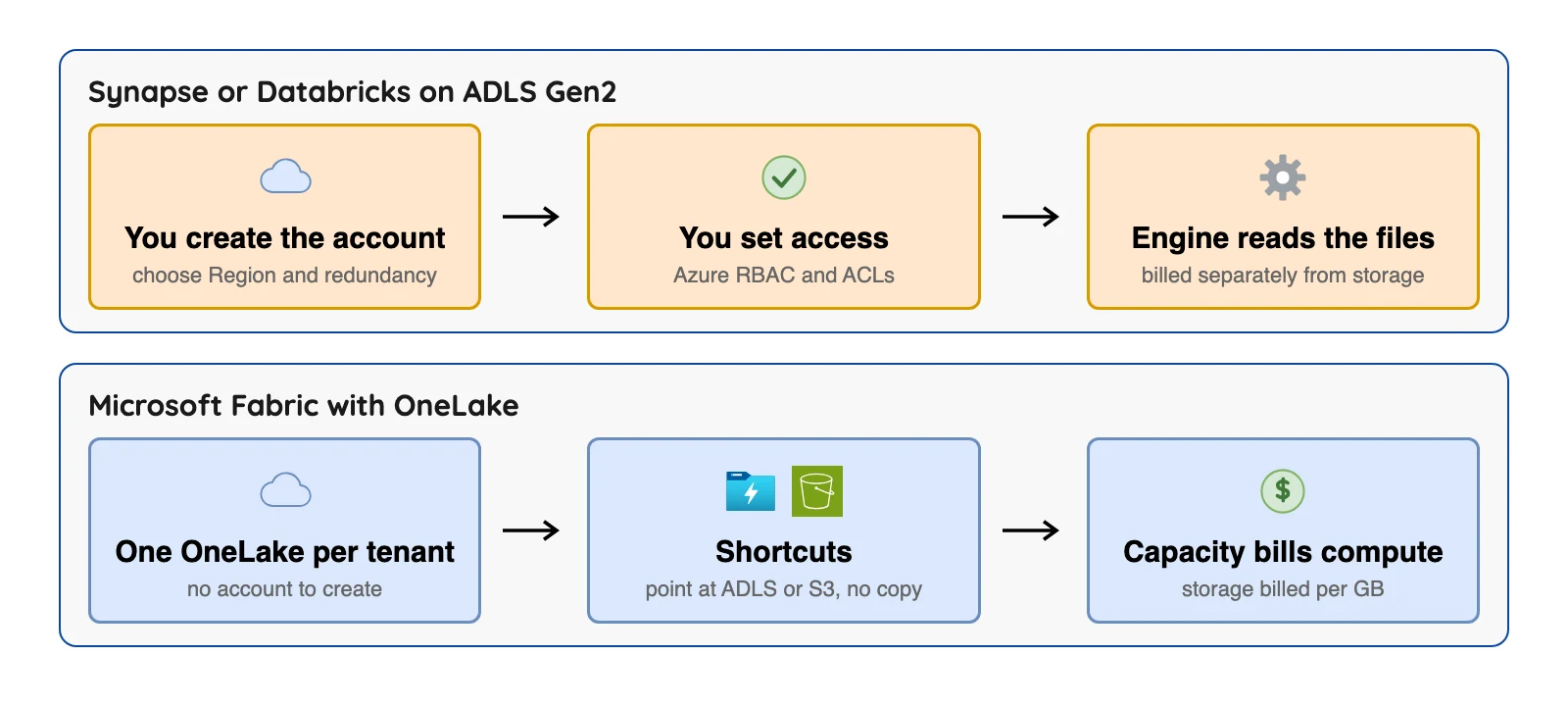
Synapse and Databricks read a storage account you create. Fabric hands each tenant its own lake, and you pay a capacity bill for compute.
Which Azure data lake option fits you
| If this sounds like you | Start with | Why |
|---|---|---|
| "We just need cheap, durable file storage." | ADLS Gen2 plus your own engines | Storage-only, no platform bill on top |
| "We already run Synapse and it works." | Keep Synapse, plan a Fabric look | Migration guide exists; Synapse still has GPU and external Hive Metastore options |
| "Our team writes Spark and trains models." | Azure Databricks | Built around Spark, Delta Lake and ML per Microsoft's overview |
| "Our analysts live in Power BI and want less setup." | Fabric with OneLake | SaaS, one lake per tenant, no Azure account needed |
| "Our data is already in ADLS and we want Fabric." | Fabric plus shortcuts | Shortcuts reach ADLS data without copying it |
| "We need PostgreSQL, MySQL, MongoDB or SQL Server data in the lake as Iceberg or Parquet." | OLake Go (ours) writing to storage you choose | Open source, reads the change logs; see our docs |
Microsoft says compute is more than 85% of total cost in many workloads, so the engine you pick can move your bill more than the storage rate does.
Azure data lake storage pricing, dated
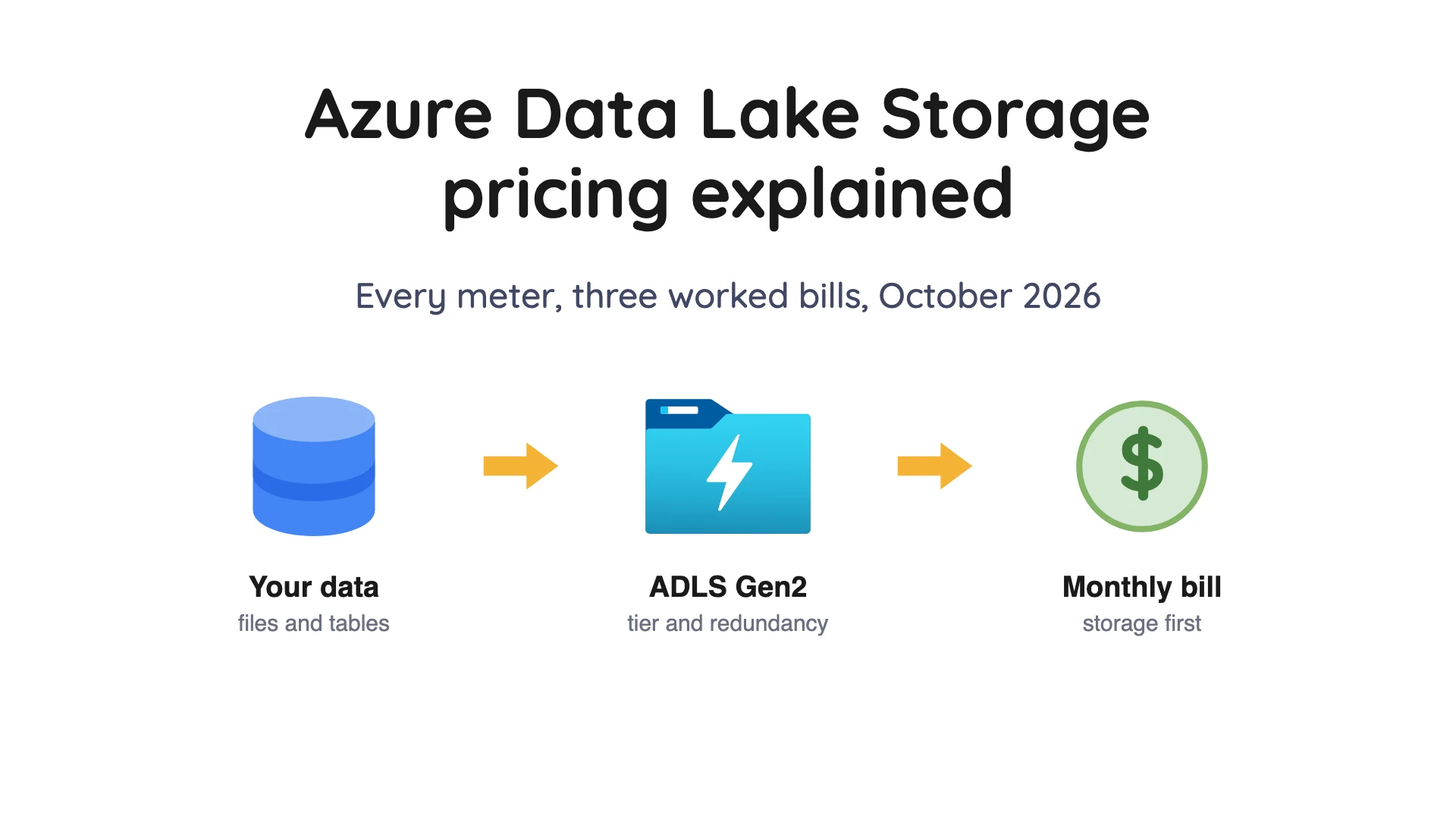
Here are Microsoft's ADLS Gen2 rates for East US with the hierarchical namespace on and locally redundant storage (LRS, three copies in one data centre), read from Microsoft's pricing page on October 2, 2026.
| Item | Rate |
|---|---|
| Hot storage, first 51,200 GB a month | $0.021 per GB |
| Cool storage | $0.016 per GB |
| Cold storage | $0.0036 per GB |
| Archive storage | $0.001 per GB |
| Premium storage | $0.15 per GB |
| Hot writes, per 10,000 operations (each 4 MB) | $0.065 |
| Hot reads, per 10,000 operations (each 4 MB) | $0.0052 |
Prices are from Microsoft's own page (checked Oct 2026). Prices change often; confirm on the page before you decide.
These rates come with cautions, all from Microsoft's own pages. The page rounds its rates, and Microsoft's retail prices API (checked Oct 2026) lists the same hot rate as $0.0208.
The page's default view (East US 2, flat namespace) shows $0.019 for hot, so your Region and namespace choice change the number.
Operations are billed in 4 MB steps, so a tiny file is charged like a 4 MB one. Microsoft suggests files of 256 MB to 100 GB.
A hierarchical namespace account also has an Index meter for folder structure and ACLs, which the pricing page lists at $0.0297 per GB-month for hot in East US (checked Oct 2026).
Fabric prices things differently. Microsoft's Fabric pricing page shows pay-as-you-go capacity at $262.80 a month for F2 (the smallest size), and says a one or three year reservation can save about 41% against pay as you go (checked Oct 2026).
We don't quote a OneLake storage rate here, because we couldn't confirm one from the page text, so don't compare it with the East US ADLS rate above. Ask Microsoft which capacity size your own workload needs, because the page lists sizes and prices but not how much work each size handles.
Users with only a free Fabric licence can view Power BI content only when the capacity is F64 or larger. Smaller sizes need Pro or Premium Per User licences for viewers. We couldn't read Synapse or Databricks rates from their pages in text form, so we don't quote them.
Old Azure data lake advice that no longer holds
Some of the top-ranking guides are stale, and you can't always tell from the title. Check for these before you trust one.
- Data Lake Storage Gen1 is retired. Microsoft's archived page says Gen1 "is now retired" and its resources are no longer accessible.
- Azure Data Lake Analytics and U-SQL are retired. Microsoft's archived page says the service retired on 29 February 2024 and points to Synapse or Fabric. Wikipedia's article and a 2025 Matillion guide still describe it as part of Azure Data Lake.
- Fabric is missing from some guides. A December 2025 Pump guide doesn't mention it, though Microsoft's own architecture page now lists it as a lake option.
- Old prices. Dremio's 2019 explainer quotes hot storage at $0.0184 per GB, which is an old rate.
Getting data into an Azure data lake
Data has to land in the lake first. On Azure the usual tools are Azure Data Factory, Event Hubs for streams, and, inside Fabric, shortcuts and mirroring. Shortcuts reference data in place, and mirroring continuously replicates an operational database into OneLake as Delta tables.
To copy PostgreSQL, MySQL and MariaDB, MongoDB or SQL Server into Apache Iceberg or Parquet on storage you choose, OLake Go, our open-source tool, reads the change logs (see our docs).
Test your Azure data lake basics
Question 1 of 4
A colleague asks, 'Is Azure Data Lake Storage its own separate service?' What is the best answer?
Q1. What is Azure Data Lake?
Q2. Is Azure a data warehouse or a data lake?
Q3. What is the difference between Azure Data Lake Storage and Blob Storage?
Q4. Is Azure Synapse a data lake?
Q5. Is Azure Data Lake Gen1 still available?
Q6. How much does Azure Data Lake Storage cost?
Q7. Can Fabric use data I already keep in ADLS Gen2?
Conclusion
So, lake or warehouse? Azure sells both, and the "Azure data lake" most people mean is ADLS Gen2 plus an engine. The real decision is which engine, and who should run it.
Choose storage first, and treat the engine as a separate choice you can revisit later. Microsoft's own Synapse to Fabric guide hints at why: engines change over time, while the files in ADLS can stay put.
If your lake also needs database data as Apache Iceberg or Parquet, OLake Go, our open-source tool, covers that ingestion step. For the wider picture, see data lake vs data lakehouse and the best data lake tools.
Check the date on any guide you read, this one included.