Best Data Management Platforms and Tools (2026)
32 min read
Key takeaways
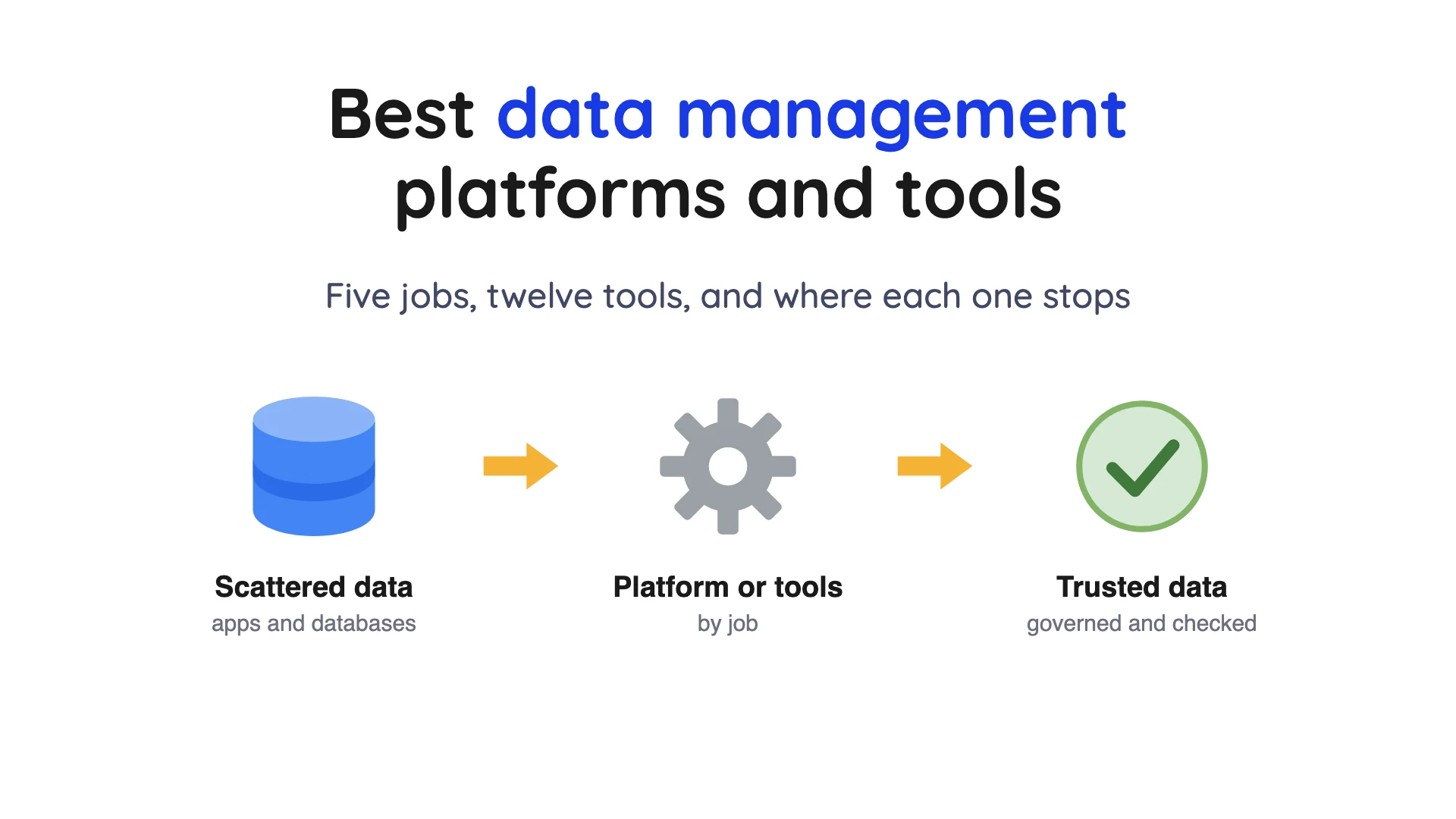
The best data management platform depends on the job, because no single product does all of it. Fivetran, Airbyte and OLake Go move your data. Snowflake, BigQuery and Databricks store and query it, while Microsoft Purview, Collibra, OpenMetadata and DataHub catalog and govern it.
Great Expectations checks quality, and Informatica and Semarchy manage master data, the single trusted record of a customer or product. So start with the pain you have today: data that's hard to reach, or data nobody trusts.
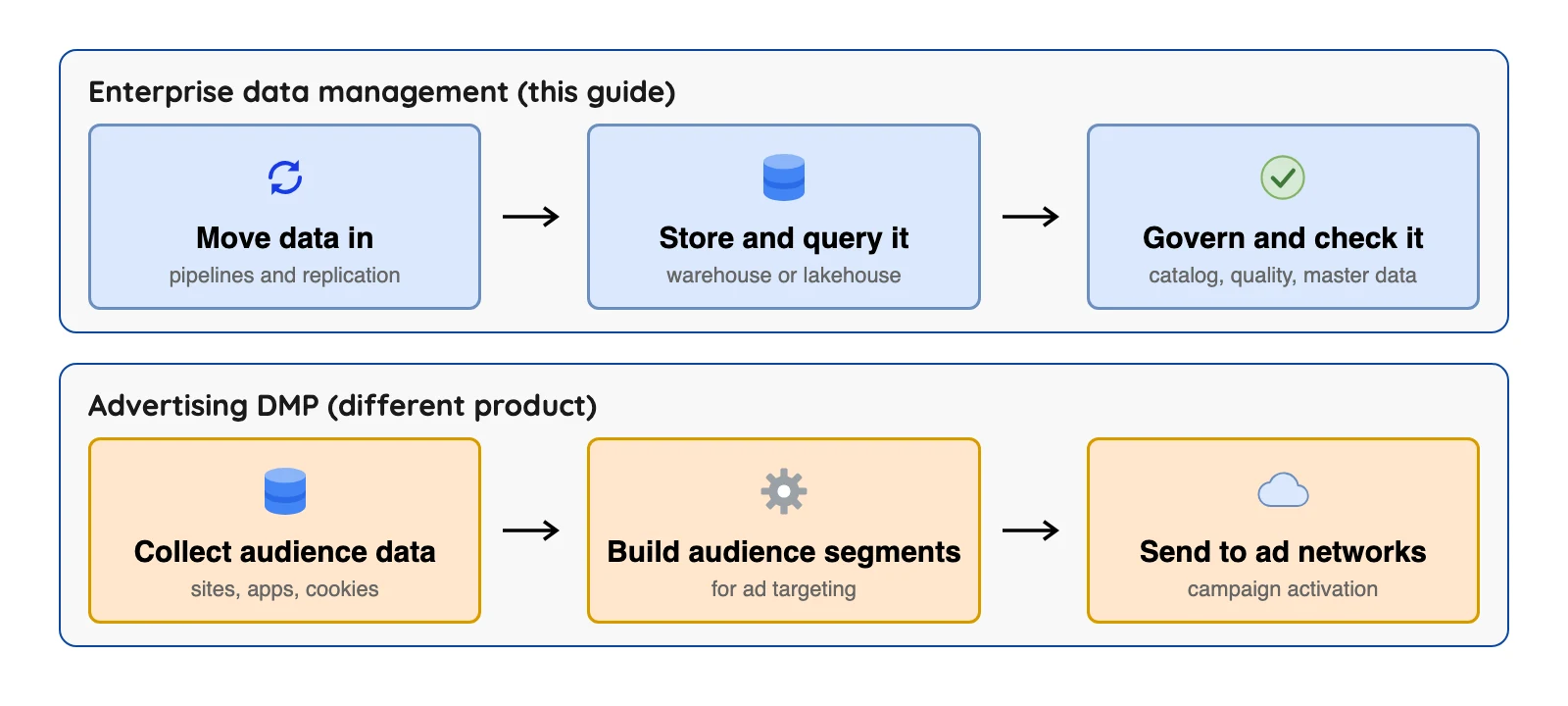
- "Data management platform" has two meanings. In advertising it means a tool that builds audience groups for ad targeting. This guide is about the other one: tools that move, store, catalog, check and govern your company's own data.
- No tool covers everything. The Data Management Body of Knowledge (DMBOK), a widely used reference, lists 11 areas of data management. We found no vendor page claiming all 11.
- Price information hides in different places. Collibra and Semarchy publish no price, and Informatica shows no dollar rate on its pricing page. Fivetran, Airbyte, BigQuery and Databricks at least publish their billing units, and Fivetran prints its per-row list rates in a separate Service Consumption Table.
- Open source covers the catalog and quality jobs. OpenMetadata, DataHub and Great Expectations are all Apache-2.0 licensed. The catch: you run them yourself, unless you buy a managed route such as DataHub Cloud.
We checked prices and plans in October 2026 against each vendor's own pages, and our saved copies of those pages are dated October 8, 2026. Plans change often, so confirm on the vendor's page before you buy.
What is a data management platform?
Data management means looking after data from the day it's created until the day it's deleted.
The Data Management Body of Knowledge (DMBOK), a reference framework from a professional body for data managers, lists 11 areas. They include governance, architecture, security, integration, master data, metadata and data quality.
A data management platform is software that covers some of those areas in one product. A data management tool usually covers just one.
The advertising meaning you may have landed on by mistake
Search this phrase and you'll get a pile of ad-tech results. In marketing, a DMP is a different product. One IT software vendor defines it as software that collects, organizes and deploys data from customers and audiences for use in online campaigns.
If that's what you're after, this guide won't help.
How we picked
A tool had to be maintained, cover one of five jobs, and publish a product or pricing page we could open. We checked each vendor's own pages in October 2026 and name the page beside the claim, linking the pricing and limit pages that matter most. You get a table first, then one block per tool in the same shape.
Vendor facts come from each vendor's own pages, read in October 2026. We did not run the other tools. We quote no user reviews, and where a vendor shows no price we write "not published."
We left out advertising DMPs, dashboard tools such as Tableau, and tools whose pages we couldn't open. The order inside each group is not a ranking.
Data management platforms and tools compared at a glance
| Tool | Job | Who runs it | Price shape, October 2026 | Free option |
|---|---|---|---|---|
| Fivetran | Move data | Vendor | Monthly active rows per connection; paid rates in its Service Consumption Table, not on the pricing page | Free to 500,000 rows a month |
| Airbyte | Move data | Vendor or you | Credits on Cloud; Core is self-run | Core is free to run yourself |
 OLake Go | Move data | You | Free, Apache 2.0; you run the servers | Yes |
| Snowflake | Store and query | Vendor | Consumption-based; $2.00 to $4.00 per credit on AWS US East | Not checked |
| Google BigQuery | Store and query | Vendor | Per TiB scanned, or reserved capacity | First 1 TiB of queries a month |
| Databricks | Store and query | Vendor | Pay as you go, billed per second | Free Edition |
| Microsoft Purview | Catalog and govern | Vendor | Per governed data asset, plus processing units | None shown |
| Collibra | Catalog and govern | Vendor | Not published; request a demo | Not published |
| OpenMetadata | Catalog and govern | You, unless you buy a managed version | Free, Apache-2.0 | Yes |
| DataHub | Catalog and govern | You, or DataHub Cloud | Free core, Apache-2.0; no cloud price found | Yes |
| Great Expectations | Check quality | You | Free library, Apache-2.0 | Yes |
| Informatica | Master data and more | Vendor | Processing units; no dollar rate on its pricing page | Its pricing page menu lists Free Cloud Data Integration |
| Semarchy xDM | Master data | Vendor | Not published; contact for a quote | Free trial offered |
Sources, pages read in October 2026:
- Prices: Fivetran pricing page and Service Consumption Table, Airbyte pricing page, Snowflake credit consumption table, BigQuery pricing page, Databricks pricing page, Azure Purview pricing page, Informatica pricing page.
- No published price: Collibra governance page and Semarchy platform page.
- Licences on GitHub: OpenMetadata, DataHub and Great Expectations.
"Free option" means a free plan or free software, not free to run.
Start from your problem
Most teams don't need all five jobs on day one. So ask which pain is real, then pick from that lane.
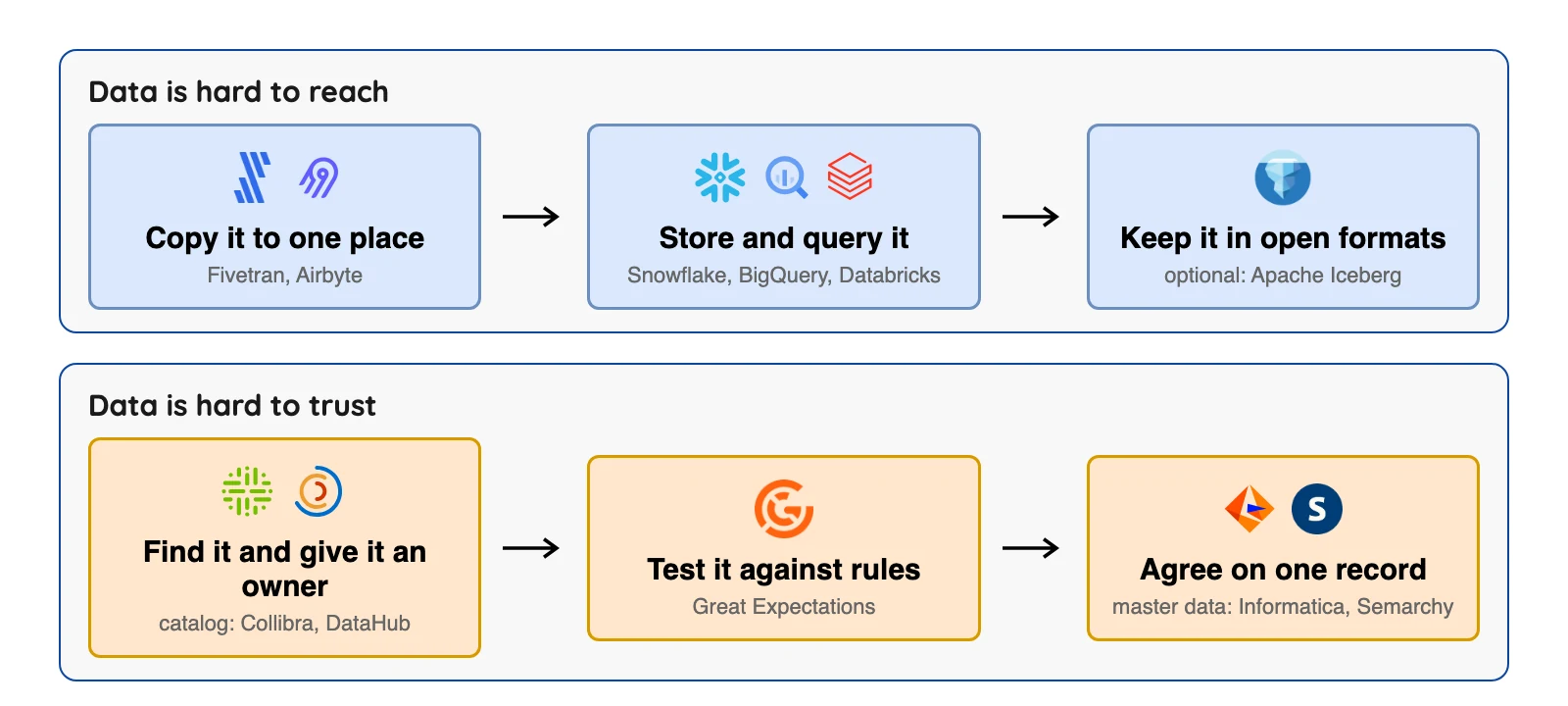
If people can't get to the data, you need a pipeline and a place to store it. If they can reach it but argue about what it means, you need a catalog, rules and a master record.
| What you hear in the team | The job | Tools in this guide | Skip it if |
|---|---|---|---|
| "I cannot get the data from our apps and databases." | Move | Fivetran, Airbyte, OLake Go | You already have a working pipeline |
| "Reports are slow or the data sits in too many places." | Store and query | Snowflake, BigQuery, Databricks | You only need a free tool to start |
| "Nobody knows which table is right or who owns it." | Catalog and govern | Microsoft Purview, Collibra, OpenMetadata, DataHub | Your data is small enough to document in one sheet |
| "The numbers broke and we found out from a customer." | Check quality | Great Expectations | You have no engineer to write rules |
| "Sales and finance each have a different customer list." | Master data | Informatica, Semarchy xDM | Duplicates are rare |
Answer five quick questions to see which tools fit.
Which data management tool fits you?
Question 1 of 5
What is the pain you have today?
The post says to start from the pain, because no single tool does every job.
Tools that move data
Moving data means copying it from apps and databases into that one place.
1. Fivetran: for teams that want a vendor to run the pipelines
Fivetran home page, October 2026.
At a glance: managed service, billed on monthly active rows (MAR), meaning rows that changed in a month.
Fivetran's connector page says 750+ sources, while its pricing page says 700+ fully managed connectors. The two pages disagree, so cite the page you use. Fivetran announced the completion of its merger with dbt Labs in a press release on June 1, 2026.
What's good
- Its pricing page lists a free plan of up to 500,000 MAR a month.
- That page says Standard includes 15-minute syncs, unlimited users, REST API access, SSH tunnels and an integration for dbt Core.
- It says Enterprise adds 1-minute syncs, custom roles, SCIM user provisioning and a Hybrid deployment option. We did not test the sync times, so ask which plan your connector gets.
- Its Managed Data Lake Service docs say Fivetran writes Parquet files to your own cloud storage on Amazon S3, ADLS or GCS and always creates Iceberg metadata for the tables. The limits are below.
Where it falls short
- Paid per-row rates sit in a separate Service Consumption Table, so your bill depends on your row counts and connections.
- Its destinations docs say your own warehouse provider charges separately for the compute Fivetran uses to load data.
- The pricing page applies a $5 base charge to standard connections with monthly usage between 1 MAR and 1 million MAR.
- That page says usage counts updates, which it defines as changes to existing rows in your destination, including deletes.
- The Managed Data Lake Service docs say Fivetran does not support position deletes for Iceberg tables. They also say it does not support the S3 Glacier Flexible Retrieval and S3 Glacier Deep Archive storage tiers, because retrieval takes too long.
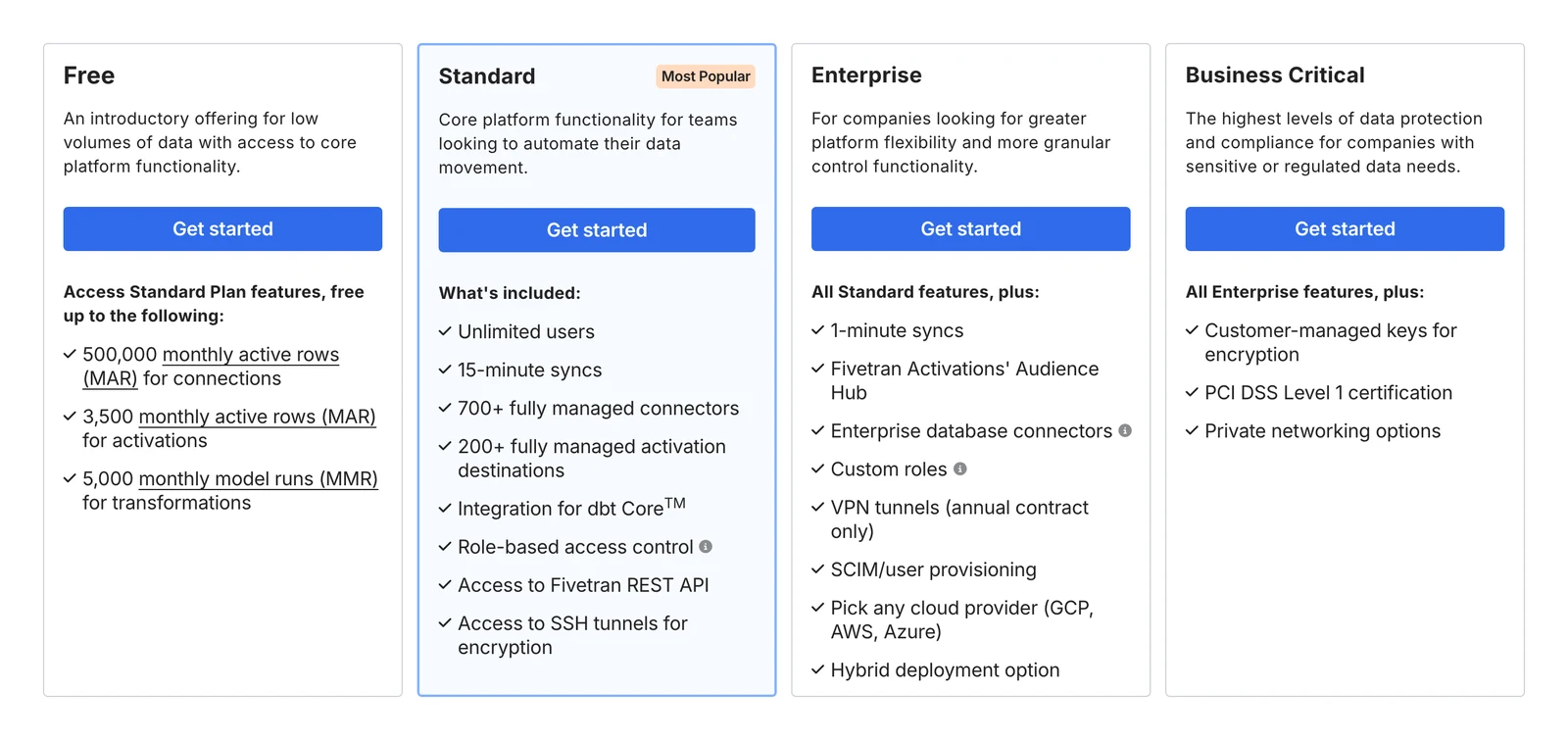
Fivetran pricing page, October 2026.
2. Airbyte: for teams that want open-source connectors
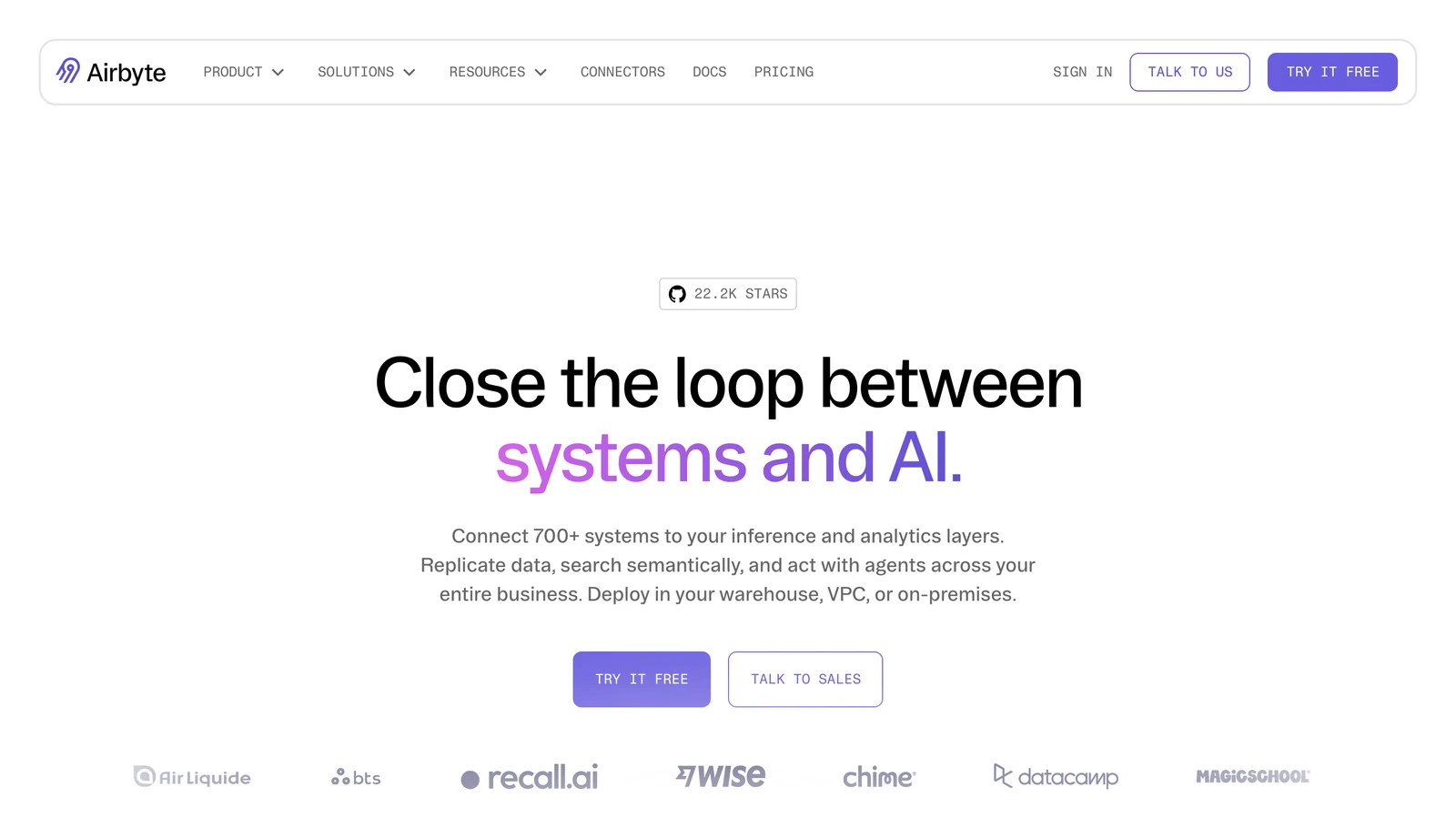
Airbyte home page, October 2026.
At a glance: open source with a self-run Core edition, plus a paid Cloud service billed in credits.
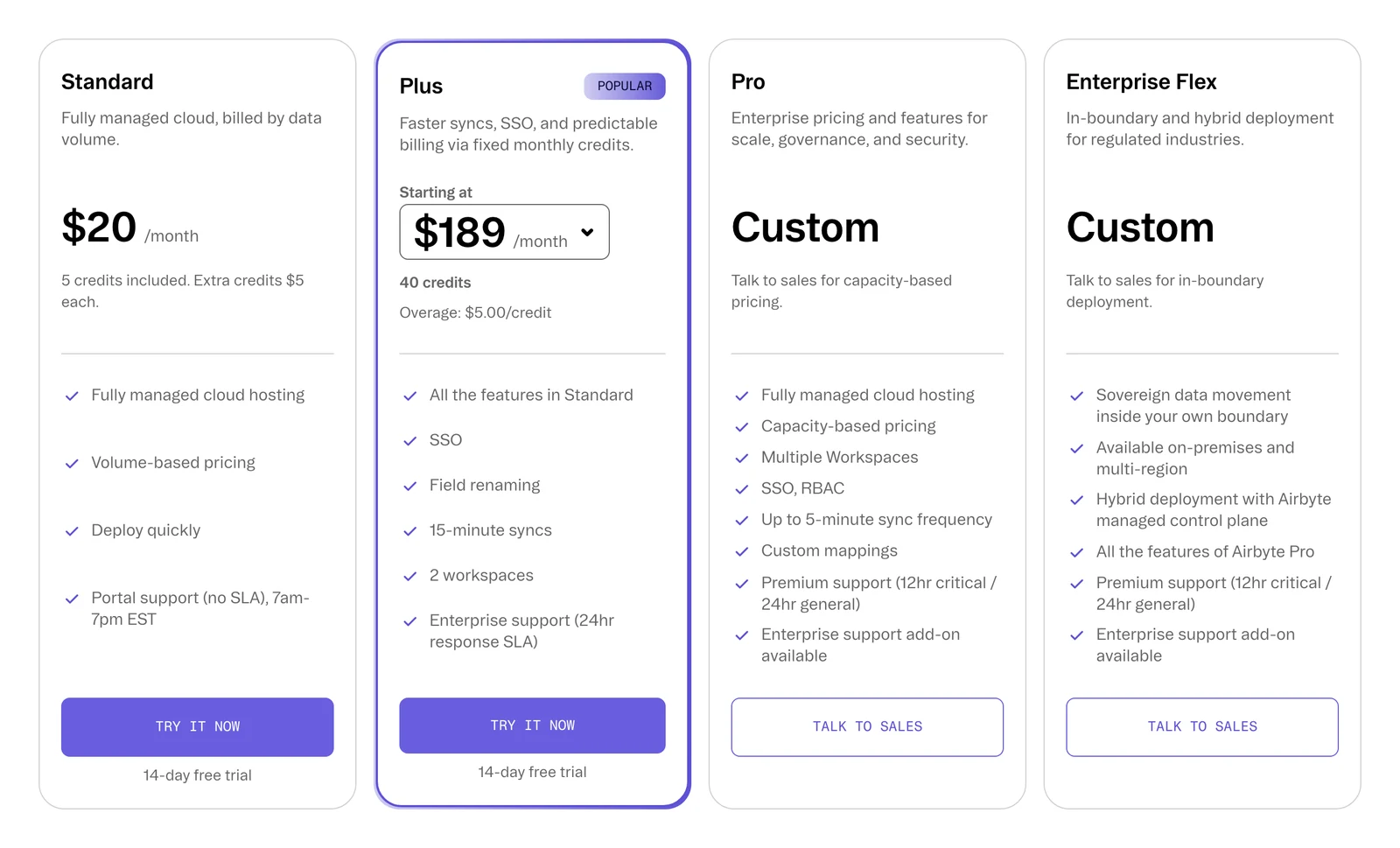
Airbyte's platform docs say it has over 600 pre-built connectors, while its why-open-source page says 700+ (another small mismatch). Its pricing page shows Cloud Standard at $20 a month with 5 credits, then $5 per extra credit.
What's good
- Its platform docs say it is available as a self-managed, hybrid or fully managed cloud solution.
- They describe Core as the free and open-source version, which you can deploy locally or in your own infrastructure, and the why-open-source page says to self-host it with
abctlor Kubernetes. - The pricing page shows Plus starting at $189 a month for a 40-credit package, plus a 14-day free trial with 400 credits.
- The Plus card lists enterprise support with a 24-hour response SLA.
Where it falls short
- Change data capture (CDC) means copying only the rows that changed. Airbyte's CDC docs say syncs are scheduled, and "We do not treat CDC sources as infinite streaming sources."
- The same docs say CDC incremental is supported only for tables with primary keys for most sources.
- They also say changes made by
TRUNCATEorALTERdo not appear in the logs, so they never reach the destination. - A refresh is required after you add a new table or collection to a CDC connection, per the same page.
- The pricing page's comparison table lists the maximum sync frequency as 1 hour on Standard, 15 minutes on Plus and 5 minutes on Pro and Enterprise Flex. Pro and Enterprise Flex use capacity-based pricing, and the page shows no price for them.
- The why-open-source page lists the connectors and core platform under the Elastic License 2.0 (ELv2), which it describes as restricted only for resale as a hosted service.
Airbyte pricing page, October 2026.
3. OLake Go: for teams that want to copy databases into Iceberg tables they own

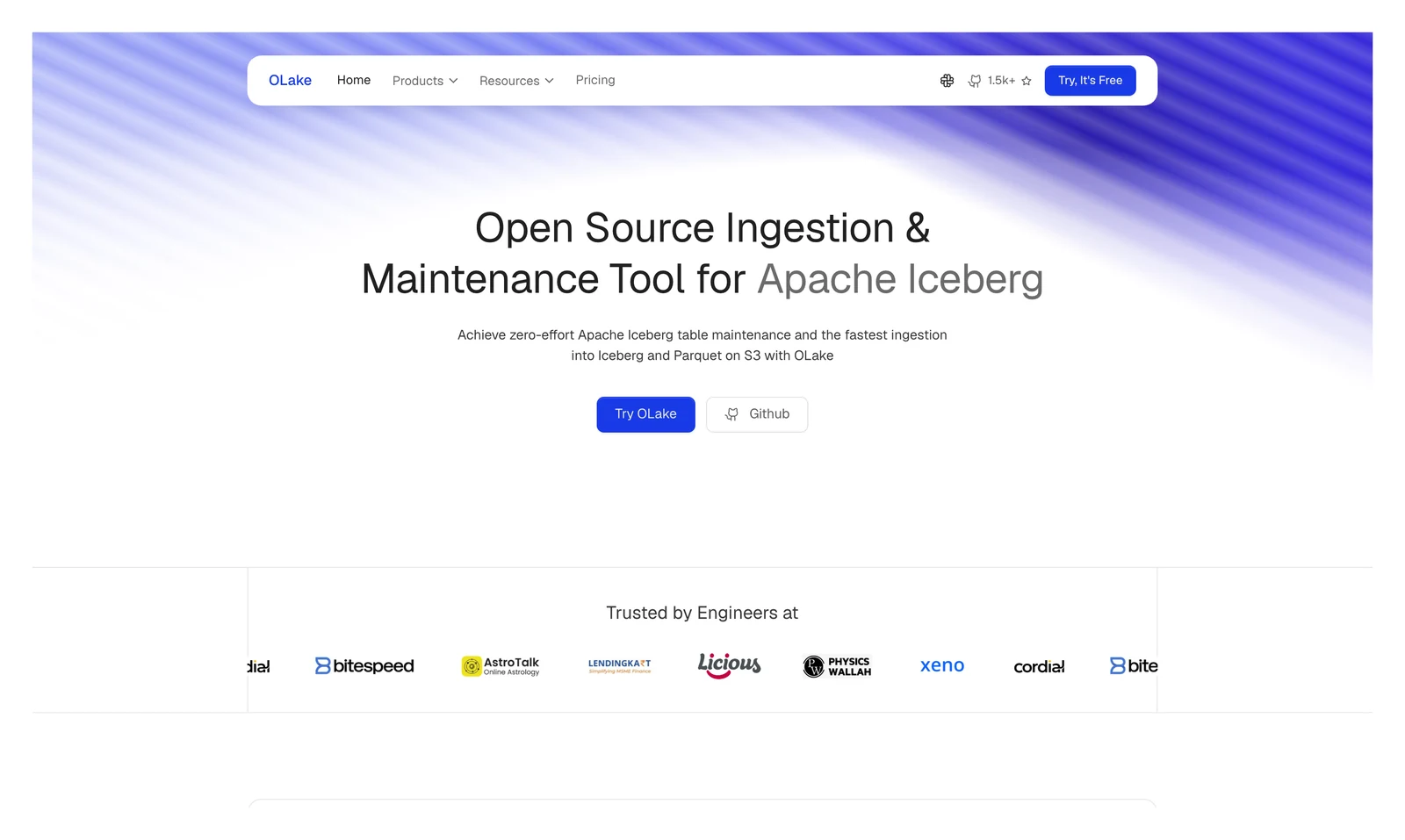
OLake home page, October 2026.
At a glance: open-source database replication under Apache 2.0. It copies Postgres, MySQL/MariaDB, MongoDB and SQL Server with a full load and then change capture (Postgres, MySQL, MongoDB, SQL Server), and writes Apache Iceberg or Parquet.
OLake Go handles the move step, so pair it with the tools in the later groups for catalog, quality and master data. For support, contact the OLake team.
What's good
- The docs overview lists, per source, full refresh, full refresh plus CDC, CDC only and full refresh plus incremental sync modes, so one tool does the first load and then the change capture.
- Oracle, Db2, S3 and Kafka also work as sources, without database change capture.
- It writes Iceberg tables to catalogs such as AWS Glue, with eleven catalog types on the catalog compatibility page, or Parquet files on object storage.
- Those catalogs include Snowflake Horizon (OLake Go v0.11.0 and later), BigLake for Google Cloud and Unity Catalog for Databricks.
- Schema discovery runs at the start of every sync, and a new source column is added to the Iceberg schema automatically (schema evolution docs).
- You run it on your own infrastructure with Docker, Helm on Kubernetes or the OLake UI.
- OLake Fusion, a companion product, compacts the Iceberg tables OLake Go writes and shows a health score per table (Fusion docs).
Tools that store and query data
A data warehouse is a database built for reports. Lakehouses keep data in cheap file storage but let you query it like a warehouse. All three tools below say they work with the open Apache Iceberg table format: see the Iceberg docs of Snowflake, BigQuery and Databricks.
4. Snowflake: for teams that want a vendor-managed warehouse
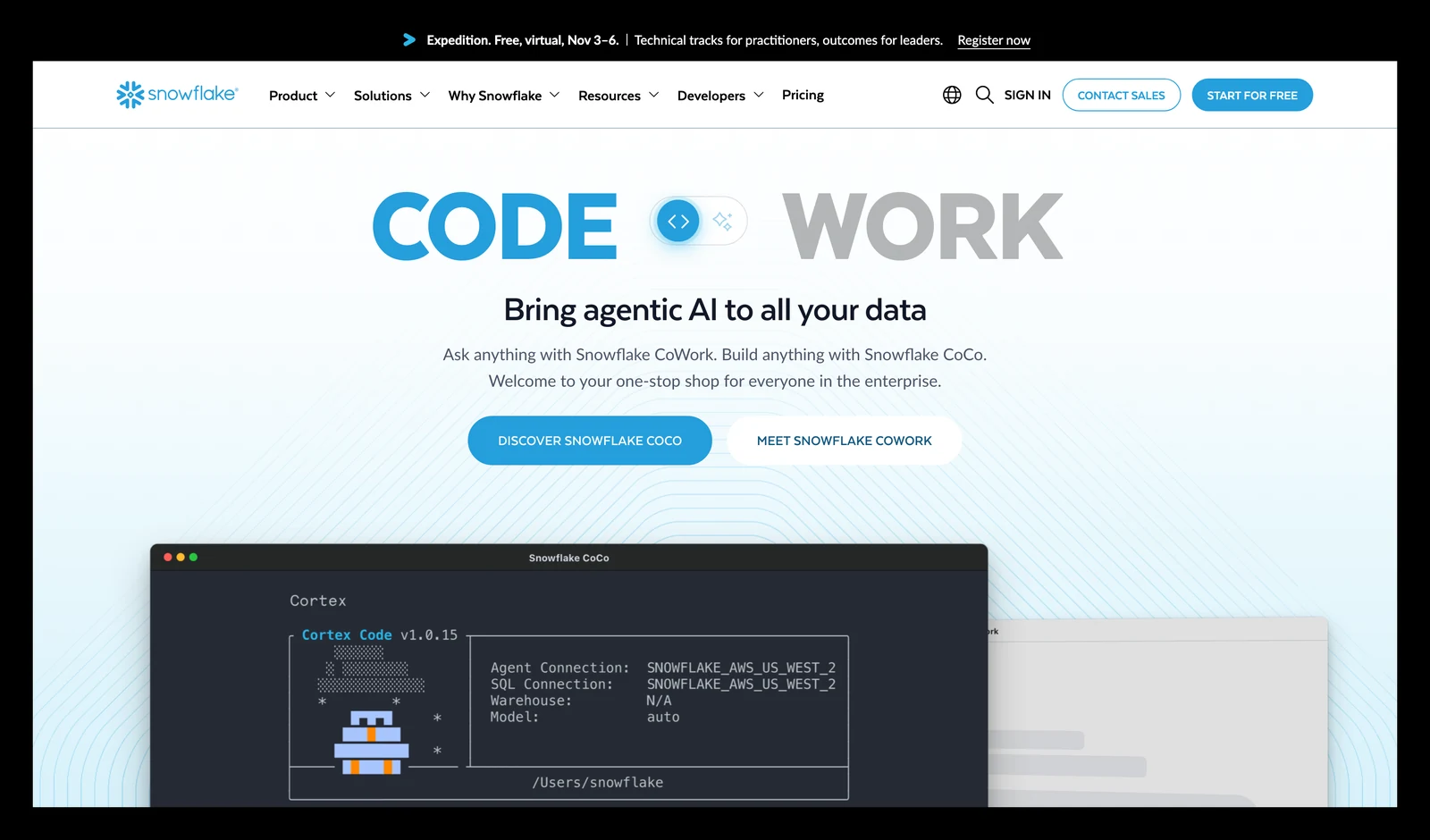
Snowflake home page, October 2026.
At a glance: a managed cloud data platform with a consumption-based price.
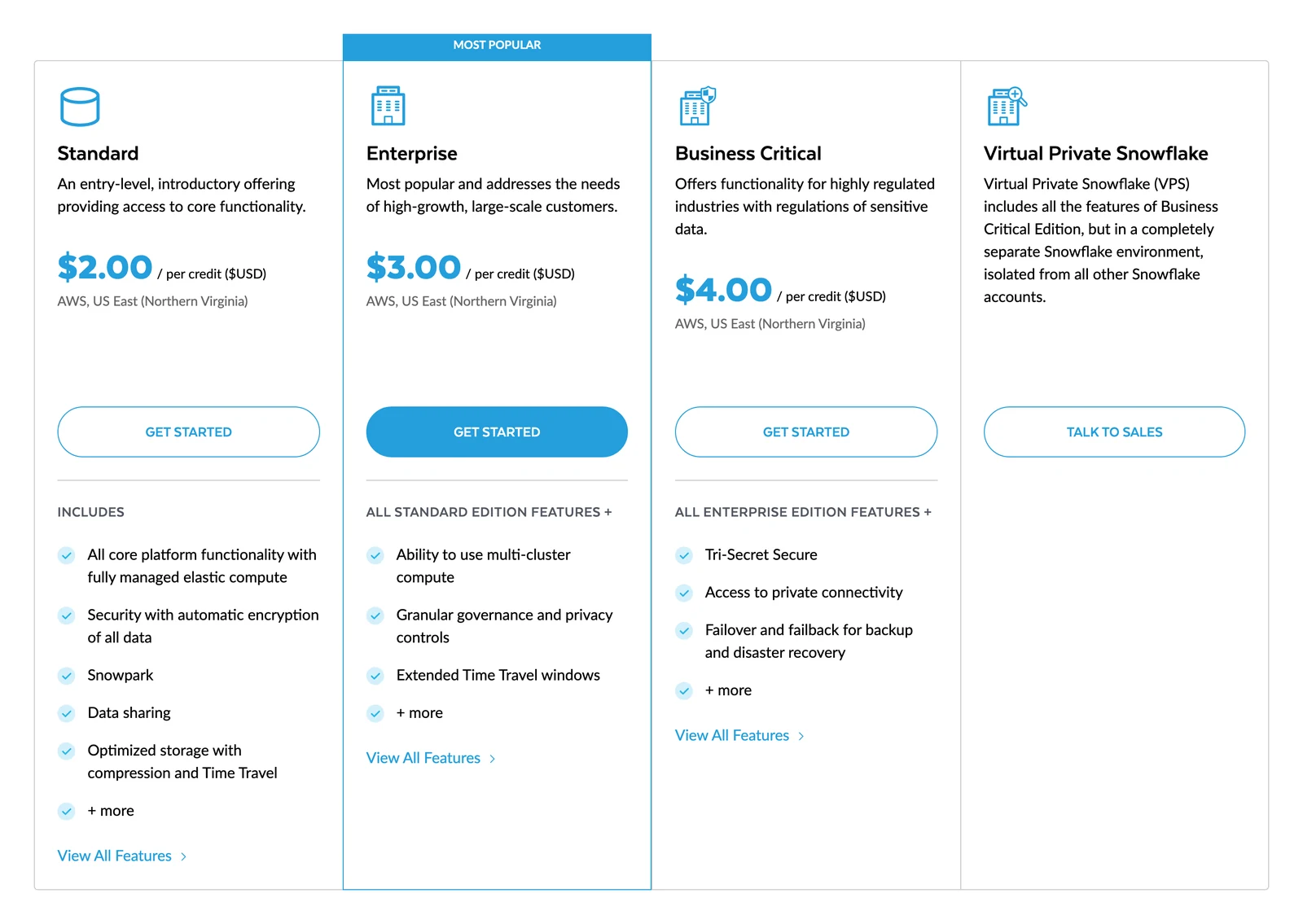
Snowflake's pricing page calls its model consumption-based (its own wording: it says it keeps pricing simple), and describes Standard as an entry-level, introductory offering. Its Iceberg docs say Iceberg tables combine Snowflake's query features with external cloud storage that you manage.
What's good
- Snowflake sells four editions: Standard, Enterprise, Business Critical and Virtual Private Snowflake (VPS), which the pricing page says includes all Business Critical features in a completely separate environment.
- The pricing page says the monthly fee for stored data uses the average amount stored per month, after compression.
- The Iceberg docs say Snowflake supports Iceberg tables that use Parquet files and versions
1,2and3of the Iceberg specification, excluding row-level equality deletes. - They list two catalog options: Snowflake as the Iceberg catalog, which gives full platform support with read and write access, or an external catalog such as a remote Iceberg REST catalog, including AWS Glue and Snowflake Open Catalog.
- They also say Snowflake supports externally managed writes for Iceberg tables that use specification version
2or3.
Where it falls short
- The pricing page showed $2.00 (Standard), $3.00 (Enterprise) and $4.00 (Business Critical) per credit for AWS, US East (Northern Virginia) when we read it in a browser in October 2026, and the credit consumption table (Table 2(a), effective October 2, 2026) lists the same rates. There is a platform and region picker, so your rate may differ, and a credit rate is not a monthly bill.
- Rates move with region: Table 2(a) lists AWS EU Frankfurt at $2.60, $3.90 and $5.20 for the same three editions, and Table 3(a) lists AWS US East storage at $23.00 per terabyte per month on demand.
- Pre-paid capacity is priced as the on-demand rate with a discount set in your order form, and the table does not publish the discount percentages.
- Per the Iceberg docs, an Iceberg table that uses an external catalog gets limited Snowflake platform support. Row-level deletes work only as position deletes on version
2tables and as deletion vectors on version3tables. - If your Snowflake account and external volume sit in different regions, your external cloud storage account incurs egress costs when you query the table.
- No self-hosted option is stated.
Snowflake pricing page, October 2026.
5. Google BigQuery: for teams already on Google Cloud
Google BigQuery home page, October 2026.
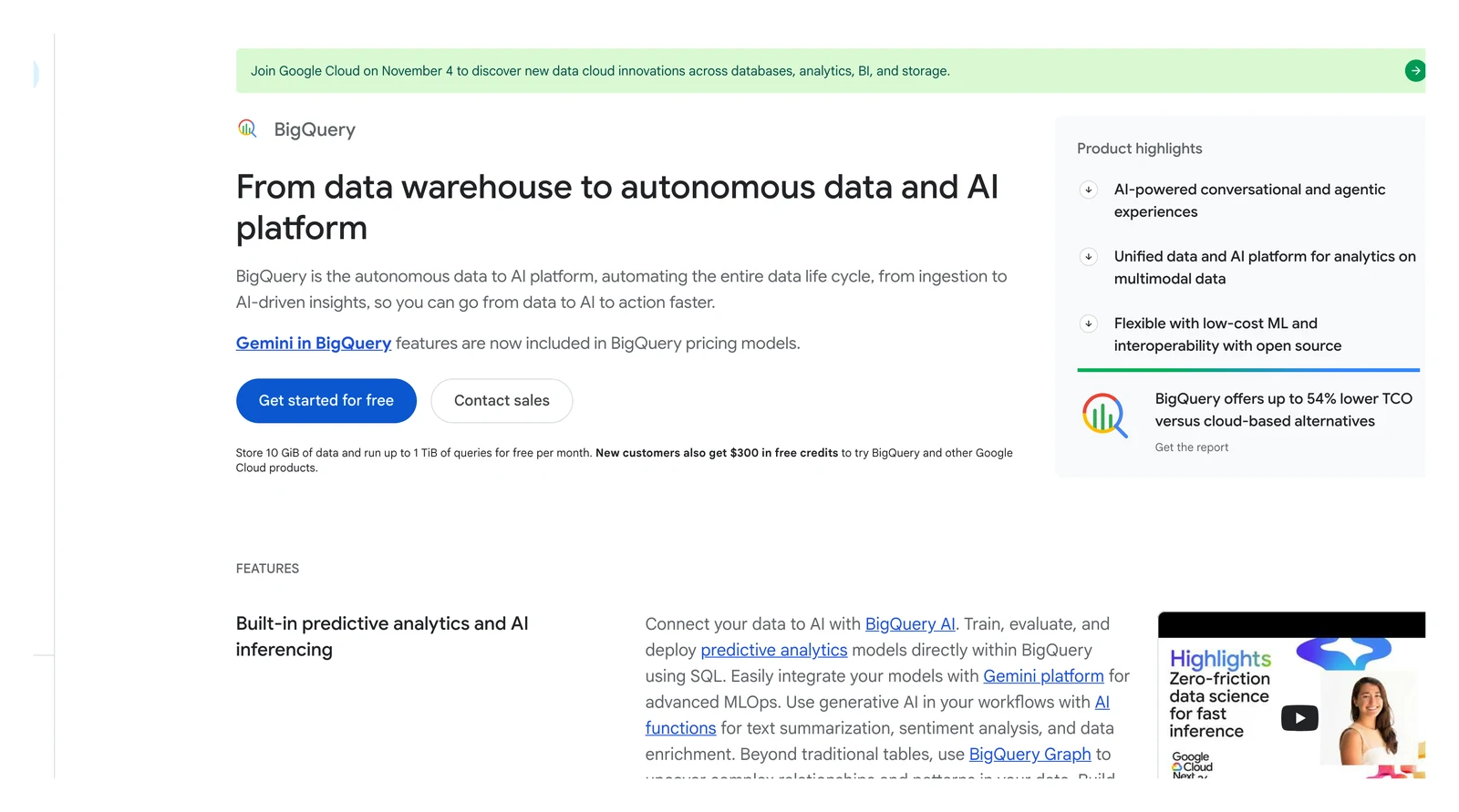
At a glance: a serverless warehouse. A TiB, the unit it bills queries in by default, is about a trillion bytes.
What's good
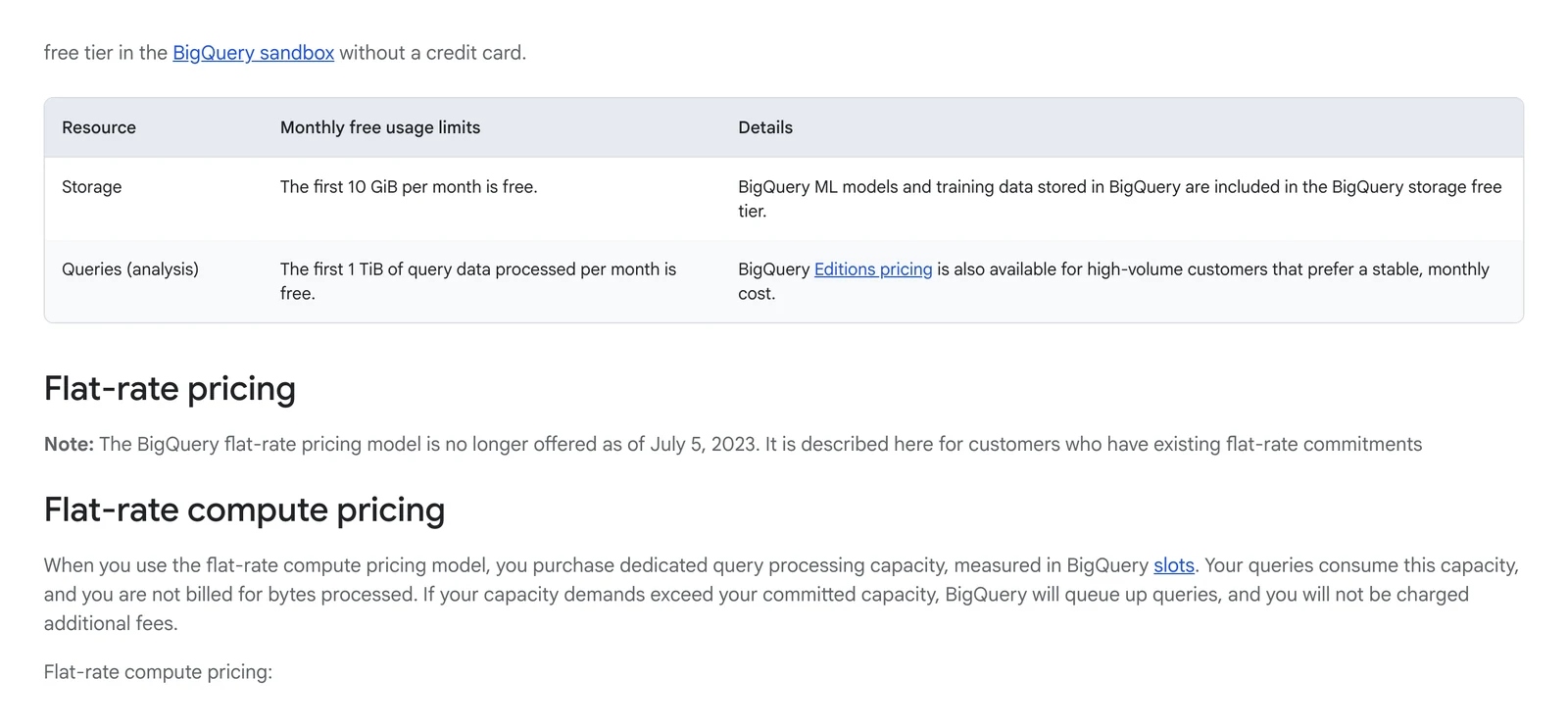
- The pricing page says queries are billed per TiB scanned by default and "The first 1 TiB of query data processed per month is free."
- The first
10 GiBof storage is also free each month. - Long-term storage covers any table or partition not modified for 90 consecutive days, and its storage price drops automatically by about 50%.
- Capacity pricing is available in 3 editions, Standard, Enterprise and Enterprise Plus, and the Standard edition lists slots at $0.04 per hour with no commitment (default view, and the price varies by region and edition).
- Its Iceberg docs say Iceberg managed tables keep data in customer-owned storage buckets and support DML, schema evolution (add, drop and rename columns) and automatic storage optimization.
- They also list an export of an Iceberg
V2snapshot, refreshed on each table mutation, for engines such as Spark.
Where it falls short
- On-demand queries get "generally ... access to up to 2,000 concurrent slots, shared among all queries in a single project," so busy projects share capacity.
- On-demand charges round up to the nearest MB, with a minimum of
10 MBper table referenced and per query, and you pay for the data in the columns you select even when you set aLIMIT. - The rendered on-demand rate after the free TiB is $6.25 per TiB, but the table text does not name its region, so check yours.
- Per the Iceberg docs, only one mutating DML statement (
UPDATE,DELETEorMERGE) runs at a time for each Iceberg managed table, and others queue. - Iceberg managed tables do not support renaming operations, table copies or table clones.
- It's a proprietary Google Cloud service, with no self-hosted option stated.
Google BigQuery pricing page, October 2026.
6. Databricks: for teams that mix analytics with machine learning
Databricks home page, October 2026.
At a glance: a data and AI platform on AWS, Azure and Google Cloud, billed pay as you go.
What's good
- The pricing page says "Only pay for the products you use at per second granularity," with no up-front costs.
- It offers committed-use contracts, where larger commitments earn greater discounts, and lists a Free Edition.
- Its Iceberg docs say it supports Iceberg tables that use Parquet files and versions
1,2and3of the Iceberg specification (the format's own version numbers). - They say it supports Iceberg tables managed by Unity Catalog and by foreign catalogs, such as AWS Glue, Hive metastore or Snowflake Horizon Catalog.
- Iceberg tables you create in Unity Catalog are managed Iceberg tables, and you can create them with Databricks Runtime, Databricks SQL or external engines that support the Iceberg REST Catalog API, such as Apache Spark, Flink, Trino or Kafka.
Where it falls short
- Iceberg tables need Unity Catalog and Databricks Runtime
16.4LTS (long-term support) or above, and managed tables also need serverless compute. - Foreign Iceberg tables are read-only in Databricks and have limited platform support.
- Credential vending is not supported on workspaces that use default storage.
- Partition evolution on managed Iceberg tables works through external Iceberg engines using the Iceberg REST Catalog, but not through Databricks SQL.
- Serverless compute must have network connectivity to the cloud storage account that backs a managed Iceberg table.
- The pricing page text we read does not list editions beyond Free Edition and pay as you go.
Tools that catalog and govern data
A data catalog is a searchable inventory of your data, with owners and descriptions. Data governance is the set of rules about who may use data and how. Lineage is a record of where a piece of data came from.
7. Microsoft Purview: for teams that already run on Microsoft
Microsoft Purview product page, October 2026.
At a glance: Microsoft's Learn page says Purview helps organizations govern, protect and manage data. It groups security, governance and compliance products, and its governance pieces are Data Map and Unified Catalog.
What's good
- The Learn page says the Purview portal provides access to data governance, data security and data compliance solutions in one place.
- It lists the data security solutions as Data Loss Prevention, Data Security Investigations, Information Barriers, Information Protection and Insider Risk Management.
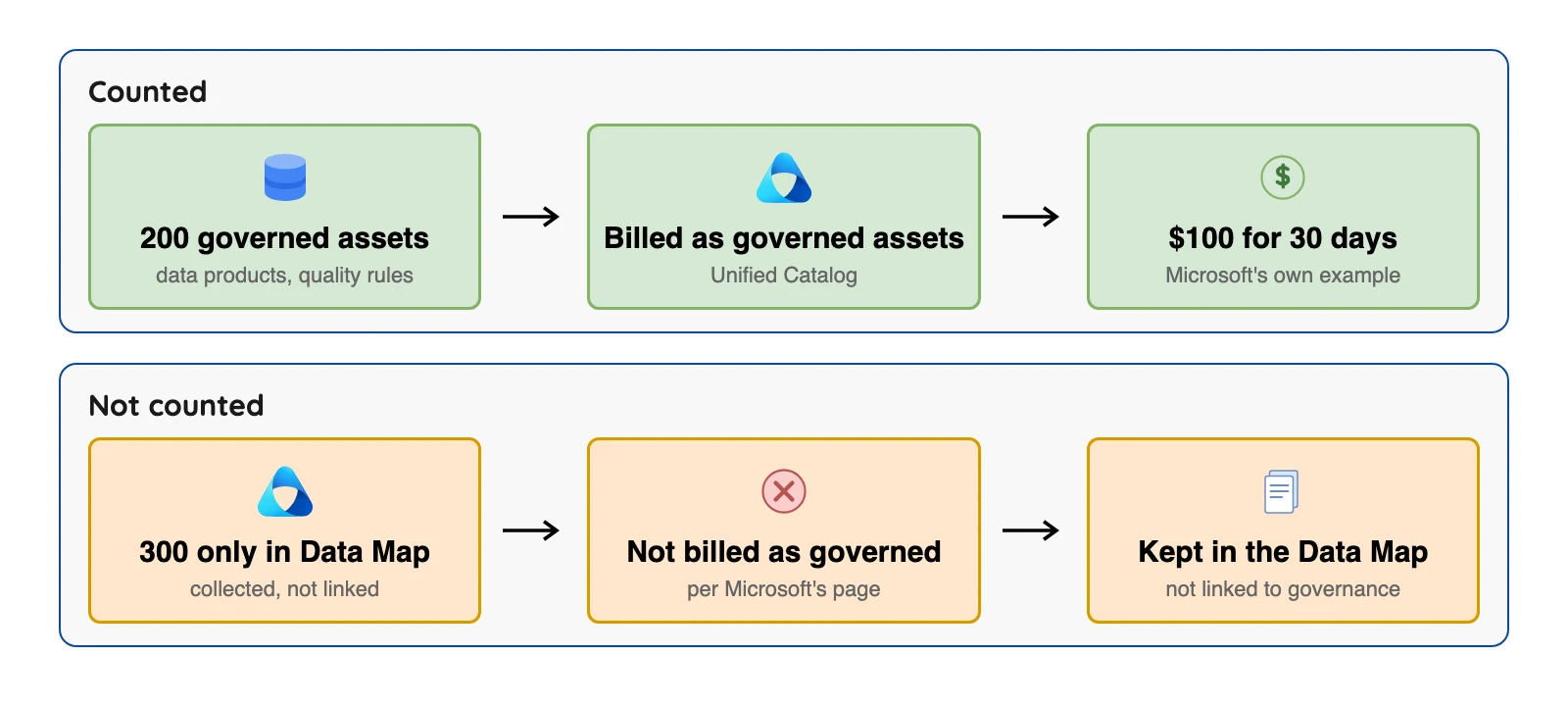
- The Azure pricing page bills Unified Catalog per governed asset, and the monthly charge for a managed asset is prorated by the days it is governed in the billing cycle.
- Governed assets can be tables, views, AI models and semantic models that are linked to governance concepts.
- A Data Map starts at 1 Capacity Unit, which supports up to
25operations per second and up to10 GBof metadata.
Where it falls short
- Per-unit rates didn't show in the pricing page text we fetched. Its own example says 200 governed assets cost $100 for 30 days without discounts.
- Only assets linked to governance concepts count as governed assets, and the Data Map needs an additional Capacity Unit for every
10 GBof metadata storage. - Governing data in other clouds such as AWS or GCP may incur data transfer and API call charges.
- Purview provisions a storage account and an Azure Event Hubs account as managed resources in your subscription, which may carry separate charges that in most cases will not exceed 2% of scanning charges.
- Microsoft's Learn page lists Data Security Posture Management as in preview.
Based on the worked example on the Azure Purview pricing page, October 2026.
8. Collibra: for large teams with formal governance programs
Collibra home page, October 2026.
At a glance: a governance product that, on its product page, says it automates workflows and centralizes policies to create a single source of truth.
What's good
- Its page lists a shared language: a consistent understanding of business terminology, rules and metrics in one location.
- It lists assigning roles and responsibilities to protect data assets from unauthorized access.
- It lists automated compliance checks that flag violations.
- It says AI-driven automation and workflows can speed up curation, classification and governance tasks.
- It says workflows can be embedded into Slack and Microsoft Teams for approvals.
- It says data issues can be submitted, tracked and resolved with automated incident workflows.
Where it falls short
- No price is shown. The page points to a "Request a demo" button, and a pricing page we tried returned an error on October 1, 2026.
- We didn't find the deployment model stated on that page.
- We also found no connector count on that page.
9. OpenMetadata: for teams that want an open-source catalog
OpenMetadata home page, October 2026.
At a glance: the OpenMetadata docs home says to document, discover and govern your data assets end to end. Its GitHub page lists the Apache-2.0 licence.
What's good
- The docs home lists setup guides for Discovery, Lineage, Observability, Insights, Data Contract and Governance.
- It describes managing data quality checks with version-controlled configurations.
- It lists an upgrade path with compatibility checks and safe rollback options.
- Its Quick Start uses a hosted sandbox or a local Docker setup, so you can try it before you deploy.
- The GitHub page says it comes with 130+ connectors, open metadata standards, semantic search, APIs, SDKs and an MCP server.
Where it falls short
- The docs home says to deploy for production using Kubernetes, cloud-managed services or bare metal, so you run and upgrade it yourself unless you buy a managed version.
- We didn't check any managed offering or Iceberg support, so we say nothing about either.
10. DataHub: for teams that want an open-source catalog with a cloud option
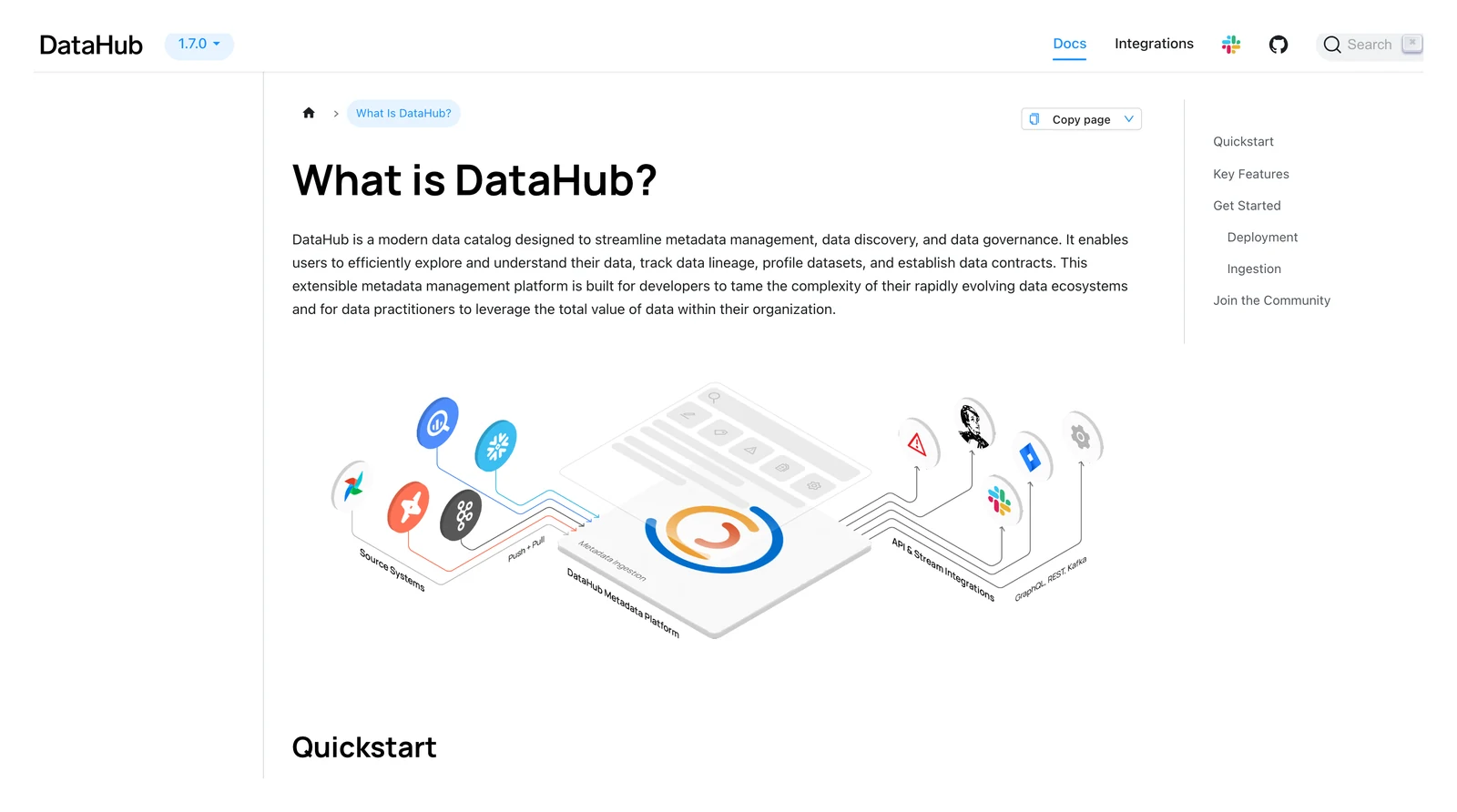
DataHub home page, October 2026.
At a glance: the DataHub docs call it a modern data catalog designed to streamline metadata management, data discovery and data governance, and list self-hosting on Kubernetes plus a managed DataHub Cloud. Its GitHub page lists the Apache-2.0 licence.
What's good
- The docs say discovery can search dashboards, datasets, ML models and raw files.
- They list governance (define ownership and track PII) and quality and observability (automated anomaly detection, assertions and data contracts).
- They say DataHub supports ingestion by UI and CLI.
- The GitHub page says the self-hosted option has 150+ integrations and column-level lineage.
- DataHub's Google Cloud trial page says a 21-day trial gives you a dedicated Cloud instance managed by the DataHub team, and it lists SLA-backed 99.5% availability for DataHub Cloud.
Where it falls short
- Self-hosting means running it yourself: the docs say to start with a CLI command or deploy to production with Docker or Helm charts, and the GitHub page calls self-hosting best for teams comfortable running their own stack.
- The trial page lists enterprise lineage views, governance workflows and AI capabilities as not available in open source.
- We found no DataHub Cloud price (its pricing path returned an error on October 1, 2026), so we state none.
11. Great Expectations: for teams that write Python
Great Expectations home page, October 2026.
At a glance: the Great Expectations docs say its Core library is a Python library for building and running data validation workflows, built around rules called expectations. The repository licence is Apache 2.0.
What's good
- The docs define an Expectation as a verifiable assertion about data.
- Every workflow follows the same four steps: set up an environment, connect to data, define Expectations and run Validations.
- Actions can send validation results as email, Slack or Microsoft Teams alerts.
- Data Docs are human-readable pages that hold your Expectation Suite definitions and Validation Results.
- You can apply the same Expectation Suite to different Batches of data.
Where it falls short
- It validates data, so you write the rules yourself and run them in code.
- The docs' scheduled-testing example needs an orchestrator to trigger the workflow.
- Its blog post of May 2026 announced that GX Cloud would no longer be publicly available beginning June 1.
- The same post says Fivetran will become the steward of the open-source community and GX Core, which it says will continue as an open-source, community-driven project.
Tools that manage master data
Sales has one customer list and finance has another. Master data is the core list of things your business cares about, such as customers and products, and master data management (MDM) keeps one trusted record of each so nobody holds two versions.
12. Informatica: for large companies that want many data jobs from one vendor
At a glance: Informatica's MDM page describes MDM as the process of creating and maintaining a single, trusted record for customers, products and more. Salesforce completed its acquisition of Informatica on November 18, 2025, per Salesforce's press release.
What's good
- Its site lists catalog, integration, quality, MDM and governance products, so it spans several of the five jobs.
- Its pricing page says Informatica Processing Units (IPUs) give access to all eligible cloud services listed in its Cloud and Product Description Schedule.
- The page's menu lists Free Cloud Data Integration.
- The Cloud and Product Description Schedule (version
39.2, effective September 11, 2026) shows Database Ingestion and Replication CDC falling from 6.5 IPU per million rows for the first 15 million to 0.55 up to 750 million and 0.05 above that.
Where it falls short
- The pricing page explains IPUs, a usage meter, and ends with a "Get Quote" button. No dollar price per unit appears, and the rates by service live in the separate schedule, so get a quote before you budget.
- Under the IPU model, unused IPUs do not carry over to the next month, and under the Flex IPU model they are consumed over an annual period instead.
- Flex IPU use above your subscription is charged at the overage fee in your order, and the fee is not published.
- IPU and Flex IPU must be provisioned separately and may not be deployed in the same Org.
- The schedule does not say whether a volume tier applies to your whole quantity or only to the units inside each band.
13. Semarchy xDM: for teams that want a focused MDM tool
Semarchy xDM home page, October 2026.
At a glance: Semarchy's platform page says it handles customer, product, supplier, location and reference data, plus any domain you model, in one model.
What's good
- Deployment choice: the page lists SaaS, on-premises, cloud and Snowflake.
- It says you can write custom match rules or use vector embeddings for entity resolution with SemQL, its SQL-like language.
- It says lineage is tracked down to the individual record.
- It says generated REST APIs connect ERP, BI, ML models or external targets.
- The page offers a free trial.
Where it falls short
- No price is published, so you'll have to contact the company for a quote.
Where all-in-one suites fit
Fivetran's guide on its site argues that unified tools reduce the work of running many point tools. That is a vendor view. The same page calls its own list "specialized data management tools you can assemble alongside others."
Choose a suite if you already have one vendor, a budget for a contract and few engineers to wire tools together. Choose separate tools if you want open source, a lower starting cost or the freedom to swap one part later.
Other names worth knowing
Atlan's pricing page shows no price and a "Start the conversation" prompt. Alation and Ataccama appear in several rival lists, but we didn't check their pages, so we say no more.
Qlik's own Talend page says the open-source version of Talend Studio was retired on January 31, 2024, so be wary of lists that still recommend it as a free option.
A zero-licence starting stack (and what it still costs)
Here's one way to start with no licence fees, using only prices shown above. Run Airbyte Core yourself, query in BigQuery under its free 1 TiB of queries a month, catalog with OpenMetadata, and check rules with Great Expectations. The software price is $0 for each of those pieces on the free terms listed above.
"No licence" does not mean "free." You still pay for servers, for BigQuery storage and any queries past the free tier, and for the engineers who keep four tools working. A paid starting point is Airbyte Cloud Standard at $20 a month with 5 credits, which swaps the server work for a bill.
How to choose a data management platform
- Name the pain. Data people can't reach needs a pipeline and a store. Data they don't trust needs a catalog, quality checks or master data.
- Check the meter. Rows, credits, scanned bytes, governed assets and processing units all grow differently, and that's where bills surprise people.
- Count who will run it. Open-source tools are free to license, but they still need servers and people.
- Ask for the missing price in writing. Collibra, Semarchy and Informatica each want you to ask for a quote.
- Test one tool before adding a second. Add jobs once the first one works.
Snowflake, BigQuery and Databricks all document support for Apache Iceberg, an open table format for data kept in your own storage (see the Iceberg docs of Snowflake, BigQuery and Databricks). If you keep data there, the copy step matters a lot. OLake Go, covered in the first group above, writes Iceberg tables through catalogs those platforms use: Snowflake Horizon, BigLake and Unity Catalog.
The short version, again
A data management platform is a set of jobs: move the data, store it, find it, check it and agree on one master record. Match each job to a tool, and add them in the order your problems show up.
The cheapest way to start is usually a free tier or an open-source tool for the first job. If a vendor doesn't publish a price, ask for a written quote before you commit.