9 Best Data Quality Tools in 2026, Compared
32 min read
Key takeaways
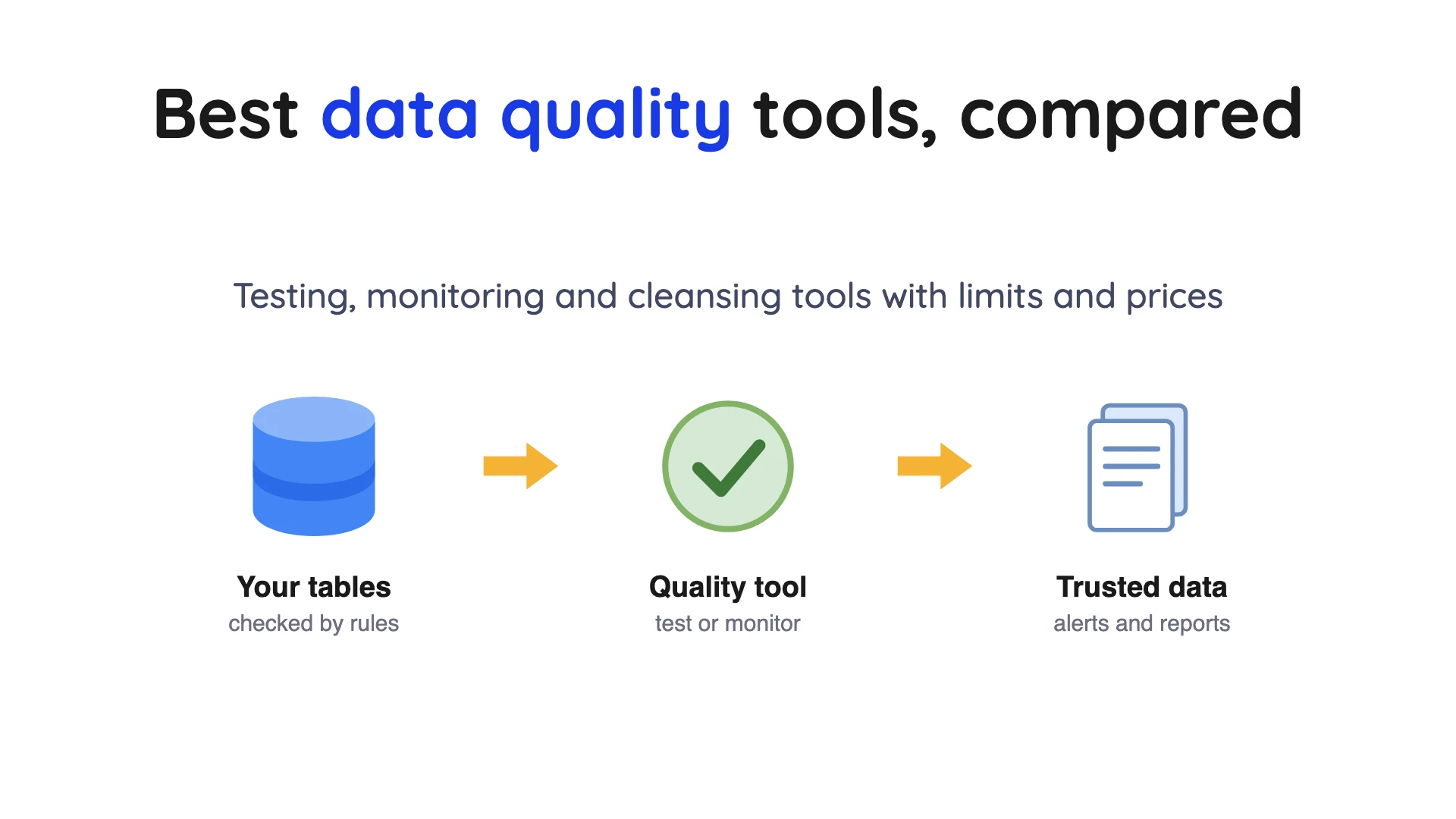
"Data quality tool" means three different jobs.
If you want rules you write and run in a pipeline, start free with Great Expectations, Soda Core, dbt tests, Deequ or OpenMetadata (a free data catalog with quality tests). If you want something to watch production tables for surprises, look at Elementary (free if you use dbt) or quote-based platforms such as Monte Carlo and Anomalo. For profiling, cleansing and governance in an enterprise suite, look at Informatica Data Quality and Ataccama ONE (a data quality platform).
Most paid platforms don't publish a price. Ask for a written quote and a trial before you get attached.
- Free options exist. Great Expectations Core, Deequ and Elementary's open-source tool use the Apache 2.0 licence (Great Expectations, Deequ, Elementary) (checked Oct 2026). Soda Core uses the Elastic License 2.0 (checked Oct 2026), not Apache or MIT, so read it before you build on it.
- Fit beats features. dbt tests and Elementary's open-source tool only help if you already use dbt. Deequ needs Apache Spark (a big-data engine), so no Spark, no Deequ.
IBM (International Business Machines) defines data quality as how well a dataset meets criteria for accuracy, completeness, validity, consistency, uniqueness, timeliness and fitness for purpose, according to IBM's data quality topic page. A data quality tool checks those things for you, so a wrong number gets caught before it reaches a report. Last reviewed October 2026.
What a data quality tool actually does
The simplest check is a rule, such as every order having a unique ID. dbt's documentation on data tests uses that very example, where the order_id column in the orders model should be unique.
Rules catch the problems you thought of. Observability tools go after the ones you didn't. They record facts about each table, such as how many rows arrived and how fresh the data is, and flag anything that breaks the usual pattern.
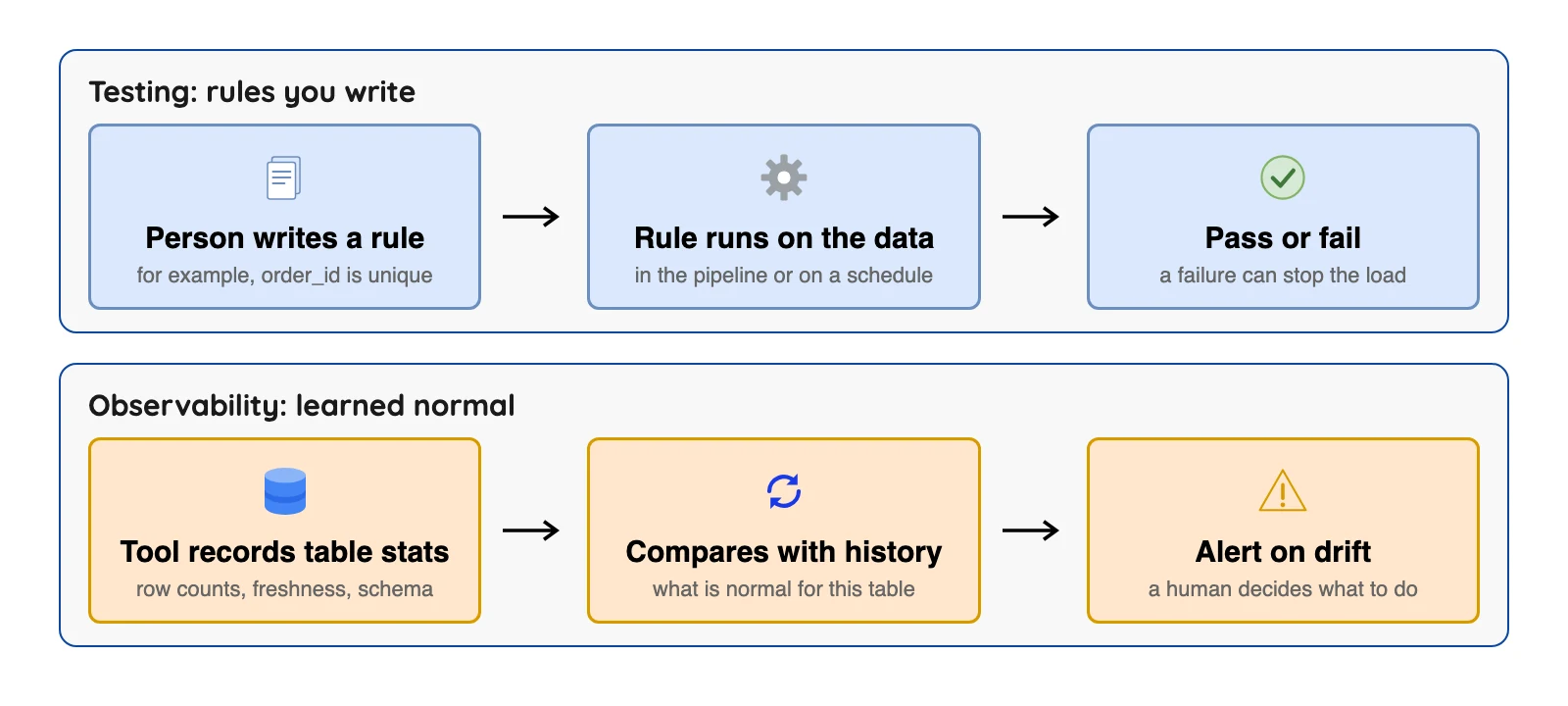
The tool turns each rule into a query that hunts for bad rows, and you get pass or fail.
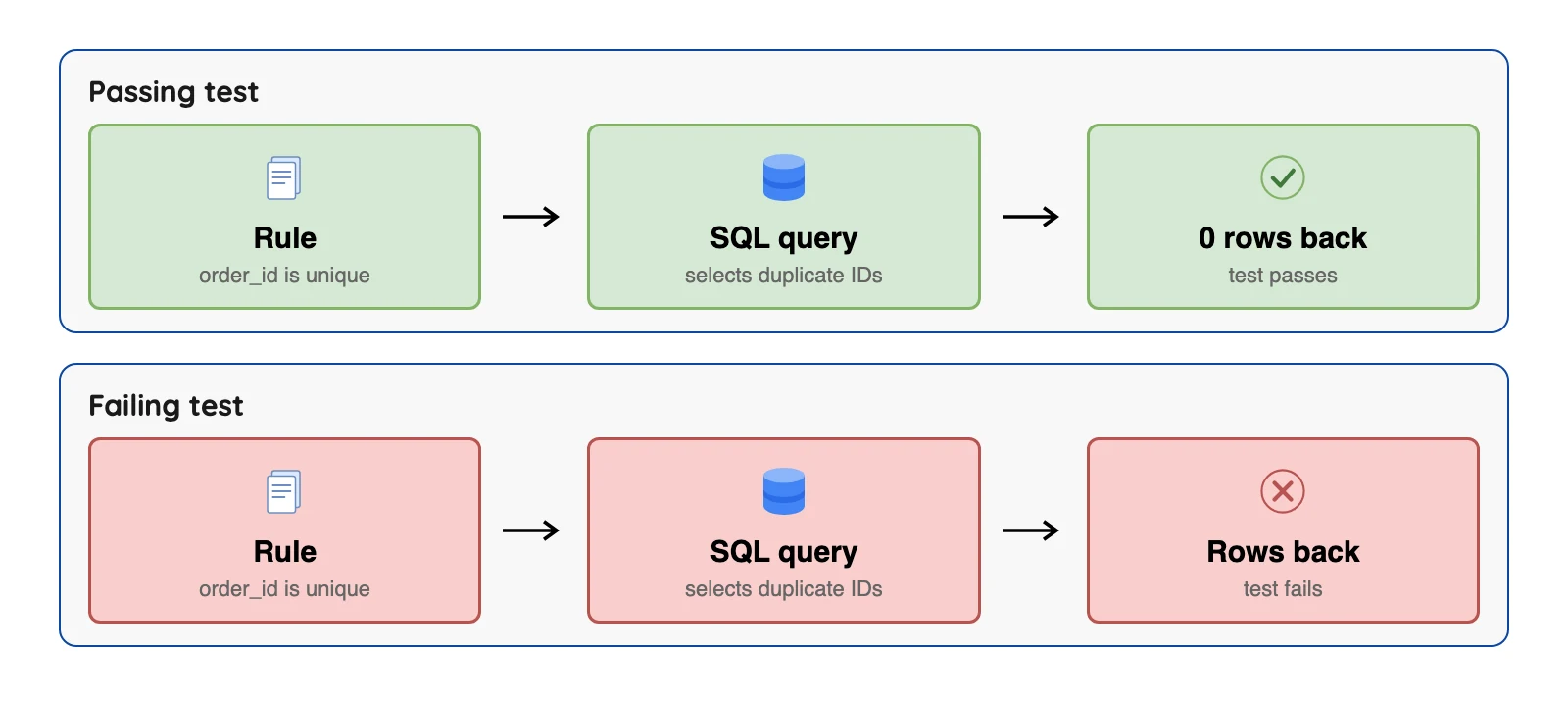
Original diagram based on dbt's data test documentation, October 2026.
Cleansing is the third job: finding duplicate records, fixing formats and matching names, which the big enterprise suites handle. Data catalogs (a searchable list of your data) are now adding quality checks too.
How we picked
Each tool had to check data quality as a main job, publish documentation or a pricing page we could read, and still be maintained. Vendor facts come from each vendor's own pages, read in October 2026. We did not run the other tools.
Tools whose pages we didn't read, and data quality features inside warehouses, are left out.
Within each group the order is not a ranking. We use no vendor testimonials and no comments from people who sell a rival tool.
Data Quality Tools at a Glance
| Tool | Main job | Licence | Free option | Price shown on its own page |
|---|---|---|---|---|
| Great Expectations | Rules in a pipeline | Apache 2.0 (GX Core) | GX Core | GX Core is free; GX Cloud is no longer publicly available, per Great Expectations' May 2026 post |
| Soda | Rules and monitoring | Elastic License 2.0 (Soda Core) | Soda Core; Free plan at $0 | Team $750 a month; Enterprise custom (checked Oct 2026) |
| dbt tests | Rules in a dbt project | Apache 2.0 (dbt Core) | Yes, free Developer plan | Starter $100 per user a month (checked Oct 2026) |
| Elementary | Monitoring for dbt | Apache 2.0 (OSS tool) | Yes, one dbt project | Cloud: "Talk to us"; not published (checked Oct 2026) |
| Deequ | Rules on Spark | Apache 2.0 | Yes | Free; you pay for Spark compute |
| OpenMetadata | Catalog with quality tests | Apache 2.0 | Yes | Free; you run it |
| Monte Carlo | Production monitoring | Licence not stated | Not mentioned | Not published; credits by tier (checked Oct 2026) |
| Informatica Data Quality | Cleansing and governance | Proprietary | Trials of other products linked | Consumption based; no dollar price shown (checked Oct 2026) |
| Ataccama ONE | Cleansing and governance | Proprietary | Not mentioned | Not published (checked Oct 2026) |
Sources: Great Expectations update (6 May 2026), dbt Core, Soda pricing, dbt pricing, Elementary pricing, Deequ, OpenMetadata, Monte Carlo pricing, Informatica pricing, Ataccama (checked Oct 2026).
The three jobs, and which tool fits
| Your job | Tools that do it | Where they fall short |
|---|---|---|
| Rules you write and run in a pipeline | Great Expectations, Soda Core, dbt tests, Deequ, OpenMetadata | They only catch problems you thought of |
| Watching production tables for surprises | Elementary, Monte Carlo, Anomalo | Paid tiers rarely show a price; Elementary's open-source tool needs dbt |
| Profiling, cleansing and governance | Informatica Data Quality, Ataccama ONE | No dollar price shown; sold as enterprise suites |
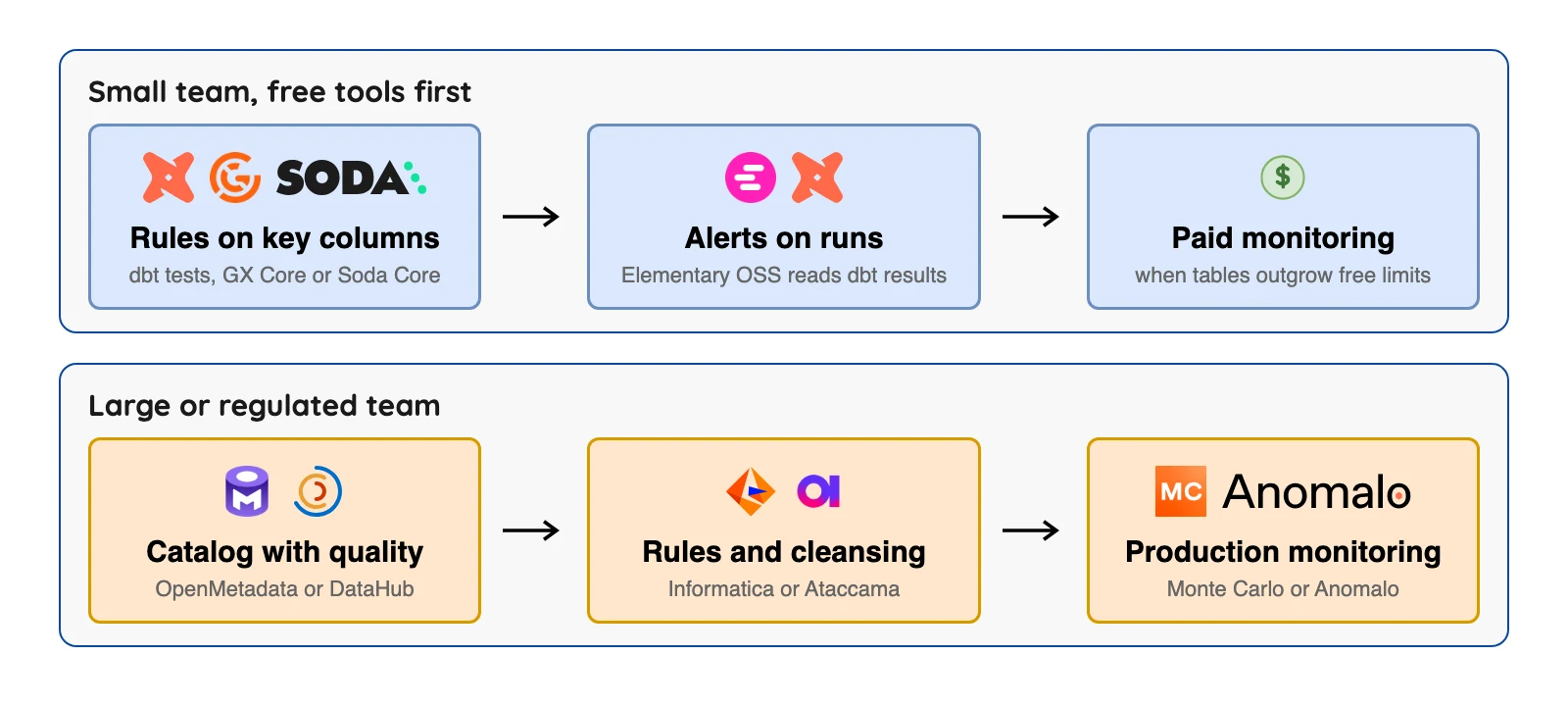
The order in the picture is our suggestion. Our read: small teams gain most from a few rules on key columns, then alerts. Large or regulated companies often begin on the catalog and governance side.
The 9 data quality tools, one by one
1. Great Expectations: rules written in Python
At a glance: A Python library for data tests. Its paid cloud service is no longer publicly available.
Great Expectations (GX) is built around the Expectation, which its docs describe as a verifiable assertion about data. You connect to data, write Expectations, group them into suites and run them. Its docs mention SQL tables and Spark dataframes (tables held in Python memory) as data to validate.
GX Core is free under the Apache 2.0 licence (checked Oct 2026). On 6 May 2026 Great Expectations posted an update saying "GX Cloud will no longer be publicly available beginning June 1."
The same post says "Fivetran will become the new steward of the Great Expectations open source community and the GX Core project." Under the planned transition, it adds, GX Core will continue as an open source, community-driven project.
Where it fits
- Rules live in code, so you can review and version them like anything else you write.
- It can validate SQL tables and Spark dataframes, so one tool can check several kinds of data.
- In production, a Checkpoint runs your validations, and Actions can send the results to email, Slack or Microsoft Teams, per the GX Core overview.
- It writes Data Docs, human-readable pages that host your Expectation Suites and Validation Results (GX Core overview).
- One Expectation Suite can be applied to different Batches, so the same checks can cover several tables or time slices (GX Core overview).
Where it falls short
- GX Cloud is no longer publicly available from 1 June 2026, per GX's own May 2026 post (checked Oct 2026), so GX Core is the way in.
- Stewardship of GX Core moves to Fivetran under the planned transition (same post).
- You write the rules yourself. It checks data against them, and that's all. It does not move, store or catalog data.
- GX Core is a Python library, so someone has to write Python to set up the connections, Expectations and runs (GX Core overview).
- The docs' scheduled-testing example has an orchestrator trigger the run, so plan to bring your own scheduler (GX Core overview).
Pick something else if you want the tool to learn normal patterns for you. Elementary or Monte Carlo is the better place to look.
2. Soda: data contracts and a free hosted tier
At a glance: A data quality platform whose engine, Soda Core, runs checks written in YAML (a simple text format).
On its GitHub page, Soda describes Soda Core as a data quality and data contract verification engine.
A data contract is a written agreement about what a dataset must look like, including its columns, types and value ranges. Soda's docs split the work into testing during development and observability in production.
Soda shows its prices openly. The pricing page (checked Oct 2026) lists a Free plan at $0 a month, a Team plan at $750 a month, and Enterprise at custom pricing. The catch: the price of one Soda Processing Unit (SPU) is not shown.
| Plan | Price | What the page lists |
|---|---|---|
| Free | $0 per month | Free SPUs, pipeline testing, metrics observability, alerting and ticketing integrations, no credit card required |
| Team | $750 per month | All Free features, unlimited users, pay as you go for additional SPUs, catalog integrations, add-ons |
| Enterprise | Custom pricing | All Team features, collaborative data contracts, no-code interface, AI-powered data quality features, audit logs, custom roles and RBAC, private deployment, SSO, premium support, annual billing and volume discounts |
Source: Soda pricing page (checked Oct 2026).
Where it fits
- A published price for the paid Team plan. Several vendors in this category show none.
- Soda Core supports many sources, including PostgreSQL, Snowflake, BigQuery, Databricks and DuckDB, per its GitHub page.
- The Free plan at $0 includes pipeline testing, metrics observability and alerting integrations, with no credit card required (pricing page (checked Oct 2026)).
- You can run it three ways: Soda Core in your pipelines, a Soda-hosted Runner, or a Self-hosted Runner in your own Kubernetes environment, where the docs say data stays within your network (deployment options docs) (checked Oct 2026).
- Its integrations docs list Slack, Microsoft Teams, Jira, ServiceNow and webhook connections for alerts and tickets (checked Oct 2026).
Where it falls short
- Soda's deployment options docs list the Python libraries (Soda Core) with no observability features, and say a Soda Runner is required for them (checked Oct 2026).
- Its licence file is the Elastic License 2.0 (checked Oct 2026), not Apache or MIT. The deployment options docs call the Python library open source, but have a lawyer read the licence before you build a product on it.
- Features such as SSO (single sign-on), audit logs and private deployment appear under Enterprise on the live pricing page (checked Oct 2026).
- The hosted and self-hosted Runners cannot scan in-memory sources such as Spark or DataFrames. Soda Core is the option for those (deployment options docs) (checked Oct 2026).
- The Self-hosted Runner needs Kubernetes expertise, per the same docs page (checked Oct 2026).
- Soda Core
v4renamed its packages (for examplesoda-postgres), and legacyv3packages are namedsoda-core-{data source}, so check which version a guide or install command targets (GitHub) (checked Oct 2026).
Pick something else if you only need tests and already use dbt. dbt's free open-source distribution already includes its built-in tests.
3. dbt tests: data already transformed with dbt
At a glance: Tests built into dbt, a tool that transforms warehouse data with SQL (Structured Query Language).
dbt's docs describe data tests as assertions you make about your models and other resources. Each test is a query that returns the bad rows, and the test passes when zero rows come back. dbt ships four generic tests: unique, not_null, accepted_values and relationships.
dbt Core is free under Apache 2.0 (checked Oct 2026). The pricing page (checked Oct 2026) lists a free Developer plan (1 seat, 3,000 successful models built a month) and a Starter plan at $100 per user a month.
Fivetran announced in a press release the completion of its merger with dbt Labs on June 1, 2026.
dbt's docs show an orders example: a short block of YAML covers the order ID, the status values and the link to customers, and the dbt test command runs it all. The docs translate that YAML into four plain-English checks and say a test passes when zero rows are returned.
Where it fits
- No new tool to learn if you already use dbt.
- Four common checks come built in, and you can write your own in SQL.
- Newer unit tests check your SQL logic on small made-up inputs before a model is built, from dbt version
1.8(unit tests docs) (checked Oct 2026). - Singular tests are plain SQL: you write the exact query that returns the failing records (dbt data tests docs).
- Open-source packages such as
dbt-utilsanddbt-expectationsadd more generic tests (dbt data tests docs). - The
error_ifandwarn_ifconfigs set custom failure thresholds for a test (dbt data tests docs).
Where it falls short
- Ordinary data tests only run after a model is built, according to dbt's own unit test docs (checked Oct 2026).
- It only tests what dbt manages. Data that never passes through dbt is invisible to it.
- Its tests return failing rows and pass on zero rows; the docs we read do not describe cleansing or learned alerts.
- Unit tests work on SQL models only, per the dbt unit test docs (checked Oct 2026).
- On paid plans, models that build successfully are counted even if the run later fails: a job of 100 models that fails after 51 counts 51 (dbt billing docs) (checked Oct 2026).
Pick something else if you don't use dbt. Great Expectations or Soda Core work without it.
Starter lists five developer seats and 15,000 successful models built a month, so the "per user" price looks aimed at a small team. This is our read.
| Plan | Price | Limits listed |
|---|---|---|
| Developer | Free | 1 developer seat, 3,000 successful models built per month, 1 project |
| Starter | $100 per user per month | 5 developer seats, 15,000 successful models built per month, 5,000 queried metrics per month, 1 project |
| Enterprise | Custom pricing | 100,000 successful models built per month, 20,000 queried metrics per month, 30 projects |
| Enterprise+ | Custom pricing | 100,000 successful models built per month, 20,000 queried metrics per month, unlimited projects |
Source: dbt pricing page (checked Oct 2026).
4. Elementary: adding alerts to a dbt project
At a glance: An open-source command line tool and dbt package that turn your dbt test results into a report and alerts.
Elementary's GitHub page calls its tool the open-source CLI for dbt-native data observability. The Elementary dbt package collects results and feeds a report and alerts to Slack and Microsoft Teams. Anomaly detection tests are added as normal dbt tests.
The open-source tool uses Apache 2.0 (checked Oct 2026). Elementary's open-source docs list 14 supported dbt adapters, including Snowflake, BigQuery, Redshift, Databricks and PostgreSQL.
Where it fits
- Free to start, and the setup lives right in your dbt code.
- A 30-day free trial of the paid Elementary Cloud is listed on its pricing page (checked Oct 2026).
- Elementary says Cloud "can't access your data". That is the vendor's claim, and we did not test it.
- Alerts can go to Slack and Microsoft Teams, with custom channels and tagging of owners (GitHub).
- The CLI can send alerts and self-host the observability report, a view of your dbt runs and all dbt test results (OSS docs).
- Cloud's Scale plan lists anomaly detection, column-level lineage, incident management and an MCP server (pricing page (checked Oct 2026)).
Where it falls short
- The docs say the open-source tool "covers a single dbt project". Teams with several projects are pointed to Cloud (checked Oct 2026).
- Cloud plans (Scale, Enterprise and Unlimited) all say "Talk to us" (checked Oct 2026) instead of a price.
- The open-source tool depends on dbt. Elementary's docs say Cloud can connect to a warehouse without dbt, which helps if you're not a dbt shop (checked Oct 2026).
- SSO and RBAC are listed under Enterprise, not Scale (pricing page (checked Oct 2026)).
- The AI Layer add-on has its own credit-based pricing, also marked "Talk to us" (pricing page (checked Oct 2026)).
- The open-source CLI reads the results that the Elementary dbt package collects in your warehouse, so you install both the package and the CLI (GitHub).
Pick something else if your data isn't in dbt. Soda Core and Great Expectations don't need it.
Elementary says its pricing is based on seats and environments. The page shows no dollar prices, and the cost of an extra 1K tables is not shown (checked Oct 2026).
| Plan | Price | Limits listed |
|---|---|---|
| Scale | "Talk to us" | Up to 10 editor seats, up to 1K tables |
| Enterprise | "Talk to us" | Up to 20 editor seats, 40 viewer seats, up to 3K tables |
| Unlimited | "Talk to us" | Unlimited editor and viewer seats, up to 3K tables |
Source: Elementary pricing page (checked Oct 2026).
5. Deequ: very large data on Apache Spark
At a glance: A free library from AWS (Amazon Web Services) Labs that runs "unit tests for data" on Spark.
The Deequ repository on GitHub describes a library built on Apache Spark, written in Scala, with a Python wrapper called PyDeequ. Its repository lists data profiling, anomaly detection over time and automatic constraint suggestion, and its rule language includes completeness and uniqueness checks.
Deequ uses Apache 2.0 (checked Oct 2026), and its latest release on GitHub, 2.1.0, came out on 2026-09-16.
Where it fits
- Free, and built on Spark, an engine made for large datasets.
- It can suggest checks from the data, which helps when you have no idea where to start.
- A declarative rule language called DQDL is supported.
- It is designed for very large datasets: the README says "think billions of rows".
- It works on anything you can fit into a Spark dataframe, including CSV files, database tables, logs and flattened JSON (README).
- Computed metrics can be stored and queried with a
MetricsRepository, and updated incrementally as data grows or partitions change (README).
Where it falls short
- You need a Spark setup and a matching Java version. Release
2.1.0and later need Java11, and each release targets specific Spark versions, so check before you install (README) (checked Oct 2026). - The repository says row-level checks in DQDL mode work only for certain rule types, and dataset-level rules such as
RowCountandMeanare marked as skipped (checked Oct 2026). - It's a library from AWS Labs, not an AWS managed service.
- The Deequ
2.xtable lists Spark3.1through3.5, and Spark3.0and earlier need a Deequ1.xrelease (README) (checked Oct 2026). - It is a Scala library, and Python use goes through PyDeequ, a separate Python interface (README).
Pick something else if you have no Spark. Soda Core and Great Expectations are Python-based and do not need Spark.
6. OpenMetadata: quality tests inside a free catalog
At a glance: An open-source data catalog with data quality tests built in.
Per its docs, you can run tests at the table and column level, write no-code test cases from the screen and use a built-in profiler. Alerts fire when a test fails. Lineage (where data came from) and governance are covered too, all under the Apache 2.0 licence (checked Oct 2026).
Where it fits
- One free tool for the catalog, the tests and the alerts, with no licence fee.
- No-code tests let analysts add checks without writing any Python.
- Its GitHub README says it has 130+ connectors (checked Oct 2026).
- The docs say quality tests are supported for all of its supported database connectors, with alerts, a health dashboard and a resolution workflow for failures (docs).
- Tests can be set up in the UI or in a YAML config file, and you can write your own tests and test suites (docs).
Where it falls short
- You run and upgrade it yourself unless you use a managed offering. The docs' production options are Kubernetes, cloud-managed services or bare metal (docs).
- Collate, which sells managed OpenMetadata, posted about a free managed tier in June 2024 with a waitlist (Collate's blog post). We did not confirm it is open today (checked Oct 2026).
- It's a full catalog with lineage and governance as well as tests.
- Quality is one feature among several in its docs. A team that only wants tests may not need all of it.
- Its connectors page marks each connector
PRODorBETA, and says aBETAconnector may have limitations or missing features (checked Oct 2026).
Pick something else if you only need pipeline tests. Great Expectations or dbt tests are lighter to carry.
7. Monte Carlo: broad production monitoring with a paid platform
At a glance: A paid observability platform that monitors your tables and traces issues.
Monte Carlo's pricing page (checked Oct 2026) says all tiers include Agent Observability, ML Observability and Data Observability. Its platform page describes monitors, anomaly data and lineage that shows what a problem touches downstream.
The pricing page (checked Oct 2026) lists four tiers: Start, Scale, Enterprise and Business Critical. Start allows up to 10 users, up to 1,000 monitors and 10,000 API calls a day.
Customers "buy credits", and the cost per credit depends on the tier. No dollar figure is shown, and a free trial is not mentioned. So you're guessing until you talk to sales (checked Oct 2026).
Where it fits
- Higher tiers add unlimited users and more API calls, up to
100,000a day. - The Scale tier lists SSO, SCIM, self-hosted storage, PII filtering and audit logging (pricing page (checked Oct 2026)).
- Integrations grow by tier: Scale adds lakes (Databricks, Hive, Glue, Azure Data Lake) and MySQL, Postgres and SQL Server, and Enterprise adds Oracle, SAP Hana, Teradata and Microsoft Fabric (pricing page (checked Oct 2026)).
- Business Critical adds a Dedicated Instance and disaster recovery that rolls over to a different region (pricing page (checked Oct 2026)).
Where it falls short
- No price is published on its pricing page (checked Oct 2026), so you have to ask for one.
- Its pricing and platform pages show no open-source edition (checked Oct 2026).
- Vendor claims on its site, such as faster resolution, come without a published method, so we do not repeat them.
- Start lists Data Warehouse, BI and ETL integrations. Lake and database integrations are listed from Scale up (pricing page (checked Oct 2026)).
- Support differs by tier: Start lists a 24-hour support SLA with self-guided onboarding, Scale 8+ hours and Enterprise 4+ hours (pricing page (checked Oct 2026)).
- Every tier is listed as "Pay per monitor", and no dollar figure for a credit or a monitor is shown (pricing page (checked Oct 2026)).
Pick something else if you have a small team and a tight budget. Elementary OSS (open source software) or Soda Free cost $0.
8. Informatica Data Quality and Observability: enterprise cleansing
At a glance: A cloud service inside Informatica's data management suite.
Informatica's pricing page (checked Oct 2026) says usage is measured in Informatica Processing Units (IPUs), and it shows no dollar price per unit. Its data quality page lists continuous profiling, cleansing, standardization, AI-generated rules and observability. It also mentions pay-for-what-you-use pricing, and its site links to free trials of other Informatica products.
Informatica's own cloud schedule (checked Oct 2026) says standard IPUs "do not carry over to the next month". Its Flex option is measured over a year instead.
Where it fits
- Its data quality page lists cleansing and standardization.
- It sits in a suite with integration and governance products, so one vendor can cover a lot.
- It states a pricing model and links to trials of other products (checked Oct 2026).
- Its Cloud and Product Description Schedule lists the Data Quality assets: rule specification, dictionary, cleanse, parse, deduplicate, labeler and verifier.
- It publishes rates in IPUs, so you can model usage before a quote: Data Quality is 0.38 IPU per compute hour for the first 2,000 hours and 0.152 above (schedule, version
39.2.1, effective 21 October 2026) (checked Oct 2026). - A real-time Data Quality option runs assets such as rule specifications and mapplets in real time, and the schedule says it is optimized for low-latency, low-volume use (schedule).
Where it falls short
- No dollar price per IPU is shown on its pricing page (checked Oct 2026), just a quote request. An AWS Marketplace listing for the wider cloud platform shows one bundle of 120 IPUs a month at $131,760 for 12 months (checked Oct 2026). That is a bundle list price, not a rate card, and it covers more than data quality.
- It's a proprietary cloud service.
- Standard monthly units that don't carry over can waste spend in a quiet month. Our read: that's the one to ask about.
- If usage passes the subscription, the monthly IPU model requires you to subscribe to more IPUs for the rest of the period, and Flex IPU charges an overage fee whose rate is not published (schedule). The Overage Protection add-on requires the monthly IPU model and does not apply to Flex IPU (checked Oct 2026).
- Address verification inside Data Quality Services needs a separate Premium Address Cleansing subscription or enough IPUs (schedule) (checked Oct 2026).
Pick something else if you only need rules in a pipeline. Free tools such as Soda Core cover that.
9. Ataccama ONE: governance-led teams that want rules and cleansing
At a glance: A data quality and governance platform, with a cloud option.
Ataccama's data quality page lists automated checks, monitoring, anomaly detection and remediation. The page says an AI agent writes and deploys rules, and that rules can run inside pipelines or as native Snowflake functions. We did not test either claim.
The platform works across multi-cloud and hybrid setups, per its page.
Where it fits
- Its page lists rules, monitoring and remediation in one platform.
- Its page mentions pushdown processing (running rules where the data sits), which it ties to security and performance.
- It supports hybrid setups, for companies that keep some systems on their own servers.
- No-code transformation plans can standardize values such as country codes, phone numbers and SKUs (page).
- Reports can be viewed in the platform or sent to Tableau or Power BI through an API (page).
- It detects similar rules and prevents duplicates, and the page says it streamlines versioning and approvals (page).
Where it falls short
- The page we read shows no prices and no free trial (checked Oct 2026). It offers an interactive walkthrough instead.
- It quotes return-on-investment and time-saved percentages with no method, so we won't repeat them.
- Connector counts weren't published on the page we read.
- The same page lists a data catalog, business glossary, data marketplace, reference data and multidomain mastering beside data quality, so it is a wide platform.
Pick something else if you want to try before you talk to sales. Soda, Great Expectations and Elementary all have a free way in.
Two others worth a look
Anomalo is an observability product that says it works in your own private cloud network (VPC, or virtual private cloud) or as a hosted service. Its home page shows no price and points to a demo (checked Oct 2026). DataHub, another open-source catalog under Apache 2.0, lists assertions and data contracts among its quality features, per its docs.
Which tool fits you?
No budget approved yet? Soda Free and Elementary OSS cost $0, and so does GX Core. Self-hosted tools cost servers and your time, and free cloud plans come with usage limits.
Which data quality tool fits you?
Question 1 of 5
What job do you want the tool to do?
The post says data quality tools do three different jobs, so start here.
Your first week with a free tool
- Pick the five columns your reports lean on most. Think order IDs, dates and amounts.
- Add
uniqueandnot_nullto every ID. One duplicated or empty ID can quietly double-count an order. - Add
accepted_valuesto status columns. A new, misspelled status then fails a test instead of silently vanishing from a chart. - Add
relationshipsbetween tables. It catches an order that points to a customer who doesn't exist. - Send failures to one chat channel. A test nobody sees is just a file.
Run it for a week before you shop for anything bigger. The failing tests show which tables deserve a monitoring tool.
Questions to ask a paid vendor
Get the answers in writing.
- What is one credit, unit or table worth in dollars on my tier?
- What counts toward usage: tables, monitors, rows scanned or users?
- Is there a trial or proof of concept on my own data?
- Which of my sources and warehouse are supported today, not on the roadmap?
- What happens to unused units at the end of the period?
- Can I export my rules and results if I leave?
Where data quality fits in the pipeline
Quality checks sit after data has been loaded, and sometimes after it's been transformed. The tools here don't copy data between systems; if your tables come from database replication, checks such as row counts compare a source against its copy.
Where OLake fits
OLake Go is an open-source extract-and-load tool with no transformation step. It reads Postgres, MySQL, MongoDB and SQL Server with change capture, Oracle, Db2 and S3 with full load and incremental sync, and Kafka topics. It writes Apache Iceberg tables or Parquet files, using any of the catalogs our docs list. Once the copy lands, a quality tool that can query those Iceberg tables through an engine such as Spark or Trino (see our engine list) can run checks such as a row count against the source. OLake Go writes Iceberg or Parquet, so the checks come from the tools above.
FAQ
Q1. What are data quality tools?
Q2. What is the difference between data quality and data observability?
Q3. Which data quality tools are free?
Q4. Do I need dbt to use a data quality tool?
Q5. How much do data quality tools cost?
Q6. Is Soda Core open source?
Q7. Should a small team buy a paid platform?
Q8. Where does OLake fit with data quality tools?
Conclusion
Start with the job you need done. Most teams can begin today for $0 with dbt tests, Great Expectations Core, Soda Core or Elementary. Move to a paid platform only after you know which tables hurt most, and ask each vendor for a written price.