Best ETL Tools in 2026: 15 Compared, Free to Enterprise
23 min read
Key takeaways
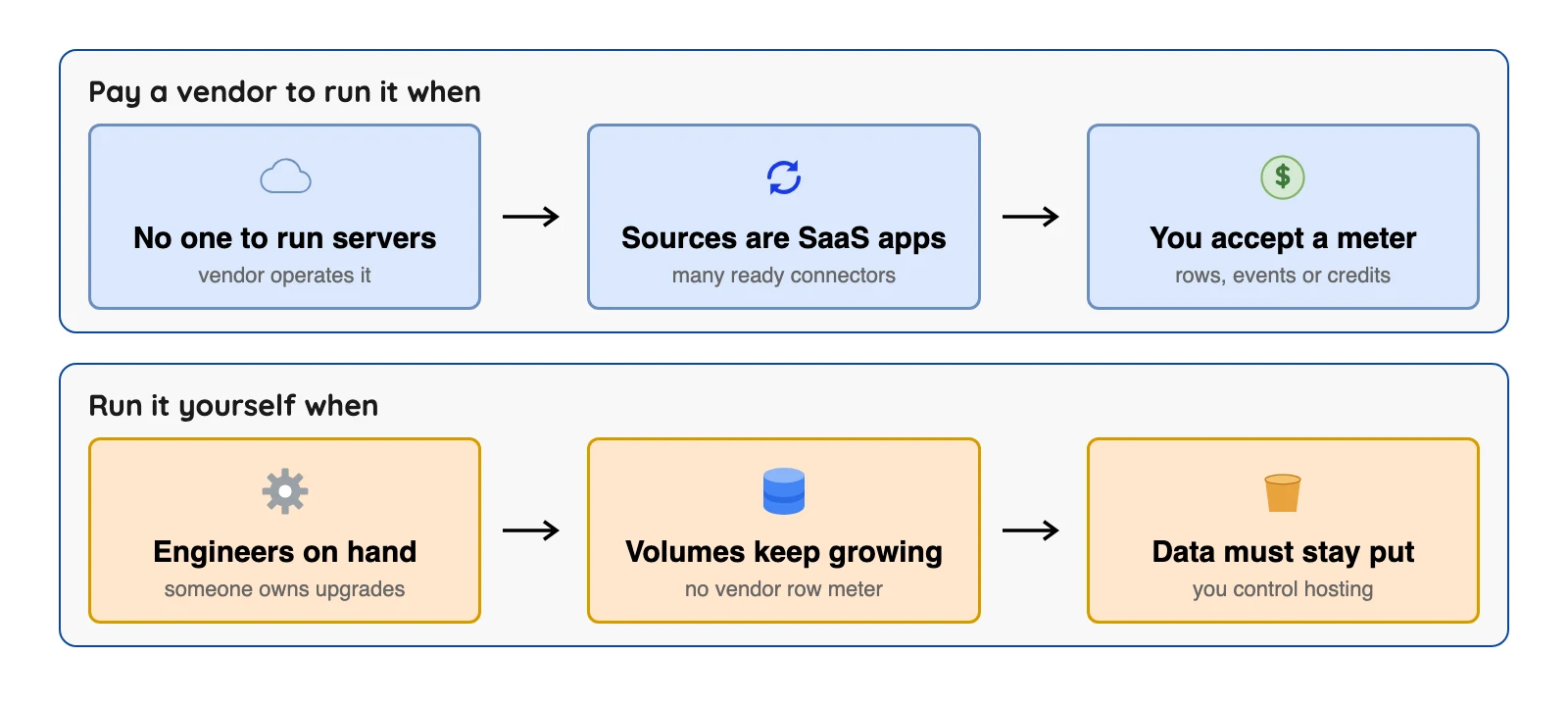
No single ETL (extract, transform, load) tool wins for everyone, and the same goes for its cousin ELT (extract, load, transform). The tools differ on who runs them and what they bill for. Want a vendor to run everything and can live with a usage meter?
Pick Fivetran.
Have engineers and like open-source code? Look at Airbyte or dlt.
Want database changes in Iceberg on your own storage? Look at OLake Go.
Already in one cloud? Use that cloud's tool, AWS Glue or Azure Data Factory.
Big company that needs governance? Informatica.
Prices below come from each vendor's own page (checked Oct 2026).
- ETL and ELT are two orders of the same steps. Most tools here can do either, so the label matters less than where your transforms run.
- The price is a meter, not a number. Run the same data through rows, events, credits, gigabytes or a flat fee. You'll get very different bills. Fivetran's pricing page prints no per-row rate, but its separate Service Consumption Table does (Standard starts at $495 per million MAR, checked Oct 2026). Matillion and Meltano Cloud show no dollar prices.
- Open-source tools have no licence fee. Airbyte Core, dlt and OLake Go (database changes into Apache Iceberg or Parquet) are free to run; you pay for servers and people.
- Check that a tool is still actively sold. Talend Open Studio was retired on 2024-01-31, Stitch steers new customers to Qlik Talend Cloud. Informatica, Rivery and Fivetran changed owners since late 2024.
ETL vs ELT in plain words
ETL means copying data out of a source, changing its shape, and then putting it in a destination. ELT flips the order and changes the shape later, inside the destination. Microsoft's architecture guide says ELT differs from ETL solely in where the transformation takes place.
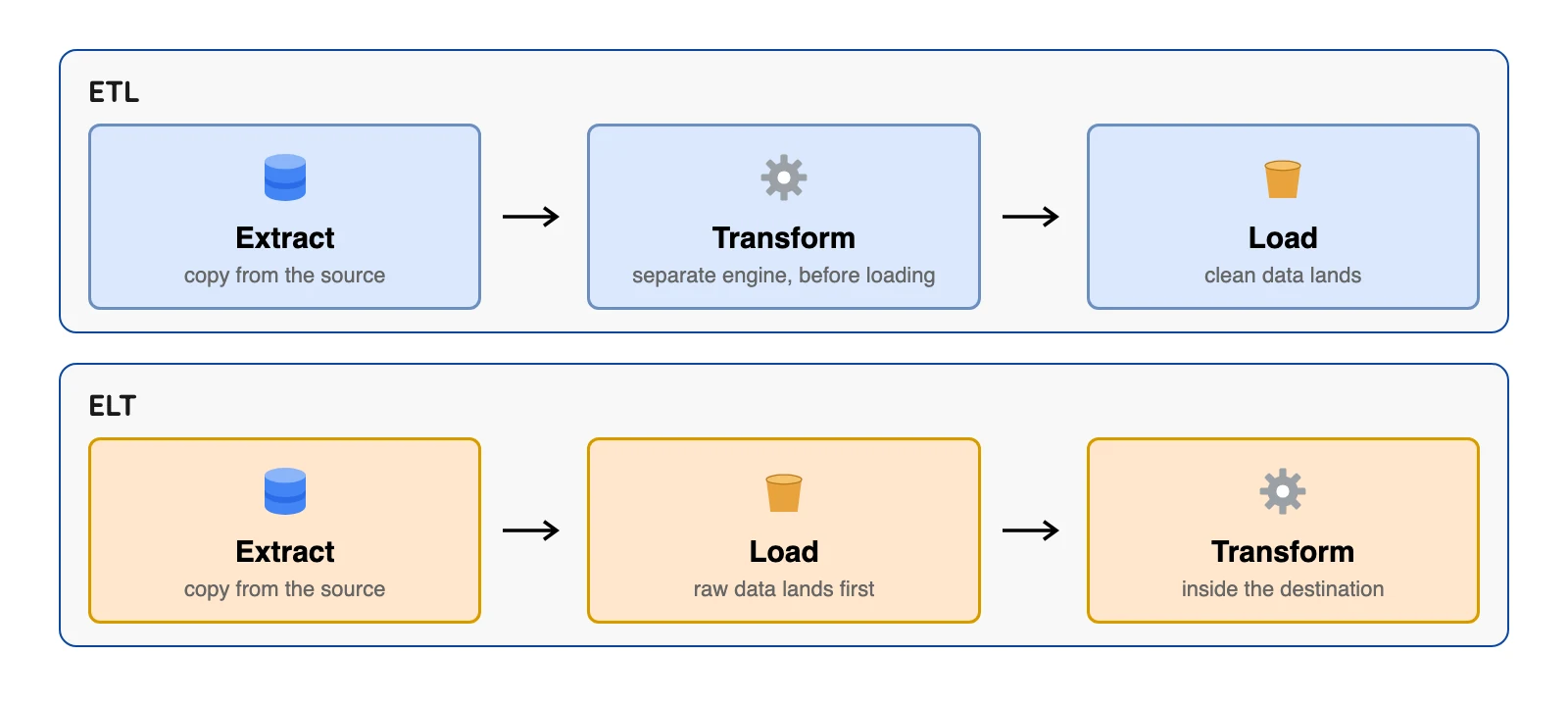
AWS says teams can use both, with ETL for some sources and ELT for the rest. On this page, "ETL tools" means both kinds. Some tools below only copy data and leave the reshaping to a second tool such as dbt (data build tool, which runs SQL transforms in the destination).
How we picked these tools
Each tool had to be still sold or maintained, move data between systems, and publish a way to try it. We checked each vendor's pricing and documentation pages in October 2026. Where a vendor hides a price, the table says "not published".
We did not run the other tools; this is a reading of vendor pages, not a lab test.
We left out Talend Open Studio (retired on 2024-01-31, per Qlik) and tools that only schedule jobs, such as Apache Airflow. The groups below aren't a ranking.
ETL Tools Compared at a Glance
| Tool | Kind | You are billed by | Price signal (checked Nov 2026) | Free way to start |
|---|---|---|---|---|
| Fivetran | Managed ELT | Monthly active rows | Standard from $495 per million MAR, in its Service Consumption Table | Free plan, 500,000 rows |
| Hevo | Managed ELT | Events | $299 a month, $265 billed yearly | 14-day free trial |
| Stitch | Managed ELT | Rows | From $100 a month | 14-day trial only |
| Integrate.io | Managed ETL | Flat fee | $1,999 a month | 14-day trial only |
| Skyvia | Managed, no-code | Records | $99 a month, $79 billed yearly | Free plan, 10,000 records |
| Rivery (Boomi) | Managed ELT | Credits | $0.9 per credit, Base plan | 14-day or 1,000-credit trial |
| Estuary | Managed streaming | Gigabytes plus connectors | $0.50 per GB plus connector fees | Free plan, 10 GB |
| Airbyte | Open source and cloud | Credits | Cloud from $20 a month | Core is free to self-host |
| OLake Go (ours) | Open source | Nothing for self-hosting | Open source (Apache 2.0), free to self-run; you pay for your own infrastructure | Free to self-host |
| Meltano | Open source | Nothing for self-hosting | Cloud prices not published | Free to self-host |
| dlt | Open-source Python library | Nothing for the library | dltHub plan $12,000 a month | Free library |
| Apache NiFi | Open-source flow tool | Nothing | Your own servers | Free to self-host |
| AWS Glue | Cloud service | Compute hours (DPU) | $0.44 per DPU-hour (ETL jobs), $0.308 on 6.0 and above | No free ETL tier |
| Azure Data Factory | Cloud service | Meters per activity | $0.25 per DIU-hour for data movement, US East | No free tier published |
| Matillion | Cloud ETL | Credits for run time | Not published | 14-day trial, 500 credits (Maia docs) |
| Informatica | Enterprise suite | IPUs (Informatica Processing Units) | Marketplace bundle $131,760 a year | Free plan, 20M rows |
OLake Go is our own tool and is not one of the 15 profiled below; the pick table explains where it fits.
Sources: Hevo pricing, Stitch pricing, Integrate.io pricing, Skyvia pricing, Rivery pricing, Estuary pricing, Airbyte Cloud release notes. Checked November 2026.
More sources: dltHub pricing, AWS Glue pricing and its price list for the Glue 6.0 rate, Azure Data Factory pricing, Informatica on AWS Marketplace. Checked October 2026.
The 15 Best ETL Tools in 2026
Managed services you pay a vendor to run
1. Fivetran: best for hands-off connectors
At a glance
- Billed by: monthly active rows (MAR), meaning rows that changed in a month, counted per connection
- Price: the Free plan covers up to 500,000 MAR; paid rates are in its Service Consumption Table, not on the pricing page (Standard from $495 per million MAR plus a $5 base per connection, Enterprise from $661.67, Business Critical from $1,061.67, list price per connection) (checked Oct 2026)
- Status: active, and merged with dbt Labs on 2026-06-01, according to Fivetran's press release
Fivetran's pricing page lists four plans: Free, Standard, Enterprise and Business Critical. It runs the connectors for you and loads into a warehouse or lake. It also writes Iceberg tables to cloud storage through its Managed Data Lake Service, and its docs say position deletes are not supported.
Pick it if you want a vendor to own connector upkeep and you'd rather pay a meter than hire an engineer.
Look elsewhere if your volume is high and changes constantly, because every connection has its own cost curve. Log-based capture for Oracle, SQL Server and SAP (business software) uses its High-Volume Agent connectors, which sit on higher plans.
Ask Fivetran before you sign for a monthly active rows estimate on your busiest table, since the pricing page prints no per-row rate.
2. Hevo: best for small teams that want a flat price per event quota
At a glance
- Billed by: events, where each record inserted, updated or deleted counts as one
- Price: Starter is $299 monthly or $265 billed yearly for the first 5M-event step; Professional starts at $849 monthly or $750 yearly; Hevo has a 14-day free trial (checked Nov 2026)
- Status: active, with numbered releases through August 2026
Hevo's pricing page lists a 14-day trial with no card. We found no self-hosted edition on its pages. Its docs describe log-based capture for MySQL, PostgreSQL, MongoDB, SQL Server and Oracle, and streaming pipelines are enabled through its sales team.
Pick it if you're a small team with common SaaS (software as a service) sources and you'd like to try it on a 14-day free trial first.
Look elsewhere if your tables change a lot, since a row updated five times counts as five events. The only Iceberg destination in its docs is an early-access Snowflake option.
3. Stitch: best for simple row-based replication
At a glance
- Billed by: replicated rows per month, including rows from nested data
- Price: Standard starts at $100 a month for 5M rows; Advanced is $1,500 a month billed yearly for 100M rows; Premium is $3,000 a month billed yearly for 1B rows (checked Oct 2026)
- Status: active, but part of Qlik
Stitch's pricing page shows no free plan, only a 14-day trial. On its home page, Stitch says "Stitch is now part of Qlik" and tells new users who want a warehouse or lake to try Qlik Talend Cloud. Its changelog shows updates dated September 2026, so we don't call it shut down.
Pick it if you just want a simple, scheduled copy of SaaS and database tables and your row counts are modest.
Look elsewhere if you need Iceberg output or a free plan, because its docs list neither. Ask Qlik about Stitch's plans before you commit. For a head-to-head, see Airbyte vs Stitch.
4. Integrate.io: best for predictable flat pricing
At a glance
- Billed by: a flat fee, with "unlimited" data volume, pipelines and connectors
- Price: Core is $1,999 a month, shown as "/mo"; the page does not say whether it is billed monthly or yearly (checked Oct 2026)
- Status: active
Integrate.io's pricing page lists Core with a 60-second pipeline frequency and 30-day onboarding. A second card, "Design Your Plan", covers security, access control and HIPAA (a US health privacy law) readiness at a price that is not published. You can try it for 14 days.
Pick it if you move large, steady volumes and want the flat fee its pricing page describes, which does not depend on row counts.
Look elsewhere if your volume is small, since $1,999 a month ($23,988 over 12 months) is a lot next to free plans. Also, its 60-second minimum is near-real-time, not streaming.
5. Skyvia: best for no-code work and small jobs
At a glance
- Billed by: records created, updated or deleted in the target
- Price: Free is $0 for 10,000 records a month; Basic is $99 monthly or $79 billed yearly; Standard is $199 monthly or $159 yearly (checked Oct 2026)
- Status: active, made by Devart
Skyvia's pricing page shows how many records each paid plan includes only through a selector, so we don't quote those counts. Free plans run daily, with two scheduled integrations and a 30-day schedule expiry. Skyvia names true change capture only for SQL Server sources.
Pick it if you want a no-code tool for spreadsheets, SaaS apps and small databases, and you'd rather click than code.
Look elsewhere if you need hourly or faster syncs on a low tier, since one-minute schedules need the Professional plan. Also, we found no Iceberg destination in its docs, and no self-hosted edition on its pages.
6. Rivery (Boomi Data Integration): best for credit-based ELT with a trial
At a glance
- Billed by: credits, called BDU (also called RPU); database sources by bytes moved, most API sources by pipeline run
- Price: $0.9 per credit pay-as-you-go on the Base edition, with one environment and two users (checked Oct 2026)
- Status: active, bought by Boomi in December 2024 and renamed Boomi Data Integration
Rivery's pricing page offers a free trial of 14 days or 1,000 credits, whichever ends first, so "Free" here is a trial, not a lasting plan. Its docs describe log-based capture for MySQL (binary log), Oracle (LogMiner) and SQL Server. Oracle capture is Enterprise only.
Pick it if your team already uses Boomi, or you like having ELT and job scheduling under one roof.
Look elsewhere if you want Apache Iceberg output. Boomi's targets list (updated 2026-09-15) shows no Iceberg target.
7. Estuary: best for real-time capture with a free tier
At a glance
- Billed by: $0.50 per GB moved, plus connector instances
- Price: the first 6 connector instances cost $100 a month each, then $50 each; Free is 10 GB a month and 2 instances (checked Oct 2026)
- Status: active, with Flow releases through August 2026
Estuary's pricing page counts each source (a capture) and each destination (a materialization) as one instance. That means one source feeding one destination is two instances, not one. Its docs list log-based capture for PostgreSQL, MySQL, MariaDB, SQL Server, Oracle and DynamoDB.
Pick it if you want the real-time delivery and log-based change capture its pricing page lists (we did not measure either) and a free tier without a sales call.
Look elsewhere if you fan one source out to many destinations, because each one adds $50 to $100 a month. Its main Iceberg connector needs S3 storage and Amazon's Elastic MapReduce (EMR) Serverless Spark service. It works only with S3-backed catalogs that use the REST (web API) style, and its licence is the Business Source License 1.1, not an open-source licence.
Open-source tools you run yourself (and babysit)
8. Airbyte: best for a large open-source connector library
At a glance
- Billed by: credits on Cloud; nothing for Core
- Price: Cloud Standard is $20 a month with 5 credits and $5 per extra credit since 2026-09-21; Plus starts at $189 for 40 credits (checked Oct 2026)
- Status: active; Airbyte 2.0 shipped on 2025-10-14
Airbyte's Cloud release notes dated 2026-09-15 raised the Standard base price from $10 to $20 and the extra-credit price from $2.50 to $5.00. Both doubled. Airbyte Core is free to self-host under the Elastic License 2.0 (ELv2), which stops you from selling it as a hosted service.
It writes Iceberg through its S3 Data Lake destination.
Pick it if you have engineers, want the widest open-source connector set, and like knowing a cloud option is there later.
Look elsewhere if you need streaming. Its docs say CDC (change data capture, reading a database's change log) runs as scheduled syncs. Its Pro and Flex prices are not published, and Self-Managed Enterprise is no longer sold.
9. Meltano: best for code-first Singer pipelines
At a glance
- Billed by: nothing for the MIT-licensed core; Meltano Cloud plans use compute hours
- Price: Meltano Cloud dollar prices are not published
- Status: active, owned by Matatika, which took over the open-source project (its blog is dated March 2026)
Meltano's pricing page says the open-source version is "not really suited for production teams unless you have a dedicated DevOps crew". It runs Singer connectors (called taps and targets), and many were written by the community. Whether you get log-based capture depends on which tap variant you pick.
Pick it if your team likes pipelines kept as code in version control and doesn't mind choosing between community connectors.
Look elsewhere if you need Iceberg. Its Hub lists no Iceberg loader.
10. dlt: best for Python teams that write their own pipelines
At a glance
- Billed by: nothing for the Apache 2.0 library
- Price: the dltHub platform is $12,000 a month with 5,000 credits and a 12-month minimum (checked Nov 2026)
- Status: active, with frequent releases through August 2026
dlt's pricing page separates the free open-source library from the paid dltHub platform. The library runs anywhere Python runs, according to its docs. Those docs say it writes Iceberg tables through the filesystem destination and PyIceberg, and that you supply the catalog.
Pick it if your team writes Python and likes the idea of a pipeline being a small piece of code.
Look elsewhere if you want point-and-click setup or database change capture across many engines. In the open-source library, built-in log-based capture is documented for PostgreSQL only (its docs point to Debezium as an outside option), and the free tier lists "limited verified OSS connectors".
11. Apache NiFi: best for drag-and-drop dataflows you host
At a glance
- Billed by: nothing; you pay for your own servers and staff
- Price: free under the Apache 2.0 licence
- Status: active; NiFi's download page says version 1 lost support on 2024-12-08
Apache NiFi describes itself as a system to process and distribute data, with a browser interface, data provenance tracking and guaranteed delivery. It has a PutIcebergRecord processor that stores records in an Iceberg table through a REST catalog. The processor page does not say how it handles updates or deletes.
Pick it if you want a visual flow designer for routing files and messages, and you want to control every piece of it.
Look elsewhere if you want a ready catalog of SaaS connectors. It has a CaptureChangeMySQL processor, but we didn't check other databases, so confirm yours first.
Cloud platforms from the Big Three
12. AWS Glue: best for teams already on AWS
At a glance
- Billed by: DPU-hours (data processing units, the compute AWS bills for), by the second with a 1-minute minimum
- Price: $0.44 per DPU-hour for ETL jobs, and $0.308 on Glue 6.0 and above, in US East (Ohio) (checked Oct 2026)
- Status: active; Glue 6.0 shipped in August 2026
AWS Glue's pricing page shows no free ETL tier. The first 1 million Data Catalog objects and requests each month are free, though. Glue reads and writes Iceberg tables and runs on Apache Spark.
Pick it if your data and team are already inside AWS and someone can write Spark jobs.
Look elsewhere if you want simple point-and-click replication or you are not on AWS. A job created without a version defaults to Glue 5.1, which has the higher rate. Read AWS Glue pricing explained for a worked bill.
13. Azure Data Factory: best for teams already on Azure
At a glance
- Billed by: several meters, including activity runs, data movement and data flow compute
- Price (US East, pay as you go): $1.00 per 1,000 activity runs, $0.25 per DIU-hour for data movement (a DIU is a data integration unit), and $0.274 per vCore-hour for General Purpose data flows (checked Oct 2026)
- Status: active, but Microsoft's own docs point new users to Fabric Data Factory
Azure's pricing page loads its rates with scripts, so we read them from Microsoft's retail price feed and checked them against a live render. We found no free tier published, either. Microsoft's docs say new Fabric Data Factory features are not backported to Azure Data Factory.
Pick it if you're on Azure and want a visual designer with plenty of connectors.
Look elsewhere if you want database change capture for open-source databases. Its native capture covers connectors such as SQL Server, Azure SQL and Cosmos DB, and its Iceberg sink writes only to Azure Data Lake Storage Gen2. See Azure Data Factory pricing explained.
Warehouse and Enterprise Platforms
14. Matillion: best for transforms that run inside your warehouse
At a glance
- Billed by: credits for pipeline run time (1 credit per task hour for orchestration and 3 for transformation, per its credit terms) plus extra developer users
- Price: Developer, Teams and Scale editions with no dollar prices published
- Status: active; its docs say Data Productivity Cloud was rebranded Maia in early 2026
Matillion's pricing page shows credits but no price per credit, and it says the overage rate sits on the order form, so you'll have to ask. Streaming change capture is on the Scale edition only, with five relational sources. Its docs index lists no Iceberg destination.
Pick it if your destination is Snowflake, Databricks, Redshift or BigQuery and you want transforms pushed down into it.
Look elsewhere if you need a price before you talk to sales, since none is published.
15. Informatica: best for governed enterprise integration
At a glance
- Billed by: Informatica Processing Units (IPU), which each service uses up every month
- Price: AWS Marketplace lists one bundle of 120 IPUs a month at $131,760 for 12 months; Informatica's own site shows no dollar price per IPU (checked Oct 2026)
- Status: active, and owned by Salesforce since 2025-11-18
Informatica's free page offers Cloud Data Integration Free with up to 20M rows or 10 compute hours a month. A document called the Cloud and Product Description Schedule publishes processing-unit rates per service in tiers. Its database replication docs list sources such as Oracle, SQL Server and Db2, and its Open Table Connector reads and writes Iceberg tables.
Pick it if you're a large company that needs governance, many older source systems such as Db2 and SAP (a business software maker), and a vendor contract.
Look elsewhere if you need a firm price without a sales conversation. Treat the marketplace list price as a reference point, not a quote.
Which ETL tool for which job
| Your situation | Pick | Why | Watch out for |
|---|---|---|---|
| Nobody to run servers, many SaaS sources | Fivetran | Vendor owns connector upkeep | Row meter; rates in a separate table |
| Small team, want to start free | Skyvia | A free plan with a clear cap | Records run out fast on busy tables |
| Engineers on hand, widest open-source library | Airbyte | Free Core, big connector list | ELv2 licence; CDC is scheduled |
| Database changes into Iceberg on storage you run | OLake Go | Open source, full load then change capture | Four CDC database families; Iceberg and Parquet output |
| Pipelines as Python code | dlt | Small, code-first library | Built-in log-based capture only for PostgreSQL |
| Real-time change capture, no Kafka to run | Estuary | Streaming with a free tier | Fees for every source and destination |
| Steady high volume, want a flat bill | Integrate.io | $1,999 a month, no meter | Costly at low volume |
| Already on AWS | AWS Glue | Spark jobs, Iceberg support | No free ETL tier; Spark skills |
| Already on Azure | Azure Data Factory | Visual designer, Azure connectors | New work is steered to Fabric |
| Transforms inside Snowflake or Databricks | Matillion | Push-down transforms | Price not published |
| Large governed enterprise | Informatica | Governance, older source systems | Price per unit not published |
| Free visual flows you host | Apache NiFi | No licence cost | You run and secure it |
| Singer connectors as code | Meltano | MIT licence, taps and targets | Variant quality varies |
Which ETL tool fits you?
Question 1 of 5
Who will run the pipelines?
Free software still has a bill: servers and people.
How fresh each tool can get
Freshness is a plan setting on many tools. These are the fastest schedules each vendor's own pages list (checked Oct 2026):
| Tool | Fastest schedule listed | Plan it needs |
|---|---|---|
| Fivetran | 1 minute (15 minutes on Standard) | Enterprise |
| Airbyte Cloud | 15 minutes, per the release note above | Plus |
| Integrate.io | 60-second pipeline frequency | Core |
| Estuary | "Real-time or batch", no figure published | Developer, Cloud |
Need data within a minute? Check which plan unlocks it before you compare list prices.
How to choose an ETL tool
- Who will run it? If nobody can own servers, shortlist the managed services. Got engineers? Add the open-source tools.
- Where does the data land? Warehouse-only tools are fine for Snowflake or BigQuery. If you want open table files such as Iceberg, check each tool's docs, because Matillion, Stitch, Skyvia and Rivery show no Iceberg destination.
- What will the meter count? Estimate rows changed, events or gigabytes for one busy month, then price that on each vendor's page. A table that updates the same rows all day is cheap on a flat fee and costly on a row meter.
- How fresh must it be? Hourly is enough for most reports. If you need changes within minutes, read each tool's change-capture limits first.
- What if the vendor changes? Fivetran merged with dbt Labs, Salesforce bought Informatica, Boomi bought Rivery. Airbyte doubled its Standard base price in September 2026.
One line about OLake
OLake Go copies databases, Kafka and S3 into Apache Iceberg or Parquet on storage you control, with full load and then change capture for Postgres, MySQL and MariaDB, MongoDB and SQL Server (see the OLake docs). It is open source and installs with Docker or Helm (install docs). Output is Iceberg or Parquet with no reshaping on the way, so a warehouse load or in-flight transforms call for one of the tools above.
Several warehouses and query engines can read the Iceberg tables it writes (see engine compatibility). Pick OLake Go when the goal is database changes in Iceberg on storage you run. For wider lists, see best data integration tools and best data ingestion tools.