9 Best Free ETL Tools in 2026, Compared
31 min read
Key takeaways
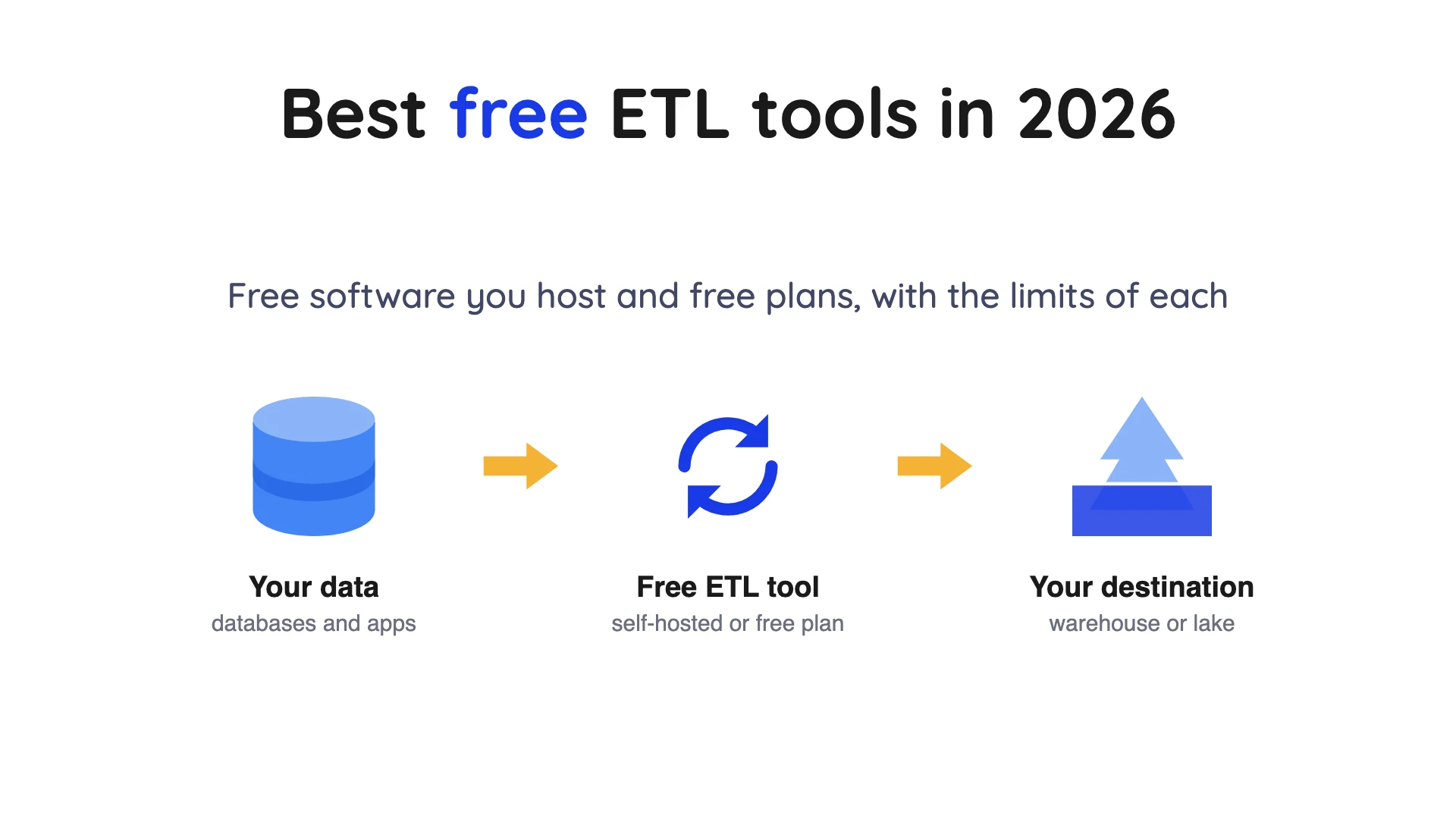
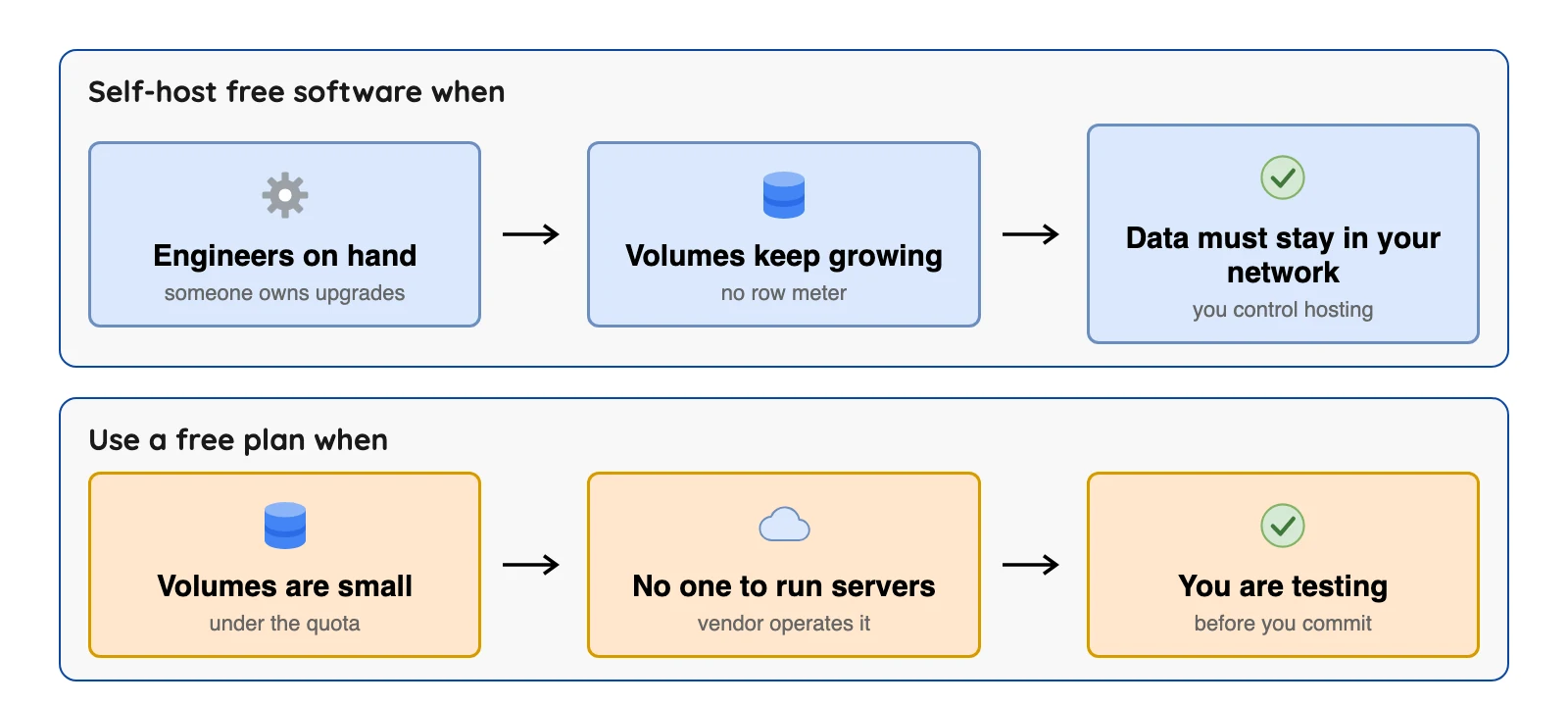
The best free ETL (extract, transform, load) tool depends on one question: who's going to run it? Small workload and nobody to look after servers? Start with a free plan.
If volumes are growing and you have an engineer, self-host.
Here's the catch: "free" means two things. Airbyte Core, Meltano, dlt, Debezium and OLake Go are free software you run yourself, so the licence costs nothing and you pay for servers and people. Fivetran, Hevo, Estuary and Skyvia are managed services with free plans that stop at a usage limit, such as 10,000 records a month (Skyvia) or 500,000 monthly active rows (Fivetran).
- Two kinds of free. Free software you host has no vendor limit but costs servers and staff time. A free plan has no servers but a quota.
- Database changes into Iceberg. OLake Go is free software that reads four database families by log and writes Iceberg and Parquet to storage you own (our docs).
ETL means copying data out of one system, reshaping it, and putting it in another. Plenty of teams now do ELT (extract, load, transform) instead, which loads first and reshapes later in the destination. People search for both as "ETL", so this page covers free tools of both kinds. For the wider field, see best data pipeline tools and how ETL pipelines work.
We checked prices and limits in October 2026 against each vendor's own pages. Plans change often, so check the vendor's page again before you decide.
What "free" actually means
We kept the test strict. A tool counts only if its own pages say you can run it, or sign up for it, at no charge and with no time limit. Trials of 14 days don't count, and neither does a "free plan" that's really a trial.
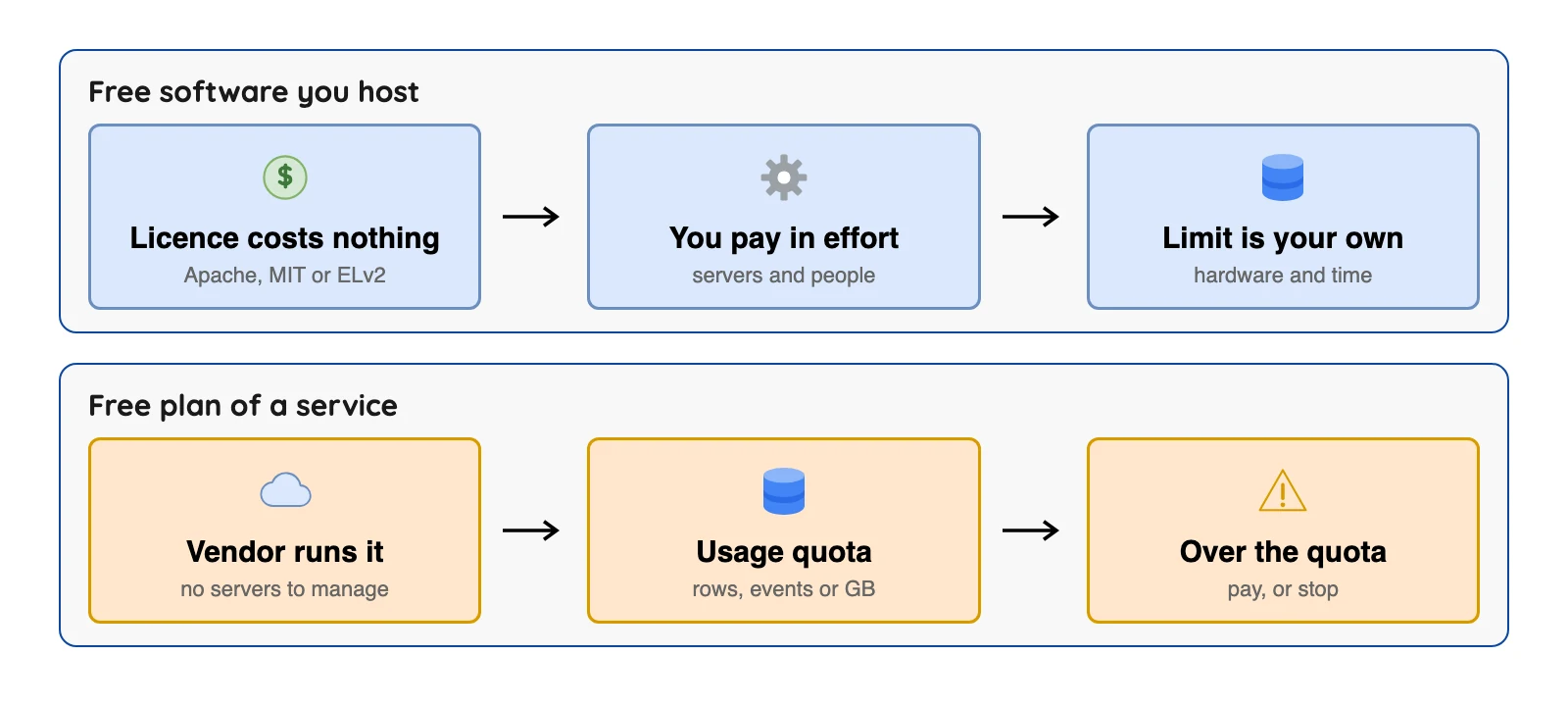
Even inside the first kind, licences differ. Apache 2.0 and MIT (a short, permissive licence) are standard open-source licences. The Elastic License 2.0 (ELv2), which Airbyte uses, lets you run the software for free but doesn't let you sell it to others as a hosted service, according to Airbyte's licence FAQ.
How we picked these nine
Each tool needed a free way to use it, described on its own pages, and it had to actually move data between systems, not just schedule jobs. For each one we looked at the licence, the free limit, what it can write to, and what the next step costs.
Competitor facts come from each vendor's own pages and docs; we did not run the other tools.
We left out tools that only schedule jobs (such as Apache Airflow), tools with only a trial, and Talend Open Studio, which is retired.
Free ETL tools at a Glance
| Tool | Kind of free | Licence | The free limit | Writes Apache Iceberg? |
|---|---|---|---|---|
| Airbyte Core | You host it | ELv2 | No limit on volume, users or connections | Per its docs, S3 and GCS destinations |
| Meltano | You host it | MIT | None stated | No official loader on its Hub |
| dlt | You host it (Python library) | Apache 2.0 | None stated | Per its docs, through the filesystem destination |
| Debezium | You host it | Apache 2.0 | None stated | Not itself; a community sink exists |
 OLake Go | You host it | Apache 2.0 | No usage limit | Yes, Iceberg and Parquet |
| Fivetran Free | Free plan | Proprietary | 500,000 monthly active rows | Not documented for the Free plan |
| Hevo Free | Free plan | Proprietary | 1M events a month | Not documented for the Free plan |
| Estuary Free | Free plan | Business Source License 1.1 | 10 GB a month, 2 connector instances | Per its docs, with extra AWS setup |
| Skyvia Free | Free plan | Proprietary | 10k records a month | No |
Which one should you pick?
| Your situation | Start with | Why |
|---|---|---|
| Small volume, no engineer to run servers | Fivetran Free or Hevo Free | The vendor runs it; check that your source is on the free plan |
| Many connectors, a platform team | Airbyte Core | Over 600 connectors per its docs, and no limit from Airbyte |
| Python team, custom sources | dlt | A library you control in code |
| Pipelines as code in Git | Meltano | MIT licence and a command-line workflow |
| Database changes into Kafka for many consumers | Debezium | Its design fits fan-out (our reading) |
| Database changes into Iceberg you own | OLake Go | Writes Iceberg and Parquet on storage you own; see entry 5 |
| Oracle sources, with change capture | Debezium or Estuary | Both read Oracle by log (table below); Fivetran's free plan excludes Oracle and SAP |
Answer a few quick questions and see which fit.
Which free ETL tool fits you?
Question 1 of 5
Who is going to run it?
Free software has no licence fee, but you pay in servers and people. A free plan has no servers to run.
The 9 Best Free ETL Tools
Free software you run yourself
These five cost nothing to license; the bill shows up in servers and people.
1. Airbyte Core: for a large connector library
At a glance
- Kind of free: self-hosted, no limit on volume, users or connections
- Licence: Elastic License 2.0
- Sources: Airbyte's docs say "over 600 pre-built connectors"
Airbyte Core is the free, self-managed version of Airbyte's platform. Airbyte's licence FAQ says anyone can use it free of charge at scale on their own infrastructure. No limits on volume, users or connections.
What's good
- Airbyte documents a web interface and a long connector list ("over 600", its own count, not checked by us), and it can write Iceberg tables to S3 or Google Cloud Storage.
- Its S3 Data Lake docs say the destination writes Iceberg to S3 or S3-compatible storage through a REST, AWS Glue, Nessie or Polaris catalog, and the page's availability row lists Core among the plans that have it.
- On that destination the sync modes are Full Refresh Overwrite, Append and Overwrite + Deduped, plus Incremental Append and Append + Deduped. Deduplication maps the stream's primary keys to Iceberg identifier columns.
- Its CDC docs list Postgres, MySQL, SQL Server, MongoDB, Oracle, SAP HANA and IBM Db2 as current support. The page doesn't say which plans include Oracle, SAP HANA and Db2.
- The deployment docs say it can be deployed into a Kubernetes cluster, on a cloud provider such as AWS, GCP or Azure, onto a single node such as an EC2 VM, or locally.
Where it falls short
- ELv2 isn't a standard open-source licence: Airbyte's licence FAQ says you can't provide the products to others as a managed service.
- The deployment docs say Airbyte is built to be deployed into a Kubernetes cluster (software that runs programs across servers), and they "highly recommend" Helm, so plan for that setup and its upkeep.
- Its change capture runs as scheduled syncs, not as a continuous stream: the CDC docs say syncs launch on an interval, read the log up to the sync's start time, and are not treated as infinite streaming sources.
- Per the same CDC page, incremental CDC needs primary keys for most sources, changes made by TRUNCATE or ALTER don't appear in the logs and so don't reach the destination, and a refresh is required after you add a table.
- On the connector support levels page, Marketplace connectors are maintained by community members, aren't covered by Airbyte support SLAs and may have breaking changes with no notice. Enterprise connectors aren't available to Open Source users.
- On the S3 Data Lake destination, the docs say the connector never rewrites existing Iceberg data files, so only some source schema changes are handled: adding or removing a column, widening a column and changing the primary key.
2. Meltano: for pipelines kept as code
At a glance
- Kind of free: install it yourself with pip or Docker
- Licence: MIT
- Price: "Open source and free to use, with paid support options" (Meltano pricing page)
Meltano runs connectors that follow the Singer standard (small programs that pull data from a source, called taps). You describe a pipeline in a file and keep it in version control. It's a command-line tool first, and its pricing page also lists Meltano Cloud, a hosted option billed by compute hours.
What's good
- The licence is MIT, and the pricing page FAQ says Meltano Open, the self-hosted version, gives you 600+ connectors and Git-native pipelines.
- Its Hub lists many taps, and some variants offer log-based change capture for Postgres and MySQL.
- Its integration docs say extractors can replicate in log-based incremental, key-based incremental or full-table modes.
- The same page says pipeline state is kept in a state backend, under a State ID built from the extractor, loader and environment names.
- The pricing page lists paid support options and Meltano Cloud plans (Starter has 200 compute hours a month, Growth 2,000 and Scale 5,000) if you don't want to run it yourself.
Where it falls short
- Connector quality varies, because the Hub keeps several variants of the same tap and you have to pick a maintained one.
- The pricing page describes Meltano Open as "not really suited for production teams unless you have a dedicated DevOps crew".
- We found no official Iceberg loader on its Hub. The closest is the community target-s3tables, which takes an S3 Tables Iceberg REST endpoint. Other Iceberg writing means a third-party Singer target or another tool.
- Log-based capture lives in individual tap variants, not in the engine. The Hub lists tap-mongodb, tap-mssql and tap-oracle, but we found no change-capture documentation for them.
- No dollar price is shown for any Meltano Cloud plan on the pricing page.
3. dlt: for Python teams that want a library, not a platform
At a glance
- Kind of free: a Python library you run wherever Python runs
- Licence: Apache 2.0 ("The dlt library stays Apache 2.0, always", per the dltHub pricing page)
- Next step: the dltHub plan is $12,000 a month with a 12-month minimum, so $144,000 over the minimum (its FAQ says $11,900) (checked Oct 2026)
dlt (data load tool) is code you add to a Python script, not a server you deploy. Its docs list Iceberg as a destination through the filesystem destination. Then there's its Postgres replication source, which reads a replication slot (a bookmark in the database's change log).
What's good
- Nothing to install except a Python package, so a first pipeline stays small.
- The sources cover SQL databases, REST APIs and files. The sql_database source supports all SQLAlchemy dialects, including PostgreSQL, MySQL, Oracle, SQL Server, MariaDB and IBM Db2, and loads with SQLAlchemy, PyArrow, pandas or ConnectorX.
- The Postgres replication source reads changes through logical decoding with the built-in pgoutput plugin. For other databases its docs point to Debezium as the change source, with dlt loading the events.
- Its Iceberg docs say dlt uses PyIceberg's load_catalog, so it works with the catalogs PyIceberg supports, including REST and SQL catalogs, and supports the upsert and insert-only merge strategies.
- The same page describes partitioning through iceberg_adapter, with year, month, day, hour, bucket and truncate transformations.
Where it falls short
- The pricing page lists "Limited verified OSS connectors" and community support for the free tier.
- Something else has to run and schedule your script. And dlt's docs don't describe binlog or redo-log change capture for MySQL or Oracle: the sql_database source is query-based, and log-based capture in the library is Postgres only.
- On Iceberg, the docs say partition evolution (changing partition columns after a table exists) isn't supported, and schema evolution isn't supported with the upsert strategy on pyiceberg 0.10.0.
- The Iceberg docs also say dlt always writes Parquet for this table format and needs Python 3.10 or higher. It writes through PyIceberg to a catalog you supply, and the page describes no managed catalog or compaction.
- The Postgres replication source doesn't support the scd2 merge strategy, per its docs.
- The dltHub pricing page says every paid dltHub subscription includes a licence to the source-available capabilities, listing change data capture and Apache Iceberg support. The Iceberg docs page doesn't say which Iceberg features need that licence.
4. Debezium: for database changes on a Kafka stack
At a glance
- Kind of free: self-hosted, with no vendor price
- Licence: Apache 2.0 (Debezium licence page)
- Runs in: Kafka Connect, Debezium Server or an embedded Java library
Debezium reads database change logs and turns each change into an event. That's the whole job. It extracts only, so you still need something else to load the events into a destination.
What's good
- Its docs describe it as an open-source tool for log-based change data capture (CDC), which means reading the database's own log of changes.
- Because it writes events to a stream, many consumers can read the same changes (our reading of its design, not something we tested).
- On PostgreSQL it reads logical decoding through pgoutput, which the PostgreSQL connector docs say is always present, so no extra libraries are needed. It takes a consistent snapshot first, then streams from that point.
- The Oracle connector docs say it uses the native LogMiner API by default and can use OpenLogReplicator. They also say it can use Oracle XStream, a commercial component of Oracle GoldenGate.
- Debezium Server, per its docs, streams change events to messaging and storage systems "without requiring Apache Kafka", with sinks that include Kinesis, Pub/Sub, Pulsar and Redis.
- The Iceberg sink supports upsert and append modes, creates the destination tables on first start when event and key schema information is enabled, and adds new columns by default when new fields appear (same Debezium Server docs).
Where it falls short
- The Iceberg sink is a community-maintained project in a separate repository, and each Debezium Server instance runs one connector.
- On that sink, upsert is off by default (append-only), and with upsert on, deleted rows are kept and marked
__deleted=trueunless you change a setting. - The sink's FAQ says to run periodic table maintenance jobs to compact data and rewrite delete files, especially in upsert mode. It also says full schema evolution, such as converting incompatible data types, isn't supported.
- The PostgreSQL connector docs say that after a fault Debezium, like Kafka, provides at-least-once delivery, so duplicates are possible, and they warn that log disk space can spike on a quiet database sharing a server with a busy one.
- Per the same PostgreSQL docs, logical decoding doesn't support DDL changes, so no DDL events are reported. With the default replica identity, a table without a primary key emits only create events, and update events carry only the primary key in the before field.
5. OLake Go: best for database changes into Iceberg on storage you own

At a glance
- Kind of free: self-hosted, Docker Compose, Docker command line or Helm
- Licence: Apache 2.0
- Writes to: Apache Iceberg or Parquet
It is open source under Apache 2.0 and reads PostgreSQL, MySQL, MongoDB and SQL Server changes from their logs, plus full and incremental loads from Oracle, Db2 and S3.
The Kafka source reads topics on Kafka 2.4.0 or later and has one synchronization mode; messages deleted by the topic's retention can't be read or synced (see the Kafka docs). Setup guides: PostgreSQL, MySQL, MongoDB and SQL Server.
OLake Go does extract and load only, with no transforms. Which engines read the Iceberg tables it writes depends on the catalog and the delete format: Athena works with the Glue and S3 Tables catalogs only, and Snowflake reads external tables in a REST (web API) catalog read-only (see the compatibility page).
Before a sync, the test connection checks change data capture (CDC) prerequisites: wal_level, replication slot and publication for Postgres, log_bin and binlog_format for MySQL, change streams for MongoDB, and database CDC and the capture job for SQL Server. Jobs run every minute, hourly, daily, weekly or on a custom cron.
What's good
- It does the first copy and then change capture in one tool, with no per-row meter.
- It writes Iceberg tables you own, with eleven catalog types and Docker, Helm and UI install paths.
- It follows schema changes.
- CDC and incremental syncs are stateful and resumable: they keep state and resume from the last checkpoint after crashes, network failures or manual pauses, and large tables and collections are split into chunks that are read in parallel (see the capabilities list).
- Each job sets its own cap on connections to the source database, and in upsert mode it deduplicates on the source table's primary key, so each key maps to one row (docs).
- On Iceberg you can use metadata-driven partitioning, or an S3-style folder layout for external tools, and level-1 nested JSON fields can be expanded into top-level columns (docs).
Good to know
- Change capture covers PostgreSQL, MySQL, MongoDB and SQL Server. Oracle, Db2 and S3 sources load by full refresh or incremental runs, and you run it on your own infrastructure.
Bottom line: Pick it if you run PostgreSQL, MySQL, MongoDB or SQL Server and want Iceberg tables you control. For Oracle change capture look at Debezium or Estuary, and for a vendor-run service look at Fivetran or Hevo.
Free plans of managed tools
These four have no servers to run. The catch is a usage cap.
6. Fivetran Free: for small volumes and a vendor-run setup
At a glance
- Free limit: 500,000 connector monthly active rows, 3,500 activation rows and 5,000 model runs a month
- Features: all Standard-plan features, per Fivetran's billing docs
- Not free: Oracle, SAP and Db2 sources
Fivetran counts monthly active rows (MAR): distinct rows, tracked by primary key, that it syncs in a month. Fivetran's usage docs say a row counts once per month however often it changes. Fivetran says the $5 per-connection base charge doesn't apply to the Free plan, which "remains entirely free" (its wording) (checked Oct 2026).
What's good
- Initial syncs "don't incur a cost for the historical data they sync" (usage docs), and the Free plan carries the Standard plan's features.
- Fivetran's billing docs recommend the Free plan for very low data volumes or to try Fivetran on a small amount of data.
- Its pricing page lists Standard with unlimited users, 15-minute syncs, "700+ fully managed connectors" (we did not count them) and Integration for dbt Core. Check which of these your Free account gets.
- The usage docs list some re-syncs as free, such as the historical data from adding a column and unchanged rows in re-imported tables.
- Its database connectors docs say database connectors capture changes with the source's native mechanism where there is one, such as the binary log for MySQL and MariaDB, logical replication for PostgreSQL and change streams for MongoDB, or with a Fivetran method, and sync every 15 minutes by default.
Where it falls short
- Oracle, SAP and Db2 sources (Oracle EBS, RAC and RDS too) need the Enterprise or Business Critical plan.
- Upgrading needs payment details, and Standard's per-row rates sit in Fivetran's Service Consumption Table, not on the pricing page. The billing docs give annual contracts a $12,000 minimum, against a $5 minimum charge per connection on monthly pay-as-you-go (checked Oct 2026).
- The bill follows distinct rows that change, so ask Fivetran for an estimate on your own tables first. The pricing page says usage counts updates, including deletes, and the usage docs say two connections syncing the same data count separately.
- Per the pricing page, 1-minute syncs and a Hybrid deployment option are Enterprise features.
- The database connectors docs say schema changes in the source are the most common trigger for a full table re-sync, and expired change logs require a full source re-sync.
7. Hevo Free: for a first managed pipeline with a small team
At a glance
- Free limit: up to 1M events a month, 1-hour scheduling, up to 5 users
- Connectors: "limited connectors" on Free; Starter lists "150+ connectors"
- Price of the next step: Starter at $265 a month billed annually, $299 monthly (Hevo pricing) (checked Oct 2026)
Hevo's pricing page says each record inserted, updated or deleted in the destination counts as one event. It calls the Free plan "free forever for limited connectors".
What's good
- Hevo says the free plan has no time limit ("free forever"), and up to 5 users can share it.
- Its billing docs say that on the Free plan, events past the 1M quota are parked in a replay queue and replayed when you upgrade or the new month starts.
Where it falls short
- Free covers only some connectors, and the pricing page doesn't say which, so check yours first. Its comparison table reads "Limited connectors" on Free and "All available connectors" on the paid plans.
- Runs are hourly, and the billing docs table lists Live Chat Support as "No" on Free and "Yes" from Starter. The pricing page shows streaming pipelines only on Professional and above.
- The log-based pipelines docs say streaming pipelines need Hevo Sales to enable them and exclude SQL Server and DynamoDB.
- Once you subscribe to a higher plan you can't go back to Free, except through Hevo Support (billing docs).
- Hevo's pages we read describe no self-hosted edition.
8. Estuary Free: for trying real-time pipelines without a card
At a glance
- Free limit: 10 GB a month and 2 connector instances, indefinitely, per Estuary's pricing page
- After the limit: a 30-day free trial of the Cloud plan
- Paid: $0.50 per GB, plus $100 a month for each of the first 6 connector instances (checked Oct 2026)
In Estuary's terms, a connector instance is one connection to a source or to a destination. So one pipeline from a source to a destination eats both of your free instances.
What's good
- Estuary's pricing page lists the free tier as indefinite with no card, per its own wording.
- Estuary says it reads database changes, and its pricing page lists streaming or scheduled batch as included on each plan (checked Oct 2026).
- Its OracleDB capture docs say the connector captures data using Oracle LogMiner and lists Oracle 11g or above as a prerequisite.
- Its PostgreSQL capture docs give setup steps for self-hosted PostgreSQL, Amazon RDS and Aurora, Azure, Google Cloud SQL, AlloyDB, Neon and Supabase, and offer a separate batch connector for managed instances without logical replication.
- With the AWS Glue catalog, the Iceberg connector docs say you can set Glue Table Optimizers for compaction, snapshot retention and orphan file deletion. They also cover writing to S3 table buckets.
Where it falls short
- Its Iceberg connector needs an Iceberg REST catalog backed by Amazon S3, an AWS EMR Serverless Spark application and an S3 staging bucket, plus IAM roles for the jobs. The docs say only REST catalogs that use Amazon S3 are supported for now, with GCP and Azure catalogs planned.
- The platform is under the Business Source License 1.1, which isn't a standard open-source licence: the licence file says it "is not an Open Source license", and its use grant bars a commercial "Data Processing Service" that lets third parties create collections or materializations. Also, the free tier is the managed service, not code you host.
- Estimating a paid bill takes care. The pricing page example (800 GB moved, 2 connector instances) shows $1,000 a month, where the listed rates give $600: at $0.50 per GB, 800 GB is $400, plus $200 for two connector instances is $600, against the $1,000 on the pricing page example (checked Oct 2026).
- The PostgreSQL capture docs say that if the replication slot is dropped or invalidated, the capture fails and needs manual recovery, and that Postgres will keep an unbounded amount of WAL data if a slot stops advancing.
- The OracleDB capture doesn't support table and column names longer than 30 characters, because LogMiner doesn't.
9. Skyvia Free: for tiny, scheduled business-app syncs
At a glance
- Free limit: 10k records a month, 2 scheduled integrations, runs daily, schedules expire after 30 days
- Next step: Skyvia's pricing page shows Basic at $79 a month billed annually, or $99 monthly (checked Oct 2026)
Skyvia is a cloud tool from Devart. A record counts on import and replication even if no field changed. Skyvia's docs also say Free and Basic allow only basic scenarios: import, export, synchronization and replication.
What's good
- It's point-and-click and lives in the cloud, so there's nothing to host.
- Its replication docs list as sources any supported cloud app plus SQL Server, MySQL, PostgreSQL, Oracle and BigQuery, and as targets all supported databases and cloud data warehouses, plus Airtable and Elasticsearch.
- For cloud warehouses, per the same page, Skyvia uploads CSV files to warehouse-specific storage and then tells the warehouse to import them.
- Its plans docs say failed records and records from a cancelled run aren't counted, and that extra paid records are off by default "to avoid unexpected additional payments".
Where it falls short
- Skyvia's pricing page shows 10k records a month, while its data integration page says 5k direct records plus 100k CSV records. Skyvia's docs call the 5k and 100k figures the legacy Free plan limits and say the current Free plan is 10,000 records a month, so trust the plan shown when you sign up.
- Skyvia's pages we read describe only a cloud service. They publish no open-source licence and list no Iceberg destination.
- When the record limit is exceeded, the plans docs say running integrations finish but no new ones can start, automatically or manually, unless the plan allows additional records.
- Incremental replication needs the object key fields, the created and modified time fields and the deleted-flag fields selected, per the replication docs. A field added later in the source isn't replicated, because replication knows nothing about source metadata changes.
- The replication docs say a database server used directly must be reachable from the Internet.
What isn't free any more
- Talend Open Studio. Qlik's page says the open-source Talend Studio was retired on January 31, 2024 and is no longer hosted or updated.
Which free tools read which databases by log
Why care about logs? Because reading a database's log is how a tool can see deletes, which a plain query can't. This table covers the databases most teams ask about, from each tool's docs.
| Tool | PostgreSQL, MySQL, MongoDB | Oracle by log |
|---|---|---|
| Debezium | Yes, all three | Yes (LogMiner, XStream or OpenLogReplicator) |
| Airbyte Core | Yes, on scheduled syncs | Not checked |
| OLake Go | Yes, all three, plus SQL Server | Oracle loads by full refresh or incremental |
| Estuary Free | Yes, within 2 instances | Yes (LogMiner) |
| Fivetran Free | Yes, per its connector docs | No: Oracle needs Enterprise |
| Hevo, Meltano, dlt, Skyvia | Varies by connector; not verified here | Not verified |
How each free tool writes Apache Iceberg
If Iceberg tables are your goal, how a tool writes them matters as much as its free limit. Apache Iceberg is a table format for files in object storage. A catalog is the service that tracks which files make up each table.
| Tool | Catalog it needs | How updates and deletes land | What it leaves to you |
|---|---|---|---|
| Airbyte Core | REST, AWS Glue, Nessie or Polaris (S3); BigLake or Polaris (GCS) | Deduplication is merge-on-read: an update is an equality delete plus an insert | Compaction and snapshot cleanup are not described on the connector page |
| dlt | Any PyIceberg catalog, such as REST or SQL | Upsert and insert-only strategies | Partition evolution is not supported |
| Debezium | Set through the community sink's properties | Append-only by default; upsert is an option, and deleted rows are kept and marked unless you change a setting | The sink is a separate community project, and it needs event flattening for upserts |
| OLake Go | One of 11 catalog types, including Glue, REST and Hive | Equality deletes, positional deletes since v0.10.0, and deletion vectors since v0.11.0 | Table maintenance with OLake Fusion |
| Estuary Free | An Iceberg REST catalog backed by S3 | Merged by a Spark job you run on AWS EMR Serverless | An EMR application, an S3 staging bucket and IAM roles |
| Meltano, Skyvia | No official Iceberg writer found | Not applicable | Everything |
Quick decoder for the terms. An equality delete says "remove rows where id is 7", and a positional delete says "remove row 12 of file X". In merge-on-read, the reader combines files and markers at query time.
Compaction rewrites many small files into fewer ones. Without it, queries slow down as markers pile up.
Sources: each vendor's Iceberg or data lake docs, plus the OLake v0.10.0 and v0.11.0 notes, read in October 2026.
The real cost of "free" software
A free licence doesn't make the bill disappear. It just moves it to other lines: servers (Airbyte is built for Kubernetes, Debezium usually runs on Kafka Connect, though Debezium Server and the Engine do not need Kafka), storage, a catalog and upgrades. Then add source upkeep and an on-call person for failed syncs.
Count one month of those hours, multiply by your engineer's hourly cost, and compare the result with the paid plan's price.
A worked example: one table on four free plans
Take one table of 250,000 rows. In a month, 40,000 distinct rows change, with 120,000 changes in total because some rows change several times. This is our own arithmetic on each vendor's published rules, and the assumptions are listed under the table.
| Free plan | What it counts | Our count | Free limit | Fits? |
|---|---|---|---|---|
| Fivetran | Distinct rows changed; the initial sync is free | 40,000 MAR | 500,000 | Yes |
| Hevo | Each insert, update or delete in the destination | 120,000 events | 1M | Yes |
| Estuary | GB moved | About 0.37 GB, or 0.74 GB if both ends count | 10 GB | Yes |
| Skyvia | Records, even if unchanged | 250,000 on the first copy | 10k | No |
Assumptions:
- Hevo delivers each of the 120,000 changes as a separate event. Hevo's billing docs count newly inserted and updated events after the pipeline is created, so we treat the first copy as not billed. If your pipeline loads changes in a different way, the count changes.
- Estuary rows average 1 KB (our guess). The first copy is 0.25 GB and the changes are 0.12 GB. Estuary's pricing page bills data "Sourced, Transformed, and Delivered" and does not say how the free 10 GB counts each side, so we show both.
When free stops being free
| Tool | Free limit | What comes next |
|---|---|---|
| Airbyte Core | None from Airbyte | Your own servers and staff; Airbyte Cloud Standard is $20 a month with 5 credits (Airbyte release notes) (checked Oct 2026) |
| Meltano | None stated | Paid support options, or Meltano Cloud billed by compute hours; dollar prices not published |
| dlt | None stated | dltHub plan, $12,000 a month, 12-month minimum (checked Oct 2026) |
| Debezium | None | Your own infrastructure; no vendor price |
| OLake Go | None; open source (Apache 2.0), free to self-run | Your own infrastructure and staff |
| Fivetran | 500,000 MAR | Standard: $5 base per connection plus $495 per million MAR for the first million, then $170 per extra million, per connection (list price, in its Service Consumption Table, not on the pricing page) (checked Oct 2026) |
| Hevo | 1M events | Starter, $265 a month annual or $299 monthly, from 5M events (checked Oct 2026) |
| Estuary | 10 GB, 2 instances | 30-day trial, then $0.50 per GB plus instance fees (checked Oct 2026) |
| Skyvia | 10k records | Basic shows $79 a month billed annually, $99 monthly (checked Oct 2026) |
Conclusion
Start with who's going to run it, then check the limit that applies to your data. Before you commit, run one real table through two finalists, delete a row, change a column, and compare what you get. If the job is database changes into Iceberg you own, OLake Go is free to self-run, and you pay only for your own infrastructure.