Confluent Pricing Explained: What You Will Pay (2026)
21 min read
Key takeaways
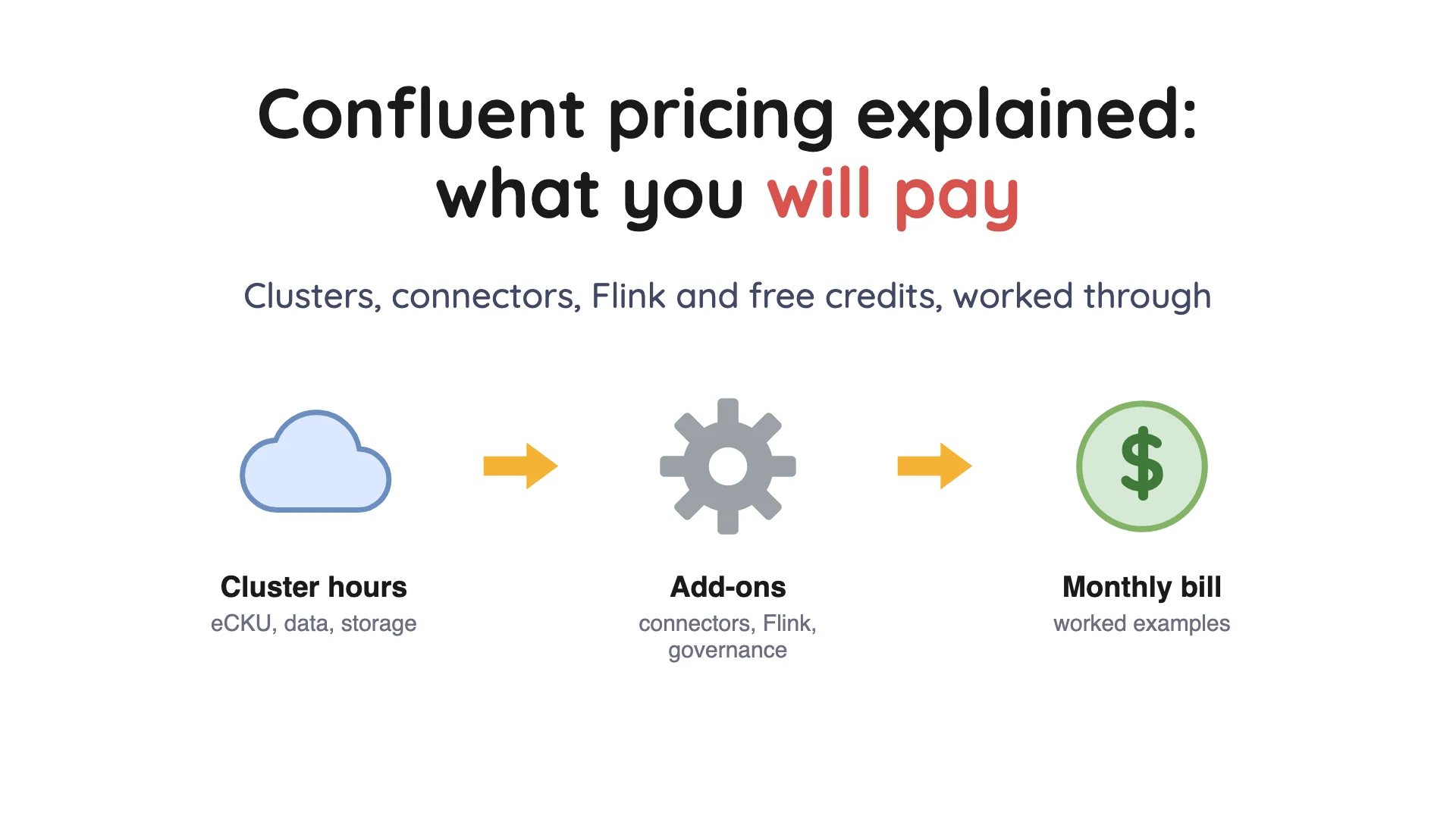
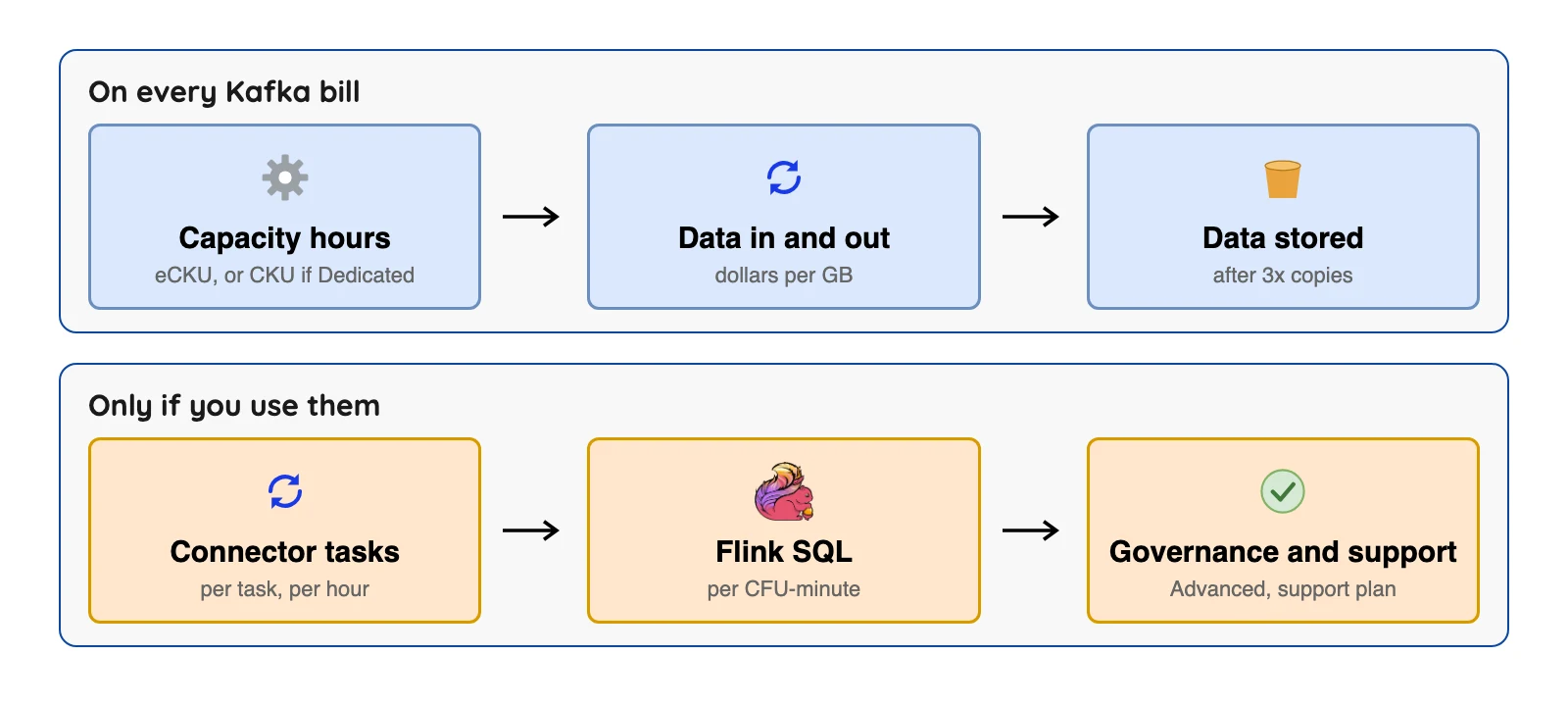
Confluent Cloud bills by use, so your bill is a pile of separate meters. The Kafka part has cluster hours (an "eCKU" is the unit, and Dedicated clusters use Confluent Units for Kafka, or CKUs), data in and out, and storage. Connectors, Flink and governance each add their own meter on top.
The pricing page lists a Basic cluster from $0, Standard at $0.75 per eCKU-hour, Enterprise at $1.75 to $2.25 and Freight at $2.25 (checked Nov 2026). It shows no rate at all for Dedicated clusters or for Tableflow, so those two need a quote.
- Not published: Dedicated rates, several CDC connector prices, and any Tableflow rate on the pricing page.
- Database tables into Iceberg: OLake Go is open source (Apache 2.0) and free to license. It reads Postgres, MySQL, MariaDB, MongoDB and SQL Server directly, with no Kafka in between.
- The headline is not the bill: one always-on connector task can cost more than a Basic cluster, and storage is billed after three copies.
Every figure below comes from Confluent's own pricing page, connector pricing page and billing documentation, read in November 2026. We did not run Confluent Cloud ourselves, so the worked bills are our own arithmetic on made-up inputs.
Prices move, so confirm them on Confluent's pages before you decide.
Quick pick: which Confluent setup should you price first?
Find the row that sounds like you, and start your estimate there.
| Your situation | Start your estimate with | Published rate? |
|---|---|---|
| Learning or testing | Basic, 1 eCKU | Yes, first eCKU free |
| Production over the public internet | Standard, at least 2 eCKUs for the 99.99% uptime target | Yes, $0.75 per eCKU-hour |
| Production with private networking | Enterprise | Yes, $1.75 to $2.25 per eCKU-hour |
| Large logging-style traffic that can wait | Freight | Yes, $2.25 per eCKU-hour |
| Fixed, high-throughput capacity | Dedicated | No, ask for a quote |
| Kafka topics into Iceberg tables | Tableflow | No rate on the pricing page |
| Database tables into Iceberg or Parquet | OLake Go | Free to license; you pay for infrastructure and staff |
Sources: cluster types page. Checked November 2026. The uptime figures are Confluent's own targets.
Not sure which row is yours? Answer five quick questions.
Which Confluent setup should you price first?
Question 1 of 5
What are you setting this up for?
How Confluent pricing works
Apache Kafka is software that moves streams of messages between systems, and Confluent Cloud is Confluent's hosted Kafka service. Confluent has been owned by International Business Machines (IBM) since March 17, 2026.
You pay for what you use, but "what you use" is measured by several separate meters that all land on one invoice.
On its pricing page, Confluent groups the meters into four jobs. Stream covers Kafka clusters: capacity per hour, network per GB and storage. Connect covers connectors, with a price per task per hour plus a price per GB.
Process covers Flink stream processing, priced in Confluent Units for Flink (CFU), and Tableflow. Govern covers Stream Governance, billed per environment per hour.
Most meters bill by the hour, and any part of an hour counts as a full hour. Flink is the exception, since it bills by the minute.
Usage is added up in Coordinated Universal Time (UTC) and invoiced monthly in arrears, per the billing overview. Prices also vary by cloud region, and Confluent says it applies a regional multiplier to its base rates. The pricing page doesn't say whether its ranges already reflect region, so a quote can differ from the figures here.
Confluent pricing by cluster type
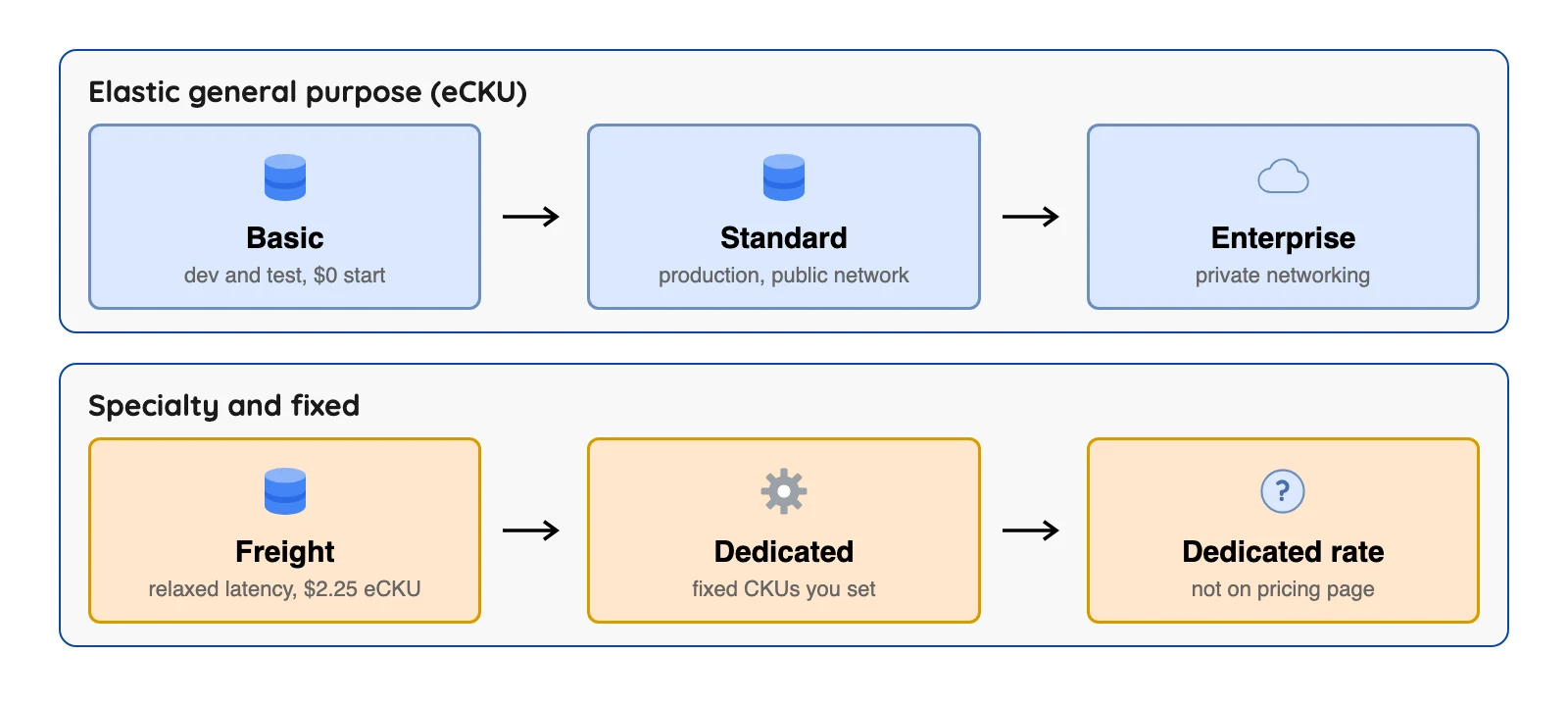
Think of a cluster as the set of Kafka servers that holds your streams. Confluent sells five types, per its cluster types page, and the unit of capacity changes from type to type.
An eCKU (elastic Confluent Unit for Kafka) is used by Basic, Standard, Enterprise and Freight clusters. It scales up and down on its own, and you pay for what you use, up to a ceiling you set.
A CKU (Confluent Unit for Kafka) is used by Dedicated clusters. You pick the number of CKUs, and you pay for them whether you use them or not.
| Type | Best for, per Confluent | eCKU rate per hour | Data in and out per GB | Storage per GB-month | Estimated monthly start |
|---|---|---|---|---|---|
| Basic | Development and testing | First eCKU free, then $0.14 | $0.05 | $0.08 | $0 |
| Standard | Production with public networking | $0.75 | $0.035 to $0.050 | $0.08 | $385 |
| Enterprise | Production with private networking | $1.75 to $2.25 | $0.020 to $0.050 | $0.08 | $895 |
| Freight | High volume, relaxed latency | $2.25 (2 eCKU minimum) | $0.014 to $0.030 | $0.03 | $2,300 |
| Dedicated | High throughput, fixed capacity | Not on the pricing page | Not on the pricing page | Not on the pricing page | Contact Confluent |
Source: Confluent's pricing page (checked Nov 2026).
The pricing page says its prices for Freight are "pre-replication", while the billing docs say storage is charged on the post-replication volume. Replication just means keeping copies of your data on several servers.
Which cluster type fits you?
- Basic is for kicking the tyres. The page lists a 99.5% uptime target and a 5 TB per partition storage limit.
- Standard is the default pick for production over the public internet. The page lists 99.9% uptime on one eCKU and 99.99% on two or more.
- Enterprise is where you go for private networking. Enterprise clusters can scale up to 32 eCKUs, and AWS clusters that use PrivateLink are limited to 10, per the cluster types page.
- Freight is for logging and other work that can live with some delay. Confluent's docs say it doesn't support share consumers and is currently available in select AWS regions.
- Dedicated is fixed capacity that you size yourself. With card billing the limit is 4 CKUs per cluster, and with marketplace or invoice billing it is 24, and larger sizes are available on request.
If your organization was created before April 16, 2024, you may still be on the older model, which charges for partitions, per Confluent's billing dimensions page.
How eCKU billing works
Each hour, Confluent bills the highest number of eCKUs you used in that hour. The billing docs give an example: if use moves between 2 and 3 eCKUs inside one hour, you pay for 3. If every meter reads zero in an hour, you pay nothing for it.
That has two practical effects. A Standard cluster that needs the 99.99% uptime target needs at least 2 eCKUs, so its floor is double the one-eCKU figure. And the "starting cost" on the pricing page isn't the price of one eCKU for a month.
Its starting costs assume 70% utilization, meaning clusters are active about 70% of the time. Our arithmetic: $0.75 times 730 hours times 0.7 is about $383, close to the $385 shown for Standard. The same sum gives about $894 for Enterprise at $1.75 and about $2,300 for Freight at its 2 eCKU minimum, so run your own numbers at your real utilization.
You can cap spending too. The cluster types page lets you set a lower maximum eCKU, but it warns that this "can lead to throttling or workload impact" when the cap is reached.
Confluent connector pricing
A connector moves data between Kafka and another system, such as a database. Managed connectors bill two ways, per Confluent's connector pricing page.
One is a price per task per hour, where a task is the unit of work a connector runs. The other is $0.025 per GB of data moved (checked Nov 2026).
Task prices change by region, so the page shows a range.
The three Debezium change data capture (CDC) rows below are the original connectors. Confluent's lifecycle table marks them end of life since March 31, 2026, and their V2 replacements show "Contact us". Here are a few examples from the page:
| Connector | Type | Task price per hour | Data price per GB |
|---|---|---|---|
| PostgreSQL CDC (Debezium) | Source | $0.104 to $0.2083 | $0.025 |
| MySQL CDC (Debezium) | Source | $0.104 to $0.2083 | $0.025 |
| SQL Server CDC (Debezium) | Source | $0.104 to $0.2083 | $0.025 |
| Amazon S3 | Sink | $0.017 to $0.0347 | $0.025 |
| Snowflake | Sink | $0.052 to $0.1041 | $0.025 |
| PostgreSQL CDC V2, MySQL CDC V2, MariaDB CDC, Oracle CDC Premium | Source | Contact us | $0.025 |
Source: Confluent's connector pricing page (checked Nov 2026). CDC means change data capture, which copies each insert, update and delete from a database as it happens.
Add-ons are listed too. Connectors that use PrivateLink cost $0.03 more per task-hour, a custom single message transform costs $0.05 more per task-hour, and a dedicated Connect cluster adds $0.27778 per hour (checked Nov 2026). The billing dimensions page lists connector capacity as a separate line for Dedicated Kafka clusters.
Two details in the billing dimensions matter. First, the connector pricing page says throughput is calculated pre-compression.
Second, pausing a connector does not stop the task charge: Confluent's connector overview says hourly task costs keep accruing while it is paused. Our read is that you have to delete a connector to stop its meter.
Flink, governance and support
Flink. Flink is a stream processing engine that runs SQL over live data. Confluent's Flink billing page says usage is metered by the minute in CFUs, a unit of processing power, and each statement uses at least one CFU-minute (checked Nov 2026). It lists no rate and says prices vary by cloud region, so check the pricing page.
Stream Governance. Governance covers Schema Registry (a service that stores the shape of your messages), plus a catalog and lineage tools. Per the packages page, the Essentials package is free and includes 100 schemas, and schemas above that are charged. The Advanced package starts at $1 per hour and includes 20,000 schemas (checked Nov 2026).
Support. Support plans are bought from the Cloud Console, and an annual commitment can cover Confluent Support, per the billing overview. We did not find plan rates on the pages we read, so this post leaves support out of the worked bills.
Tableflow. Tableflow turns Kafka topics into Apache Iceberg tables. The pricing page says it's billed by topic-hour and data processed, but it shows no rate.
Per Confluent's Tableflow billing page, data processed counts what Tableflow reads for the first load and for compaction, which merges small files. Upsert mode adds index-related processing charges, so ask your account team what applies today.
A Confluent blog dated May 14, 2026 states $0.10 per topic-hour and $0.04 per GB (checked Nov 2026), and says tiered pricing was coming. That's a blog, not a price list, so treat it as a hint.
Free credits, discounts and marketplace billing
Confluent's billing FAQ says a new organization gets $400 in credit (checked Nov 2026). Per the free trial page it ends after 30 days or when the credit runs out, and the FAQ says you can't pause it.
Two pages disagree on payment. The billing FAQ says a payment method is required to create any resources, and that it isn't charged until the free trial ends.
The trial page says that when the trial ends, Confluent suspends your organization until you enter a payment method or claim a promotional code. Our read: set up payment before day 30, and ask Confluent how it applies to you.
Discounts come in two flavours, per Confluent. One is automatic tiered pricing, where deeper discounts apply as your usage grows.
The other is a volume discount negotiated upfront on an annual commitment, which is a minimum spend over a fixed term. Confluent says the negotiated kind doesn't grow automatically with usage. If you go over the commitment, the extra is billed at your discounted rate.
Vendr, a software buying service, reports that the median buyer pays $86,309 per year, based on data from 101 purchases, with buyers saving 9% on average (checked Nov 2026). That's Vendr's anonymized data, not a Confluent price, so treat it as a rough guide.
You can also pay through the AWS, Google Cloud or Azure marketplace. Per the billing overview, your resources must run in the same cloud as your marketplace billing relationship, so you can't add resources in a different cloud while billed that way.
Marketplace listings price in Confluent Consumption Units (CCUs). Expect your cloud provider's usage view to run 6 to 24 hours late.
Worked examples: three monthly Confluent bills
These are made-up workloads priced at Confluent's published rates, with 730 hours in each month. We show a low and a high figure because Confluent publishes ranges for data rates, eCKU rates and connector tasks.
Assumptions for all three:
- Region: a multiplier of 1x, with the listed rates used as given. Other regions can cost more, so don't take our totals as yours.
- eCKUs: a steady count held all month. Real bills use the highest count in each hour, so a spiky workload costs more. A Standard cluster at 2 eCKUs for 630 hours and 3 for 100 bills (630 x 2 + 100 x 3) x $0.75 = $1,170, not $1,095.
- Data in and out: GB moved during the month. Stored GB is the average logical data kept over the month, which is roughly daily ingest times retention days, and that's not the same as monthly ingest.
- Connector: Postgres CDC (Debezium) tasks run all month, and connector data equals the data written to Kafka. We didn't check how many tasks a given database needs, so confirm that with Confluent.
- Not included: Tableflow, Flink, Advanced governance, support, private networking charges, and discounts.
Storage: one documented basis and one open question.
The billing docs say Confluent charges storage "based on the total post-replication volume", and billed storage is typically about three times the volume you write. The pricing page says its prices are "pre-replication" in a note beside the Freight rate.
We use the docs' three-copy basis for the main totals. We can't confirm whether $0.08 applies per GB you write, so the second total is a sensitivity check.
| Small | Medium | Large | |
|---|---|---|---|
| Cluster | Basic, 1 eCKU | Standard, 2 eCKUs | Enterprise, 6 eCKUs |
| Data in, out, stored (GB) | 50, 50, 50 | 500, 1,000, 1,000 | 10,000, 20,000, 10,000 |
| Cluster hours | $0 (first eCKU free) | 2 x 730 x $0.75 = $1,095 | 6 x 730 x $1.75 to $2.25 = $7,665 to $9,855 |
| Data in and out | 100 GB x $0.05 = $5.00 | 1,500 GB x $0.035 to $0.050 = $52.50 to $75.00 | 30,000 GB x $0.020 to $0.050 = $600 to $1,500 |
| Storage, on three copies | 150 x $0.08 = $12 | 3,000 x $0.08 = $240 | 30,000 x $0.08 = $2,400 |
| Storage, on GB you write | 50 x $0.08 = $4 | 1,000 x $0.08 = $80 | 10,000 x $0.08 = $800 |
| Connector tasks | 1 task: $75.92 to $152.06 | 1 task: $75.92 to $152.06 | 4 tasks: $303.68 to $608.24 |
| Connector data | 50 GB x $0.025 = $1.25 | 500 GB x $0.025 = $12.50 | 10,000 GB x $0.025 = $250 |
| Total, storage on three copies | $94 to $170 | $1,476 to $1,575 | $11,219 to $14,613 |
| Sensitivity: storage on GB you write | $86 to $162 | $1,316 to $1,415 | $9,619 to $13,013 |
Sources for every rate: Confluent's pricing page and connector pricing page (checked Nov 2026). The sums are ours.
How to get your own inputs. Confluent's cluster types page says the eCKU usage chart on a cluster's Monitor tab shows the eCKU count over time. The billing FAQ points to Confluent's Cost Estimator for throughput and retention. Connector prices appear on Confluent's Add Connector screen, per the billing dimensions page.
- Small: the connector costs about 4.5 to 9 times the rest of the bill, because the cluster is free and the task meter runs all month.
- Medium: the 2 eCKU floor drives the total, so the cluster is about 70% to 74% of the bill.
- Large: the storage question changes the bill by $1,600 a month, so ask Confluent which basis applies.
Costs that surprise people
Storage is billed after replication
Write 100 GB and you may be billed for about 300 GB. That's what the billing dimensions page means by "typically about three times". Retention limits, set with the topic settings retention.ms and retention.bytes, are your lever to bring it down.
Reading data in the console counts as egress
Confluent says all data transfers are charged, including requests the Cloud Console makes to show messages in its message browser. The Produce (v3) API adds an extra ingress charge.
Every reader multiplies egress
Confluent charges for "all data transfers," including consume requests, per the billing dimensions page. Our reading is that each application that reads a topic adds its own egress.
Say 1,000 GB is written in a month and three applications each read all of it. That is 4,000 GB at the data rate, or $140 to $200 on Standard at $0.035 to $0.050 per GB, against $70 to $100 with one reader. Do confirm with Confluent how your readers are counted.
Paused connectors still bill
Pause isn't stop. A paused connector keeps its tasks active, so the hourly task charge carries on. Self-managed connectors have no connector fee, but they still create ingress, egress and storage charges.
How to lower a Confluent bill
The billing FAQ lists four of them: set sensible topic retention, size clusters to real usage, compress data, and consider an annual commitment. Our read of the facts above adds one more, which is to delete unused connectors instead of pausing them.
Questions to ask before you sign
Bring these to your sales call. They're the gaps this page couldn't fill.
- Which cluster type and how many eCKUs or CKUs do you expect us to need, and what is the Dedicated price if you suggest it?
- Does the storage price apply to the data we write, or to all three copies?
- What is the exact task price for each connector we need in our region, and which ones are "Contact us"?
- What is the Tableflow price per topic-hour and per GB, including compaction, and what is the upsert charge?
- Does the 70% utilization behind the "estimated monthly starting cost" match our workload, and what is the regional multiplier for our regions?
- What discount tiers apply automatically, and what commitment unlocks the negotiated discount?
- If we buy through a cloud marketplace, which cloud must our resources run in, and what is the CCU price?
What these bills leave out if your goal is Iceberg
The worked examples stop at Kafka and a database source connector. Getting all the way to Apache Iceberg tables adds more meters, and we can't fully price them.
Confluent's own Iceberg path is Tableflow, covered above, and its rate isn't on the pricing page.
A sink connector is another route. The Amazon S3 sink is listed at $0.017 to $0.0347 per task-hour plus $0.025 per GB (checked Nov 2026), but that only moves data into S3. It doesn't build table metadata or keep tables tidy, and we haven't priced that work.
If the source is a database, OLake Go, our open-source tool, copies Postgres, MySQL, MariaDB, MongoDB and SQL Server into Iceberg or Parquet on storage you choose (our docs). It can also read Kafka as a source.
When Confluent pricing fits (and when it doesn't)
Confluent's pricing is a good fit if you want Kafka, connectors, stream processing and governance on one managed bill, and your traffic is uneven. An idle eCKU cluster costs nothing, per the billing docs.
Confluent's pricing page says its serverless clusters "autoscale instantaneously to demand without user intervention", which is Confluent's claim and not one we tested. If it holds, that's a real strength.
It's a weaker fit if your workload is steady and large, if you need a Dedicated cluster and want a price before talking to sales, or if connectors are most of your bill. A single task of the original Postgres CDC connector can cost $76 to $152 a month before any data moves (checked Nov 2026), and its V2 replacement has no public rate. If that sounds like you, compare meters across other tools, not just headline rates.
If your job is database tables into Iceberg, OLake Go has no per-task or per-GB meter; you pay for your own infrastructure. Other products count different things. Fivetran counts monthly active rows, Airbyte counts credits, and AWS Glue charges for compute time.
We did not price Amazon's managed Kafka service or other hosted Kafka here, so this page can't say which is cheaper for you.
FAQ
Q1. How much does Confluent Cloud cost?
Q2. Is Confluent Cloud free?
Q3. What is an eCKU?
Q4. How much do Confluent connectors cost?
Q5. Does Confluent publish Dedicated cluster prices?
Q6. How much does Tableflow cost?
Q7. Can I pay for Confluent through AWS, Google Cloud or Azure?
Conclusion
A Confluent bill is a pile of meters, and the cluster is only one of them. The published rates are clear enough for Basic, Standard, Enterprise and Freight, and murky for Dedicated, several CDC connectors and Tableflow.
A fair estimate needs your throughput, retention, connector count and region, plus a quote for the parts Confluent doesn't publish.
Use the worked table as a template, swap in your own numbers, and put the seven questions in front of Confluent before you commit. If the goal is database tables in Iceberg, price OLake Go beside it: it is free to license, and you pay for infrastructure and staff.