ETL vs ELT: What Changed and Which to Use
16 min read
Key takeaways
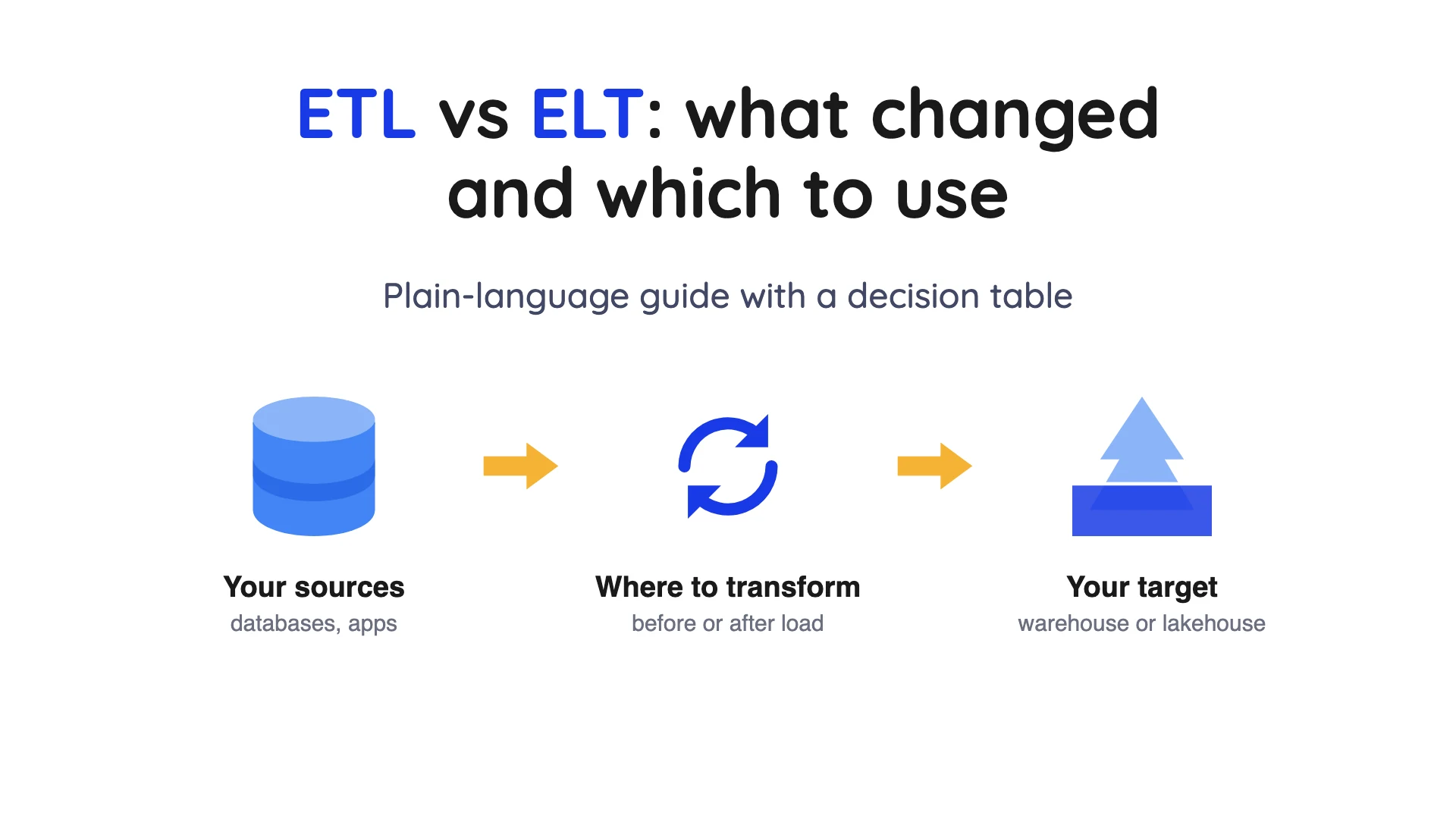
The short version: ETL (extract, transform, load) cleans your data before it reaches the target. ELT (extract, load, transform) copies it in raw and cleans it up inside the target. If your target is a modern warehouse or lakehouse with room to scale, pick ELT.
If rules must be applied before data lands, if the target is weak, or if source formats are fixed, pick ETL. And plenty of teams quietly use both. For database data landing in a lakehouse, OLake Go does the extract-and-load step and your query engine does the transforms.
- The only real difference is where the transform step runs. Microsoft says ELT differs from ETL "solely in where the transformation takes place" (Microsoft) (checked Oct 2026).
- ELT is the usual choice for modern analytics. AWS calls ELT the standard choice for modern analytics, and still lists cases where ETL fits better (AWS) (checked Oct 2026).
- ELT does not remove transform work. The work moves into the warehouse or lakehouse, and so does its cost.
- ETL keeps its edge on rules before loading. Microsoft lists compliance audits on staged data and heavy transforms for a weak target as reasons to choose ETL.
- OLake Go covers the load half of ELT for databases. It copies PostgreSQL, MySQL and MariaDB, MongoDB and SQL Server (full load, then change capture) into Apache Iceberg or Parquet, and transforms run afterwards in the engine you choose (see Where OLake fits).
- You can mix them. AWS says teams can run ETL pipelines for some sources and ELT for the rest.
Every vendor fact below comes from a named page with the link next to the claim. The main sources are Microsoft, AWS, IBM (International Business Machines), Fivetran and dbt Labs. Where a source gives no number, we say so and don't guess. Vendor facts come from the vendor pages linked beside them, and we did not run the other tools.
ETL vs ELT at a glance
Each row says what the sources claim, and the last column says which side they favour.
| ETL | ELT | Better fit | |
|---|---|---|---|
| Order of steps | Extract, transform, load | Extract, load, transform | Depends on the target |
| Where transform runs | A separate engine, often with staging tables | Inside the target, using its own compute, per Microsoft | ELT if the target is strong |
| What lands in the target | Cleaned, shaped data | Raw data first | ELT if you want raw data kept |
| Data types | Best with structured data that fits a fixed schema (IBM) | Structured, semi-structured and unstructured, per IBM | ELT for mixed data |
| Speed | Loading waits until the transform is done | Data lands sooner; it can take time to format inside the target, per IBM | Depends on which delay hurts you |
| Cost | Higher upfront cost than ELT, per IBM | Lower upfront, but unpredictable volumes can cause unexpected costs later, per IBM | No clear winner |
| Sensitive data | Can mask personal data before it lands, per IBM | Needs access controls and masking inside the target | ETL for strict rules |
| If a transform fails | "Transformation failures stop pipeline" (Fivetran, August 2022) | "Transformation failures do not stop pipeline," per Fivetran | ELT, because loading keeps running |
| Who writes the transforms | "Scripting languages," per Fivetran | SQL, per Fivetran | ELT if analysts own the logic |
Sources: IBM on ELT (checked Oct 2026)
What is ETL?
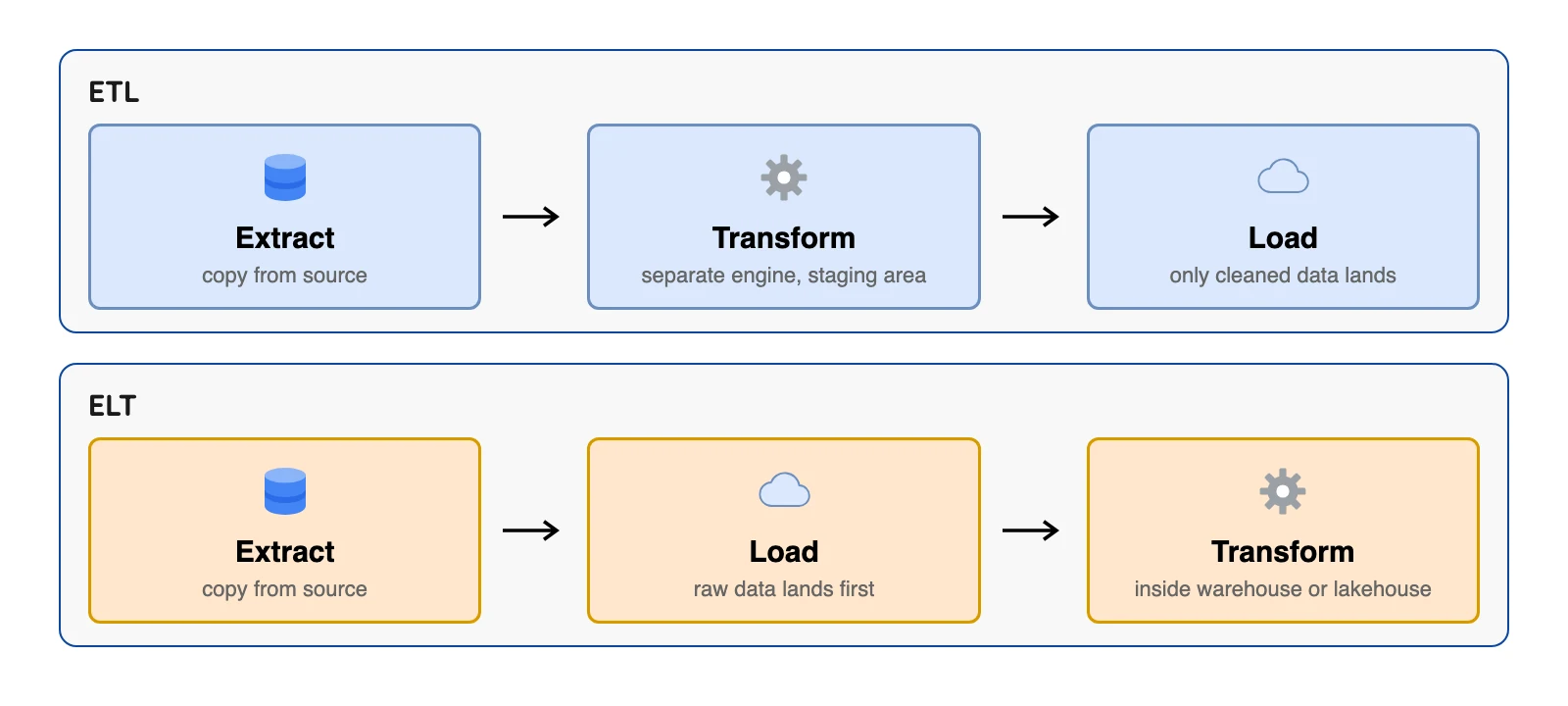
ETL stands for extract, transform, load. The tool copies data out of a source (extract), cleans and reshapes it using business rules (transform), and writes the result to the target (load). Microsoft says the transform often happens in a specialised engine with staging tables that hold data for a while.
Typical transform steps are filtering, sorting, joining, cleaning, removing duplicates and checking values. Picture a kitchen that preps everything in a back room, so only finished dishes ever reach the counter.
What is ELT?
ELT stands for extract, load, transform.
IBM defines it as moving raw data from a source into a target, such as a cloud data warehouse, a data lake or a lakehouse. The data is then transformed there.
A data lake is cheap storage for files in many formats, and a lakehouse adds table features on top of such files.
Now picture the same kitchen, but the raw ingredients go straight to the counter. Each cook preps what they need, when they need it.
SQL (the standard language for querying tables) is the usual transform language. A tool such as dbt runs SQL select statements inside your platform.
dbt docs say it works alongside your ingestion tools (dbt docs).
What changed between ETL and ELT?
The order of the steps stayed the same. What grew is the number of places your data can land. Below is the short history, with a source for each row.
| Change | What the source says | Source |
|---|---|---|
| Where ETL began | ETL has been around since the 1970s and became popular with data warehouses | AWS |
| Cloud warehouses | Between 2012 and 2016, cloud warehouses such as Snowflake, BigQuery and Redshift became popular and organisations shifted from ETL to ELT | IBM |
| Lakes and lakehouses as targets | ELT can start with files in scalable storage, queried by engines such as Spark, in formats such as Parquet | Microsoft |
| Streaming | ELT was historically batch-oriented but can now support streaming data | IBM |
| Transform tools split off | dbt works alongside ingestion tools and transforms data inside the platform | dbt docs |
| Vendors merging the steps | Fivetran, a loading vendor, completed its merger with dbt Labs on June 1, 2026 | Fivetran |
Sources are linked in each row (checked Oct 2026).
Fivetran sells ELT tools. It says storage went from nearly $1 million to cents per gigabyte over four decades, a factor of 50 million (checked Oct 2026).
dbt Labs also sells into ELT. It says ETL can be slower for large datasets and that ELT suits high volumes of unstructured data (dbt Labs, March 2023) (checked Oct 2026). Both are sellers, so read them as one side of the case.
Why did the shift happen? Our read: when a target scales its own compute, a separate transform engine becomes one more thing to run.
The sources above point this way but don't measure it. IBM says organisations rely on ELT as their data estates grow, yet it gives no measured share, so treat that as a trend.
ETL vs ELT: which one should you use?
Find your situation in the table below. The last column names the price of each choice.
| Your situation | Choose | Why | The limit you accept |
|---|---|---|---|
| Target is a modern warehouse or lakehouse that scales | ELT | Microsoft lists this as the first reason to choose ELT | Costs can grow with data volume, per IBM |
| You want raw data kept for later questions | ELT | Raw data stays available, so teams can build their own transforms, per IBM | Bad data can surface after loading (Databricks) |
| Rules require checked, curated data before loading | ETL | Microsoft lists staging audits as a reason to choose ETL | More parts to run |
| Target is small or constrained | ETL | Heavy work stays off the target | You run and pay for a second engine |
| Source or partner data has a fixed format | ETL | AWS says transform once, then reuse it | Less room for new questions |
| Sensor or edge data that needs protocol conversion | ETL | AWS lists IoT use cases for ETL | Extra tooling to run |
| Databases feeding an Iceberg lakehouse | ELT | OLake Go does the load and your query engine runs the transforms (see below) | You pick and run the transform engine |
| A mix of all the above | Both | AWS says ETL and ELT can be used together | Two patterns to document and test |
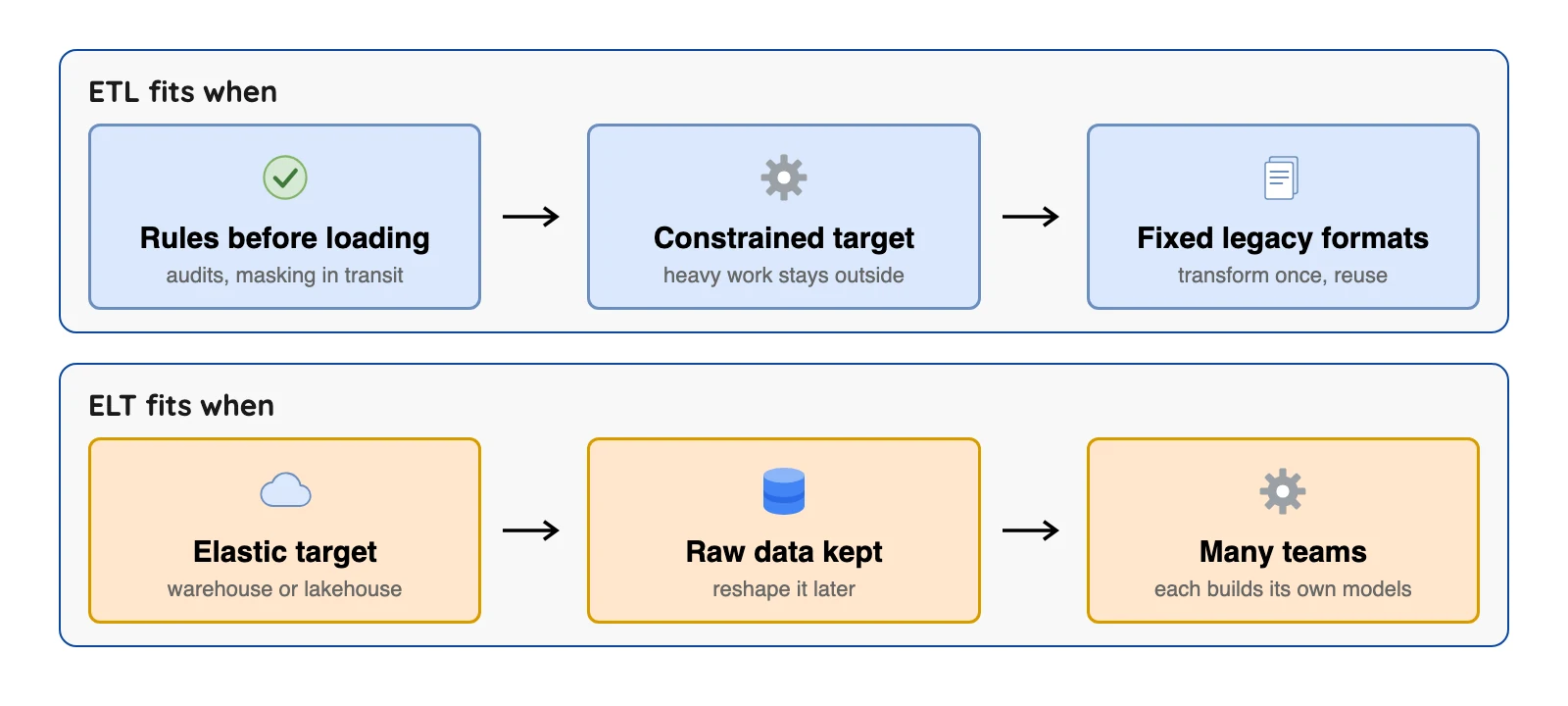
AWS names legacy databases, experiments and IoT (internet of things, meaning sensor devices) as places where ETL may fit. It says both patterns may be used together for complex analytics (checked Oct 2026).
Limits of each option
Neither approach is free of trade-offs. The named limits:
ETL is a weaker fit when:
- The transform engine is another system to run, scale and fix. Microsoft notes that ELT removes this engine from the pipeline.
- Raw data isn't kept in the target, so a new question may need a new pipeline.
- IBM says ETL pipelines need reengineering when data sources or downstream needs change.
ELT is a weaker fit when:
- The target isn't strong enough. Microsoft says ELT only works well when the target can transform data efficiently.
- Data quality problems show up after loading, not before. Databricks says validation and testing become important for this reason.
- Costs surprise you. IBM says lower upfront cost can turn into unexpected cost when data volumes are unpredictable.
- Raw sensitive data sits in the target until someone masks it.
Fivetran says ETL still fits when data models are well known and unlikely to change quickly. It also fits when data cannot be stored anywhere that might be compromised (checked Oct 2026). Neither Fivetran nor dbt Labs says ELT is always faster or cheaper.
A worked example (illustration, not real data)
Say a shop has an orders table with a customer email column. This invented example shows the trade-off.
Under ETL, the pipeline swaps each email for a scrambled value before loading. The warehouse never holds the real email. Analysts give something up for that safety, because they can't get the real value back without a new pipeline.
With ELT, the real email lands in a raw table. Then you limit who can see it.
Snowflake's docs describe Dynamic Data Masking as a column-level feature that masks plain-text data in columns at query time, based on policy (Snowflake docs) (checked Oct 2026). The masking applies when someone queries the column, so you still need to control who can reach the raw table.
The real question is whether your rules allow raw personal data in the target at all.
A simple way to decide, source by source
Pick the pattern per source, not once for the whole company. Ask these four questions in this order.
- Is there a rule that data must be checked or masked before it lands? If yes, plan on ETL for that source. Microsoft lists staging audits before loading as a reason to choose ETL.
- Can the target do the transform work? If the target is a warehouse or lakehouse that scales, ELT removes a whole system from your pipeline.
- Will other teams want the raw data later? If so, ELT keeps it. With ETL, you keep only what the pipeline let through.
- Who writes and fixes the transform code? ELT puts it in SQL inside the target. ETL puts it in the pipeline tool.
Run this for your three most important sources first, before you buy a tool.
What happens inside the transform step of ELT?
ELT does not mean "load it and forget it." Microsoft says the final phase of an ELT pipeline usually turns raw data into a format that suits your queries. For example, the data might be split by commonly filtered keys, or stored in a columnar format such as Parquet, which groups values by column so scans are cheaper.
Microsoft makes a second point that many guides skip. Transforms run in the same store where the data is consumed, which skips copy steps that ETL has and that can be time consuming for large data sets. One cost follows: your analysts and your transform jobs may now share one pool of compute.
Four myths about ETL vs ELT
- "ELT needs no transform work." Wrong. Microsoft says the transform still happens, in the target.
- "ELT has replaced ETL." No. AWS and Microsoft both name cases where ETL is the better fit, and IBM says ETL remains popular.
- "ELT is always cheaper." Not proven. IBM says costs can surprise you when data volumes are unpredictable.
- "ELT needs a data warehouse." Not so. Microsoft's own examples start with files in scalable storage.
Can you use both?
Yes, and many teams do. AWS says data scientists may run ETL pipelines from some sources and use ELT with the rest. A common split is ELT for the bulk of tables and ETL for the few sources with strict rules.
In that setup, the ETL path carries the audit and masking rules, and the ELT path carries everything analysts want to explore freely. Write down which source uses which path.
Microsoft also notes that ELT does not always mean purely virtual transforms. Some workloads save transformed tables or views to speed up queries or enforce governance rules. So even in an ELT setup you may keep a cleaned layer.
Zero-ETL, streaming and CDC
Zero-ETL is a name AWS uses for "a set of integrations that minimizes the need to build ETL data pipelines" (AWS) (checked Oct 2026).
The page lists benefits and states no limits, so check the docs for your source before relying on it. AWS Glue says that for self-managed database sources, zero-ETL replicates only to Amazon Redshift (AWS Glue docs) (checked Oct 2026).
Microsoft says streaming processes data as it arrives, while ETL and ELT work on datasets in scheduled batches. Change data capture (CDC) reads a database's change log and copies each insert, update and delete. It is one way to feed either pattern (see what change data capture is).
Questions to ask before you choose
- What will the transform cost at your data volume? Ask for an estimate at your size, not a general claim.
- Who may see raw data in the target? ELT keeps it, so name the people and the masking rules.
- What does the loading tool cost? Prices differ a lot.
- Can the vendor back a "faster" or "cheaper" claim with a number from your own data? The pages we read give general statements, not measurements.
Where OLake fits
OLake Go is an open-source (Apache 2.0) extract-and-load tool. It runs a full load and then change capture for Postgres, MySQL and MariaDB, MongoDB and SQL Server. It writes Apache Iceberg or Parquet on storage you control (see our docs for Postgres, MySQL, MongoDB, SQL Server and Iceberg catalogs).
It offers data filters and normalization but no modelling or SQL transformation step. That makes it a natural fit for ELT into a lakehouse, with transforms running after the load in the engine you choose. For the wider picture, see ETL pipelines and what a data pipeline is.
Short quiz:
Test your ETL vs ELT basics
Question 1 of 5
In the kitchen picture from the post, ETL preps the food in a back room and ELT sends raw ingredients straight to the counter. So what really separates ETL from ELT?
FAQs
Q1. What is ELT?
Q2. What is the main difference between ETL and ELT?
Q3. Is ELT faster than ETL?
Q4. Has ELT replaced ETL?
Q5. Which is better for sensitive data?
Q6. Do I need a data warehouse to use ELT?
Q7. Is ETL still used today?
Conclusion
The two differ in one thing: where the transform step runs. ELT is the usual choice when your target is a modern warehouse or lakehouse, and ETL fits when rules apply before loading or the target is weak. Many teams use both. For database data going into a lakehouse, OLake Go handles the load step.
Note your target, your compliance rules and your data volume, then use the decision table above to match each source to one pattern.