Fivetran Pricing Explained: What You Will Pay (2026)
24 min read
Key takeaways
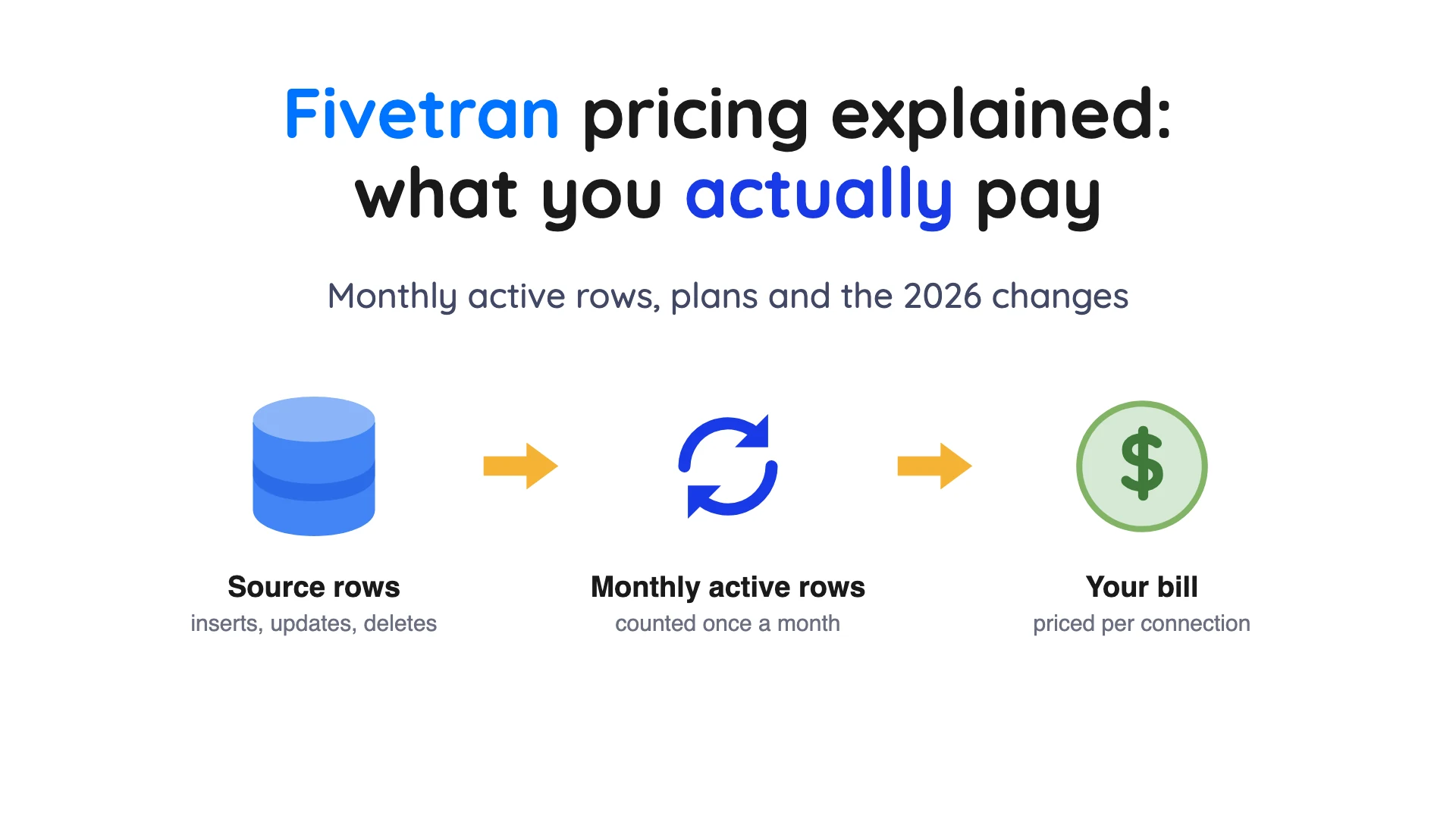
The short version: Fivetran bills by monthly active rows (MAR), and it counts them per connection. Yes, it does publish the rate. On the Standard plan, a connection costs a $5 base plus $495 per million MAR up to 1 million MAR (Service Consumption Table) (checked Oct 2026), so 100,000 MAR is about $54.50 a month at list price.
After that the rate falls with volume, and each connection gets its own curve. Annual contracts start at $12,000 (billing and plans docs) and the Free plan covers up to 500,000 MAR (pricing page) (checked Oct 2026). Open-source OLake Go has no per-row meter: you pay for your own servers and staff.
- You pay for distinct rows that changed in a month, not for table size or the number of changes.
- Each connection is priced on its own curve. Rows are never pooled across connections.
- Standard list price is $5 plus $495 per million MAR up to 1 million MAR, then $500 at 1 million and $170 per extra million (checked Oct 2026).
- Deletes and history mode changes now count as paid rows, and small connections carry a $5 base (checked Oct 2026).
- Annual contracts start at $12,000 and pay-as-you-go has no MAR minimum (checked Oct 2026). The Free plan covers up to 500,000 MAR for connections (checked Oct 2026).
- Self-hosting swaps the meter for your own costs. OLake Go is open source under Apache 2.0 (OLake on GitHub) and has no per-row bill; you pay for servers and operator time.
You searched for Fivetran pricing because you want one number. Fair enough.
The pricing page shows plans and four sample connectors, but the per-row rates sit in a legal document called the Service Consumption Table. This guide puts that table, the counting rules and the 2026 changes in one place. For how Fivetran works and what it is, see What Is Fivetran?.
First, the case Fivetran makes for itself, because it's a fair one. You pay for rows that changed, not for the size of your tables, the rate falls as a connection grows, and small sources can stay on the Free plan. Whether that works out for you depends on how many distinct rows change.
How we sourced these figures
Every figure below comes from Fivetran's own pages, with the page linked and the check date stated. Where a page doesn't state a figure, we say so instead of guessing.
The pages are the pricing page, the Service Consumption Table, the usage-based pricing docs, the billing and plans docs and the 2026 pricing updates (checked Oct 2026).
How Fivetran pricing works
Let's start with the unit, because everything else hangs on it. Fivetran's usage-based pricing docs say usage is "measured in Monthly Active Rows (MAR)". Each MAR is a distinct row, tracked by its primary key.
A primary key is just the unique ID of a row in a table. If a table has none, Fivetran makes up a hashed one, and most connections sync only new, changed or deleted rows.
Keys are counted separately for each account, destination, connection, table, activation and activation sync. Once a row is active, it counts only once that month. Fivetran's own example says it best: a row synced 30 times in a month is still one MAR.
So what does Fivetran actually bill? Three things:
- Connections move data in. They are measured in MAR.
- Activations move data from your warehouse out to other tools. They are also measured in MAR.
- Transformations run models on the data you have loaded. They are measured in successful model runs, with up to 5,000 free each month (transformations docs) (checked Oct 2026).
What counts as a row, with Fivetran's own example
Here's the example from Fivetran's docs, because it's the clearest one around. A table has three rows, and row c has a counter of 3.
Update it to 4, then to 5, in the same month, and you still have 1 active row. Touch row a too, and the table has 2.
Fair warning, from Fivetran's usage-based pricing docs: if your source changes years-old records on every sync, Fivetran may re-import the whole table. A large share of it can then count as active.
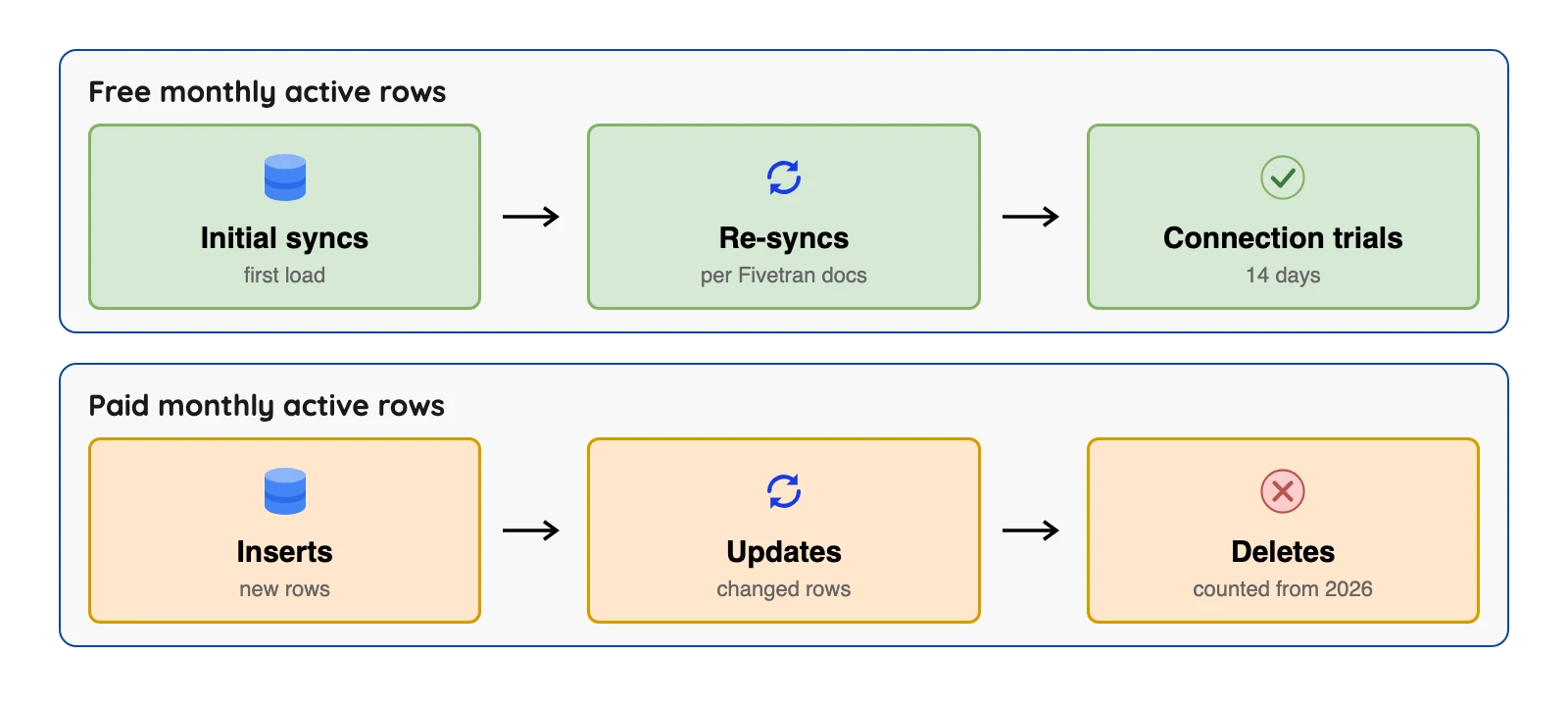
Some rows are synced but not billed. The usage-based pricing docs list these as free MAR:
- initial syncs
- connection trials
- re-syncs
- Fivetran's own system tables
- the Free plan and promotions
Everything else that changed in the source since the last sync is paid, or incremental, MAR. That includes re-imported rows that changed.
A worked example: one connection, one month
Let's make this concrete. Our example below is built from Fivetran's counting rules, and it shows MAR only. The next section turns MAR into dollars.
| Row (primary key) | What happens this month | MAR on connection A |
|---|---|---|
| 101 | Inserted on the 2nd, updated on the 9th and the 20th | 1 |
| 102 | Updated 30 times | 1 |
| 103 | Inserted on the 4th, deleted on the 15th | 1 |
| 104 | Deleted, with no other change this month | 1 |
| 105 | Not touched | 0 |
| Total | 4 |
Now send the same source to a second destination through connection B. Fivetran counts connections separately, even when they sync the same data. Connection B has its own total of 4, so the same source data adds up to 8 MAR.
A production-database example, with made-up numbers
The four sample connectors Fivetran shows are marketing and analytics tools, and the biggest has under 850,000 MAR. Your production database probably looks different. So here's a bigger case with hypothetical row counts, to show which quantities Fivetran bills and which it doesn't.
Dollar figures come from the rate card in the next section.
Picture an orders table with 10 million rows.
| Measure | Number | Billed? |
|---|---|---|
| Rows in the table | 10,000,000 | No |
| Initial load of those rows | 10,000,000 | No, initial syncs are free MAR |
| Change events this month | 450,000 | No |
| Distinct rows touched this month | 109,000 | Yes, as MAR |
| Same data sent to a second destination | 109,000 more | Yes, 218,000 in total |
Where does 109,000 come from? Like this:
- 40,000 new rows were inserted.
- 90,000 rows were updated, but 25,000 of those were the new rows. That adds 65,000 more.
- 5,000 rows were deleted, and 1,000 of them were also updated that month. The other 4,000 were deleted and nothing else, so they add 4,000 more.
None of those 4,000 deleted-only rows were inserted or updated that month. So the total is 40,000 + 65,000 + 4,000 = 109,000.
Three different numbers are in play: table size, change events and distinct rows touched. Fivetran bills the third one. So a busy table with few distinct rows can be cheap, while a small table that touches lots of different rows can be pricey.
The Rate Card: What a Connection Costs
The list rates sit in the Service Consumption Table, version 10, effective February 1, 2026 (checked Oct 2026). That page is linked from the pricing page, but the numbers aren't on the pricing page itself. Every dollar value below is a list price, before any annual-contract discount.
Each row of the table is a volume threshold. The formula Fivetran prints is: base spend per month, plus (your MAR minus the threshold) times the incremental spend per million MAR. Partial millions are prorated, so you don't pay for a whole million you didn't use.
Here are the Standard plan rows, in plain words:
| Connection MAR in a month | Base spend | Rate for each extra million MAR |
|---|---|---|
| Up to 1 million | $5 | $495 |
| 1 million to 4 million | $500 | $170 |
| 4 million to 16 million | $1,010 | $58 |
| 16 million to 64 million | $1,706 | $19.70 |
| 64 million to 250 million | $2,651.60 | $6.72 |
| 250 million to 1 billion | $3,901.52 | $2.29 |
| Above 1 billion | $5,619.02 | $1.18 |
Enterprise and Business Critical use the same shape with higher rates. Their first-tier rate is $661.67 and $1,061.67 per million MAR (checked Oct 2026), about 34% more and 2.1 times the Standard rate by our arithmetic.
Worked examples at list price
Time to do some sums. These use the Standard plan and the formula above, and the arithmetic is ours.
| One connection, one month | Calculation | List price |
|---|---|---|
| 21,993 MAR (Fivetran's Google Analytics 4 sample) | $5 + 0.021993 x $495 | about $15.89 |
| 100,000 MAR | $5 + 0.1 x $495 | $54.50 |
| 500,000 MAR | $5 + 0.5 x $495 | $252.50 |
| 1 million MAR | $5 + 1 x $495 | $500 |
| 5 million MAR | $1,010 + 1 x $58 | $1,068 |
| 20 million MAR | $1,706 + 4 x $19.70 | $1,784.80 |
See how fast the rate falls? One million MAR costs $500, which is $500 per million. Twenty million costs $1,784.80, about $89 per million.
Back to the production-database example, with 109,000 MAR on one connection:
| Plan | Calculation | List price per month |
|---|---|---|
| Standard | $5 + 0.109 x $495 | about $58.95 |
| Enterprise | $5 + 0.109 x $661.67 | about $77.12 |
| Business Critical | $5 + 0.109 x $1,061.67 | about $120.72 |
Remember the second destination? That's a second connection, so on Standard the bill doubles to about $118.
Each connection has its own curve
This is the part people miss. The Service Consumption Table says each connection's MAR goes on its own curve, and you can't combine MAR across connections, activations or accounts for a better rate (checked Oct 2026).
Connection count becomes a cost lever. Four million MAR on one Standard connection costs $1,010 a month at list price. Split across four connections with 1 million MAR each, it costs 4 x $500, or $2,000.
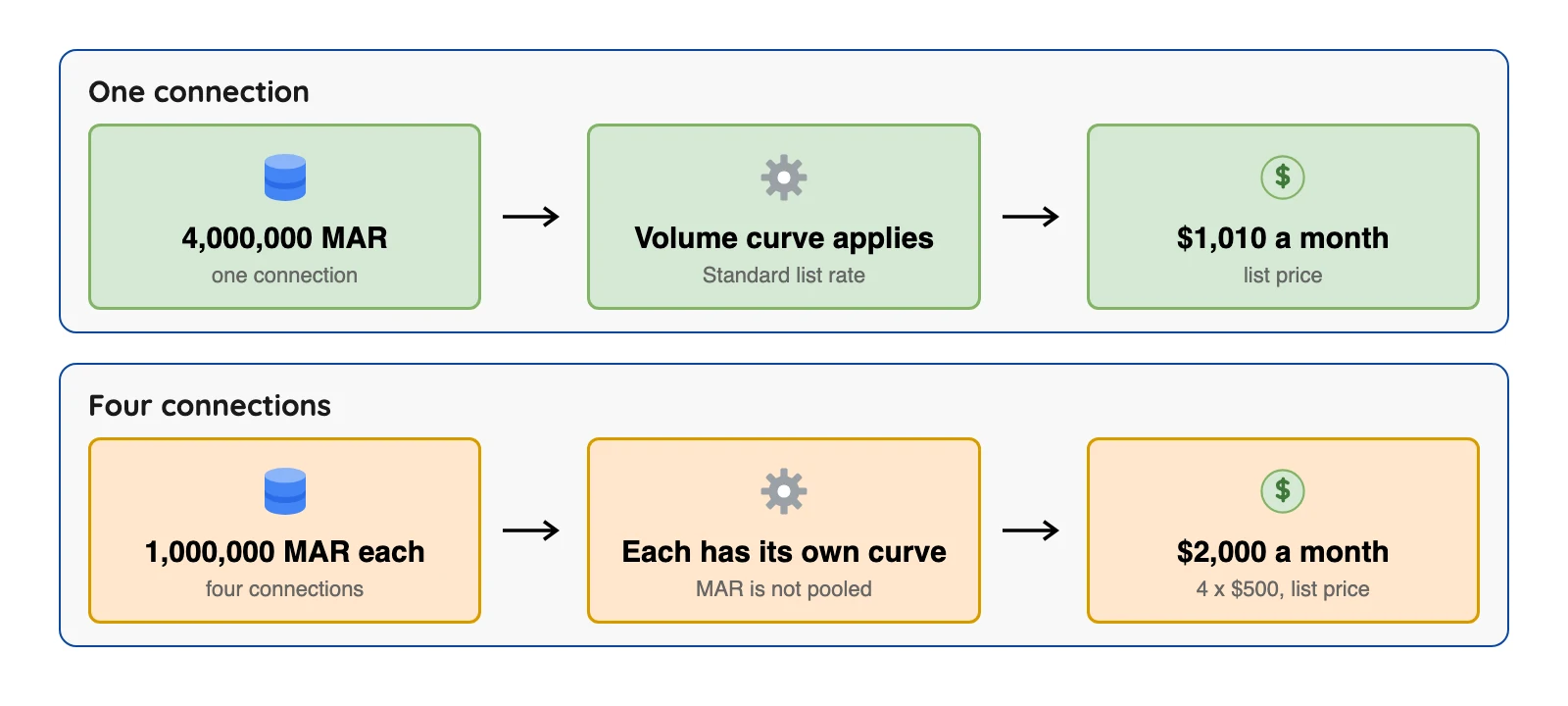
Our arithmetic from the Service Consumption Table (checked Oct 2026).
Whether you get to pick one big connection depends on the source. If you do, it's cheaper per row.
Does the $5 get added to the row charge?
Yes, on the rate card. The $5 is the base spend in the first row, and the formula adds the row charge on top of it. Fivetran's four sample prices on the pricing page match that formula to within a cent (checked Oct 2026), and that wouldn't work if $5 were only a floor.
The billing page calls it a "minimum charge", while the 2026 pricing updates page uses both "minimum charge" and "base charge" (checked Oct 2026). Our read: the rate card is the clearest source, and your order form is the one that actually binds you.
The four plans
The pricing page lists four plans. It puts $0 on the Free plan and prints no per-row price for the other three (checked Oct 2026). Those rates live in the Service Consumption Table.
| Plan | What the page says is included | Price |
|---|---|---|
| Free | Standard features, free up to 500,000 MAR for connections, 3,500 MAR for activations and 5,000 model runs a month | $0 |
| Standard | Unlimited users, 15-minute syncs, 700+ managed connectors, 200+ activation destinations, dbt Core integration, REST API | $5 base, then $495 per million MAR (list) |
| Enterprise | Everything in Standard, plus 1-minute syncs, enterprise database connectors, custom roles, SCIM user provisioning, hybrid deployment, a choice of cloud | $5 base, then $661.67 per million MAR (list) |
| Business Critical | Everything in Enterprise, plus customer-managed encryption keys, PCI DSS Level 1 certification and private networking | $5 base, then $1,061.67 per million MAR (list) |
A few terms in that table need plain words:
- SCIM adds and removes users automatically from your company's login system.
- Hybrid deployment keeps the data moving inside your own network.
- PCI DSS Level 1 is the highest level of a card-payment security standard.
One more rule from the billing and plans docs, and it's a sneaky one: only the Enterprise and Business Critical plans offer enterprise database connectors (checked Oct 2026). It lists several Oracle sources, two sources from SAP (a business-software vendor), and Db2 for z/OS and Db2 for LUW (both in Beta). High-Volume Agent connectors for Oracle and SQL Server are on the list too.
So if your main job is copying one of those databases, the connector picks your plan for you. And the plan sets the price.
Annual Contracts and Pay-as-You-Go
According to its billing and plans docs, you can buy Fivetran two ways (checked Oct 2026).
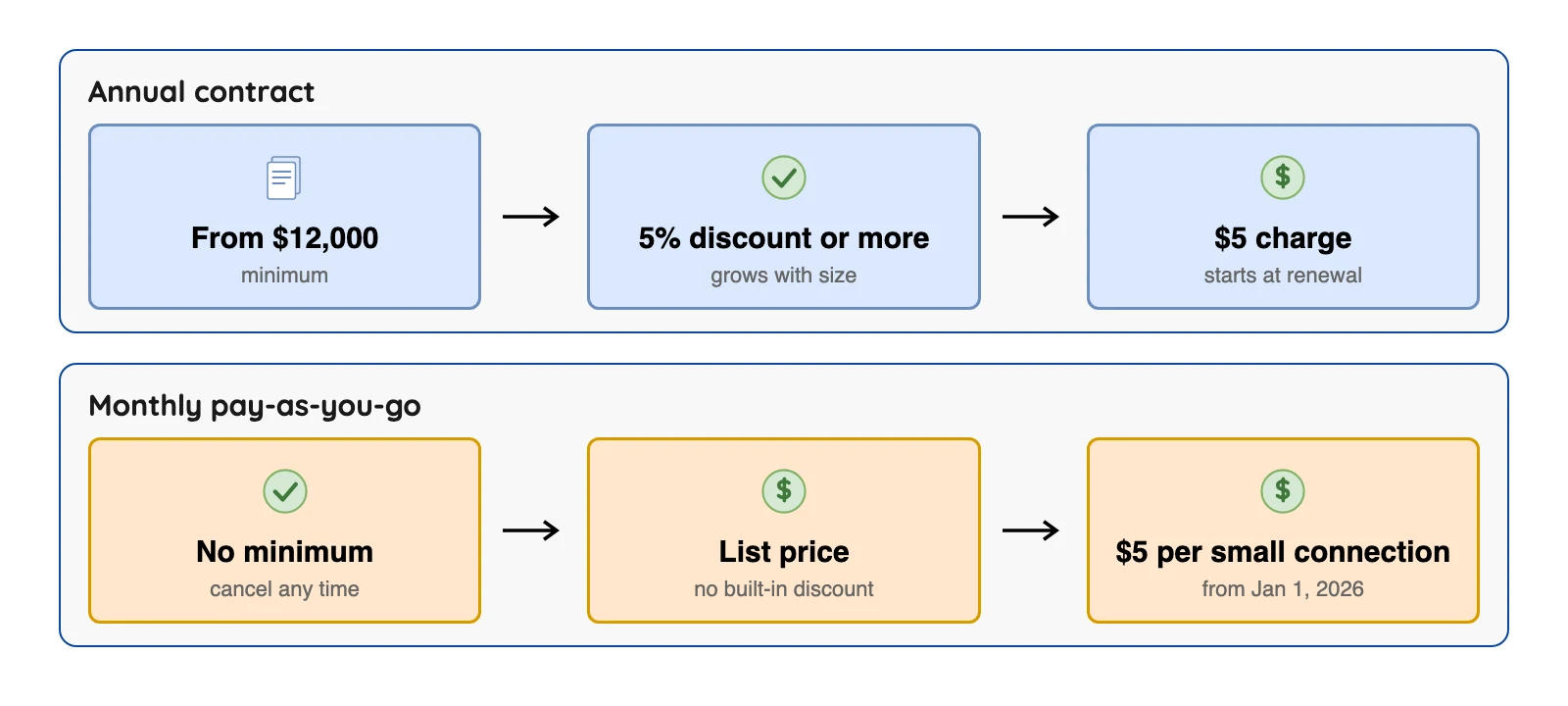
| Annual contract | Monthly pay-as-you-go | |
|---|---|---|
| Minimum | $12,000 a year | No MAR minimum |
| Discount | 5% built in, and more on larger contracts | List price, no built-in discount |
| Billing | Contracted spend bought up front | Billed monthly, after use |
| Cancel | Fixed term | Any time |
| Small connections | The $5 charge starts at renewal | $5 per connection with 1 to 1 million MAR, from January 1, 2026. The billing page calls it a minimum charge |
Bigger contract, bigger discount. On the Standard plan, the billing and plans docs show 5% for contracts up to $37,900 at list price (checked Oct 2026).
Between $37,900 and $145,340 the discount runs from 5% to 22.6%, and it is 22.6% or more above that. Business Critical goes further, to 36.42%. The pricing page rounds the top end to "save up to 22%" (checked Oct 2026).
The usage-based pricing docs list 14 days of free usage for every new connection, and the billing and plans docs list a 14-day trial for every new account (checked Oct 2026).
Does an annual contract pay off?
Don't let the percentage discount fool you. The $12,000 minimum is the real hurdle.
Fivetran's own sample profile costs $511.15 a month at list price (checked Oct 2026), which is $6,133.80 over a year. That's well below the $12,000 minimum.
Here's another way to see it: $12,000 a year is $1,000 a month.
Picture one Standard connection: list price reaches $1,000 at about 3.9 million MAR ($500 + 2.94 x $170). Spread across several connections, you need more total rows to get there, because each connection starts its own curve.
So an annual contract suits a team with large or fast-growing volume. There's a safety net, too: the Service Consumption Table lets you carry over 100% of unused contracted spend into a qualifying new purchase (checked Oct 2026), which lowers the risk of overbuying. The break-even figures above are our arithmetic.
What Fivetran's own examples show
The pricing page also gives four sample connectors (checked Oct 2026). Estimates here assume the Standard plan and a company with 1 to 200 employees.
| Connector | Median usage (MAR) | Median monthly list price | Price per 1,000 MAR |
|---|---|---|---|
| Google Analytics 4 | 21,993 | $15.88 | about $0.72 |
| Facebook Ads | 34,479 | $22.06 | about $0.64 |
| Google Ads | 88,240 | $48.67 | about $0.55 |
| Marketo | 847,574 | $424.54 | about $0.50 |
Add those four prices and you get the $511.15 the page shows. The last column is our arithmetic: the price divided by MAR, times 1,000.
Check them against the rate card. Each sample equals $5 plus $495 per million MAR, to within a cent.
So Google Analytics 4 gives $15.89, Facebook Ads $22.07, Google Ads $48.68 and Marketo $424.55. Rate card and page agree.
That also explains the last column. The rate is a flat $0.495 per 1,000 MAR in this range, and the $5 base gets spread over more rows on bigger connections. Small connections look dearer per row because of that $5.
Pricing Changes You Should Know About
Fivetran launched updated usage-based pricing on March 1, 2025. Then in 2026 it added the $5 charge and started counting deletes, per its 2026 pricing updates (checked Oct 2026). Which date hits you depends on how you pay.
| How you pay | When the $5 charge and the delete rule apply |
|---|---|
| Pay-as-you-go | From January 1, 2026 |
| Annual contract signed after March 1, 2025 | At renewal |
| Annual contract signed before March 1, 2025 | Moving to the March 2025 pricing happens at renewal. For deletes, Fivetran says the rules "already apply" under its pre-March 2025 pricing, so you see no change. When the $5 charge starts for these contracts is not stated on the pages we read |
The costs that surprise people
A $5 charge on small connections
A $5 charge applies to connections that generate between 1 and 1 million paid MAR a month. It does not apply to connections with no paid MAR, to inactive connections, or to the Free plan (checked Oct 2026).
The update page calls it a base charge, and the billing page calls it a minimum charge. As shown in the rate card section, the rate table adds it to the row charge. So a small connection whose rows come to $3 pays $8.
It's small money until it isn't. Add ten small connections, each syncing a few thousand rows a month, to Fivetran's four examples, and the base adds at least $50 a month. Thirty small connections add at least $150.
Deletes now count
Under the March 2025 pricing, deleted rows did not count toward paid MAR until the 2026 change. Now inserts, updates and deletes all do (checked Oct 2026). The dates are in the table above, and some older annual contracts already counted deletes.
A row counts once a month, so a delete adds to your bill only if that row hasn't already counted that month.
Row 104 in the worked example is the one that adds MAR: it was deleted and nothing else happened to it. Why does Fivetran count it? In its words: "deletes in the source are changes in data that have analytical value" (checked Oct 2026).
History mode counts every change
History mode keeps old versions of a row in your destination, which is handy. But the 2026 pricing updates say that, as of January 1, 2026, the changes tracked in history mode count toward paid MAR (checked Oct 2026).
In its words, whenever a record's value changes in a history mode table, "we insert a new row into the destination table" (checked Oct 2026). That new row counts, so every change is a bill line.
Transformations are billed on their own meter
Transformations run on a separate meter. They bill by model runs, not rows, and the first 5,000 runs a month are free. After that it's $0.01 per run to 30,000, $0.007 per run to 100,000 and $0.002 per run above that (checked Oct 2026).
How to lower the bill, using Fivetran's own rules
These levers come from Fivetran's own pages, linked on each line.
- Use the Free plan for small sources. It covers up to 500,000 MAR for connections with no base charge (checked Oct 2026).
- Watch what your source rewrites. If a job updates years-old records on every run, Fivetran may re-import a large part of the table.
- Block columns you do not need. The usage-based pricing docs say updates to a blocked column that is not a primary key do not count toward MAR.
- Turn off history mode where you do not need it. Its tracked changes now count as paid rows.
- Watch the Usage tab. Your Fivetran dashboard tracks usage, so you can spot the biggest meter first.
- Use the estimator before you commit. Fivetran offers a pricing estimator on its pricing page. Run your real connector list through it.
Before you ask for a quote
To avoid surprises in a quote, do the homework first. List your connections, price each one with the rate card, and mark the small ones and the tables with deletes or history mode.
Ask Fivetran these
- Does my order form use the published Service Consumption Table rates, or different ones?
- Is the $5 per connection added to the row charge on my order form?
- Will the estimator result for my connector list be written into the quote?
- How does the discount change as my contract grows past $37,900 at list price?
- What counts as free on my account: re-syncs, trials, promotions?
What the community says about Fivetran's price
Public talk about Fivetran splits in a familiar way: some users praise the low-effort pipelines, and others worry about the bill. We could not open G2, Capterra or Reddit, because they block automated readers. Each quote below is one person's view, with its date and link.
| Source | What a user wrote | Mood |
|---|---|---|
| Hacker News, thread "Why is it so hard to buy things that work well?", Dec 2024 | "Fivetran works perfectly fine for syncing Postgres databases into Snowflake." | Praise |
| Hacker News, same thread, Dec 2024 | "Either you have a lot of data and fivetran will be too expensive or you don't" | Cost worry |
Our read: this matches the rate card above. Users like the saved work, and the cost worry grows with row counts.
So don't take anyone's word for it, ours included. Take your busiest table, estimate its monthly active rows with the method earlier in this guide, and price it on the rate card. If the result is far above a quote you hold, ask Fivetran which of your tables drive the row count, and whether any of them can be filtered or synced less often.
Which option fits which team
Choose Fivetran if you want a hosted service, lots of ready-made connectors, or enterprise database connectors such as its Oracle connectors, which its pricing page lists on the Enterprise plan (checked Oct 2026). Its best case is less work for your team, in return for a bill that depends on usage you can't fully predict.
Self-hosting open-source ingestion suits a team that mostly lands production databases in a lake or warehouse and can run the software. There's no per-row bill, but that doesn't make it cheaper. Four cost inputs take its place: compute, storage requests, table maintenance and operator time.
OLake Go is our open-source option here. It copies PostgreSQL, MySQL and MariaDB, MongoDB and SQL Server into Apache Iceberg or Parquet and has no per-row bill (see our docs). Table maintenance comes from OLake Fusion (see the compaction types).
Fivetran's docs say its Managed Data Lake Service keeps data in your own cloud storage as managed data lake tables (checked Oct 2026). So the real question is cost, and who runs it.
To compare fairly, add four monthly numbers for self-hosting: ingestion compute, storage requests, table maintenance compute and operator hours at your hourly cost. Put that total next to the rate-card price for the same connections. Connection count alone won't tell you which is cheaper.
Not sure which way to lean? Try this quick quiz.
Which pricing model fits you?
Question 1 of 5
Who should run the pipelines?
Self-hosting has no per-row bill, but compute, storage requests, table maintenance and operator time still cost money.
How the billing models compare
Every tool bills for something different, so comparing prices head to head is tricky.
| Tool | What it bills | What the vendor publishes |
|---|---|---|
| Fivetran | Monthly active rows, per connection | Free plan, samples and a full rate table (Standard: $5 base, then $495 per million MAR, falling with volume) |
| Airbyte Cloud | Credits: 4 credits per GB for databases and files, 6 per million rows for APIs | Standard plan at $20 a month with 5 credits, then $5 per extra credit (since the 2026-09-15 release) |
| Hevo | Events: each record inserted, updated or deleted | Free to 1M events; Starter from $299 a month on monthly billing for 5M events |
| Stitch | Replicated rows per month | Standard plan from $100 a month for 5M rows |
| Estuary | Data moved, plus connector instances | $0.50 per GB, plus per-connector fees |
| OLake Go (ours) | Nothing per row or per event | Open source (Apache 2.0), free to self-run; you pay for your own infrastructure |
Sources: the the Airbyte, Hevo, Stitch and Estuary pricing pages, plus Airbyte's credit rules and Cloud release notes (checked Oct 2026).
Frequently asked questions
Q1. How does Fivetran charge?
Q2. Does Fivetran have a free plan?
Q3. How much does Fivetran cost per million rows?
Q4. Does Fivetran charge for deleted rows?
Q5. What is the minimum Fivetran contract?
Q6. Is there a Fivetran free trial?
Q7. Is there a Fivetran pricing calculator?
Q8. Does Fivetran get cheaper as volume grows?
Q9. Does history mode cost extra?
Conclusion
So, what will you pay?
Price comes down to how many distinct rows change, how many connections you run, and which plan your connectors force on you. The rate card is public, which is good news, because you can estimate it yourself before you ever talk to sales. If your data is mostly databases going into a lake, price OLake Go beside it: no per-row bill, with the cost moved to your own servers and staff. Before you sign, do three things:
- List your connections and mark the small ones and the ones with deletes.
- Price each one with the Service Consumption Table, then run the list through Fivetran's estimator.
- Get your order-form rates and contract dates in writing.