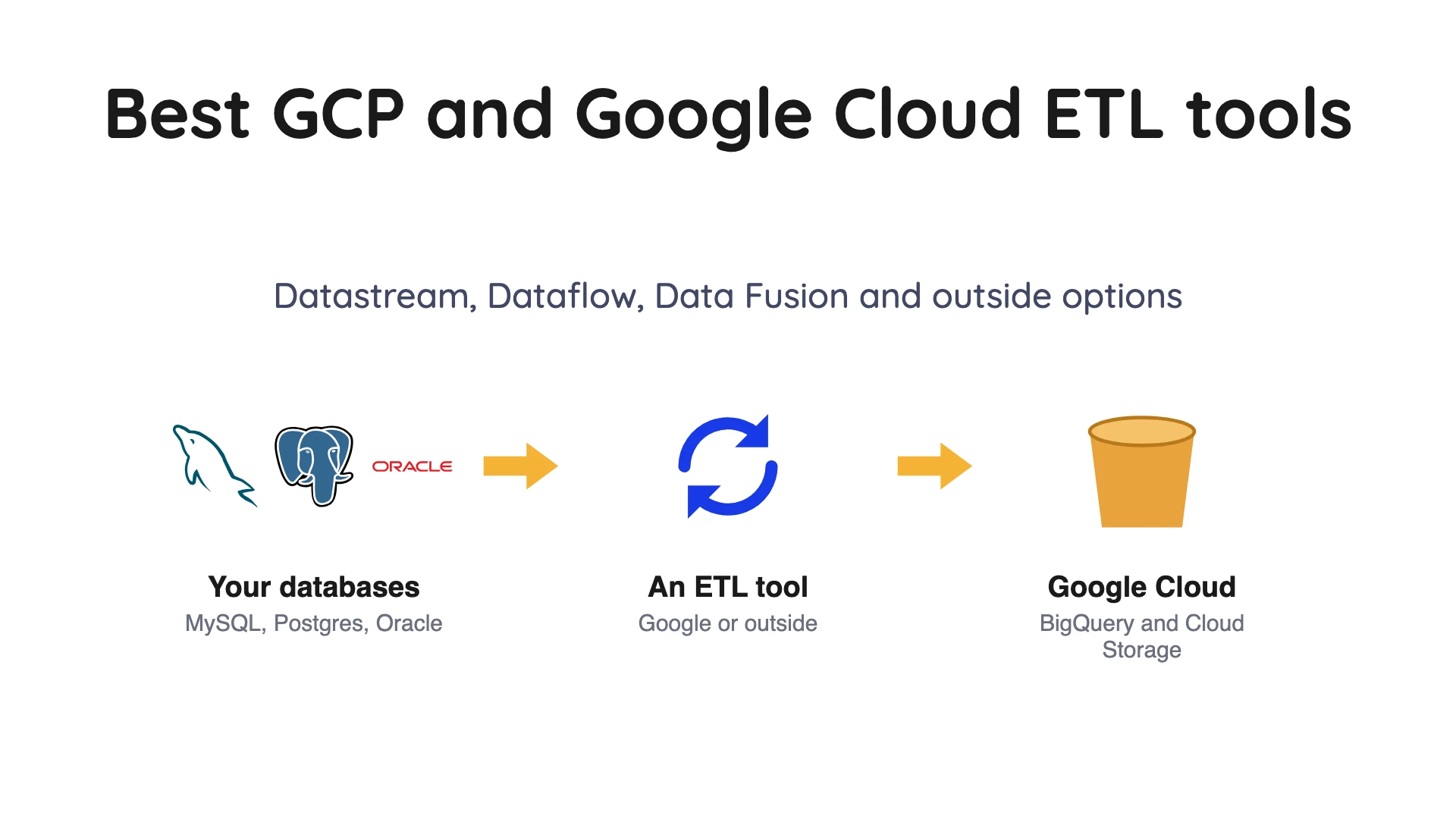
Best GCP ETL Tools in 2026, Compared
29 min read
Key takeaways
Pick by the job, not by the brand. To copy a live MySQL, PostgreSQL, Oracle or SQL Server database into BigQuery, start with Google's Datastream, then use Dataflow for code-based streams and files, Cloud Data Fusion if you'd rather click, or the BigQuery Data Transfer Service for scheduled Salesforce and ad data. For a long connector list and no servers to run, Fivetran, Hevo and Airbyte Cloud describe themselves that way.
To land database changes as open Iceberg or Parquet files instead, our open-source OLake Go is another route.
- Google prints its prices, but each in a different unit. Datastream bills gibibytes (GiB) processed, Data Fusion bills instance hours, and Dataflow bills worker seconds. So you can't compare them until you work an example (we do that below).
- Datastream's "processed" bytes can be 2 to 5 times your data. Google's Datastream pricing page says so (checked Oct 2026).
- For database changes into Iceberg or Parquet, OLake Go. It is open source, runs on your own infrastructure, and has log-based capture for Postgres, MySQL, MariaDB, MongoDB and SQL Server.
ETL means extract, transform, load: you copy data out of one system, reshape it, and put it somewhere else. Plenty of teams now load first and reshape later (ELT). Search lumps both under "ETL", so we do too.
Google Cloud has five or six services that sound alike and do very different jobs, so we sort them by job first and brand second.
Prices come from each vendor's own page (checked Oct 2026), and plans change often. Facts about each tool come from the vendor's own pages and docs; we did not run the other tools.
GCP ETL tools at a glance
| Tool | Kind | Used for | Database change capture | Billing unit | Where it is the wrong pick |
|---|---|---|---|---|---|
| Datastream | Google service | Copying live databases into BigQuery | Yes, log-based | GiB processed | You want Iceberg with updates and deletes, or a non-Google target |
| Dataflow | Google service | Code-based stream and batch jobs | Only through templates or your own code | Worker vCPU, memory, shuffle | Nobody on your team writes code |
| Cloud Data Fusion | Google service | Visual pipelines | Replication to BigQuery from three databases | Instance hours | You run a few small jobs and want to pay per run |
| BigQuery Data Transfer Service | Google service | Scheduled loads from SaaS and storage | No, scheduled and watermark based | Slot-hours | You need deletes or log-based freshness from a database |
| Managed Service for Apache Spark | Google service | Spark jobs you write | Not stated | Management fee or DCUs | You want ready-made connectors |
| Cloud Composer and Dataform | Google services | Scheduling jobs and SQL steps in BigQuery | No | DCU-hours, free | You need to move data from outside |
| Fivetran | Managed ELT | Many connectors, no servers | Yes, many databases | Monthly active rows | You want a flat monthly price |
| Airbyte | Self-hosted Core and cloud | Self-hosting, connector choice | Scheduled CDC syncs | Free (Core), credits (Cloud) | You want no servers to run |
| Hevo | Managed ELT | Small teams loading BigQuery | Yes, log-based pipelines | Events | You want Iceberg on Google Cloud Storage |
| Matillion | Cloud ETL | Visual pipelines on BigQuery | Streaming on the Scale edition | Credits | You want a printed price |
| OLake Go (ours) | Open source, self-run | Databases into Iceberg or Parquet | Yes, log-based for four database families | Free software | Output is Iceberg or Parquet |
OLake Go is our own tool and is not one of the 10 profiled below; the pick table explains where it fits.
How We Picked
A tool had to move data into BigQuery or Google Cloud Storage, and its own pages had to say how you buy it. We read Google's documentation and pricing pages first, then outside tools whose docs name a Google destination. A tool we couldn't source from a primary page is out, and the order is not a ranking.
We left out Pub/Sub, Storage Transfer Service and Database Migration Service because they aren't ETL tools, and a short section near the end says why.
Which Google Cloud ETL tool fits the job
Change data capture (CDC) means reading a database's own change log instead of re-reading whole tables, so your copy stays fresh without hammering the source. A warehouse like BigQuery stores tables you query with SQL, and a lake like Cloud Storage holds plain files.
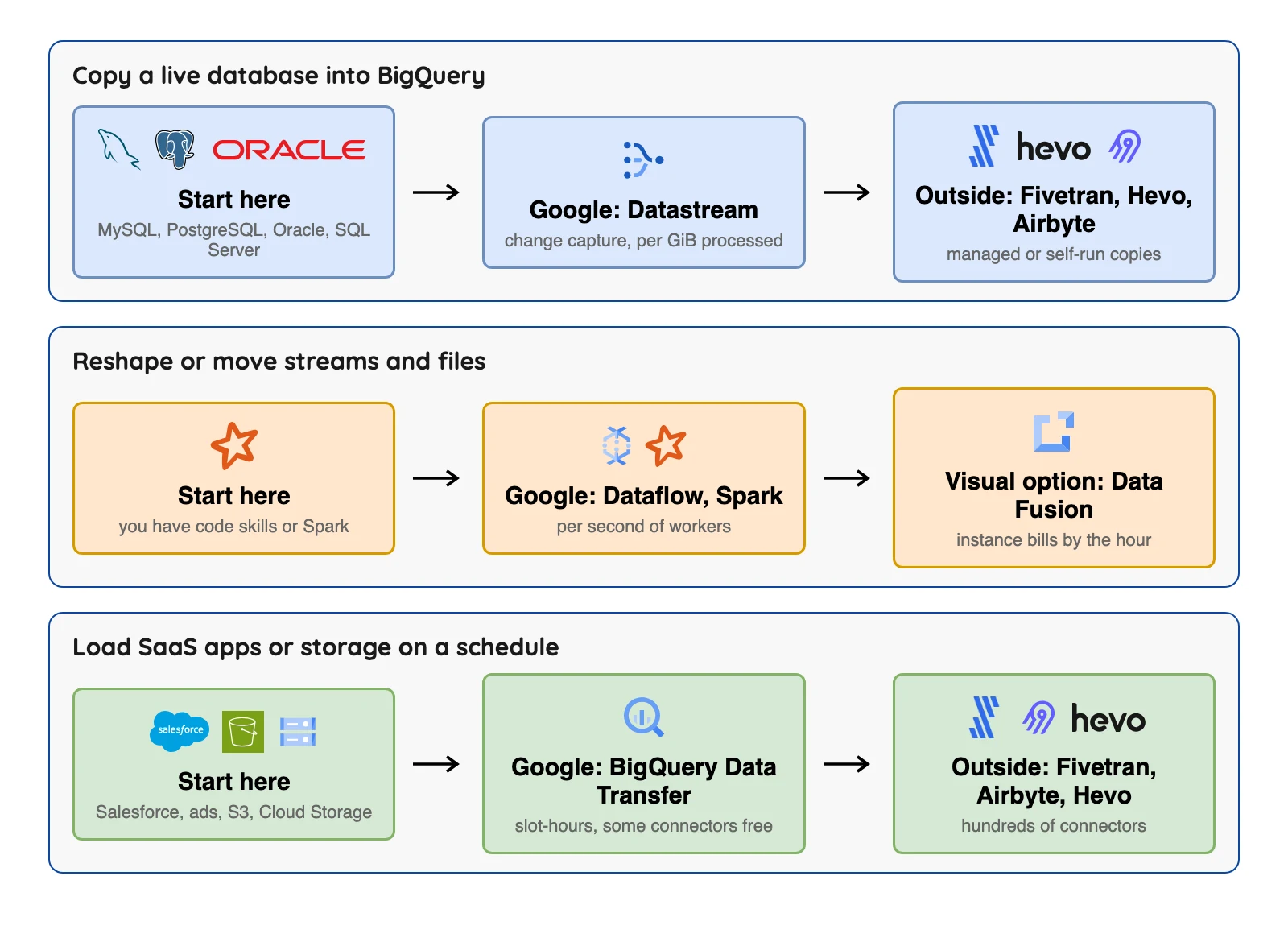
Our read: if your job is "copy my database", Datastream is the first thing to price. If your job is "reshape things on the way", you're choosing between code (Dataflow, Spark) and clicks (Data Fusion).
The 10 GCP ETL tools
Google Cloud services
1. Datastream: copying live databases into BigQuery
At a glance
- Sources: MySQL, Oracle, SQL Server and PostgreSQL, plus MongoDB, Spanner and Salesforce, per Google's sources page
- Billing: per GiB processed, per Google's Datastream pricing page. CDC is $2.00 per GiB for the first 2,500 GiB a month, then $1.50, $1.20 and $0.80 above 10,000 (US regions, Iowa shown) (checked Oct 2026)
Google's overview calls it "a serverless change data capture (CDC) and replication service". It starts with a backfill of existing rows, then keeps copying changes. Destinations are BigQuery, Cloud Storage and Apache Iceberg tables, per the destinations page.
What its docs list
- Per Google's Datastream pricing page, backfill gets the first 500 GiB a month free, then $0.40 per GiB (checked Oct 2026).
- BigQuery destinations support a merge write mode as well as an append-only mode, per the BigQuery destination page.
- For SQL Server you choose between two capture methods. Transaction logs "requires fewer resources and allows for faster data retrieval" but has more limitations; change tables has lower throughput, fewer limitations and supports encrypted tables.
- Iceberg output goes to your own storage: Iceberg tables in BigQuery keep data in customer-owned Cloud Storage buckets in the Apache Iceberg table format and Parquet file format, per the Iceberg destination page.
Where it falls short
- The bill counts "processed bytes", which Google says "can be 2-5 times larger than the actual data" for most use cases.
- Iceberg output is append-only: "Datastream supports streaming to Apache Iceberg tables only in the append-only write mode," says the Iceberg destination page.
- On PostgreSQL, one replication slot serves a whole stream, so one big transaction can delay every table in it. A stopped stream that keeps its slot makes PostgreSQL hold its change log, which can fill the disk, per the PostgreSQL source page.
- Don't count on the free CDC tier. It covers only AlloyDB and Spanner sources, 100 GiB a month.
- Iceberg output needs setup: the Cloud Storage bucket, BigQuery dataset and Datastream connection must share a region, and the connection's service account needs storage.admin on the bucket, per the Iceberg destination page.
- SQL Server has hard edges, per its source page: a table over 500 million rows can't be backfilled without a unique index on non-nullable columns, and the transaction logs method doesn't support Transparent Data Encryption (column-level encrypted data is replaced with NULL).
2. Dataflow: code-based stream and batch jobs
At a glance
- Billing: per second of worker vCPU and memory, plus shuffle data and other resources. Batch in Iowa: $0.056 per vCPU hour, $0.003557 per GiB hour of memory, $0.011 per GiB shuffled
- Streaming in Iowa: $0.069 per vCPU hour, per Google's pricing page (checked Oct 2026)
Google's overview says "Dataflow is a Google Cloud service that provides unified stream and batch data processing at scale." It is built on Apache Beam.
What its docs list
- Google's template list includes Pub/Sub to BigQuery, Kafka to BigQuery, MongoDB to BigQuery and JDBC to BigQuery, so you don't have to write code for the common cases.
- Batch templates on the same list copy MySQL, Oracle, PostgreSQL and SQL Server tables to BigQuery, and streaming templates read Spanner and Bigtable change streams.
- Per the overview, you write pipelines with Apache Beam in Java, Python or Go, or deploy Google's templates "without knowing any Apache Beam programming concepts".
- Discounts exist for steady use, per the pricing page: committed use saves 20% (one year) or 40% (three years), and FlexRS batch jobs are billed about 40% less on vCPU and memory.
Where it falls short
- It's a processing engine, not a log reader. The template page names one MySQL change capture template and a Datastream to BigQuery template, and we found no PostgreSQL log-reading template there.
- The bill has many parts: workers, shuffle, disks and the other Google services a job touches (Cloud Storage, Pub/Sub, Bigtable, BigQuery, Cloud Logging), each at its own price. The pricing page states no free allowance.
- Disks are billed on every job, and a batch worker defaults to 250 GB of Persistent Disk without Dataflow Shuffle (25 GB with it).
- The cheaper FlexRS batch mode has a catch: it delays a job within a 6-hour window to find the best start time, per the same page.
- Someone has to write, test and run pipelines.
3. Cloud Data Fusion: visual pipelines
At a glance
- Billing: instance hours. Developer $0.35, Basic $1.80 after 120 free hours a month, Enterprise $4.20, per Google's pricing page (checked Oct 2026)
- Also billed: the Spark cluster each pipeline run creates
Google's overview says Data Fusion starts a temporary Spark cluster at the beginning of a run and deletes it afterwards. On top sits a drag-and-drop designer, so analysts can build pipelines without writing code.
What its docs list
- A replication feature copies SQL Server, MySQL and Oracle changes into BigQuery, with an initial snapshot that Google describes as zero-downtime, per the replication docs.
- Google's pricing page lists the same prices in every supported region. The rate is quoted per hour but billed by the minute.
- The replication docs name the capture method for each source: the MySQL binary log, SQL Server CDC change tracking tables (SQL Server 2016 and later) and Oracle LogMiner. After the initial snapshot, they say continuous replication starts.
- The overview says Data Fusion is "powered by the open source project CDAP".
Where it falls short
- The instance is billed from the minute it's created to the minute it's deleted, even when no pipeline is running. Google's own note says instances "always need to be available." A deleted instance can't be recovered and its pipeline data is lost.
- Pipeline runs cost extra. Google charges for the Spark clusters Data Fusion creates at current Managed Service for Apache Spark rates, plus Cloud Storage, networking and BigQuery use.
- For replication jobs, the pricing page says BigQuery flat-rate pricing is recommended, not on-demand pricing, which is one more bill to plan for.
- Replication supports only BigQuery as a target, and PostgreSQL and MongoDB aren't on the source list we read.
- Concurrency is capped. Concurrent pipeline execution isn't available on Developer and is "limited" on Basic and Enterprise, and an instance supports at most 50 users (25 with role-based access control on), per the pricing page.
4. BigQuery Data Transfer Service: scheduled loads from SaaS and storage
At a glance
- Sources: Salesforce, ServiceNow, Facebook Ads, Google Ads and Google Analytics 4, plus MySQL, Oracle, PostgreSQL, Amazon S3, Azure Blob Storage and more, per the overview
- Billing: slot-hours at $0.06 an hour (Google's own example is priced in us-central1), but some connectors are free to run, per the BigQuery pricing page (checked Oct 2026)
Google says the service "automates data movement into BigQuery on a scheduled, managed basis."
What its docs list
- Per the BigQuery pricing page, the orchestration part is free for Google sources, object storage such as Cloud Storage, Amazon S3 and Azure Blob Storage, and the migration connectors for Amazon Redshift and Teradata.
- It's a feature of BigQuery itself, so there's no separate service to host.
- The overview says you can start backfills "to recover from outages or gaps".
- For PostgreSQL, the transfer docs say an incremental transfer (Preview) can use an Append or an Upsert write mode.
- Connectors in Preview aren't charged until they reach general availability, per the BigQuery pricing page. Google also gives a planning figure of up to 20 slot-hours per hour of transfer run time, an estimated upper bound of $1.20 an hour in us-central1 (checked Oct 2026).
Where it falls short
- It's BigQuery only. Nothing lands in a lake, and the overview says you "can't use BigQuery Data Transfer Service to transfer data out of BigQuery".
- Database transfers run on a schedule. Per the MySQL transfer docs, incremental mode is in Preview, needs a watermark column, and "cannot sync delete operations in the source table." Only TIMESTAMP columns can be the watermark, and its values must keep increasing.
- On PostgreSQL, a single transfer configuration "can only support either incremental or full ingestion", not both.
- Many connectors are still in Preview. The BigQuery pricing page lists Stripe, PayPal, HubSpot, Klaviyo and SQL Server, and the overview adds Mailchimp and Shopify.
- The database connectors you'd use for replication are not on the free list. MySQL, PostgreSQL and Oracle are billed in slot-hours, per the BigQuery pricing page.
5. Managed Service for Apache Spark (formerly Dataproc): Spark code
At a glance
- Billing: clusters pay a $0.010 per vCPU hour management fee plus the virtual machines. Serverless bills Data Compute Units (DCUs) per second, per Google's pricing page (checked Oct 2026)
- Name: Google's pricing page now says "Managed Service for Apache Spark (formerly Dataproc)"
Spark is the open-source engine many teams use for big data jobs, and this is Google running it for you.
What its docs list
- Serverless mode scales to zero, so Google says you "never pay for idle capacity." It bills per second on Data Compute Units (DCUs), shuffle storage and any attached accelerators.
- Cluster mode bills by the second with a 1-minute minimum, and the management fee is $0.010 x number of vCPUs x hours (checked Oct 2026).
- It is the engine behind another Google tool: Data Fusion's overview says it provisions a temporary Managed Service for Apache Spark cluster for each pipeline run.
Where it falls short
- You write the code. It ships no connector library and no change capture on the page we read.
- Iceberg support isn't stated on the pricing page, so check the docs for your version.
- Cluster mode bills for the cluster while it exists, plus the underlying Compute Engine machines and disks. The management fee applies to every vCPU across master, worker and secondary worker nodes.
6. Cloud Composer and Dataform: scheduling jobs and SQL steps
At a glance
- Billing: Composer bills DCU-hours, $0.06 per 1,000 milli-DCU hours for Gen 3 standard, per its pricing page (checked Oct 2026). Dataform is a free service, though other services it uses cost money
- Name: Google's pricing page now says "Managed Service for Apache Airflow"
Neither one actually pulls data out of a source. Composer is managed Apache Airflow (a job scheduler) and runs your other jobs in the right order, and Dataform builds SQL steps inside BigQuery and turns raw tables into clean ones. Google's Dataform overview describes it as "a service for data analysts to develop, test, control versions, and schedule complex workflows for data transformation in BigQuery."
What its docs list
- Dataform lets analysts keep SQL in Git with tests, and Google's Dataform page says the service is free. It adds that "There may be associated costs from other services when using the product."
- Dataform runs can be scheduled with workflow configurations, Managed Service for Apache Airflow, or Workflows and Cloud Scheduler, per the overview.
- Composer environments are billed "for the actual time period when it was running", in short intervals, per its pricing page.
- Committed use discounts apply to Composer Gen 3. On Composer's pricing page its standard milli-DCU-hour row drops from $0.06 to $0.054 and $0.048 per 1,000 hours in the table's other two price columns (checked Oct 2026).
Where it falls short
- Composer bills for the time an environment exists. Google's pricing page says a highly resilient setup roughly doubles the database storage cost, which is billed at $0.000232877 per GiB hour on Gen 3 (checked Oct 2026).
- The Dataform overview names BigQuery as the only target.
- Neither one has change data capture.
Outside tools that load Google Cloud
All four name BigQuery as a destination, and two of them document an Iceberg route on Google Cloud Storage.
7. Fivetran: many connectors with no servers
At a glance
- Free plan: up to 500,000 monthly active rows (MAR), counted per connection
- Standard list rate: $5 base per connection plus $495 per million MAR for the first million, per its Service Consumption Table (version 10, effective February 1, 2026) (checked Oct 2026)
Fivetran's destinations page lists BigQuery, and its Managed Data Lake Service writes Parquet files to your own Google Cloud Storage. Its catalog docs say the BigLake metastore "registers your tables as BigQuery external Iceberg tables."
What its docs list
- Fivetran describes the service as fully managed. Its pricing page lists "700+ fully managed connectors" on the Standard plan, and there is a free plan until you pass the row limit.
- Its database docs name log-based capture methods such as the MySQL binary log and PostgreSQL logical replication.
- Sync speed depends on the plan. The pricing page lists 15-minute syncs on Standard and 1-minute syncs on Enterprise.
- Fivetran's usage docs say a row is counted once per month however many times it syncs, and that initial syncs, re-syncs and connection trials count towards free MAR. Every new connection gets 14 days of free usage.
- For lakes, its docs say Fivetran Catalog is built on Apache Polaris and implements the Iceberg REST specification. The BigLake integration is optional and doesn't replace it, per the catalog docs.
Where it falls short
- Billing by rows means a busy table can cost more than you expect, and the rows are counted per connection. Deletes count as paid rows from January 2026, and so do changes tracked in history mode, per Fivetran's 2026 pricing updates.
- The Service Consumption Table says you cannot combine MAR across connections, activations or accounts to get a better rate. On Standard, a $5 base charge applies to every connection with 1 to 1 million MAR a month (the Free plan is exempt), per its usage docs (checked Oct 2026).
- The same catalog page warns: "Modifying Fivetran-delivered tables directly can corrupt the tables and disrupt downstream workflows."
- The BigLake integration registers tables as BigQuery external Iceberg tables, and the catalog docs say it does not register them in the Google Lakehouse Runtime Catalog.
- The list rate above is before any discounts, and the main pricing page prints no per-row rate.
8. Airbyte: self-hosting and connector choice
At a glance
- Core: free to self-host under the Elastic License 2.0. You pay for servers and the people who run them
- Cloud: Standard "Starts at $20 /month" with 5 credits included (about 1 GB of syncs), per Airbyte's pricing page (checked Nov 2026)
Airbyte's docs list BigQuery as a destination, and a GCS Data Lake destination that offers "official support for the Iceberg protocol on Google Cloud Storage," with BigLake and Polaris catalogs, per its GCS Data Lake page.
What its docs list
- Core has no volume limit from Airbyte, and you pick the connectors you need.
- The connector count is printed on the pricing page: its comparison matrix reads "700+" for all four plans.
- Per its docs page, that destination supports the BigLake and Polaris catalogs and five sync modes: Full Refresh Overwrite, Append and Overwrite + Deduped, and Incremental Append and Append + Deduped.
- Airbyte's CDC docs list current support for Postgres, MySQL, SQL Server, MongoDB, Oracle, SAP HANA and IBM Db2.
- Cloud starts with a 14-day free trial that includes 400 credits, which the pricing page puts at about 100 GB of syncs (checked Nov 2026).
Where it falls short
- Per its CDC docs, syncs are scheduled, not continuous: "We do not treat CDC sources as infinite streaming sources."
- CDC has gaps. The CDC docs say changes made by TRUNCATE or ALTER "won't appear in logs and therefore in your destination", and a refresh is required after any new table is added to a CDC connection.
- Per the same CDC docs, CDC incremental is "only supported for tables with primary keys for most sources", and the first CDC sync is a snapshot taken with a SELECT statement that the docs call "effectively a Full Refresh".
- Sync speed depends on the plan. The pricing page matrix reads 1 hour on Standard, 15 minutes on Plus and 5 minutes on Pro and Enterprise Flex, and Pro and Enterprise Flex pricing is shown as "Custom".
- The GCS Data Lake destination needs a service account with several roles: Storage Admin, BigQuery Data Editor, BigQuery User and Service Usage Consumer.
- Core runs under the Elastic License 2.0, which, per Airbyte's license FAQ, bars you from providing the products to others as a managed service.
9. Hevo: small teams loading BigQuery
At a glance
- Paid: Starter from $299 a month ($265 on annual billing), Professional from $849 ($750 annual), per Hevo's pricing page (checked Nov 2026)
Hevo's docs list Google BigQuery as a destination. An "event" here is a record inserted, updated or deleted in the destination.
What its docs list
- Hevo's pricing page posts its plans and offers a "14 day free trial" with 24x7 support and no credit card.
- Its log-based pipeline docs name the MySQL binary log, PostgreSQL logical replication, MongoDB change streams and Oracle redo logs, plus Change Tracking for SQL Server.
- Per the pricing page, Starter lists up to 10 users, all available connectors, dbt integration, SSH/SSL and 24*7 email and live chat support.
- Professional adds unlimited users, Hevo APIs for pipeline automation, Reverse SSH and add-ons, and the comparison table lists SOC 2 Type II compliance, per the same page.
Where it falls short
- Writing Iceberg to Google Cloud Storage with your own catalog isn't stated in its destination docs, so we say not published. The one Iceberg destination its docs describe loads into Snowflake-managed Iceberg tables with an S3 external volume, and it is in Early Access (Hevo docs).
- Streaming pipelines need Hevo Sales to enable them, and the Enterprise tier shows "Custom" pricing. The log-based pipeline docs exclude SQL Server and Amazon DynamoDB from streaming.
- For newer teams the minimum log-based ingestion frequency is 30 minutes, per its ingestion docs. The pricing page's sync frequency row reads 1 hour.
- Usage above your plan's quota is billed on demand on top of the plan, and the page shows no rate for it.
- Add-ons are listed from Professional up, and the pricing FAQ says they are not available on Starter.
10. Matillion: visual pipelines on BigQuery
At a glance
- Billing: credits by task hour. Orchestration pipelines are 1 credit per task hour, transformation 3, and streaming CDC 1 or 2, per its credit terms
- Price: no dollar price for an edition or a credit is printed on its pricing page
Matillion's docs describe push-down transformation in BigQuery, which means the heavy SQL runs inside BigQuery rather than on Matillion's servers. Its streaming pipelines can write to Google Cloud Storage.
What its docs list
- It has a visual designer, like Data Fusion, but works across several warehouses. Its pricing page lists a low-code canvas with SQL and Python and a built-in Git repository on every edition.
- Credits are charged only while a pipeline runs, and its terms say validation and sampling don't count. Task consumption is measured in 2-second increments.
- Editions are laid out in the open: Developer has 1 developer user, Teams has 5 plus an audit log and a service level agreement, and Scale adds hybrid deployment, data lineage tracking and 180+ days of log retention.
- Streaming pipelines capture changes from Db2 for IBM i, SQL Server, MySQL, Oracle and PostgreSQL and can write to Amazon S3, Azure Blob Storage, Google Cloud Storage or Snowflake, per the streaming docs.
- You can contract directly with Matillion or pay through your AWS, Azure or Snowflake account, per the pricing page FAQ.
Where it falls short
- No plan shows a dollar price, so you need a quote to budget. The credit terms say the overage rate "will be listed on the Order Form", and they don't define the "essential" and "premium" CDC pipelines that set the 1 or 2 credit rate.
- Streaming change capture sits on the Scale edition only. The pricing page lists it on the Scale card, and the streaming docs say it is "only available to customers on specific Maia plans".
- Streaming sources are limited to the five relational databases above: the streaming docs say they "only currently support relational databases as sources".
- Schema changes follow the data, not the DDL. The streaming docs say a source change isn't reflected in the target until the data changes, a dropped column stays in the destination with NULLs after the drop, and a new source table needs a new streaming pipeline.
- Extra developer users cost credits: the credit terms list 70 credits per user a month for developer users.
What each GCP ETL option bills for
Our read: the billing unit shapes your bill more than any feature does.
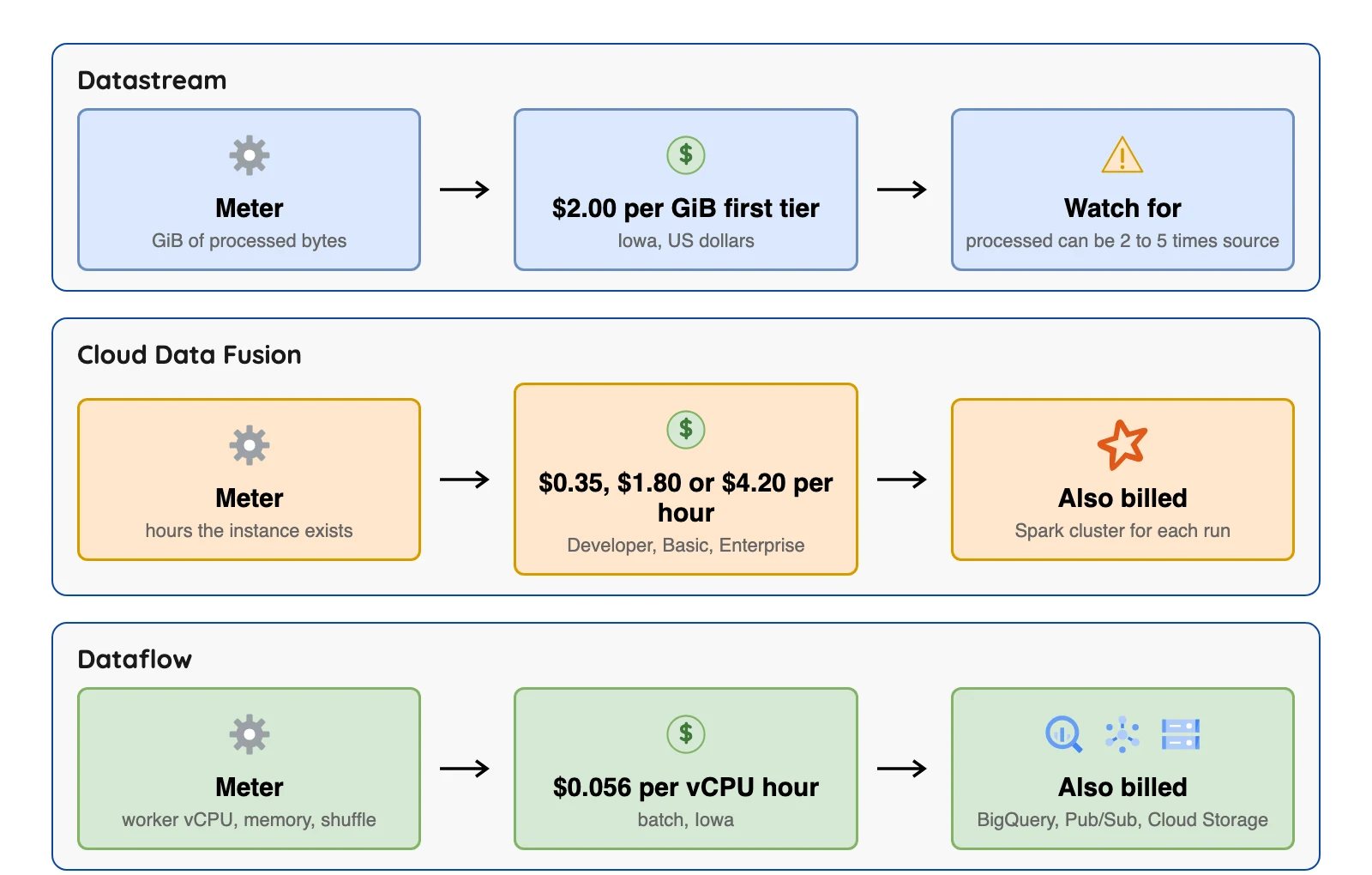
Three small examples, our own arithmetic on Google's published rates, not a quote.
| Example | Math | Result |
|---|---|---|
| Datastream CDC for 100 GiB of source changes in a month, if processed bytes run 2 to 5 times larger (Google's own range) | 200 to 500 GiB x $2.00 | about $400 to $1,000 a month in Iowa, before backfill |
| One Data Fusion instance running a 30-day month (720 hours), Spark cluster costs not counted | Developer 720 x $0.35. Basic (720 minus 120 free) x $1.80. Enterprise 720 x $4.20 | $252, $1,080 and $3,024 |
| Dataflow batch: 10 workers of 1 vCPU and 3.75 GiB, 2 hours a day for 30 days | 600 worker-hours x ($0.056 + 3.75 x $0.003557) | about $42 for workers, before disks, shuffle and other services |
Rates are from the Datastream, Data Fusion and Dataflow pricing pages linked earlier (checked Oct 2026). Google says Datastream "processed" bytes are an internal measure, so check a trial stream before trusting the 2 to 5 range. The cheapest Data Fusion edition costs the same whether it runs one pipeline or fifty.
What lands in your warehouse or lake
Many teams now want open table formats such as Apache Iceberg, so more than one engine can read the same data. Google-native tools mostly write BigQuery tables.
| Tool | What each tool's own docs name as the output | The catch |
|---|---|---|
| Datastream | BigQuery tables, Cloud Storage files, or Iceberg tables | Iceberg is append-only, per Google |
| Dataflow | Anything the pipeline or template writes, including BigQuery and Iceberg through Managed I/O | You build it, so you own the table design |
| Cloud Data Fusion | BigQuery for replication | Iceberg isn't stated on the pages we read |
| BigQuery Data Transfer Service | BigQuery tables | No lake output |
| Fivetran | BigQuery, or Parquet files on Cloud Storage with Iceberg metadata via BigLake | Direct edits to the tables can corrupt them, and the bill is row-based |
| Airbyte | BigQuery, or Iceberg through the GCS Data Lake destination | Scheduled syncs, a service account with several roles |
| Hevo | BigQuery | Iceberg on Cloud Storage isn't stated |
| Matillion | BigQuery, and Cloud Storage for streaming | Check the current Cloud Storage components |
| OLake Go (ours) | Iceberg tables or Parquet files on storage you choose (our docs) | Runs on your own infrastructure |
Google Services That Look Like ETL Tools but Are Not
These are not on our list, and why.
- Pub/Sub. It's a messaging service. Google's overview describes it as a messaging service that decouples the services producing messages from the services processing them, and it's not a database change reader.
- Storage Transfer Service. It moves files and objects into Cloud Storage from other clouds and on-premises file systems. Google's docs say it's optimized for transfers of more than 1 TiB and "does not provide an SLA".
- Database Migration Service. It moves databases to Cloud SQL and AlloyDB, which are Google's own database services. No lake or warehouse is listed as a destination in its overview.
- Knowledge Catalog (formerly Dataplex Universal Catalog). A catalog for lineage and data quality, renamed on April 10, 2026. It describes data rather than moving it.
- Dataprep. We couldn't confirm its current status. Google's Dataprep page redirected to the BigQuery page when we checked on October 2, 2026, and we found no retirement notice, so we neither list it nor call it retired.
So which one should you pick?
| If your situation is... | Start with | Why |
|---|---|---|
| Keep a MySQL, PostgreSQL, Oracle or SQL Server database in sync with BigQuery | Datastream | Log-based copies, pay by GiB |
| Process streams or files with code | Dataflow | One model for batch and streaming |
| Analysts build pipelines by clicking | Cloud Data Fusion | Visual designer, but an always-on instance |
| Load Google Ads, Analytics, Salesforce or S3 into BigQuery | BigQuery Data Transfer Service | Free orchestration for several sources |
| You already have Spark jobs | Managed Service for Apache Spark | Runs your code as is |
| Hundreds of SaaS connectors and no servers | Fivetran or Hevo | Managed connector libraries |
| A free tool you host yourself, or Iceberg files on Cloud Storage | Airbyte | Core is free, GCS Data Lake destination |
| Visual pipelines across several warehouses | Matillion | Push-down SQL in BigQuery |
| Databases into Iceberg or Parquet on storage you choose, open source | OLake Go | Change capture for Postgres, MySQL, MariaDB, MongoDB and SQL Server (our docs) |
| Scheduling jobs, SQL steps in BigQuery | Cloud Composer and Dataform | Glue around the other tools |
Which Google Cloud ETL tool fits you?
Question 1 of 5
What is the main job?
This one answer removes about half the list.
Conclusion
Google Cloud has no single ETL tool: Datastream, Dataflow, Data Fusion and the BigQuery Data Transfer Service each do a different job and bill in a different unit, so work the small example for your volume before you pick. If the target is Iceberg or Parquet rather than BigQuery tables, OLake Go is free to self-run and reads PostgreSQL, MySQL and MariaDB, MongoDB and SQL Server (full load, then changes; our docs).
For other clouds and wider lists, see Best data ingestion tools, AWS ETL tools and Azure ETL tools.