MariaDB vs MySQL: Differences and Which to Pick
19 min read
Key takeaways
MariaDB and MySQL are close cousins, and for a simple app either one will do. Choose MySQL if you host on Azure, want the native JSON type, or follow Oracle's release track; choose MariaDB if you want a foundation-led project, a built-in thread pool or extra storage engines. Don't assume MariaDB is a drop-in swap for current MySQL, because MariaDB's own compatibility page names drop-in status only for old versions, up to 10.4 (checked Oct 2026).
Whichever you run, OLake Go reads the change log of both MySQL and MariaDB into Apache Iceberg or Parquet (see the MySQL connector in our docs).
- MariaDB and MySQL both speak SQL, the standard language for asking a database questions. Both are free to download under the GNU General Public License version 2 (GPLv2). See the MySQL licence and the MariaDB Foundation (checked Oct 2026).
- The biggest practical gap is drift: the two have drifted apart in JSON storage, transaction IDs and replication.
- MySQL 8.0 moved to Oracle Sustaining Support on April 21, 2026 (MySQL notice). MariaDB 10.6 reached community end of life on July 6, 2026 (Amazon MariaDB version page) (checked Oct 2026).
- Azure Database for MariaDB was retired on September 19, 2025 (Microsoft lifecycle page) (checked Oct 2026).
- The popular "200,000 connections" claim traces back to one old line on MariaDB's features page, about versions 5.1 and 5.5, with no method. Its current thread pool page gives no connection count (checked Oct 2026).
- Either database can feed an analytics copy. OLake Go supports MySQL and MariaDB as change capture sources and writes Apache Iceberg or Parquet.
- PostgreSQL is a different family and is not a MySQL fork, so its tooling doesn't carry over.
Every fact below comes from the MariaDB, MySQL, PostgreSQL, Amazon and Microsoft documentation, with the page linked beside the claim (checked Oct 2026). Last reviewed October 2026.
MariaDB vs MySQL at a glance
| MySQL | MariaDB | |
|---|---|---|
| Run by | Oracle | MariaDB Foundation, with MariaDB Corporation as the main code contributor |
| Licence of the free edition | GPLv2 with extra linking permissions | GPLv2, and the foundation says it will stay free and open source "independent of any commercial entities" |
| Release tracks | Long Term Support (8.4 and 9.7) and Innovation releases | Long-term releases, with end-of-life dates listed below |
| JSON column | Binary format, checked on insert | Stored as plain text, checked by a rule |
| Thread pool | Enterprise Edition only (commercial) | Built in, not a plugin |
| Extra storage engines | InnoDB and NDB are the transactional ones | ColumnStore, MyRocks, Aria, Spider and CONNECT are listed |
| Cluster option | Group Replication and InnoDB Cluster | Galera Cluster |
| Transaction ID format | Server UUID plus number | Domain, server and sequence numbers |
| Managed on Azure | Yes, Azure Database for MySQL | Retired September 19, 2025 |
Sources: MySQL JSON manual, MariaDB JSON docs, MySQL thread pool, MariaDB thread pool, MySQL Group Replication, MariaDB Galera, MariaDB transaction ID page, Azure Database for MySQL, MySQL (checked Oct 2026).
If you're wondering about WordPress, the best-known app on this database family, it's happy with either. Its requirements page recommends MariaDB 10.11 or greater, or MySQL 8.0 or greater (checked Oct 2026).
Where MariaDB and MySQL came from
It helps to know the family story. MariaDB began as a copy of MySQL's code, called a fork. MariaDB's own compatibility page says that up to version 5.5, each MariaDB release worked as a "drop-in replacement" for the matching MySQL release, with some limits (checked Oct 2026).
Since then the two have gone their own ways. Oracle runs MySQL.
MariaDB Server is governed by the MariaDB Foundation, which lists its mission as "Openness, Adoption, and Continuity" on its about page. The Foundation says the server "will remain Free and Open Source Software licensed under GPLv2".
That tells you who decides the roadmap, and who you'd rely on for paid support.
Is MariaDB a drop-in replacement for MySQL?
The answer is not any more, per the vendor's own words. MariaDB's compatibility page calls versions 10.0 and 10.1 limited drop-in replacements for MySQL 5.6. It says the same of 10.2 to 10.4 and MySQL 5.7, as far as the InnoDB storage engine is concerned (checked Oct 2026).
The page adds that "the implementation differences continue to grow in each new MariaDB version." It names no drop-in status for 10.6 or later, and points to separate lists of incompatibilities with MySQL 8.0.
The page says data files are generally binary compatible with the matching MySQL version, and the client protocol matches, so MySQL connectors for languages such as Python still work with MariaDB. You still have to run mysql_upgrade after switching to update the permission tables (checked Oct 2026).
The sharpest break is the transaction ID. A GTID (global transaction identifier) is a label that tells a copy of the database which changes it already has.
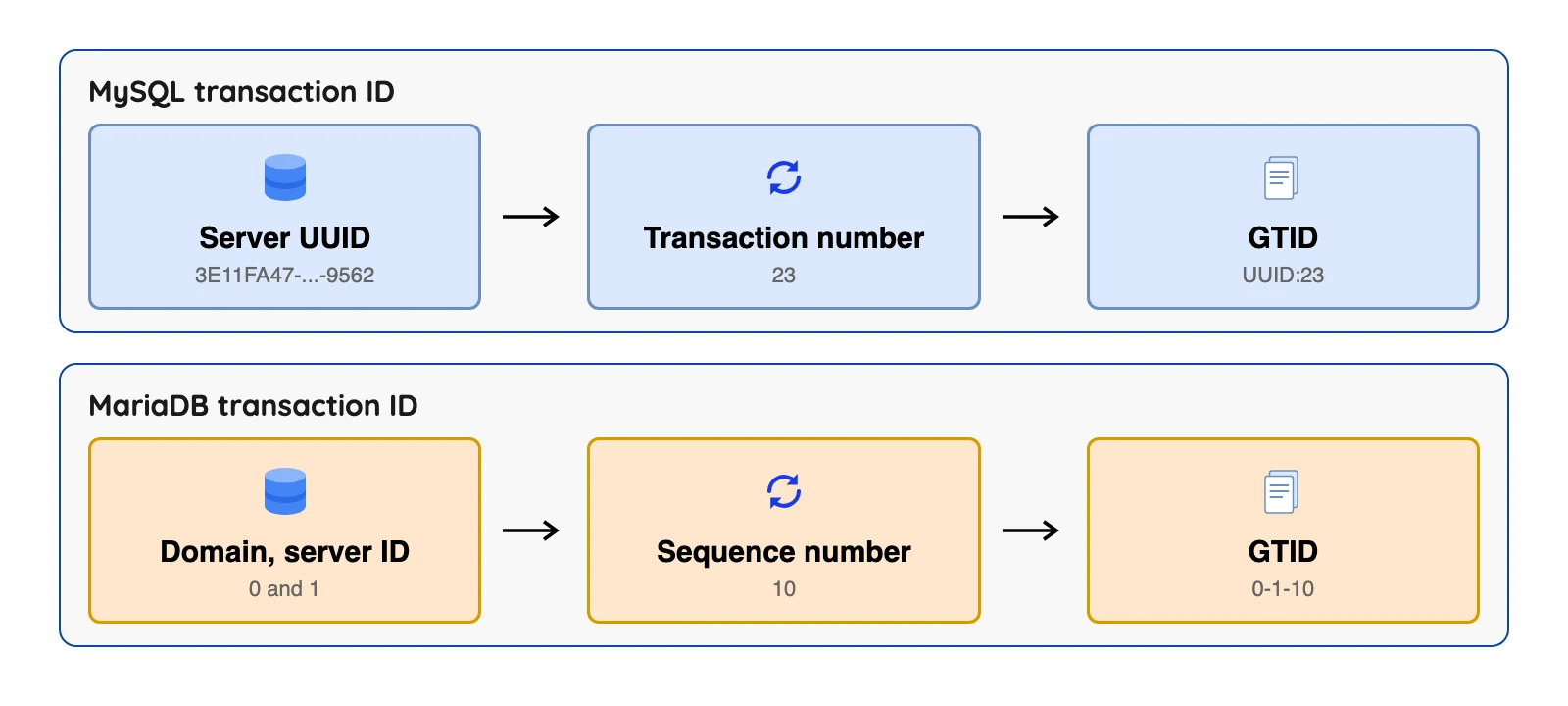
MariaDB's GTID page says the two are "not compatible." It then names the limit. "MariaDB can be a replica for a MySQL primary, but MySQL cannot be a replica for a MariaDB primary." So MariaDB can follow a MySQL primary. Going the other way needs a different plan (checked Oct 2026).
JSON: the clearest difference in how data is stored
JSON is a text format for nested data, such as a customer record with a list of orders inside it. Both databases accept a JSON column, but what happens behind the scenes is quite different.
MySQL turns the text into an internal binary format. Its manual says the server can look up nested values "directly by key or array index".
Version 8.4 can also update part of a JSON value in place. That works under set conditions. One is that the new value is no larger than the old one (checked Oct 2026).
MariaDB takes the opposite route. MariaDB's docs say MariaDB stores JSON in a long text column (LONGTEXT). In their words, JSON is "an alias for LONGTEXT".
They say a native JSON type "contradicts the SQL:2016 standard". A built-in check rejects invalid JSON. Values are kept as text, and JSON strings are compared as plain strings.
The same page also says its own benchmarks show performance "at least equivalent." That's the vendor talking about its own design, and we didn't find an independent test of it.
It bites when you move data. MariaDB's compatibility page says it "does not support MySQL 5.7's packed JSON objects," so a JSON-heavy app needs testing before a swap in either direction. The same page advises storing the JSON as plain text, or using statement-based replication, when you copy JSON columns from MySQL to MariaDB (checked Oct 2026).
Thread pool, speed and the 200,000 connections claim
A thread pool lets a database serve many connected users with a limited number of working threads. Without one, the server uses one thread per connection.
MySQL's manual says its thread pool is part of MySQL Enterprise Edition, "a commercial product." By default, MySQL uses one thread per client connection. MariaDB's thread pool page says "Unlike Oracle MySQL Enterprise Thread Pool, MariaDB's one is built in, not a plugin" (checked Oct 2026).
A figure of up to 200,000 connections circulates for MariaDB. It appears in one place. MariaDB's features comparison page says the pool of threads in versions 5.1 and 5.5 "allows MariaDB to run with 200,000+ connections" (checked Oct 2026).
That line has no hardware, no method and no date, and it's about versions from many years ago. The current thread pool page gives no connection count. Our read: treat it as an old vendor claim, not a tested number for MariaDB 11 or 12.
The same goes for "MariaDB is faster" claims. We found no dated, independent benchmark with a stated method, so this post makes no speed claim in either direction.
If speed matters to you, test your own queries on your own data. That's the only number you can trust.
The same MySQL manual page says the thread pool is meant for "large numbers of client connections," so it matters most if you have many of them. If a vendor quotes a connection or speed figure, ask which version, which hardware and which workload produced it.
What each side adds that the other does not list
Most of the real differences are in features. MariaDB's features page lists what it adds on top of the MySQL base, and MySQL's own manual covers the MySQL side.
| Feature | MariaDB | MySQL |
|---|---|---|
| Extra storage engines | ColumnStore ("optimized for Data warehousing"), MyRocks, Aria, Spider, CONNECT | InnoDB is the default engine |
| Query old data | System-versioned tables, to "access both current and historic data" | Not covered by our sources |
| Oracle-style SQL | Oracle-compatible SEQUENCE and a SQL mode for Oracle syntax | Not covered by our sources |
| Cluster | Galera Cluster, described as "synchronous multi-primary replication" | Group Replication, in single-primary or multi-primary mode, wrapped by InnoDB Cluster |
| Binary JSON | No, text with a check | Yes |
The same page notes that two engines, TokuDB and Cassandra, were removed in MariaDB 10.6 (checked Oct 2026). An engine on a feature list isn't a promise it stays, so check your version before you design around one.
Support dates in 2026
Both projects run more than one version at a time, and some have just ended. These dates change every year, so check them again before you plan.
| Version | What the vendor says | Source |
|---|---|---|
| MySQL 8.0 | Covered under Oracle Sustaining Support as of April 21, 2026 | MySQL EOL notice |
| MySQL 8.4 LTS | Oracle recommends it, along with 9.7 LTS, as the move from 8.0 | MySQL EOL notice |
| MariaDB 10.6 | Community end of life July 6, 2026 | Amazon RDS for MariaDB |
| MariaDB 10.11 | Community end of life February 16, 2028 | Amazon RDS for MariaDB |
| MariaDB 11.4 | Community end of life May 2029 | Amazon RDS for MariaDB |
| MariaDB 12.3 | Released May 28, 2026; community end of life June 2029 | Amazon RDS for MariaDB |
The two release models differ too. MySQL has Long Term Support (LTS) versions and Innovation versions. Oracle's notice points users to the 8.4 and 9.7 LTS lines, the ones meant for steady production use.
MariaDB's own downloads list also gives end-of-life dates for its long-term releases. They matched the Amazon dates for 10.11, 11.4 and 12.3, but not for 11.8, so we left 11.8 out. Check the MariaDB downloads page for your version.
Hosting, apps and who runs it for you
Many teams rent their database from a cloud provider, and that choice can settle the question before features come up.
Microsoft retired Azure Database for MariaDB on September 19, 2025. Its lifecycle page lists the date and links to migration guidance (checked Oct 2026). The page we read doesn't name a replacement service, so check Microsoft's guidance if you're on Azure.
Apps often care less than you'd think. WordPress accepts either database, so the choice there comes down to what your host runs and supports.
Amazon Relational Database Service (RDS) still lists MariaDB, as the version table above shows. Look at your own provider's current version list before you commit. AWS says it adds a new major version within 3 months of the first community patch release (checked Oct 2026).
A worked example: a small WordPress site
Picture a site on MySQL 8.0, and the owner wonders whether to move to MariaDB. WordPress accepts both, so the app isn't a reason to move.
The MySQL notice puts 8.0 under Sustaining Support from April 21, 2026, and names 8.4 LTS or 9.7 LTS as the places to go. Our read: the easier path is to stay in the MySQL family and move to 8.4. A move to MariaDB 11.4 or 12.3 only makes sense if the host offers it and the JSON and replication checks below pass.
How to test before you switch
Switching is a small project. The vendor pages above point to a short test list that you can run on a copy of your data (never on the live one).
- Replication direction. If you plan to run both for a while, check which one is the primary. MariaDB can replicate from MySQL, and the reverse isn't supported, per MariaDB's GTID page. JSON columns add a catch, noted above.
- JSON columns. Load a sample of your JSON data into both and compare query results. MariaDB's docs say JSON strings are compared as strings, while MySQL compares JSON values.
- Upgrade scripts. Run
mysql_upgradeon MariaDB as the compatibility page requires, then check that your permissions and scheduled events still work. - Connection pattern. If you have very many short connections, test with and without a thread pool. On MySQL that means the paid Enterprise Edition.
- Version dates. Write down the end-of-life date for the exact version you will run, and plan the next upgrade before you start.
None of this needs a special tool. A copy of the database, a few representative queries and a day of testing will tell you more than any comparison page, including this one.
Where MySQL fits
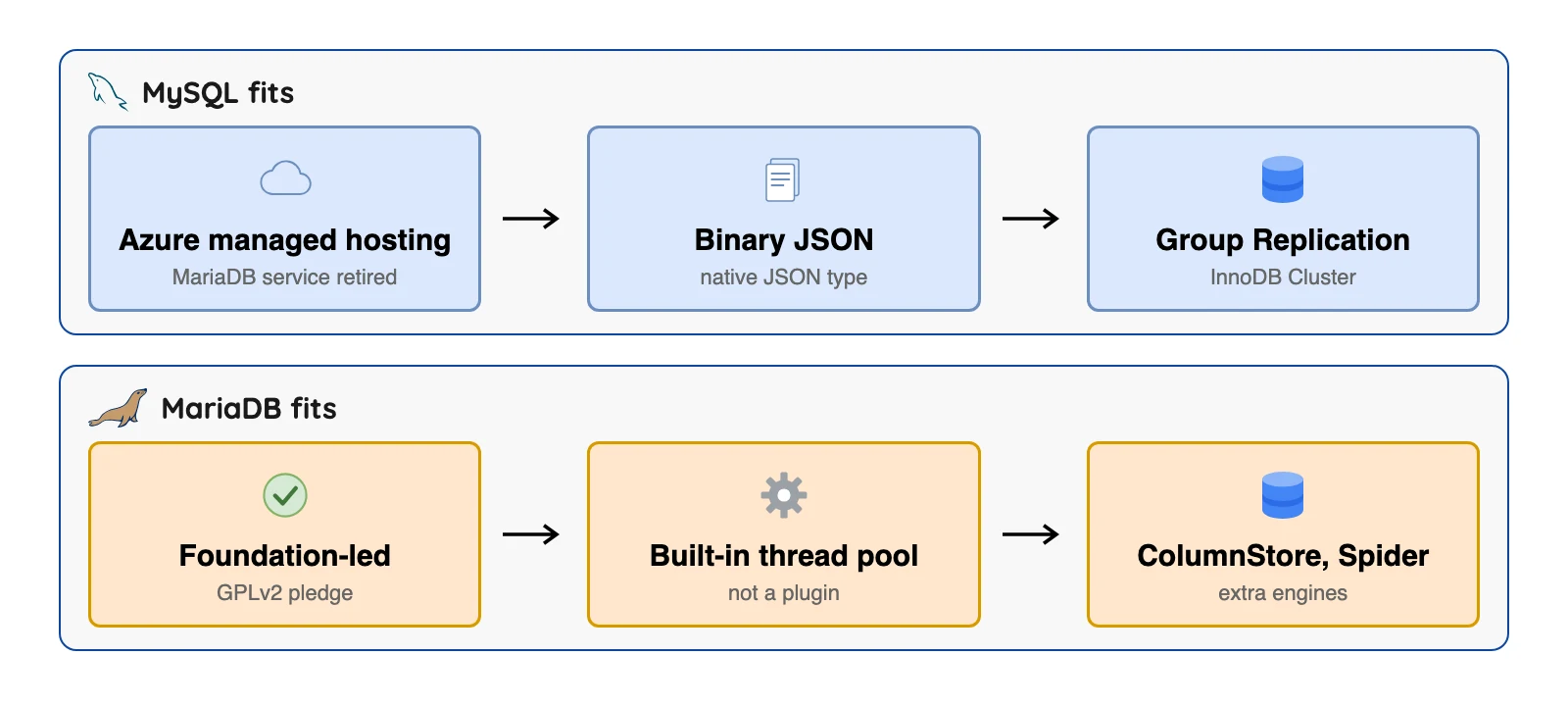
Choose MySQL if you need:
- A managed service on Azure, where Microsoft lists Azure Database for MySQL flexible server (checked Oct 2026).
- A native, binary JSON type, per the MySQL manual.
- Oracle's published LTS schedule.
Its limits: the thread pool needs the paid Enterprise Edition (checked Oct 2026), and one company, Oracle, sets its roadmap.
What users say (one person's view, with its date and link):
On PeerSpot, a December 2025 reviewer praises setup: "It is easy to set up and allows you to focus on your business logic initially without going for more complicated databases." An August 2026 reviewer has a gripe. "Changing the database schema on large tables can also be challenging and may require careful planning to minimize downtime."
Where MariaDB fits
Choose MariaDB if you need:
- A server governed by a foundation that has pledged to keep it free and open source. That is the Foundation's own statement on its about page (checked Oct 2026).
- A built-in thread pool, per MariaDB's docs (checked Oct 2026).
- MySQL connectors with a foundation-led server behind them.
Its limits: it no longer swaps in cleanly for current MySQL, its JSON is text, and Azure has retired its managed MariaDB (checked Oct 2026).
What users say (one person's view, with its date and link):
On PeerSpot, a January 2026 reviewer praises support: "The technical support of MariaDB is very helpful." A June 2026 reviewer has a gripe. "the built-in visual tools for administration, management, and query design feel outdated compared to some competitors."
Which should you pick?
Find the row that sounds most like you. If two rows fit, test both.
| Your situation | Lean toward |
|---|---|
| Hosting on Azure and want a managed service | MySQL |
| Existing app written for MySQL 8.x, no reason to change | MySQL |
| Need many connections and no paid MySQL Enterprise licence | MariaDB, then test it |
| Want foundation governance and a GPLv2 pledge | MariaDB |
| Heavy JSON queries you want stored in binary form | MySQL |
| Want to move from MySQL to MariaDB gradually | MariaDB can replicate from MySQL; test the reverse first |
| You want an analytics copy of either database | Either; OLake Go reads MySQL and MariaDB changes into Iceberg |
| Indexed binary JSON matters most | Look at PostgreSQL (jsonb) |
Which database fits you?
Question 1 of 5
Where will the database run?
Many teams rent their database from a cloud provider, and that can settle the question early.
Postgres vs MariaDB
PostgreSQL, often called Postgres, is an independent project with its own code and community, so moving to it is a migration rather than an upgrade.
| PostgreSQL | MariaDB | |
|---|---|---|
| Licence | PostgreSQL License, similar to the BSD or MIT licenses | GPLv2 |
| JSON | json keeps an exact text copy; jsonb is binary and can be indexed, per the Postgres docs | Alias for LONGTEXT |
Sources: PostgreSQL licence (checked Oct 2026).
Postgres documents indexing for its binary jsonb type, which is the JSON feature its docs describe most clearly. We didn't check how MariaDB indexes JSON. MariaDB keeps MySQL's family of tools, if your app, host or tools are already built around them. We found no neutral benchmark with a stated method, so we don't rank them on speed.
What users say (one person's view, with its date and link):
On PeerSpot, a March 2026 reviewer praises stability: "PostgreSQL has been very stable in my experience, handling concurrent requests reliably while maintaining data consistency".
Postgres records changes in its write-ahead log (WAL). On Hacker News, a November 2025 thread is titled "Listen to Database Changes Through the Postgres WAL". A commenter who builds a sync product gripes: "it is a great tool, but it is also very low-level and under-documented."
Copying data out of either database
Many teams want to analyse this data somewhere else, and the usual way is change data capture (CDC). CDC reads the database's own change log and copies each insert, update and delete, instead of re-reading whole tables.
OLake Go is open source under Apache 2.0 (repo). It supports MariaDB as a change capture source through the MySQL connector in our docs, and it writes to Apache Iceberg or Parquet.
For the wider picture, see what change data capture is, Postgres vs MySQL and MySQL to Iceberg tools.
Q1. What is the main difference between MariaDB and MySQL?
Q2. Is MariaDB a drop-in replacement for MySQL?
Q3. Is MariaDB faster than MySQL?
Q4. Which is better for a new project, MariaDB or MySQL?
Q5. Are MariaDB and MySQL both free?
Q6. Is MySQL 8.0 still supported?
Q7. Does WordPress work with MariaDB and MySQL?
Q8. How does PostgreSQL compare with MariaDB?
Conclusion
The two share a past and a lot of syntax, but they're now two products with their own rules for JSON, transaction IDs and release dates. Choose by where you host, how you use JSON, which tools you depend on and who you want steering the roadmap.
If you plan to switch, test replication and JSON on a copy of your data first. Postgres is worth a look if indexed binary JSON matters most to you. MySQL or MariaDB fits better when your app and host are built around the MySQL family. Whichever you choose, OLake Go can copy its changes into Iceberg for reporting.