MongoDB Alternatives: 7 Options and Their Limits
30 min read
Key takeaways
No single alternative fits every app. The right one depends on how much of your app you're willing to change. Want to keep your MongoDB code?
Look at Amazon DocumentDB, Azure DocumentDB or FerretDB, and read each one's list of missing features first. Want JSON documents with a new query language? That's Couchbase.
Ready for a new data model? PostgreSQL with JSONB (JSON stored in a binary column type) suits joins and reports.
Amazon DynamoDB suits known key lookups on AWS. Apache Cassandra suits write-heavy work you run yourself.
- "MongoDB-compatible" does not mean MongoDB. Amazon DocumentDB emulates MongoDB APIs on its own engine. Azure DocumentDB's 99.03% figure counts operators only, and FerretDB lists commands it hasn't built yet.
- Every option has a named limit. DynamoDB items stop at
400 KB. Couchbase Community Edition stops at five nodes. FerretDB has no transaction commit command yet.
We checked prices in October 2026 against each vendor's own page. Plans change often, so confirm on the vendor's page before you decide. Last reviewed October 2026.
Why teams look for a MongoDB alternative
MongoDB's release notes page lists the 9.0 series as the current stable release. Three reasons usually start the search.
- The licence. The MongoDB server's licence file is the Server Side Public License (SSPL), Version 1, dated October 16, 2018, with copyright held by MongoDB, Inc. You can read it yourself in the
LICENSE-Community.txtfile in MongoDB's GitHub repository. Microsoft's Azure DocumentDB page says the SSPL doesn't apply to DocumentDB or Azure DocumentDB, because they don't run the MongoDB server. - The bill. MongoDB's managed service, Atlas, lists a Free tier at $0, a Flex tier that "can cost between $8 and $30 for a month's usage", and Dedicated clusters from $0.08 an hour, which is $56.94 a month. See the Atlas pricing page, read in October 2026.
- Joins. MongoDB can join collections with
$lookup, a left outer join to another collection in the same database. Its own$lookupdocs page warns that unindexed or correlated-subquery lookups on large collections can slow queries. They suggest an embedded data model instead.
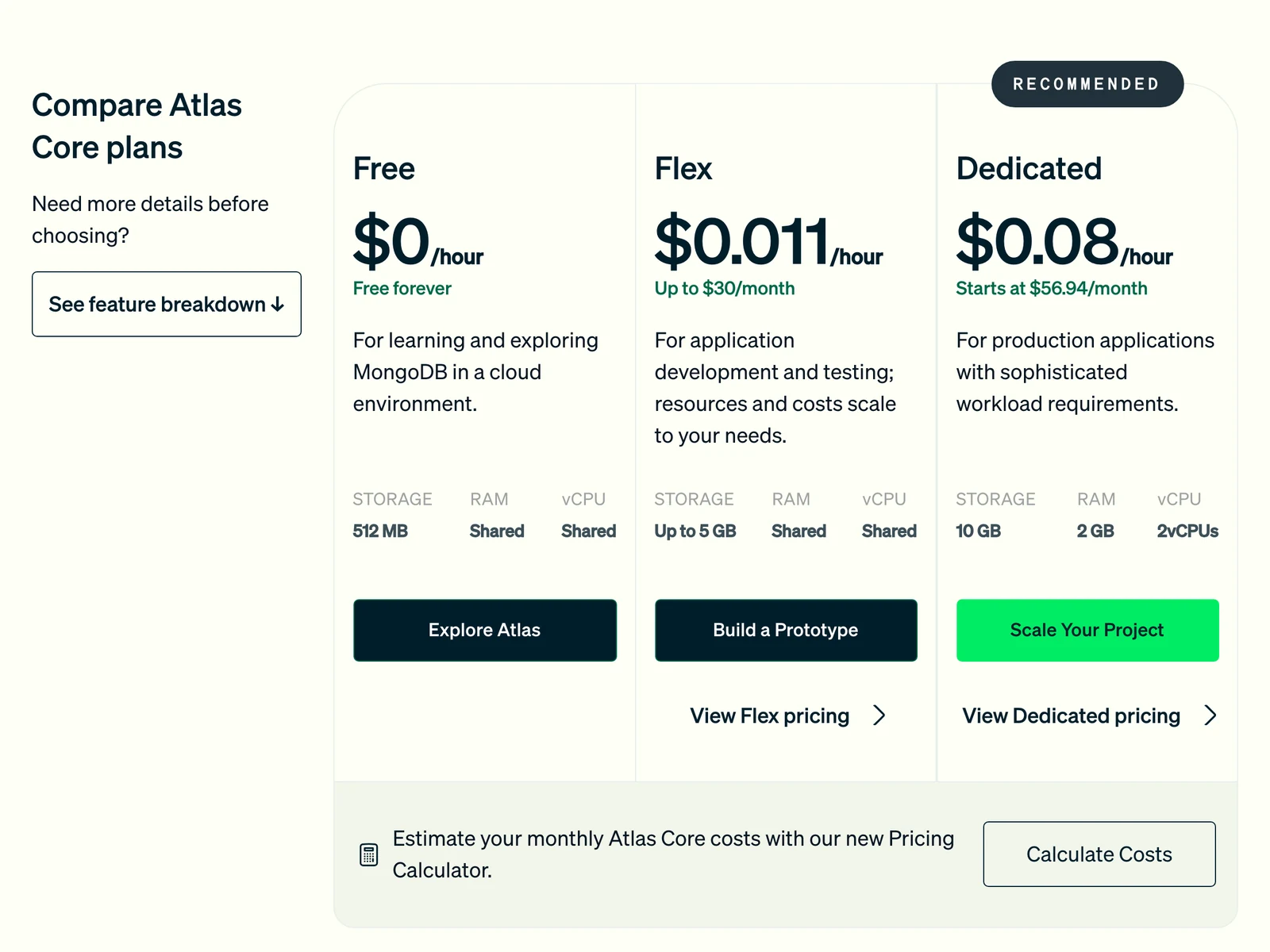
MongoDB Atlas pricing page, October 2026.
How we picked
Vendor facts come from each vendor's own docs and pricing pages, read in October 2026. We did not run the other tools. User opinions come only from named public sources, with a month and year where the page shows one. Treat them as opinion.
CouchDB, Redis, Firestore, Elasticsearch, RethinkDB, OrientDB and others are left out. We didn't check their current docs for this page.
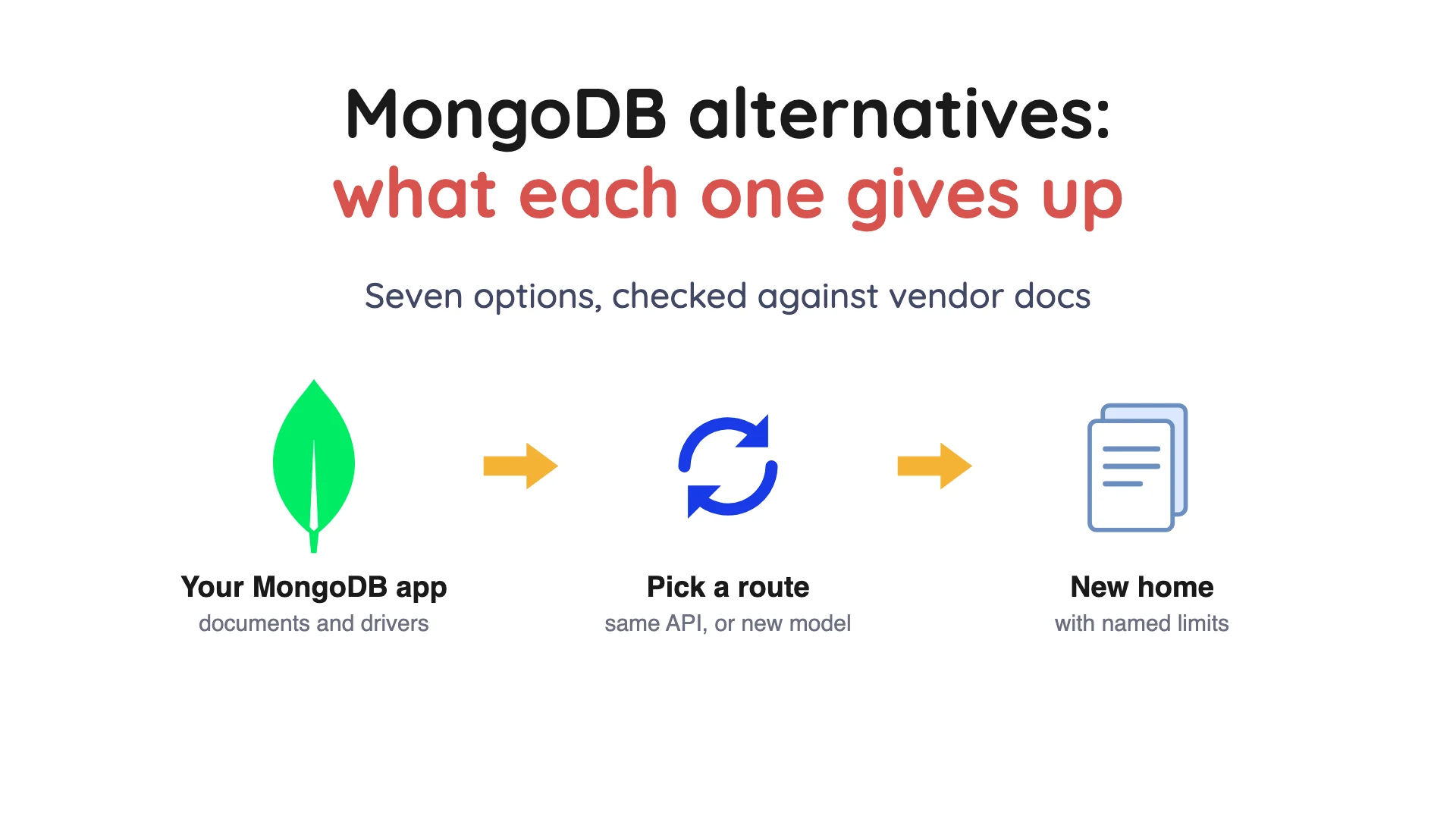
First, pick a route
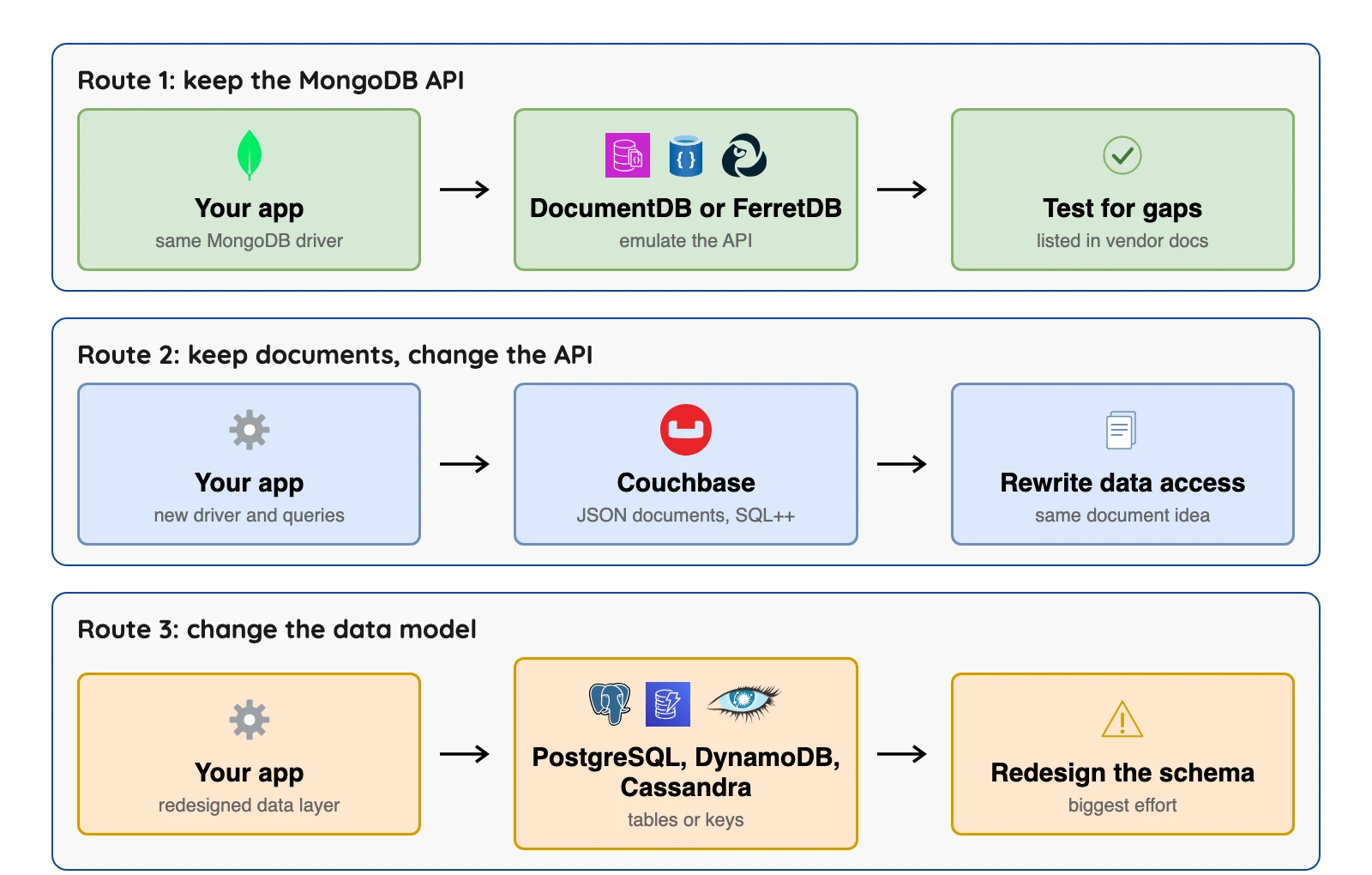
Route 1 keeps your MongoDB code. An API (application programming interface) is the set of commands your app sends. These engines accept MongoDB's commands but aren't MongoDB: Amazon DocumentDB, Azure DocumentDB and FerretDB. You'll still need to test for missing features.
Route 2 keeps the documents. Couchbase also stores JSON documents, but you use its own driver and query language, SQL++. Your data shape carries over, and you rewrite the data access code.
Route 3 changes the data model. PostgreSQL stores rows and tables, DynamoDB stores items found by key, and Cassandra stores rows grouped by a partition key. This is the most work. It's also the route where joins, for example in PostgreSQL, become possible.
MongoDB alternatives at a glance
| Option | Route | Licence | Who runs it | Starting price (vendor page) | Biggest named limit |
|---|---|---|---|---|---|
| MongoDB (baseline) | n/a | SSPL v1 (server) | You, or Atlas | Atlas Free $0; Flex $8 to $30 a month; Dedicated from $0.08 an hour | 16 MiB per document |
| PostgreSQL with JSONB | 3 | PostgreSQL License | You, or a host | Software free; host prices vary | Any update locks the whole row |
| Amazon DocumentDB | 1 | Proprietary | AWS | db.r5.large $0.277 an hour, plus storage and I/O | Emulates APIs; no wildcard or hashed indexes |
| Azure DocumentDB | 1 | MIT (engine); Azure service proprietary | Microsoft, or you | Free tier; compute rates not published on the page we read | Some commands unsupported, such as bulkWrite |
| FerretDB | 1 | Apache 2.0 | You | Software free; hosted price not published | Transaction commit and abort not implemented |
| Couchbase | 2 | See note below | You, or Capella | Capella Basic from $0.15 an hour per node | Community Edition: 5 nodes, 4 cores per node |
| Amazon DynamoDB | 3 | Proprietary | AWS | $0.625 per million write request units | 400 KB per item; no joins |
| Apache Cassandra | 3 | Apache 2.0 | You | Software free; project publishes no price | No joins in its query language |
Sources: MongoDB pricing, Amazon DocumentDB pricing, Couchbase pricing, Amazon DynamoDB on-demand pricing, and each project's own docs. Checked October 2026.
Couchbase's documentation calls Couchbase Server "an open source" database, but we couldn't confirm the licence terms from a primary page, so we don't name one. Prices are US East (N. Virginia) where a region applies.
The 7 MongoDB alternatives
1. PostgreSQL with JSONB
PostgreSQL home page, October 2026.
At a glance: PostgreSQL License · you run it or rent it from a host · route 3 · software is free
JSONB is a PostgreSQL column type that stores JSON documents in a binary format. Its documentation says most applications should prefer jsonb, and that it supports several index types.
What its docs list
jsonbis stored in a decomposed binary format, which the docs say makes input slightly slower but processing significantly faster than plainjson. It also supports indexing, and GIN indexes can search for keys or key/value pairs across a large number ofjsonbdocuments.- It speaks SQL, so joins, reports and the tools your analysts already know work as they do on any relational database. Its docs say it supports most of the major features of
SQL:2023and conforms to at least 170 of the 177 mandatory Core features, per its SQL conformance appendix. - Under its multiversion concurrency control (MVCC) model, the concurrency docs say reading never blocks writing and writing never blocks reading.
- Its change feed, called logical replication, can publish inserts, updates, deletes and truncates, according to its publication docs, so downstream systems can follow it.
Where it falls short
- Any update takes a row-level lock on the whole row, so the docs say to keep JSON documents a manageable size. Large documents that change a lot are a poor fit.
jsonbdoes not keep white space, the order of object keys or duplicate keys, and if a key appears twice only the last value is kept. The docs also recommend a somewhat fixed document structure, which is typically not enforced by the database.- The built-in partitioning described in its docs splits a table by range, list or hash, and the page doesn't mention sharding across servers. Ask any host how it scales writes.
- Your MongoDB queries become SQL, so your data access code has to change.
- A logical replication slot that nobody reads keeps write-ahead log (WAL) files on disk, and in extreme cases could shut the database down to prevent transaction ID wraparound, according to its logical decoding docs.
Fits: reports and joins matter more than a drop-in swap. Less suited if your existing MongoDB code has to keep working.
What users say: On the Hacker News thread "Go ahead, self-host Postgres" (December 2025), one commenter wrote "No issues selfhosting either. I have backups and I know they work." Another said "And Postgres upgrades are not transparent."
2. Amazon DocumentDB
Amazon DocumentDB home page, October 2026.
At a glance: proprietary · AWS managed service · route 1 · db.r5.large at $0.277 an hour standard
Amazon DocumentDB "emulates the MongoDB 3.6, 4.0, 5.0, and 8.0 APIs on a purpose-built database engine", according to AWS's functional differences page. It isn't MongoDB code. AWS says query plans and explain() output may differ.
What its docs list
- AWS describes it as fully managed. Its developer guide says storage keeps six copies of your data across three Availability Zones (separate data centers in one region), and grows in
10 GBsteps up to256 TiBfor engine version8.0and later (128 TiBfor earlier versions). You don't provision extra storage for growth. - A cluster holds
0to16instances and all writes go through the primary. AWS says that on an instance failure it fails over automatically to one of up to15replicas that you create in other Availability Zones. - Point-in-time recovery restores a cluster to any second in the retention period, up to the last
5 minutes, and automatic backup retention can be set up to35 days. - Elastic clusters, the horizontally scaled type, are described as supporting workloads with millions of reads and writes per second and petabytes of storage.
- Change streams are supported on instance-based clusters for all four API versions, per the supported-commands table in AWS's MongoDB APIs page. Explicit multi-statement ACID transactions are supported from DocumentDB
4.0, according to the functional differences page. - AWS offers a one-month free trial of 750 hours on
db.t3.medium, with 30 million I/Os and 5 GB of storage. It is not available in the AWS GovCloud (US) regions or the China (Ningxia) region.
Where it falls short
- AWS's supported-index table marks wildcard and hashed indexes as not supported, and capped collections,
cloneCollectionAsCappedandconvertToCappedare marked No for every engine version. - Change streams are not supported on elastic clusters, the horizontally scaled type.
- Retryable writes arrive in engine version
8.0.2. Earlier versions return an error unless the driver turns them off. - Only one index build can run on a collection at a time.
- It does not support the
adminorlocaldatabase, or MongoDBsystem.*collections, and it does not guarantee result ordering unless you sort explicitly. - Do the sums: one
db.r5.largeinstance running 30 days is 720 hours, or about $199 at $0.277 an hour (our own sum, not a price on the page: 0.277 x 720 = 199.44), before storage and I/O. Billing has more moving parts than a flat tier: instance hours, I/O, storage, backup and data transfer. The pricing page example, read in October 2026, lists $0.10 per GB-month and $0.20 per million I/O requests on standard, or an I/O-Optimized option at $0.3047 an hour and $0.30 per GB-month.
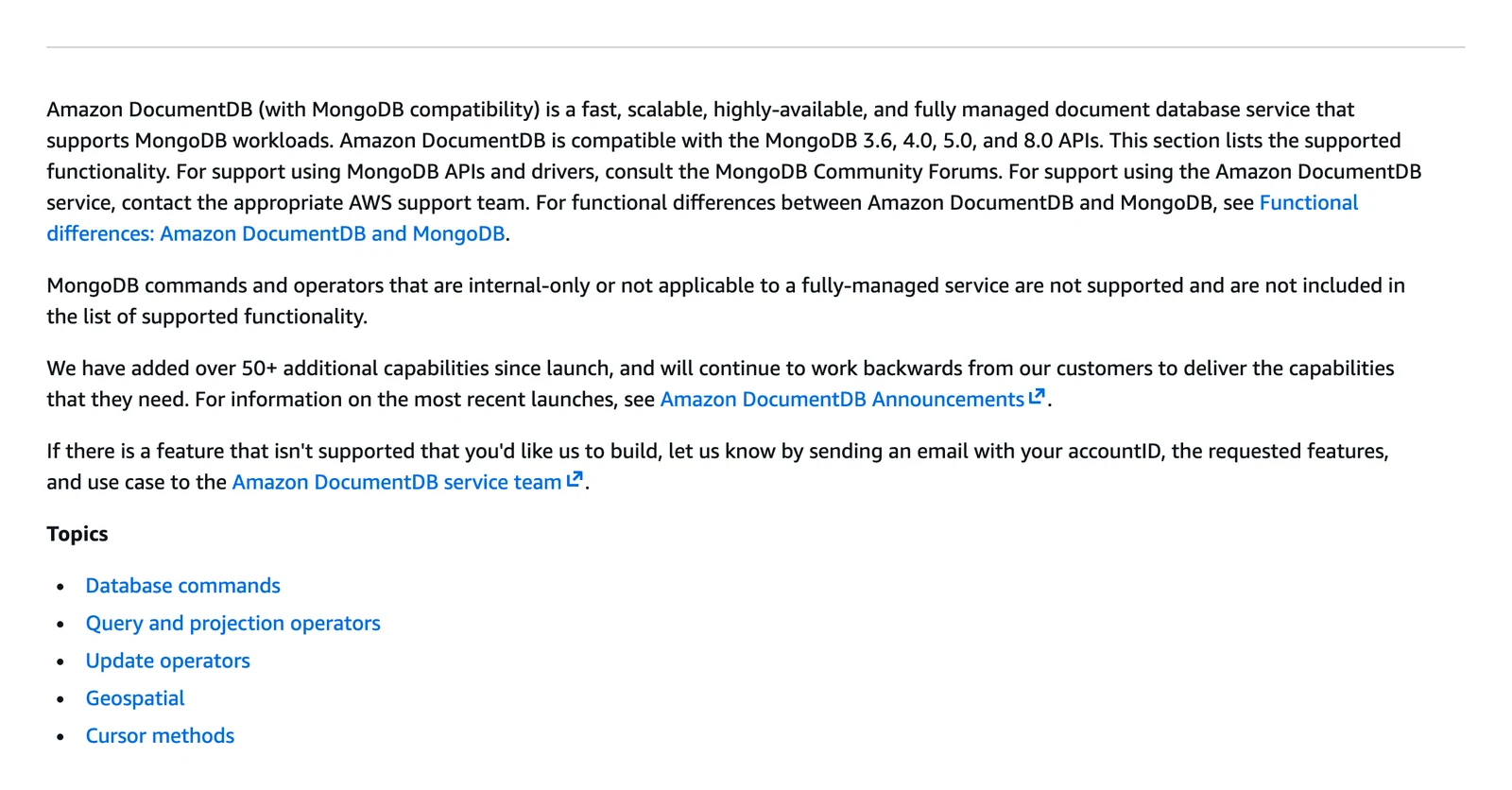
Amazon DocumentDB developer guide, MongoDB APIs page, October 2026.
Fits: an app already on AWS that sticks to the supported features. Test the exact features you use; AWS publishes the list of what is and isn't supported.
3. Azure DocumentDB
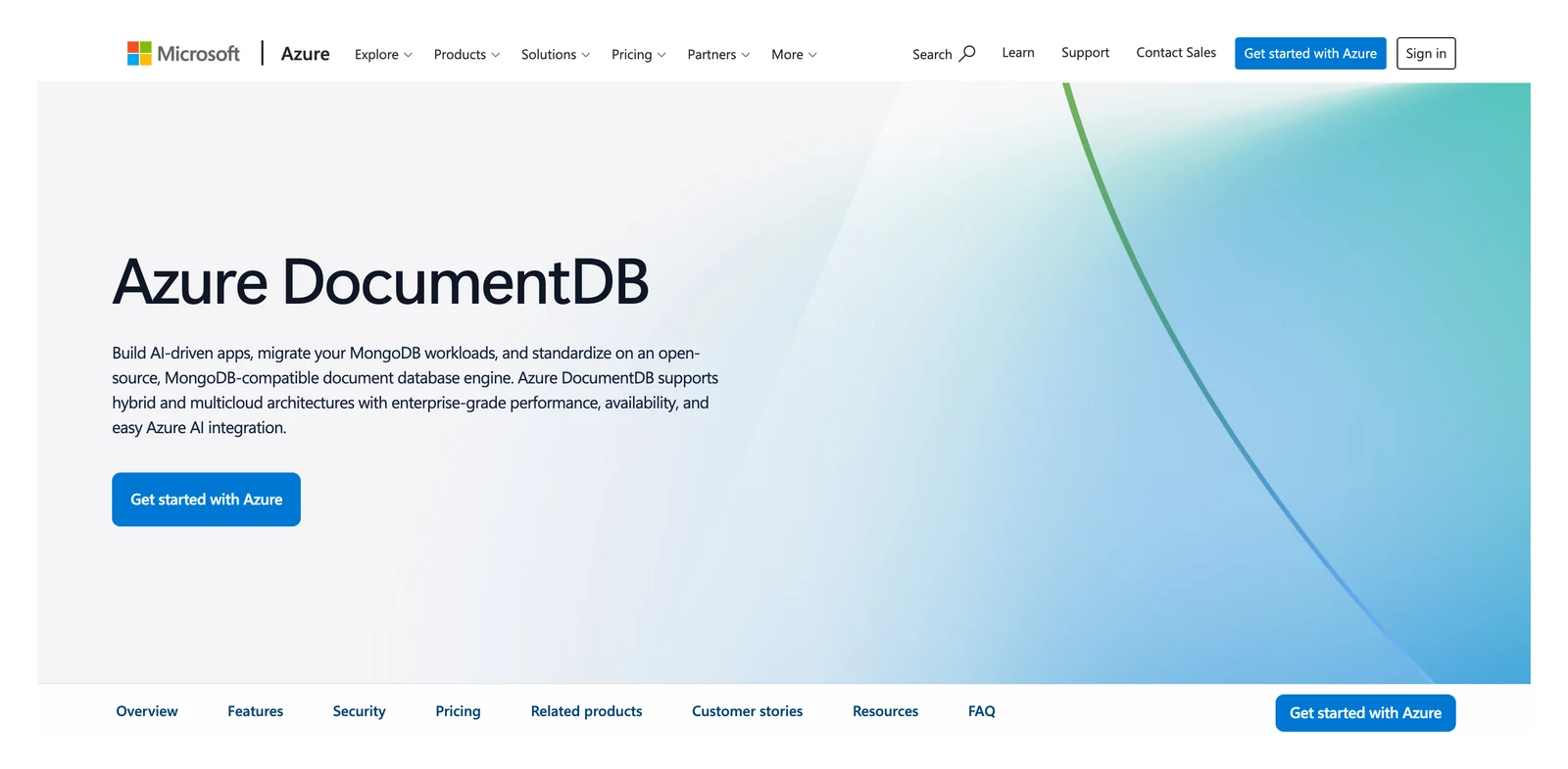
Azure DocumentDB product page, October 2026.
At a glance: open source engine, proprietary Azure service · route 1 · free tier, other rates not published on the page we read
Azure DocumentDB is described by Microsoft as "a fully managed, open-source, 99.03% MongoDB-compatible database". It is built on the open source DocumentDB engine, which is governed by the Linux Foundation and, according to the DocumentDB project's GitHub page, built on PostgreSQL. The engine uses the Massachusetts Institute of Technology (MIT) licence, a permissive open source licence, and the service does not run the MongoDB server.
The overview page was last updated on June 12, 2026.
What its docs list
- Microsoft says the open source engine can run on-premises or in any cloud, and that a Kubernetes operator is provided to get started.
- Microsoft says the service supports high-capacity vertical and horizontal scaling, with no shard key required until the database surpasses terabytes. That is Microsoft's description, and we didn't test it.
- Its compatibility page lists all 181 aggregation operators and all 22 update operators as supported.
- The same page lists wildcard, hashed, text, multikey, compound, geospatial and vector indexes. The vector index is marked as available only in DocumentDB.
- The
$changeStreamstage is marked supported for versions5.0to8.0. - Microsoft's pricing page lists a free tier cluster, and a savings plan at 20% off per node on one and three year terms.
Where it falls short
- The 99.03% is Microsoft's own measure. It counts operators: 58 of 60 aggregation stages, 181 of 181 aggregation operators, 44 of 45 query and projection operators, and 22 of 22 update operators. Commands and admin operations are excluded, per Microsoft's compatibility page. That does not mean 99% of your app will run.
- Commands marked not supported include
bulkWrite,serverStatus,top,dataSize,compactandsetDefaultRWConcern. - Creating a unique index takes an exclusive lock on the collection for the whole build, which blocks reads and writes.
$changeStreamSplitLargeEventis marked not supported, even though$changeStreamitself is.- Compute and storage rates are not published on the pricing page text we read, so you can't price a cluster from that page alone.
- The savings plan needs a one or three year term, so the 20% discount requires that commitment.
Fits: Azure, or an engine whose licence you can read in full. Less suited if your app depends on the unsupported commands.
4. FerretDB
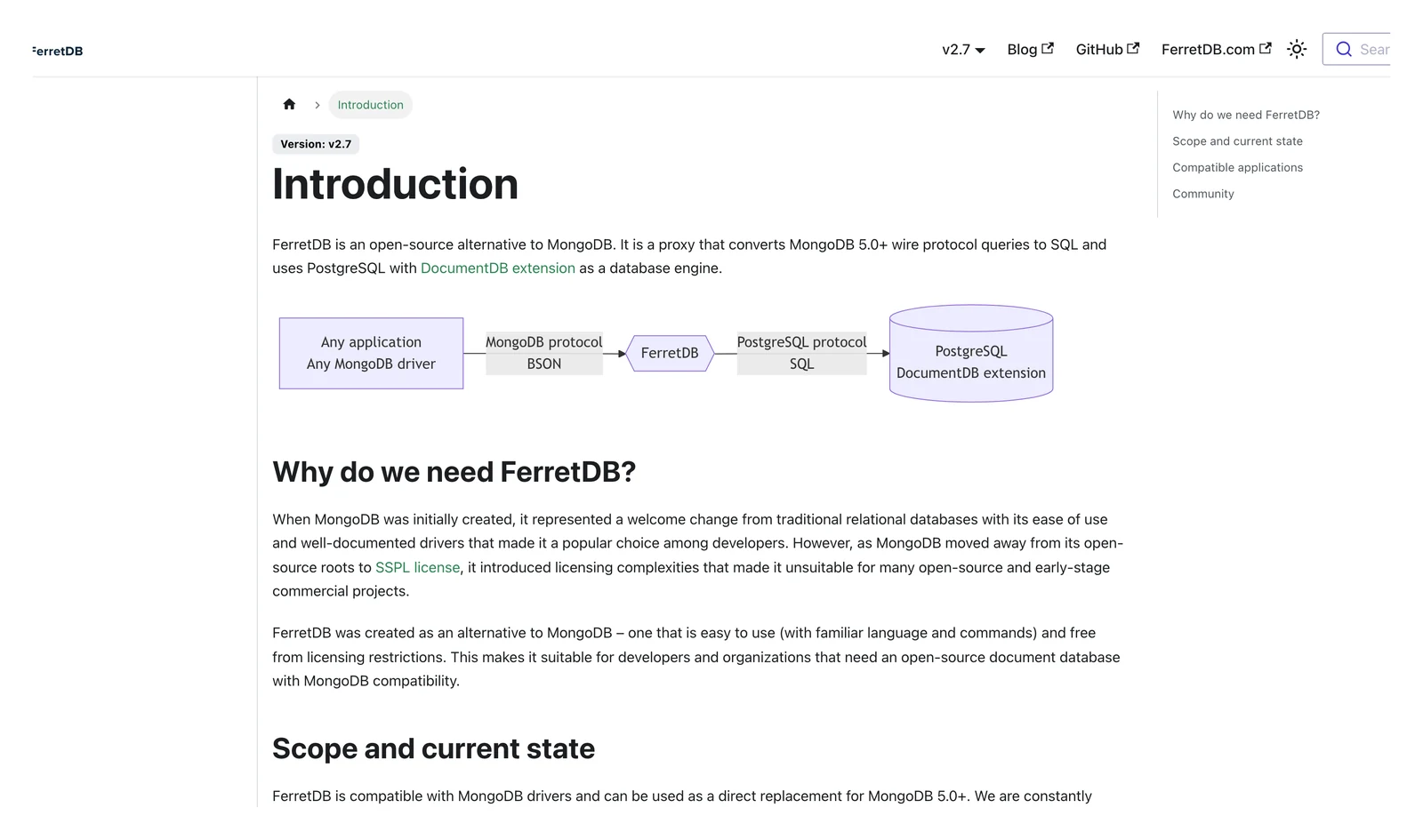
FerretDB documentation home page, October 2026.
At a glance: Apache 2.0 · you run it · route 1 · software free, hosted price not published
FerretDB's documentation home page describes it as an open-source alternative to MongoDB. In plain terms, it's a proxy that converts MongoDB 5.0+ wire protocol queries to SQL, and it uses PostgreSQL with the DocumentDB extension as its database engine. The wire protocol is how a driver talks to the server.
What its docs list
- The licence is Apache 2.0, shown on its GitHub page.
- The project README (its front page on GitHub) says it is compatible with MongoDB drivers and popular MongoDB tools, and works as a drop-in replacement for MongoDB
5.0+in many cases. The "in many cases" is the project's own wording. - Your data sits in PostgreSQL, which many teams already run.
- The README lists managed FerretDB at FerretDB Cloud, Civo, Tembo, Elestio and Cozystack, and a Go library package that embeds FerretDB into your application.
- The project states its own policy on gaps in its compatibility docs: "We consider all other differences in behavior to be problems" and want to address them. That is the project's stated intent. It also says it uses the same error names and codes as MongoDB.
Where it falls short
- On the
v2.7compatibility page,abortTransactionandcommitTransactionare "Not implemented yet". The newerv2.8docs are labelled unreleased and show the same two gaps. - The role management commands, such as
createRole,dropRoleandrolesInfo, are not implemented. bulkWrite,cloneCollectionAsCappedandconvertToCappedare not supported.- Change streams are not documented as supported on the page we read.
- Exact error messages may sometimes differ from MongoDB's, and collection names must be valid UTF-8, which MongoDB does not require.
- The README says the quickstart Docker command is unsuitable for production use because it keeps all data inside and loses it on shutdown. It also advises users not to build FerretDB themselves, and to use the binaries, Docker images or packages it provides.
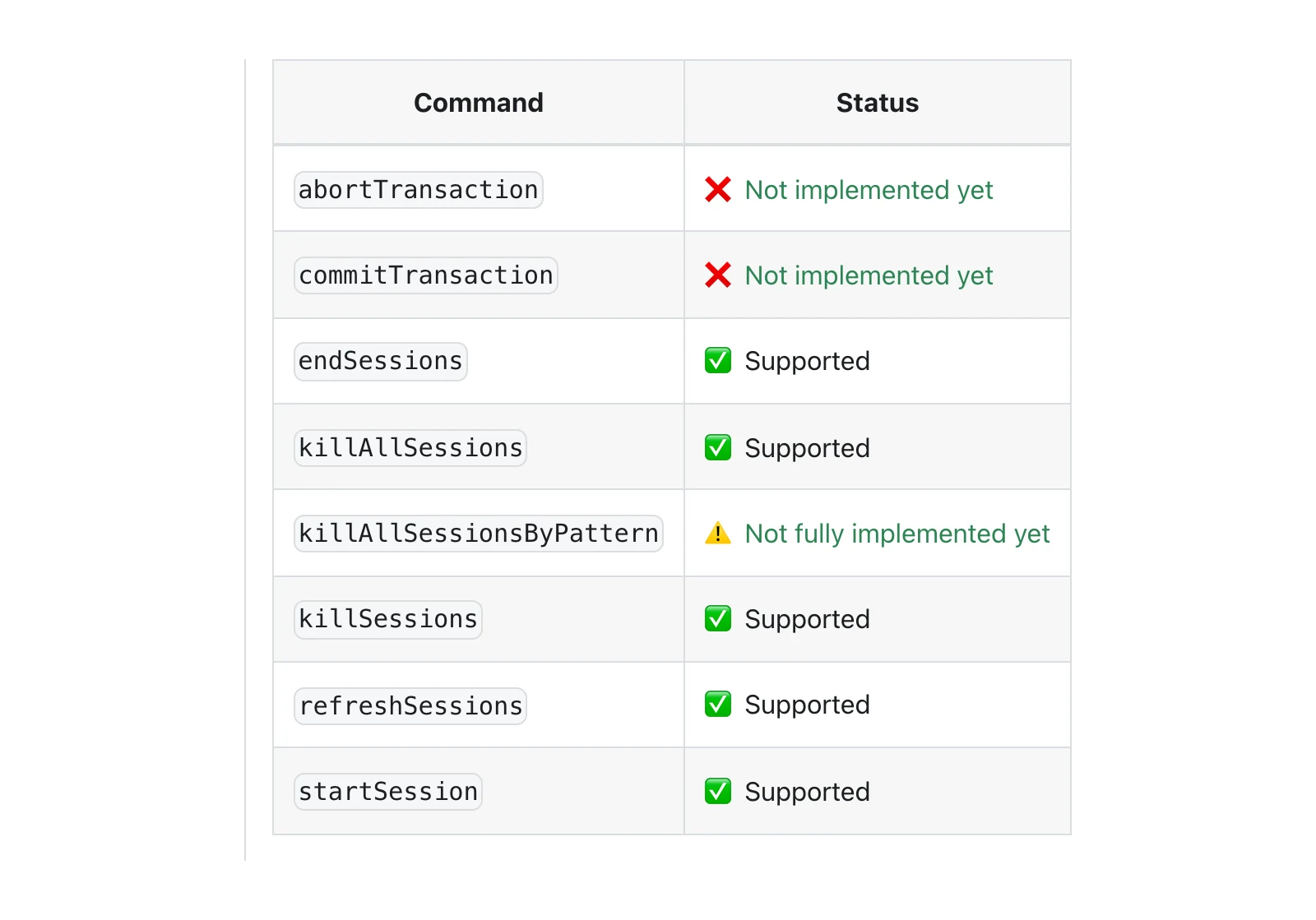
FerretDB v2.7 compatibility page, October 2026.
Fits: self-hosted and permissively licensed, if you can live without those commands. Less suited if you need multi-statement transactions or change streams today.
5. Couchbase
At a glance: editions: Community and Enterprise · you run it, or use Capella · route 2 · Capella Basic from $0.15 an hour per node
Couchbase Server stores items with a key and a value, inside buckets, scopes and collections. A value can be binary or a JSON document, and its query language is SQL++, which looks like SQL but works on JSON. The data docs say the maximum size of a value is 20 MiB.
What its docs list
- Data is saved as items, each with a unique key and a value that can be binary or JSON. The data docs put the maximum size of a value at
20 MiB. - A bucket can have up to
3replicas, and XDCR (cross data center replication) copies data between clusters that may sit in different data centers, per its replication docs. - Capella, the managed service, lists a Free plan with 1 node and 8 GB, per its pricing page. Basic starts at $0.15 an hour per node, Developer Pro at $0.35 and Enterprise at $0.49.
- The transactions docs describe atomicity, consistency, isolation and durability (ACID) guarantees, meaning all-or-nothing changes. Changes are not visible until commit, which the docs call Read Committed isolation, and transactional reads are stricter (Monotonic Atomic View).
- Transactions offer three durability levels, from
majority(the default) topersistToMajority, which the docs call the strongest protection and the least performant. - Couchbase's docs describe a Kafka connector that streams changes using its Database Change Protocol (DCP). We didn't test it, so check it yourself if you feed analytics.
Where it falls short
- Community Edition is free for clusters of up to five nodes and supports a maximum of
4cores per node, with limited concurrency and parallelism, per the editions page. - Its licence was updated to disallow XDCR, now an Enterprise-only feature, and Community Edition does not include the latest bug fixes.
- The docs say to use transactions only on documents under
10 MB, inside one data center, and not with active-active two-way XDCR. - The default transaction expiry is
15 seconds, and transactions need Network Time Protocol (NTP) to keep time in sync across all cluster nodes. - The Capella Free plan lists forum support only.
- You'll change drivers and rewrite queries.
Fits: the document model with a different query language. Less suited if you need to keep MongoDB commands.
6. Amazon DynamoDB
Amazon DynamoDB home page, October 2026.
At a glance: proprietary · AWS service · route 3 · $0.625 per million write request units
AWS's DynamoDB introduction page describes it as a serverless, fully managed, distributed NoSQL database with single-digit millisecond performance at any scale. That is AWS's own claim, and we didn't test it.
What its docs list
- On-demand mode is pay per request. The worked examples on the on-demand pricing page, read in October 2026, use $0.625 per million write request units and $0.125 per million read request units, and standard storage at $0.25 per GB.
- A write request unit covers an item up to
1 KB, and a read request unit covers4 KB. An eventually consistent read costs half a read request unit per4 KB. - The free tier lists 25 GB of storage, 25 write and 25 read capacity units, 2.5 million stream read requests and 1 GB of data transfer out.
- Transactions can group up to
100write actions on up to100items, with a4 MBtotal. The transactions docs say each item costs two underlying reads or writes, one to prepare and one to commit. - Global tables replicate item changes to other Regions typically within a second by default, and multi-Region strong consistency is available as an option, per the read consistency docs.
- Strongly consistent reads are available on tables and local secondary indexes, so you can choose per read between cost and freshness.
Where it falls short
- The maximum item size is
400 KB, which includes attribute names, per the quotas docs. AWS's best-practices page suggests storing a large item as an object in Amazon S3 and keeping the object identifier in the DynamoDB item. - There is no
JOINoperator, according to the AWS introduction page. AWS recommends denormalizing, which means copying data into the shape each query needs. - A
Scanreads the whole table or index before filtering and returns up to1 MBper call. - Reads are eventually consistent by default, and reads from global secondary indexes and streams always are. Strongly consistent reads work only on tables and local secondary indexes.
- Change history in DynamoDB Streams is removed after
24 hours, according to AWS's Streams docs. - It's an AWS service. AWS also offers a downloadable DynamoDB Local for developing and testing applications, and transactions give ACID guarantees only in the Region where the write API was called.
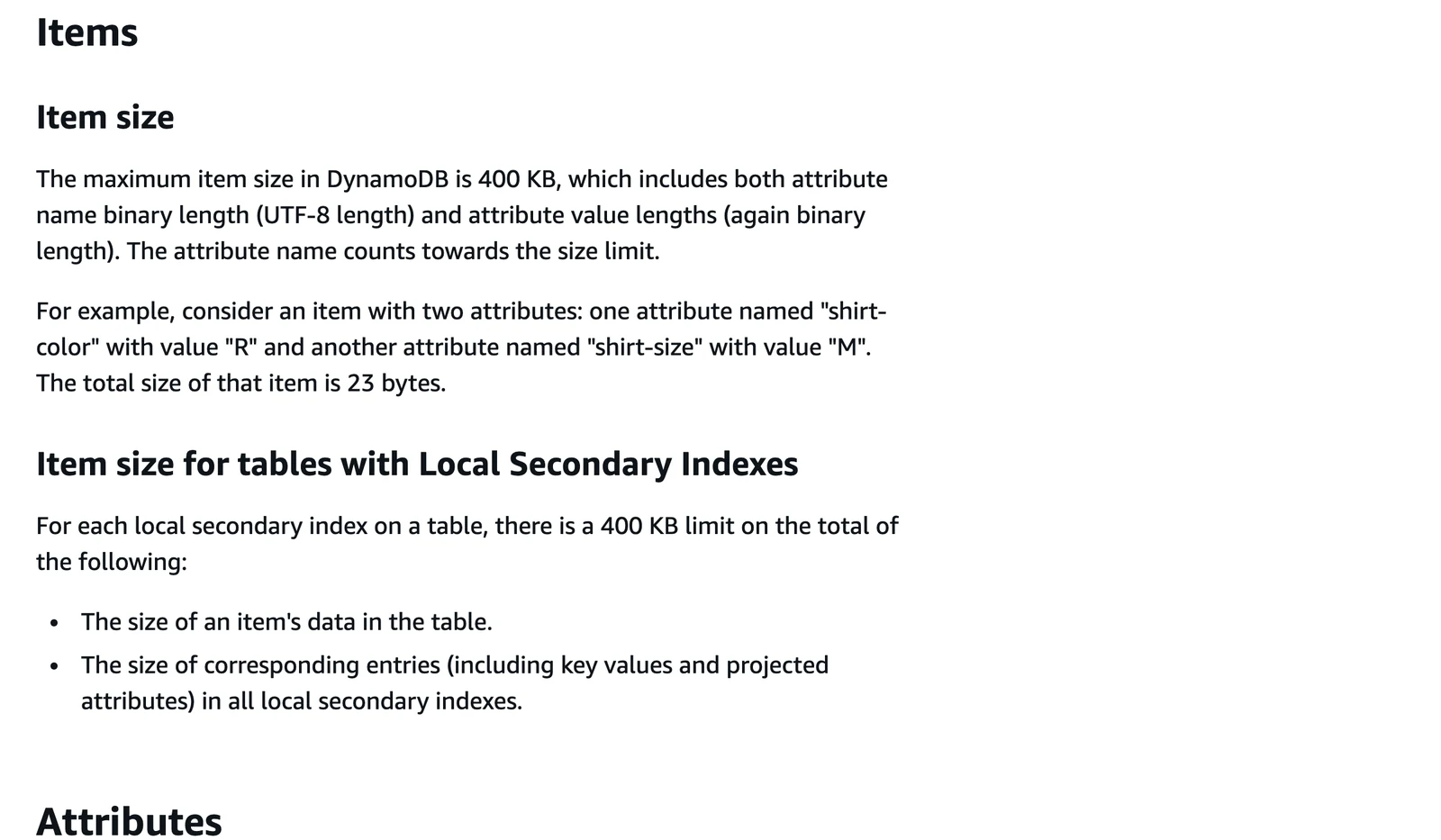
Amazon DynamoDB developer guide, quotas page, October 2026.
Fits: known questions on AWS. Less suited if your documents are large or your questions keep changing.
What users say: On PeerSpot, an August 2024 reviewer (older) wrote "We previously paid around $20,000 a month for MongoDB, and now we're paying just $4,000 monthly for Amazon DynamoDB." A May 2026 reviewer wrote "we lack joins in the table".
7. Apache Cassandra
Apache Cassandra home page, October 2026.
At a glance: Apache 2.0 · you run it · route 3 · software free, project publishes no price
Cassandra is an open source distributed database. It keeps several copies of each partition, and any copy can take a write (multi-master replication).
You pick a consistency level per operation, such as one replica or a majority (called quorum). The latest stable version is 5.0, with 5.0.9 released on August 7, 2026.
What its docs list
- The storage engine docs say it is optimized for write-oriented workloads, using log structured merge (LSM) trees with an append-only approach, so the write path has no read lookups. We didn't benchmark it.
- Its architecture docs describe multi-master replication, so there is no single primary to fail over. With a replication factor of
3, data is written to three distinct replicas. - Consistency levels include
ONE,TWO,THREE,QUORUM(a majority of replicas) andALL, so you tune the trade-off per operation. - Version
5.0adds Storage Attached Indexes, a vector data type, trie memtables and trie SSTables, the Unified Compaction Strategy and Dynamic Data Masking. - CQL
INSERTandUPDATEaccept a time to live (TTL) in seconds, and the values are removed automatically after that time. Updates within one partition key are applied atomically and in isolation, per the CQL docs. - The project publishes no price list, and the software itself is free.
Where it falls short
- Its query language, Cassandra Query Language (CQL), runs no joins or sub-queries, and a
SELECTreads one table. The data modeling guide says to group all required columns in one table, which duplicates data. - The guarantees page says Cassandra picks availability and partition tolerance and compromises on consistency to some extent. Single-table writes are eventually consistent, and its architecture docs say concurrent updates are settled by last-write-wins.
- Conditional writes such as
IF NOT EXISTSuse a protocol called Paxos, which needs the replicas to agree. The CQL docs say this carries a non-negligible performance cost and should be used sparingly. - Its guideline is under
100,000values and100 MBof disk per partition, though the docs say requirements vary by application. - The storage engine docs list trade-offs in read performance and write amplification for the append-only design.
- A CQL query that needs a full scan of all partitions has to add
ALLOW FILTERING, which the docs say runs the full scan and makes performance unpredictable.
Fits: write volume as the problem and people to run clusters. Less suited if you need ad hoc queries or joins.
What users say: On a Hacker News thread about ACID (all-or-nothing) transactions in Cassandra 6 (August 2026), one commenter said Cassandra at scale has "better cost and availability" than anything else they had tried, "as long as you have a competent team". Another wrote "It's an operational nightmare".
Other options worth knowing
MySQL also stores JSON, and its docs say JSON columns validate the documents stored in them. We didn't compare it in full, because we found fewer MongoDB-specific facts than for the seven above.
What happens to your change feed
If other systems read your MongoDB change streams today, that feed doesn't come along. Each option has its own change data capture (CDC) feed: PostgreSQL has logical replication, DynamoDB has Streams, and Cassandra has a per-table change data capture log, switched on with a table property. Our CDC tools comparison covers tools that read these feeds.
Which MongoDB alternative should you pick?
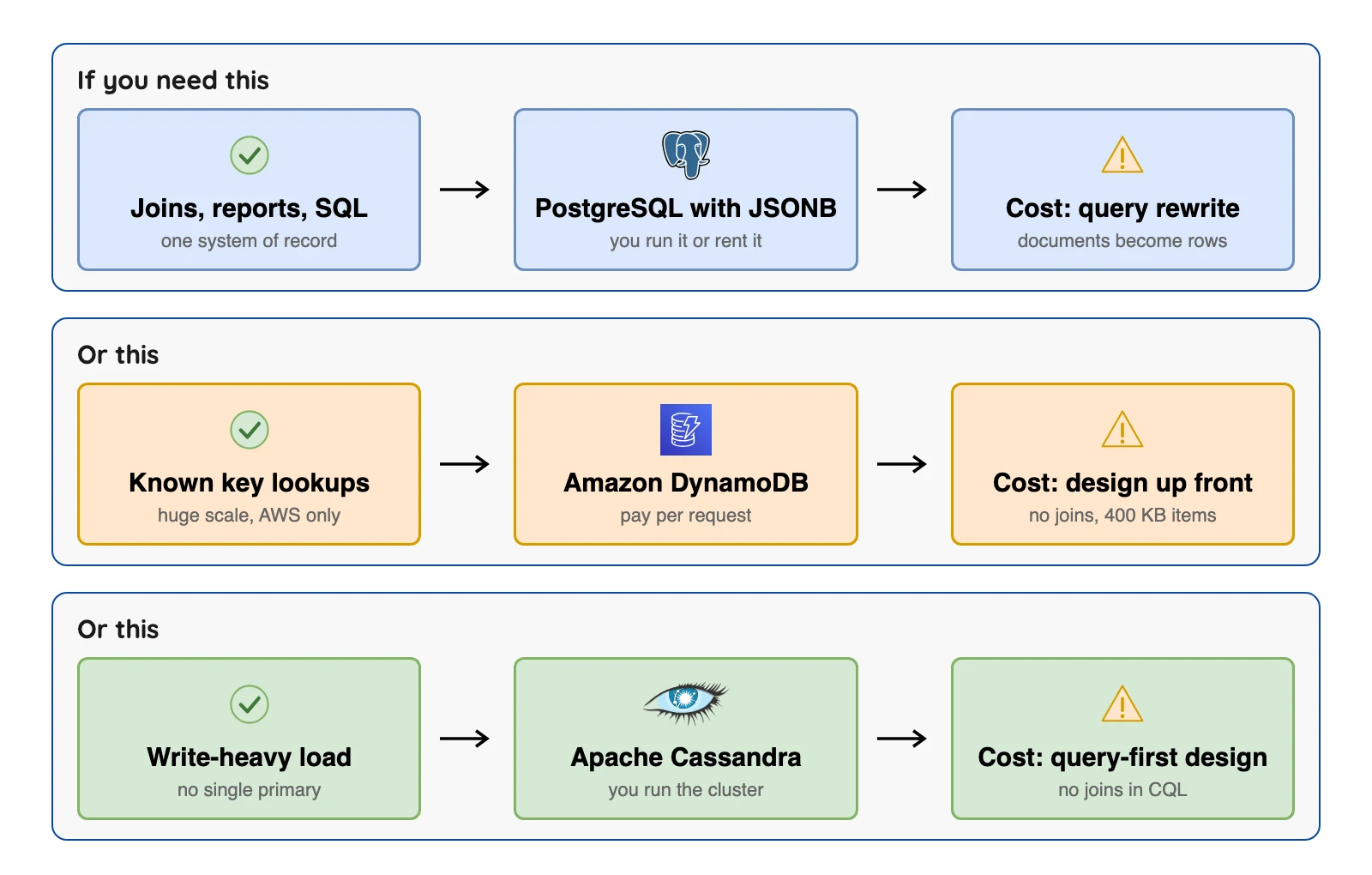
- You want to keep your MongoDB code: Amazon DocumentDB on AWS, Azure DocumentDB on Azure, FerretDB if you self-host. Test first, always.
- You want documents but are fine with a new language: Couchbase.
- You need joins, reports and SQL: PostgreSQL with JSONB.
- You know your key lookups and you're on AWS: DynamoDB.
- You have heavy writes and a team to run a cluster: Cassandra.
- You want to keep MongoDB and add analytics: copy its changes into Iceberg or Parquet (see Where OLake Go fits). Our OLTP vs OLAP explainer covers why teams split the two.
If you can't say which route you're on yet, stay on MongoDB until you can. Or try this short quiz.
Which MongoDB alternative fits you?
Question 1 of 5
How much of your app can you change?
This one answer removes most of the list.
Where MongoDB fits
Choose MongoDB if your app uses features the alternatives list as missing or limited.
What its docs list
- ACID transactions across documents. They need
featureCompatibilityVersion4.0on a replica set (a group of servers holding copies of the same data) or4.2on a sharded cluster, and MongoDB says a distributed transaction usually costs more than single-document writes. - An operation on a single document is atomic. MongoDB says that because embedded documents and arrays can hold related data in one document, many practical use cases don't need multi-document transactions.
- Sharding with hashed and ranged keys, and a changeable shard key (the field that decides which server holds a document).
- Change streams with pre- and post-images, which you can switch on per collection from MongoDB
6.0. There is no pre-image for an inserted document and no post-image for a deleted one. - Change streams work on replica sets and sharded clusters, and a stream can resume from a resume token as long as the oplog still holds enough history.
Where it falls short
- A document can't exceed
16 MiB, nesting stops at100levels, and a collection can have at most64indexes, per MongoDB's limits page. - By default a transaction must run for less than one minute, and it waits up to
5 millisecondsfor the locks it needs before it aborts, per MongoDB's transactions production considerations page. - With a hashed shard key, range queries on that key are less likely to hit one shard and cause more cluster-wide broadcast operations.
- Change streams are restricted to database events, time series collections do not support them, and they only report changes persisted to a majority of data-bearing replica set members.
- Pre- and post-images use storage space and add processing time, and a change stream event must stay within the
16 MBdocument limit. - On Atlas, the Free tier includes 512 MB of storage and Flex includes 5 GB, and Dedicated clusters start at $56.94 a month, per the Atlas pricing page linked above.
On a Hacker News thread about MongoDB costs (November 2025), one commenter wrote "MongoDB Atlas was around 500% more expensive than in-house every time I evaluated it". A PeerSpot reviewer in April 2026 wrote "we prefer this because of the reliability of MongoDB Atlas", per PeerSpot's Atlas reviews.
Worked example: one app, five answers
Take an app that sends bulkWrite calls, uses a wildcard index, and stores some 5 MB documents. It's a made-up app, but each cell below comes from the vendor pages cited in the sections above. "Unknown" means we didn't read a page that answers it.
| Need | Amazon DocumentDB | Azure DocumentDB | FerretDB | Couchbase | DynamoDB |
|---|---|---|---|---|---|
| Wildcard index | Marked "No" | Listed as supported | Unknown | Not MongoDB code, so rewrite | Not MongoDB code, so rewrite |
bulkWrite | Unknown | Not supported | Not supported | Not MongoDB code, so rewrite | Not MongoDB code, so rewrite |
| 5 MB document | Unknown | Unknown | Unknown | Fits (20 MiB value limit) | Fails (400 KB item limit) |
The result: no compatible engine passes without a change. Two fail on a named item, and the rest need a test. Write your own feature list before you pick.
What to test before you switch
- Your feature list. Write down every command and operator your app uses, then check each against the vendor's compatibility page. If you're on Route 1, do this before anything else.
- Your biggest document. Compare it with the item limit:
400 KBon DynamoDB,20 MiBon Couchbase,16 MiBon MongoDB,1 GBper field in PostgreSQL. - Your consistency assumptions. MongoDB's default write concern is
majority, except on some replica sets with arbiters, where it is{ w: 1 }. DynamoDB reads are eventually consistent by default, and Cassandra single-table writes are eventually consistent. - Your change feed. List who reads change streams today and how long history must be kept.
- Your real bill. List prices use different meters (monthly tier, hourly instance, request), so price your own traffic in the vendor calculator.
- What to ask each vendor. For any compatibility, speed or scale claim (Azure's 99.03%, DynamoDB's single-digit milliseconds, DocumentDB's "fast, reliable" wording), ask what was measured, on which versions, and whether your commands were in the test. We tested none of them.
A safe order for moving
This order is our own suggestion and does not come from a vendor.
- Audit. List every command, operator and index your app uses, and the biggest document it stores.
- Test in parallel. Run the same queries against the new engine with copied data, then compare answers.
- Move reads first. Send read traffic to the new system while MongoDB stays the source of truth.
- Move writes last. Switch writes only after you've tested a rollback.
Where OLake Go fits
OLake Go is not a MongoDB alternative. It is for the team that keeps MongoDB for the app and wants analytics somewhere else. We build it, and it is open source. It reads MongoDB 4.0 or higher with full refresh, incremental sync or change capture (CDC), which needs a replica set, and writes Apache Iceberg tables or Parquet files that analysts can query outside MongoDB. Our docs cover self-hosted MongoDB and Atlas, and a data filter can limit which rows a stream replicates. Setup steps are on our MongoDB connector page. You run it yourself, with Docker, Helm on Kubernetes or the OLake UI; the quickstart walks through it.
Q1. What is the best MongoDB alternative?
Q2. Is there a free MongoDB alternative?
Q3. Is Amazon DocumentDB the same as MongoDB?
Q4. Is FerretDB a drop-in replacement for MongoDB?
Q5. Can PostgreSQL replace MongoDB?
Q6. Why do teams leave MongoDB?
Q7. Should I move to Azure Cosmos DB for MongoDB?
Q8. Do I have to leave MongoDB at all?
Q9. Do I lose change streams if I switch?
Conclusion
Start with your own feature list, pick your route, and test before you trust any "compatible" label. If you only need reports or search, keep MongoDB and copy its changes into a second system.