MySQL vs SQL Server: Differences and How to Choose
16 min read
Key takeaways
Both are widely used databases, and the choice mostly comes down to licence, edition limits and your team's tools. The money is where they split: MySQL Community Edition is free under an open-source licence, while SQL Server 2025 Standard lists at $3,945 per 2-core pack and Enterprise at $15,123 (checked Oct 2026). Pick MySQL when cost and open source matter, and SQL Server when your team already lives in the Microsoft world and uses its built-in tools.
Need Always On availability groups? That means SQL Server Enterprise. And which one is faster?
We found no neutral, current benchmark, so test your own queries.
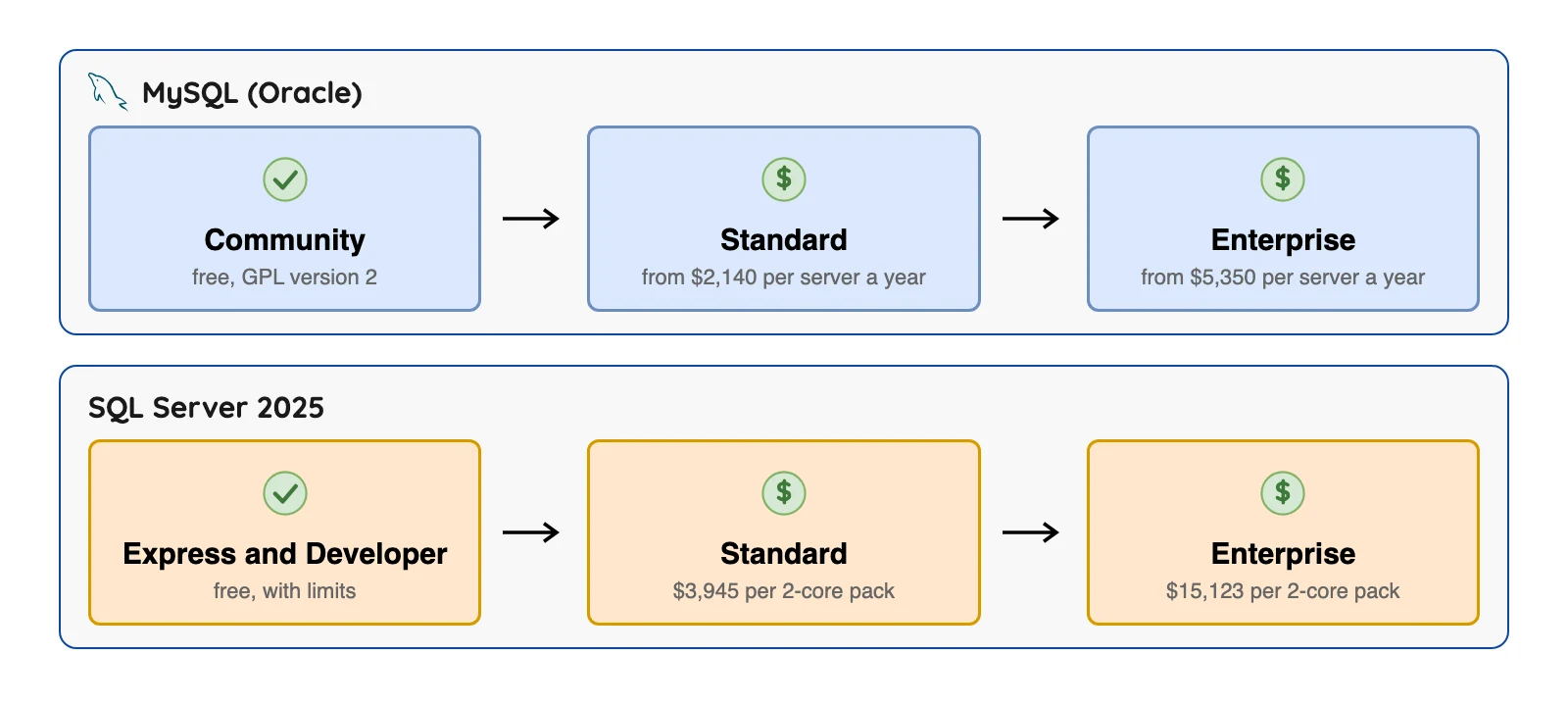
- MySQL Community Edition is free. Oracle sells paid editions too, with Standard listed from $2,140 and Enterprise from $5,350 per server (checked Oct 2026).
- SQL Server 2025 gives you free Express and Developer editions (with limits), plus paid Standard and Enterprise editions priced per 2-core pack.
- Free Express now allows 50 GB per database. Older pages may still say 10 GB, so don't trust them.
- Always On availability groups, a high availability feature, are Enterprise only in SQL Server 2025. Standard gets a basic version with two replicas and one database.
- The two handle locks differently out of the box. SQL Server reads take shared locks, while MySQL's InnoDB engine reads from a snapshot.
Every fact below comes from Microsoft, Oracle or MySQL pages, or a named survey, read on October 1, 2026, with the page linked beside each claim.
We did not run either database ourselves. So this is a careful read of their documents, not a lab test. Last reviewed October 2026.
MySQL vs SQL Server at a glance
Each row is explained, with a source, in the sections after the table.
| MySQL | SQL Server | |
|---|---|---|
| Maker | Oracle | Microsoft |
| Free option | Community Edition, GPL version 2 | Express and Developer editions |
| Paid price (checked Oct 2026) | Standard from $2,140, Enterprise from $5,350 per 1 to 4 socket server | Standard $3,945 and Enterprise $15,123 per 2-core pack |
| Free tier limit | None listed for Community | Express: 50 GB per database, 4 cores |
| Default read behaviour | InnoDB: REPEATABLE READ snapshot | READ COMMITTED with shared locks |
| Versions named in Oracle's notice | 8.4 and 9.7 long-term support (LTS); 8.0 in Sustaining Support | SQL Server 2025 (17.x) |
| Support end | Not sourced for 8.4 or 9.7; 8.0 moved to Sustaining Support on April 21, 2026 | Mainstream 1/7/2031, extended 1/7/2036 |
| Developer use (Stack Overflow 2025) | 40.5% of all respondents | 30.1% of all respondents |
Sources: Oracle MySQL store, Microsoft SQL Server 2025 pricing sheet (checked Oct 2026).
MySQL vs SQL Server cost and licensing
The answer depends on the edition, so here are the list prices.
MySQL. The Community release is released under version 2 of the GNU (GNU's Not Unix) General Public License (GPL, a licence that keeps derived software open).
Oracle's own store lists the MySQL Standard Edition subscription for a 1 to 4 socket server from US$2,140, and Enterprise Edition from US$5,350. For 5 or more sockets, the lowest listed prices are US$4,280 and US$10,700 (checked Oct 2026).
The store shows each price as a range, such as US$5,350.00 to US$16,050.00 (checked Oct 2026), and doesn't say what the range means or whether the price is per year. So we quote only the low end, as "from". Check the store before you budget.
SQL Server. Microsoft's SQL Server 2025 pricing sheet lists Enterprise at $15,123 per 2-core pack and Standard at $3,945 per 2-core pack. Standard can also be bought as $989 per server plus $230 for each client access license (CAL, a licence for each user or device) (checked Oct 2026). Developer and Express are free.
The same sheet lists subscriptions at $5,434 a year (Enterprise) and $1,418 a year (Standard) per 2-core pack (checked Oct 2026). Microsoft calls these open no-level estimated retail prices. Translation: ask a reseller what you'd really pay.
A worked price example
Take one server with 4 cores.
At the listed Standard price of $3,945 per 2-core pack, SQL Server 2025 Standard needs 2 packs, which is $7,890 at list price (our arithmetic, from the sheet above). Enterprise on the same 2 packs is 2 x $15,123 = $30,246. The Standard subscription is 2 x $1,418 = $2,836 a year. Buying Standard outright breaks even after about 2.8 years. On the same server, Oracle's store lists MySQL Standard from $2,140 and Enterprise from $5,350 (checked Oct 2026), and Community is free.
That example ignores support terms, discounts, cloud hosting and staff time. It also assumes you buy the MySQL subscription at all, and Community users don't. The two are billed differently, per server for MySQL and per core pack for SQL Server, so redo the sum with your own core count and edition.
Editions and limits: where each one stops
Microsoft's 2025 editions page sets Express at the lesser of 1 socket or 4 cores, 1,410 MB of buffer pool memory, and 50 GB per database. Standard is capped at the lesser of 4 sockets or 32 cores and 256 GB of buffer pool memory. Enterprise is limited only by the operating system.
Two older facts have changed, so some of what you've read may be stale.
Microsoft's what's new page for 2025 says Express now has a 50 GB limit, and the Web edition is discontinued. Microsoft also adds free Standard Developer and Enterprise Developer editions. They're licensed for development and test, not for production.
MySQL's limits sit in a different place: the commercial split. Its manual says the thread pool, a way to handle many connections, is part of the Enterprise Edition, so a Community server uses one thread per client connection. We couldn't read Oracle's full feature table, so there may be more Enterprise-only items.
Locking and concurrency: how each one reads data
Concurrency is how a database serves many people at once. The defaults differ, and it shows up when a long report runs next to busy writes.
In SQL Server, READ COMMITTED is the default isolation level. With the READ_COMMITTED_SNAPSHOT setting off, which is the SQL Server default, reads take shared locks and can wait on rows another transaction has changed.
Flip the setting on and reads use row versioning. That gives each statement a consistent snapshot without those locks. Microsoft says the setting is on by default in Azure SQL Database.
MySQL's InnoDB engine defaults to REPEATABLE READ, where plain reads see the snapshot set by the first read in the transaction. So MySQL starts with snapshot reads, while SQL Server needs a setting change to get something similar. In both, a writer still locks the rows it changes.
This is a fact about defaults, not speed. Both can be configured either way.
Everyday differences in SQL and storage
The two speak different flavours of SQL, which matters for anyone moving code between them. A common example is limiting rows: SQL Server uses a top-rows keyword, and MySQL uses LIMIT.
| Task | SQL Server | MySQL 8.4 |
|---|---|---|
| First 10 rows | SELECT TOP (10) ... ORDER BY ... | SELECT ... LIMIT 10 |
| Skip 20, take 10 | ORDER BY ... OFFSET 20 ROWS FETCH NEXT 10 ROWS ONLY | LIMIT 20, 10 or LIMIT 10 OFFSET 20 |
Microsoft's page on the top-rows clause says to use OFFSET and FETCH for paging, and that you can't mix it with them in one query scope. MySQL's manual says its two-argument LIMIT skips rows from an offset that starts at 0, and that it also accepts OFFSET for PostgreSQL compatibility.
Storage is another difference. MySQL lets you pick a storage engine for each table, and InnoDB is the default. We didn't find a Microsoft page that offers the same per-table choice, so we won't stretch the comparison any further.
Features that differ in 2026
SQL Server 2025 added some features. According to Microsoft's what's new page, it now has a native JSON data type, regular expression functions and a vector data type. The vector index and search functions are still in preview and need an opt-in setting.
The editions page lists row-level security, dynamic data masking, temporal tables and a native JSON type as available in Enterprise, Standard and Express. It also lists Transparent Data Encryption (TDE) for Enterprise and Standard only. SQL Server Agent, the job scheduler, is missing from Express.
On the MySQL side, the manual says InnoDB follows ACID (atomicity, consistency, isolation and durability). In plain terms, a group of changes either all happens or none of it does.
MySQL 8.4 also supports window functions and CHECK constraints, and a schema change commits the open transaction first. We didn't find a source that compares the two feature lists line by line. So we won't crown a winner on features.
High availability and copies of data
High availability keeps the database running when a server dies. Both have built-in answers, and both come with edition or setup limits.
On SQL Server, Always On availability groups are Enterprise only, with up to 8 secondary replicas. The cheaper tier gets basic availability groups, which support two replicas and one database. Standard also supports two-node failover cluster instances and log shipping, and Express doesn't.
On MySQL, Group Replication supports single-primary and multi-primary modes. InnoDB Cluster wraps it with MySQL Router for failover.
Check Oracle's edition table for which pieces you pay for.
Versions and support dates
Old comparison pages still talk about MySQL 8.0 like it's the current one. It isn't. Oracle's notice says MySQL 8.0 moved to Sustaining Support on April 21, 2026, and recommends the 8.4 or 9.7 long-term support (LTS) releases.
On the Microsoft side, SQL Server 2025 (17.x) reached its lifecycle start on November 18, 2025. Microsoft's lifecycle page lists mainstream support to January 7, 2031 and extended support to January 7, 2036. It also lists Linux and Windows as supported platforms, so no, it isn't Windows only.
SQL Server vs Postgres: the same questions for PostgreSQL
Many readers are also weighing PostgreSQL, so here is the same comparison.
| PostgreSQL | SQL Server | |
|---|---|---|
| Maker | Community project | Microsoft |
| Licence | An open-source licence | Commercial editions, plus free Express and Developer |
| Price of the software | Free | Standard $3,945 and Enterprise $15,123 per 2-core pack (checked Oct 2026) |
| Edition limits | No paid tiers from the project | Express 50 GB, Standard 32 cores |
| Developer use (Stack Overflow 2025) | 55.6% of all respondents | 30.1% of all respondents |
Choose SQL Server over PostgreSQL if you run a Microsoft-centred stack, want one vendor to call, or rely on tools that target it, such as mirroring into Microsoft Fabric. Choose PostgreSQL if licence cost is the issue and you don't need Microsoft's built-in tooling. Speed between them isn't sourced either.
One note on the survey rows: they count the share of all respondents who report extensive development work with each database, from the 2025 Stack Overflow Developer Survey.
So which should you pick?
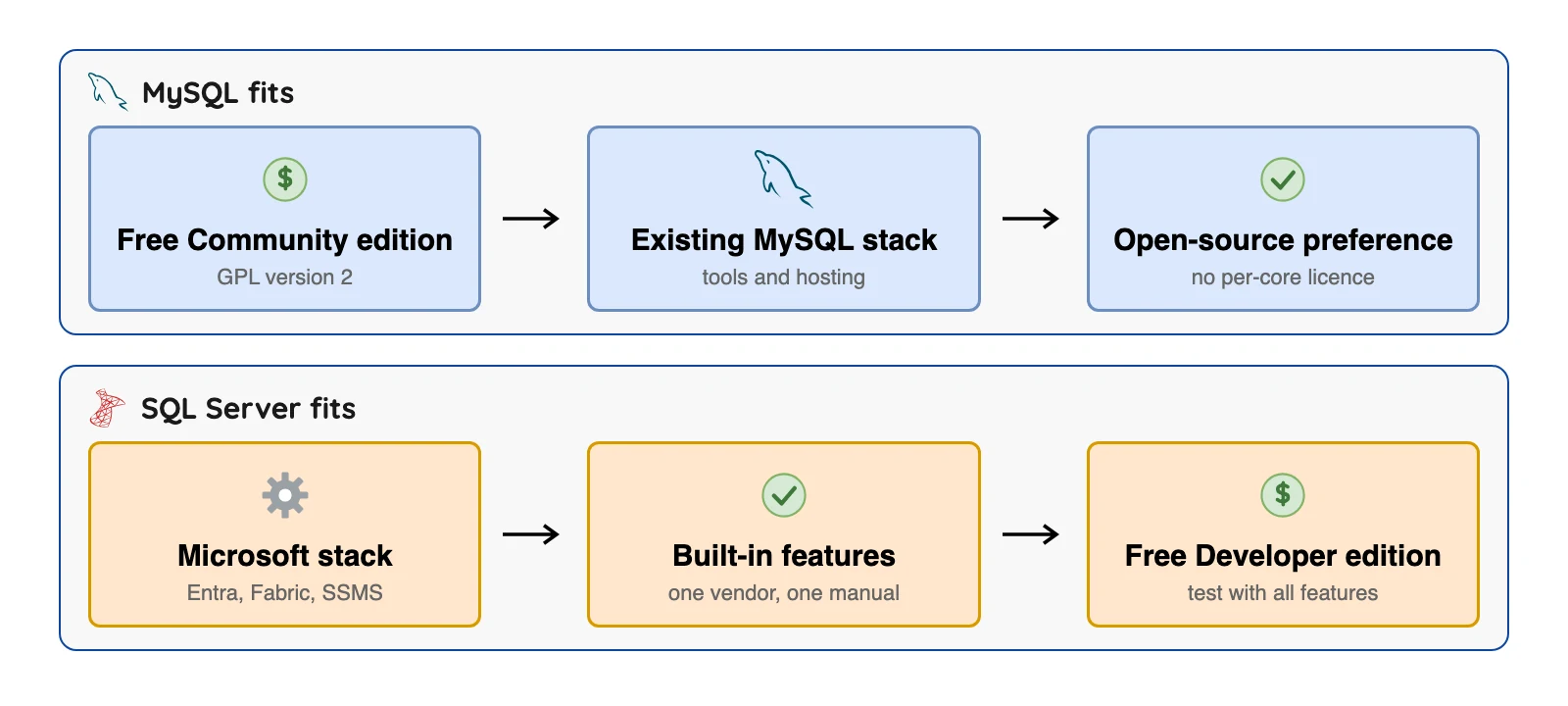
Choose MySQL if licence cost matters, your hosting or app already assumes it, or you want a free Community edition with a paid option later.
Choose SQL Server if your team and tools are Microsoft-centred, you need Enterprise high availability, or you want a free Developer edition that matches production features for testing. Microsoft's pages give lifecycle dates out to 2036.
| Your situation | Lean toward | Why |
|---|---|---|
| Tight budget, small team | MySQL Community | Free, with Oracle subscriptions optional |
| Microsoft-centred company | SQL Server | Built-in Microsoft tools and Fabric mirroring |
| Need free tier past 50 GB per database | MySQL Community | SQL Server Express stops at 50 GB |
| Need Always On availability groups | SQL Server Enterprise | Enterprise only at $15,123 per 2-core pack (checked Oct 2026) |
| Testing production features for free | SQL Server Developer | Free for development and test, not for production |
| Running MySQL 8.0 | Plan an upgrade | In Sustaining Support since April 21, 2026 |
Five quick questions:
Which MySQL or SQL Server edition fits you?
Question 1 of 5
What is your budget for licences?
Software cost is only part of the bill. Hosting and staff time count too.
What the community says
We read public reviews and forum threads for both. Each line below is one short quote, with its source and date. These are individual opinions; one person's view, not a survey.
| Tool | What users say |
|---|---|
| MySQL | A reviewer on PeerSpot, "MySQL reviews 2026" (December 2025) praised it: "It is easy to set up and allows you to focus on your business logic initially". Another PeerSpot reviewer (August 2026) complained: "Changing the database schema on large tables can also be challenging". |
| SQL Server | A reviewer on PeerSpot, "SQL Server reviews 2026" (2026, month not shown) said: "the licensing cost is very high, although the return on investment is good". |
The pattern is simple. MySQL gets praise for easy setup and gripes about changing large tables. The SQL Server reviewer sets a high licence cost against a good return on investment, which fits the price gap above (our read, not a measured result).
Performance: what we can and can't say
Some top pages say one of these is faster. We found no linked, neutral, current benchmark behind that claim, and we ran no tests. Speed depends on your queries, data size, indexes and hardware.
Common myths, checked against vendor pages
- "SQL Server Express is limited to 10 GB." Not for the 2025 release. Microsoft lists 50 GB per database, so that one's out of date.
- "SQL Server runs only on Windows." Microsoft's lifecycle page lists Linux and Windows.
- "MySQL 8.0 is the current MySQL." Not any more. It's been in Sustaining Support since April 21, 2026.
- "MySQL is free, so it costs nothing." The Community edition is free. Hosting, staff and optional Oracle subscriptions are not, and those add up.
How to test both on your own data
- Load a copy of your real data, at your real size, into both databases on the same hardware.
- Run your ten slowest queries and your busiest write path on each.
- Turn on row versioning in SQL Server and compare it with MySQL's default.
- Price your real core count and edition from the vendor pages above.
- Ask who on your team can fix each one at 3 a.m., and count that as a result.
Copying data out for analytics
Both databases keep a change log that tools can read. Reading it to copy only what changed is called change data capture (CDC). Our open-source OLake Go does this for MySQL and MariaDB (docs) and SQL Server (docs), writing Apache Iceberg or Parquet on storage you choose. For the same questions on other pairs, see Postgres vs MySQL, and for the tools that read the SQL Server log, SQL Server CDC tools.
Q1. Is MySQL or SQL Server better?
Q2. Is SQL Server free?
Q3. How much does SQL Server 2025 cost?
Q4. Is MySQL free for business use?
Q5. Does SQL Server run on Linux?
Q6. What is the difference between SQL Server and PostgreSQL?
Q7. Which should I use for a new project?
Conclusion
MySQL suits you when licence cost and open source matter most. SQL Server suits teams already in the Microsoft stack, and Always On availability groups need Enterprise.
Check your version and edition first. MySQL 8.0 is in Sustaining Support, and SQL Server Express now stops at 50 GB. Then test your own queries, because no linked benchmark we found will decide it for you.