Snowflake Alternatives and Competitors in 2026
38 min read
Key takeaways
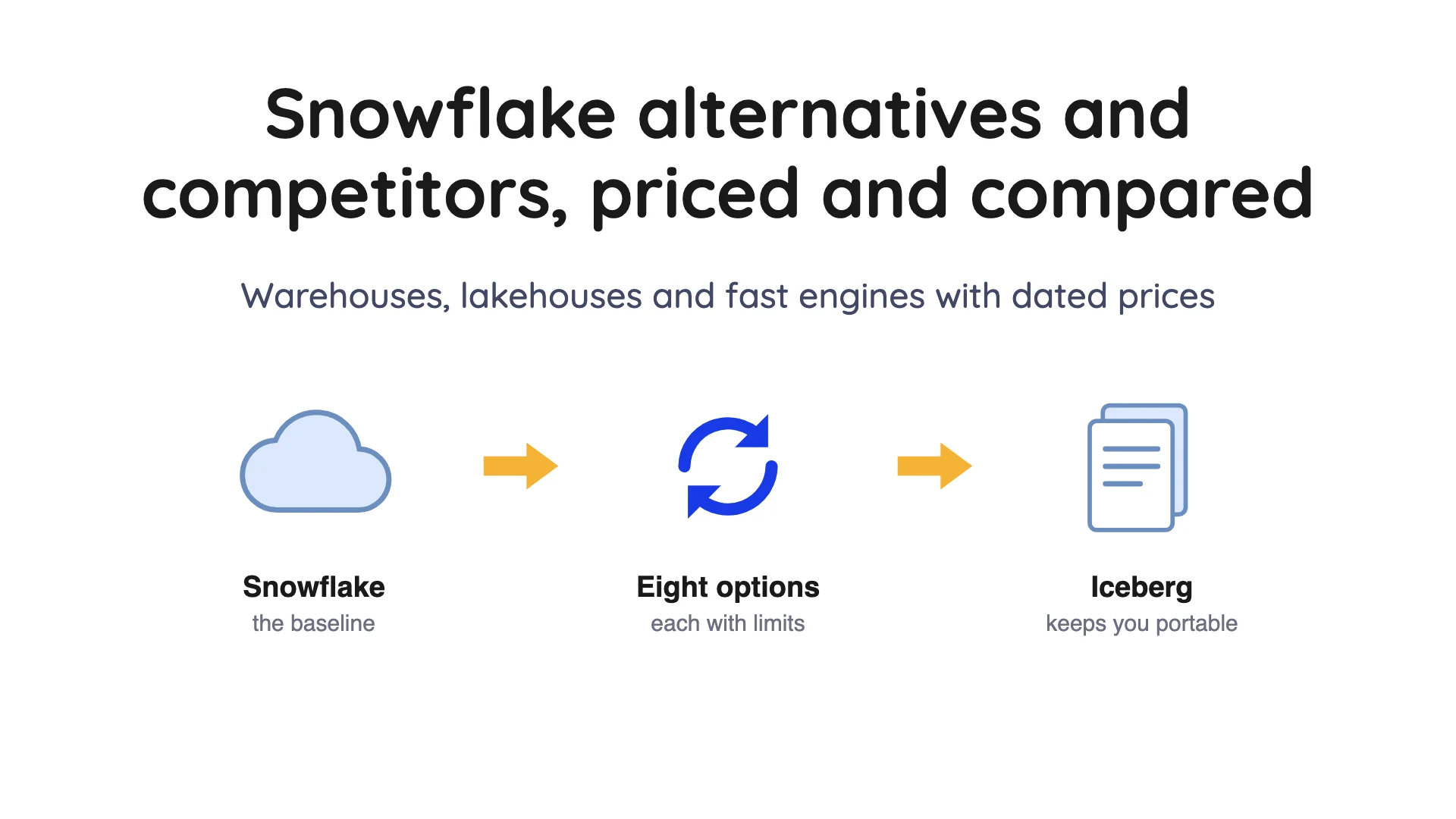
The big Snowflake competitors are Databricks, Google BigQuery, Amazon Redshift and Microsoft Fabric, and the right one mostly follows the cloud and the skills you already have. Pick Databricks if your team writes code and trains models. Pick BigQuery if you live on Google Cloud, Redshift if you live on AWS, and Fabric if Power BI (Microsoft's reporting tool) runs your reporting.
ClickHouse, MotherDuck, Dremio and Amazon Athena are aimed at narrower jobs. Prices don't line up one to one because the billing units differ.
- The options bill in different units. Snowflake sells credits, Databricks sells Databricks Units (DBU), BigQuery bills per tebibyte (TiB) scanned, Redshift Serverless per Redshift Processing Unit (RPU) hour, and Dremio per Dremio Compute Unit.
- Apache Iceberg lowers the cost of leaving. Most of these options document a way to read Iceberg tables in your own storage, each with limits.
- OLake Go can fill the tables. It copies database data into Iceberg tables that several of these engines read, and into Snowflake itself through the Snowflake Horizon Catalog. See Where OLake Go fits.
Every price below comes from the vendor's own page. We link the page next to the number and mark it "(checked Oct 2026)". If a vendor doesn't publish a price, we say "not published" and leave it there.
Why teams look past Snowflake
Snowflake is a cloud data warehouse that runs on Amazon Web Services, Microsoft Azure and Google Cloud, according to its Service Consumption Table. Its pricing page describes consumption-based pricing, and that's where most of the friction starts.
You pay in credits, and what a credit costs depends on your edition and region. On AWS US East (Northern Virginia) a credit costs $2.00 on Standard, $3.00 on Enterprise and $4.00 on Business Critical. That is per Snowflake's Service Consumption Table (checked Oct 2026), effective October 15, 2026. In AWS EU Frankfurt the same editions cost $2.60 and $3.90 for Standard and Enterprise.
Then there's the warehouse size. It sets how many credits you burn per hour. Per the same table (checked Oct 2026), that is 1 for an X-Small, 4 for a Medium and 8 for a Large on a Standard warehouse.
A Medium warehouse (4 credits an hour) running 8 hours a day for 22 working days is 176 hours. That costs $1,408 on Standard at $2.00 a credit and $2,112 on Enterprise at $3.00. The hours are our assumption, and the credit prices are Snowflake's.
Two other things push teams to look around. Some features sit in higher editions. Per Snowflake's editions page and Time Travel docs (checked Oct 2026), multi-cluster warehouses and Time Travel beyond one day need Enterprise or above. And Snowflake's Iceberg docs (checked Oct 2026) warn that reading or writing across regions or clouds can add egress charges. Egress means fees for moving data out of a cloud.
How we picked
We started from the platforms that the pages ranking for this search keep naming, plus engines that Snowflake users look at for narrower jobs. We used none of those pages' numbers.
Vendor facts come from each vendor's own pages and docs, checked in October 2026. We did not run the other tools, so any performance claim is the vendor's own words.
Where we quote users, we pair one praise with one complaint, copied word for word from a public page. Each is one person's view, with its date and link. Prices are list prices, so a negotiated contract will differ.
First, choose the shape
Broad platforms try to run most of your SQL, reporting and, in some cases, machine learning. Databricks, BigQuery, Redshift and Fabric live here. Narrower engines do one job well: fast scans of event data (ClickHouse), analytics for a small team (MotherDuck), or SQL straight over files in your own storage (Dremio, Athena, Trino).
Snowflake competitors at a glance
| Option | Billing unit and entry price (vendor page) | Self-host (as stated on vendor pages) | Apache Iceberg (per vendor docs) | Best for |
|---|---|---|---|---|
| Snowflake (baseline) | Credits: $2.00 to $4.00 each on AWS US East, by edition | Not stated | Iceberg tables, Parquet, v2 or v3 externally managed writes | SQL reporting, data sharing |
| Databricks | DBUs: SQL Serverless $0.70 per DBU on AWS US East, Premium | Not stated | v1 to v3; managed tables need Unity Catalog; foreign tables are read-only | Code, pipelines, machine learning |
| BigQuery | $6.25 per TiB scanned after the first free TiB each month | Not stated | Managed Iceberg tables in your bucket | Google Cloud teams, no servers |
| Redshift | Serverless $0.375 per RPU-hour (US East examples) | Not stated | Queries Iceberg in the Glue catalog, v1 to v3 | AWS teams |
| Microsoft Fabric | Capacity units, billed per second; dollar rates not in the page text we read | Not stated | Delta first, Iceberg bridged by metadata | Power BI and Azure estates |
| ClickHouse | Cloud compute from $0.2181 per unit-hour (Basic, N. Virginia) plus $25.30 per TB a month storage; open source is free | Yes, Apache 2.0 | Table engine "may have limitations" | Fast scans of event data |
| MotherDuck | Business $250 per org per month plus usage; Lite is $0 | Not stated | Pricing page lists Iceberg catalog support, read and write through REST catalogs | Small teams, embedded analytics |
| Dremio | Cloud $0.20 per Dremio Compute Unit; Enterprise by quote | Enterprise and Community Edition | Lists an Iceberg lakehouse use case | An Iceberg lakehouse |
| Amazon Athena | $5.00 per TB scanned (US East Ohio example) | Not stated | Glue catalog, v2 tables | Occasional queries on S3 files |
Sources: Snowflake Service Consumption Table, Databricks SQL pricing page, BigQuery pricing page, Amazon Redshift pricing page, Microsoft Fabric licensing page (checked Oct 2026).
More sources: ClickHouse pricing page, ClickHouse licence, MotherDuck pricing page, Dremio pricing page and Amazon Athena pricing page (checked Oct 2026).
Athena price list: AWS price list for Athena (US East Ohio) (checked Oct 2026).
Iceberg column sources: Snowflake, Databricks, BigQuery, Redshift, Fabric, ClickHouse, MotherDuck, Dremio and Athena (checked Oct 2026).
Which Snowflake alternative fits you?
| If this describes you | Look first at | Why, from the vendor's own pages | Watch for |
|---|---|---|---|
| Your team writes Python or trains models | Databricks | Notebooks in Python, R, Scala and SQL, plus MLflow | You need the vendor calculator to forecast a bill |
| Everything already runs on Google Cloud | BigQuery | Serverless, with a free first TiB a month | Bytes scanned drive the bill |
| Everything already runs on AWS | Redshift, or Athena for light use | Redshift queries Iceberg tables in Glue; Athena bills per scan by default | AWS ends Python user-defined function support after June 30, 2026, enforced in phases (checked Oct 2026) |
| Power BI runs your reporting | Microsoft Fabric | Capacity at F64 or larger lets free-licence users view reports | Delta first, Iceberg through bridging |
| Dashboards over huge event tables | ClickHouse | Open source, or Cloud with metered compute and storage | Iceberg engine "may have limitations" |
| Two or three analysts, small data | MotherDuck | $0 Lite plan, $250 a month Business | Iceberg updates and deletes are merge-on-read only, per its docs |
| You want an open Iceberg lakehouse | Dremio, Trino or Athena | Query Iceberg in your own storage | Athena and Trino list table-version limits; SAP now owns Dremio |
| Data sharing, three clouds, in-warehouse AI | Stay on Snowflake | Its consumption table lists all three | Credits depend on edition and region |
Sources: Databricks introduction docs, BigQuery pricing page, Redshift welcome page, ClickHouse pricing page, MotherDuck pricing page, Fabric licensing page, Athena Iceberg docs, Trino Iceberg docs and the Dremio acquisition notice (checked Oct 2026).
Which Snowflake alternative fits you?
Question 1 of 5
Which cloud does most of your stuff live on?
The 8 best Snowflake alternatives
1. Databricks: for teams that write code and train models
At a glance: proprietary platform on AWS, Azure and Google Cloud, SQL Serverless $0.70 per Databricks Unit (DBU) on the Premium plan (AWS US East), pay-as-you-go per second, per its SQL pricing page (checked Oct 2026).
Databricks calls itself a "unified, open analytics platform" in its introduction docs. Its notebooks support Python, R and Scala as well as SQL, and it lists machine learning tools such as MLflow.
On its SQL pricing page (checked Oct 2026), SQL Classic is $0.22 per DBU, SQL Pro $0.55 and SQL Serverless $0.70. These are Premium plan rates on AWS US East. The Serverless rate includes the cloud machines. Classic and Pro are self-managed warehouses that run in your own cloud account, so that machine bill is separate.
What's good
- One platform for SQL, pipelines and model training. Its introduction docs list Delta Lake, Apache Spark, MLflow and Unity Catalog among the open source projects Databricks employees created, and notebooks support Python, R and Scala as well as SQL.
- Its Iceberg docs (checked Oct 2026) say it supports Iceberg tables on Parquet at specification
v1,v2andv3, managed by Unity Catalog or by foreign catalogs such as AWS Glue, Hive metastore or Snowflake Horizon Catalog. - Outside engines can use the same tables: the Iceberg docs say the Iceberg REST Catalog API "supports read and write operations from external Iceberg engines", and managed tables can be created by engines such as Apache Spark, Flink, Trino or Kafka.
- Serverless SQL warehouses start in typically 2 to 6 seconds, per its warehouse docs (checked Oct 2026).
Where it falls short
- DBUs used per hour by warehouse size aren't on the sizing docs page we read (checked Oct 2026), so check the vendor calculator to forecast a bill.
- Managed Iceberg tables need Unity Catalog, Databricks Runtime
16.4LTS or above and serverless compute, and they can only be created when predictive optimization is enabled for table maintenance, per its Iceberg docs (checked Oct 2026). - Foreign Iceberg tables are read-only in Databricks, per the same docs (checked Oct 2026). They don't support partition evolution, and only the
mainbranch is accessible, because branching and tagging aren't supported. - On Iceberg
v2, position deletes and equality-based deletes aren't supported, per the same docs (checked Oct 2026). Databricks uses Icebergv3deletion vectors for row-level deletes instead. - External Iceberg engines can't read views through the REST catalog, per the same docs (checked Oct 2026). Partition evolution on managed tables works through external engines but not through Databricks SQL.
- Classic and Pro warehouses take about 4 minutes to start, against 2 to 6 seconds for Serverless, per its warehouse docs (checked Oct 2026).
2. Google BigQuery: for Google Cloud teams that want no servers
At a glance: serverless, run by Google Cloud, $6.25 per TiB scanned after the first free TiB each month, or slot pricing under editions, per its pricing page (checked Oct 2026).
Google describes BigQuery as a "fully managed serverless data warehouse" in its introduction docs.
On-demand pricing charges for the bytes your queries read, per its pricing page (checked Oct 2026), and the first 1 TiB each month is free.
A team that scans 10 TiB in a month pays for 9 TiB, which is $56.25 by our arithmetic.
Capacity pricing is the other model. The Standard edition shows $0.04 per slot-hour on the pricing page (checked Oct 2026). It has no commitment and is billed per second after a one-minute minimum (a slot is a unit of query compute).
What's good
- No cluster to size or pause: the introduction docs describe "zero infrastructure management" and say the BigQuery engineering team handles updates and maintenance.
- Its Iceberg docs say managed tables live in storage buckets you own, accept GoogleSQL data changes (DML) and support schema changes such as adding, dropping and renaming columns.
- Those tables also offer automatic storage optimization (adaptive file sizing, automatic clustering, garbage collection and metadata optimization), per the Iceberg docs.
- The Iceberg docs list export of an Iceberg
v2snapshot for direct reads by open source engines such as Spark. - The pricing page (checked Oct 2026) gives a monthly free tier of
1 TiBof queries and the first10 GiBof storage. Storage not modified for90 consecutive daysdrops about 50 percent in price. - Enterprise and Enterprise Plus list a 1-year capacity commitment at a 20 percent discount or a 3-year commitment at 40 percent, per the editions table (checked Oct 2026).
Where it falls short
- On-demand billing follows bytes scanned, and the pricing page (checked Oct 2026) says you are charged for the columns you select even with an explicit
LIMIT, so one careless query over a whole large table costs real money. - On-demand queries get "up to 2,000 concurrent slots, shared among all queries in a single project", per its pricing page (checked Oct 2026).
- The Standard edition has no column-level access control, row-level security, data masking, BigQuery ML or VPC Service Controls, and it has no access to capacity commitments, per the editions table (checked Oct 2026).
- On Iceberg managed tables only one mutating DML statement (
UPDATE,DELETEorMERGE) runs at a time per table, and the others queue, per its Iceberg docs (checked Oct 2026). - Iceberg managed tables don't support renaming, table copies, table clones or table snapshots, per the same docs (checked Oct 2026).
- It's a Google Cloud service, and a self-hosted option isn't stated.
What users say: Praise on PeerSpot (2025 to 2026): "BigQuery allows for very fast access, and it is efficient in handling large datasets compared to other SQL databases". Complaint on SoftwareReviews (June 2025): "What I dislike most is the lack of real-time cost visibility and predictability".
3. Amazon Redshift: for teams that already live on AWS
At a glance: managed AWS data warehouse, Provisioned from $0.543 per hour or Serverless from $1.50 per hour, per its pricing page (checked Oct 2026).
AWS calls Redshift a "fully managed, petabyte-scale data warehouse service in the cloud" on its product page. Serverless is billed at $0.375 per Redshift Processing Unit (RPU) hour (RPU is its unit of compute). That is the rate in the US East examples on its pricing page (checked Oct 2026). One example there prices 128 RPUs for 8,190 seconds at $109.20.
New Serverless users can claim a $300 credit that expires after 90 days, per the pricing page (checked Oct 2026). AWS also says its zero-ETL (no extract, transform, load pipeline for you to build) integrations copy data into Redshift. Sources include Aurora, RDS (managed databases) and DynamoDB, per its zero-ETL docs.
What's good
- Serverless compute is billed per second with no charges during idle periods, and base capacity can be set from
4to1024RPUs, per the pricing page (checked Oct 2026). - Serverless Reservations reduce compute costs by up to 45 percent for a 3-year term or up to 24 percent for a 1-year term, per the pricing page (checked Oct 2026).
- Each Redshift cluster earns up to one hour of free Concurrency Scaling credits per day, per the pricing page (checked Oct 2026).
- Its zero-ETL docs list sources such as Aurora MySQL and PostgreSQL, DynamoDB, and RDS for MySQL, PostgreSQL and Oracle, plus applications such as Salesforce, SAP, ServiceNow and Zendesk.
- The pricing page (checked Oct 2026) says Redshift adds no extra fee for zero-ETL. You still pay for storage, compute and cross-AZ transfer, and the source may add fees.
- Its Iceberg query docs (checked Oct 2026) say it queries Iceberg tables in the Glue catalog,
v1tov3, andINSERT INTOorCREATE TABLE AScan copy an Iceberg table into a local Redshift table.
Where it falls short
- Writing new Iceberg tables from Redshift itself isn't stated on the Iceberg query page (checked Oct 2026), which says to create them in the Glue Data Catalog with a service such as Athena or Amazon EMR.
- AWS's docs (checked Oct 2026) say Redshift will no longer support Python user-defined functions after June 30, 2026, and AWS says it's enforcing this in phases. That date has passed, so check any you rely on.
- Zero-ETL tables need a primary key, data is replicated as-is with no transformation, and the destination database is read-only in Redshift, per its zero-ETL limits page (checked Oct 2026).
- Zero-ETL is capped at
50integrations per Redshift target, per the same limits page (checked Oct 2026). The minimum latency is 15 minutes for DynamoDB and 1 hour for application sources. - The pricing page (checked Oct 2026) gives a Provisioned example: four RG instances for 730 hours come to $8,884.60 a month on demand.
- It's an AWS service with no self-hosted option stated.
What users say: Praise on PeerSpot (June 2025). A reviewer wrote: "Amazon Redshift handles scalability automatically, so we do not need to scale up or down; it is all managed by Redshift". Complaint on PeerSpot (April 2024): "Amazon Redshift could work on reducing its costs, as they tend to increase significantly".
4. Microsoft Fabric: for Power BI and Azure estates
At a glance: Microsoft's analytics platform, capacity-based, F SKUs billed per second, with an optional yearly reservation.
You buy Fabric as capacity. Per Microsoft's licensing page (checked Oct 2026), F capacities are billed per second with a one-minute minimum and no commitment. Microsoft's Fabric pricing page (checked Oct 2026) says a 1 or 3 year reservation can save about 41 percent against pay-as-you-go.
Its storage layer, OneLake, stores tables in Delta Parquet or Iceberg format, per Microsoft's OneLake overview. Fabric's engines store data in the open Delta Parquet format, and metadata virtualization bridges Iceberg to it.
What's good
- Free-licence users can view Power BI content when the capacity is
F64or larger, per the licensing page (checked Oct 2026). - Shortcuts reference data in OneLake, Azure Data Lake Storage, Azure Blob storage, Amazon S3 and S3-compatible stores, Iceberg-compatible sources and more, and unify data across clouds without copying it, per the OneLake overview.
- One OneLake per tenant keeps storage in a single place, per the OneLake overview. It supports Azure Data Lake Storage Gen2 APIs and SDKs, so existing applications for that service can be used.
- The OneLake overview says you can write Iceberg tables directly to OneLake or create shortcuts to Iceberg tables stored elsewhere. Metadata virtualization lets Iceberg tables be read as Delta Lake tables inside Fabric, and Delta Lake tables be read by external Iceberg readers.
- The same overview says database mirroring continuously replicates data from an operational database into OneLake as Delta tables.
- Power BI reports can be built on top of OneLake with Direct Lake mode in the Analysis Services engine, per the OneLake overview.
Where it falls short
- The dollar rates for each F SKU didn't load in the pricing page text we read (checked Oct 2026), so use the Azure calculator.
- On capacities smaller than
F64, each person viewing Power BI content needs a Pro or Premium Per User licence, or an individual trial, per the licensing page (checked Oct 2026). - The roughly 41 percent saving needs a yearly commitment, per the Fabric pricing page (checked Oct 2026). The per-second option has none, so the two suit different loads.
- Delta Lake to Iceberg conversion produces Iceberg
v2metadata, per Microsoft's Iceberg conversion docs (checked Oct 2026). - Iceberg
v3source tables are only partially supported, equality deletes make conversion fail, and Parquet is the only underlying file format, per the same docs (checked Oct 2026). - Source tables must have fewer than
5,000commits for conversion to happen. Generating the metadata can take 5 seconds to 2 minutes, and conversion isn't supported on tenants or workspaces with private links enabled, per the same docs (checked Oct 2026).
5. ClickHouse: for fast scans of event data
At a glance: open source under Apache 2.0, plus ClickHouse Cloud. compute is $0.2181 per unit-hour on Basic, $0.2985 on Scale and $0.3903 on Enterprise, plus $25.30 per TB of storage a month (N. Virginia), per its pricing page (checked Oct 2026).
ClickHouse describes itself in its docs as a "column-oriented SQL database management system (DBMS) for online analytical processing (OLAP)". OLAP just means questions that sum or count across many rows, like dashboards.
You can run the open source server yourself or pay for the cloud service. It meters compute and storage separately and offers $300 in credits for 30 days, per its pricing page (checked Oct 2026).
What's good
- You can self-host it: the intro docs say it is available as both open source software and a cloud offering, and the repository licence is Apache 2.0 (checked Oct 2026).
- Compute and storage are metered separately and scale to zero when idle in the cloud service. Compute is metered per minute in units of
8 GiBof RAM and2 vCPUs, and storage is $25.30 per TB per month in the N. Virginia view of its pricing page (checked Oct 2026). - In N. Virginia, a compute unit costs $0.2181 an hour on Basic, $0.2985 on Scale and $0.3903 on Enterprise, per the pricing page (checked Oct 2026).
- The Iceberg table engine docs (checked Oct 2026) say ClickHouse reads tables that use position deletes, equality deletes (from version
25.8) and deletion vectors. - Its distinctive features page says "No locks are taken when new data is ingested."
- The Enterprise plan lists SAML single sign-on, private regions, transparent data encryption (CMEK), and "HIPAA and PCI compliance" on its pricing page (checked Oct 2026).
Where it falls short
- Its Iceberg table engine page (checked Oct 2026) says it "is available but may have limitations", and that ClickHouse "wasn't originally designed to support tables with externally changing schemas".
- Deletion vector support is read-only,
ALTER TABLE ... DELETEandUPDATEaren't supported on Icebergformat-version 3tables, and ClickHouse cannot create an Iceberg schema withBool,Decimal,FixedString,Int8,UInt8,Int16orUInt16columns, per the same page (checked Oct 2026). - The distinctive features page (checked Oct 2026) lists "No full-fledged transactions" and no ability to modify or delete inserted data "with a high rate and low latency" among the features that can be disadvantages.
- The same list (checked Oct 2026) says the sparse index makes ClickHouse "not so efficient for point queries retrieving single rows by their keys".
- Its ClickPipes docs (checked Oct 2026) describe change data capture (copying database changes) through ClickPipes for ClickHouse Cloud, and its MongoDB pipe is in public beta.
- Enterprise compute is $0.3903 per unit-hour against $0.2181 on Basic (N. Virginia), per the pricing page (checked Oct 2026), so the tier you need changes the bill.
What users say: Praise on Hacker News, "ClickHouse gets lazier and faster" thread (April 2025). One commenter wrote: "We migrated some analytics workloads from postgres to clickhouse last year, it's crazy how fast it is". Complaint on PeerSpot (December 2025): "Too many issues exist for beginners to set up ClickHouse".
6. MotherDuck: for small teams and embedded analytics
At a glance: managed cloud service built on DuckDB. Lite is $0; Business is $250 per org per month plus usage, per its pricing page (checked Oct 2026).
DuckDB is an open source database that runs inside your own program, with no server to install. It's under the MIT (permissive open source) licence, per DuckDB's own page. MotherDuck sells a hosted version for sharing and scale.
Lite includes up to 3 internal active users, 10 GB of storage and 10 hours of Pulse compute per month, per the pricing page (checked Oct 2026). Standard compute is $2.40 per hour billed per second, and storage is $0.04 per GB per month. Business adds up to 10 internal users and read-scaling replicas, and it offers a 7-day free trial.
What's good
- A free Lite plan, and Business at $250 per org per month, per its pricing page (checked Oct 2026).
- Hosted by MotherDuck, so there is no cluster for you to run. The pricing page says the plans fit "customer-facing analytics and internal data warehousing use cases".
- Pulse compute is $0.60 per compute unit hour, metered per query with a minimum of one compute unit second, per the pricing page (checked Oct 2026).
- You can pay MotherDuck directly or through an AWS Marketplace private offer on your AWS invoice, per the pricing page.
- Its Iceberg docs say you can attach an Iceberg REST catalog as a MotherDuck database. The catalog table shows read and write for Amazon S3 Tables, Apache Polaris, AWS Glue, Cloudflare R2, Databricks Unity Catalog and Snowflake Horizon (Unity and Horizon tables must be backed by external storage).
Where it falls short
- Lite caps internal users at
3, and Business at10, per the pricing page (checked Oct 2026). Enterprise pricing is custom. - Iceberg updates, deletes and merges write small delete files (merge-on-read), per the Iceberg docs (checked Oct 2026). Copy-on-write isn't supported, and a
DELETEagainst a copy-on-write table fails. - Per the Iceberg docs (checked Oct 2026),
INSERTandUPDATEfail on a table that declares a sort order. Reading from REST catalogs is limited to S3, S3-compatible storage including Cloudflare R2, S3 Tables and GCS backends. - The larger Jumbo, Mega and Giga instances cost $4.80, $12.00 and $24.00 per hour, per the pricing page (checked Oct 2026).
7. Dremio: for an Iceberg lakehouse
At a glance: Dremio Cloud at $0.20 per Dremio Compute Unit (DCU), on AWS, with Azure listed as coming soon. Dremio Enterprise is by quote, per its pricing page (checked Oct 2026).
Dremio sells a lakehouse query platform. Its pricing page (checked Oct 2026) lists Apache Iceberg as an open source technology and an Iceberg lakehouse use case. Enterprise can be self-managed on cloud, Kubernetes or on-premises, and the page also lists a free Community Edition query engine for local machines or servers.
The pricing page also says "Query your data in minutes, no manual configuration required". That is Dremio's claim.
Ownership just changed. SAP (the business software company) lists its completed acquisition of Dremio on its news site, dated July 6, 2026. The Dremio pricing page banner reads "Dremio is now part of SAP". The page we read doesn't say what happens to Dremio Cloud's pricing or products.
What's good
- Lists an Iceberg lakehouse as a use case on its pricing page.
- Its Iceberg docs say connected sources use default Iceberg catalogs that support both read and write commands, and the built-in Iceberg catalog is based on Apache Polaris (incubating).
- Its data sources docs list lakehouse catalogs (including AWS Glue, Hive, Iceberg REST, Nessie and Unity Catalog), object storage (Amazon S3, Azure Storage, Google Cloud Storage, HDFS and NAS) and databases such as MongoDB, MySQL, Oracle, PostgreSQL and SQL Server.
- A published cloud rate of $0.20 per DCU, with a 30-day trial that includes $400 in credits and needs no credit card, per the pricing page FAQ (checked Oct 2026).
- A self-managed Enterprise option, and a free Community Edition query engine, per the pricing page (checked Oct 2026).
Where it falls short
- The Enterprise price is not published ("Contact Sales") on its pricing page (checked Oct 2026), so you can't budget for it from the page.
- The cloud service is on AWS today, with Azure only listed as coming soon, per the pricing page (checked Oct 2026).
- On Iceberg, the docs (checked Oct 2026) say only Parquet file formats are currently supported and Amazon DynamoDB and JDBC catalogs are not supported. They also say Dremio does not support reading global equality deletes for Iceberg
v2tables in one described case, and the page doesn't mention Icebergv3. - Relational sources must use a collation equivalent to
LATIN1_GENERAL_BIN2, and case-sensitive source file and table names are not supported, per its data sources docs (checked Oct 2026). - The SAP deal is new, and the plans after it aren't stated on the pricing page (checked Oct 2026).
8. Amazon Athena: for occasional queries on files in S3
At a glance: serverless SQL on files in Amazon S3, $5 per TB scanned (US East Ohio example), 10 MB minimum per query. Both figures are per its pricing page and the AWS price list for US East (Ohio) (checked Oct 2026).
Athena is a query service. It reads files in S3 and bills for the data each query scans.
AWS's own example on the pricing page (checked Oct 2026) shows a 3 TB scan costing $15 on text files. Converted to compressed Parquet (a compact column file format), the same one-column query costs $1.25. For steady load it also sells Capacity Reservations, and its example uses $0.30 per Data Processing Unit (DPU) hour.
What's good
- Serverless per AWS, so there is no server to run. You can use SQL or Apache Spark, and the default bill follows the data each query scans.
- It queries data directly in Amazon S3, with no additional storage charges for querying, per the pricing page (checked Oct 2026).
- Its Iceberg docs say it can read, time travel, write and run DDL queries on Iceberg tables, and engine version
3supports the Parquet, ORC and Avro file formats. - Converting to Parquet cuts the scan bill sharply, per AWS's pricing example (checked Oct 2026).
- Spark use is billed per DPU-hour: AWS's pricing example (checked Oct 2026) prices 3.0 DPU-hours at $0.35 each, or $1.05.
- AWS's price list (checked Oct 2026) shows DDL, failed queries and statements that create or load partitions as free query types.
Where it falls short
- Its Iceberg docs (checked Oct 2026) say only tables created against the AWS Glue catalog are supported, and that Athena operates on Iceberg
v2tables only. - Table definition commands (DDL) are not supported on Iceberg tables registered with Lake Formation, and timestamps are limited to millisecond precision, per the same docs (checked Oct 2026).
- Athena supports AWS Glue optimistic locking only, per the Iceberg docs (checked Oct 2026). Using it to modify an Iceberg table with any other lock implementation can cause data loss and break transactions.
- It doesn't support
ALTER TABLE SET LOCATIONon Iceberg tables or partitioning them by nested fields, per the Iceberg docs (checked Oct 2026). - The bill follows bytes scanned, with a
10 MBminimum per query per the AWS price list (checked Oct 2026), so large text files are the costly case, as AWS's own 3 TB example shows.
What users say: Praise on Hacker News, "Apache iceberg the Hadoop of the modern-data-stack?" thread (March 2025): "I never found Athena expensive. Compared to employment cost it will be miniscule". Complaint on PeerSpot (2025 to 2026): "Since the pricing is $5 per TB, large queries on big datasets can result in substantial bills".
Other Snowflake competitors worth knowing
- Trino is an open source query engine (Apache 2.0 repository licence). Its docs say it's not a replacement for databases such as MySQL or PostgreSQL, and that it wasn't designed for online transaction processing, the many small writes an app makes. Its Iceberg connector docs (checked Oct 2026) say it supports table versions
v1andv2, withv3experimental.
Billing units side by side
Snowflake, Databricks and Redshift Serverless meter compute over time, BigQuery on-demand and Athena meter data scanned, and Fabric and BigQuery slots reserve capacity. A workload with many small queries behaves very differently under each, so price your own query log.
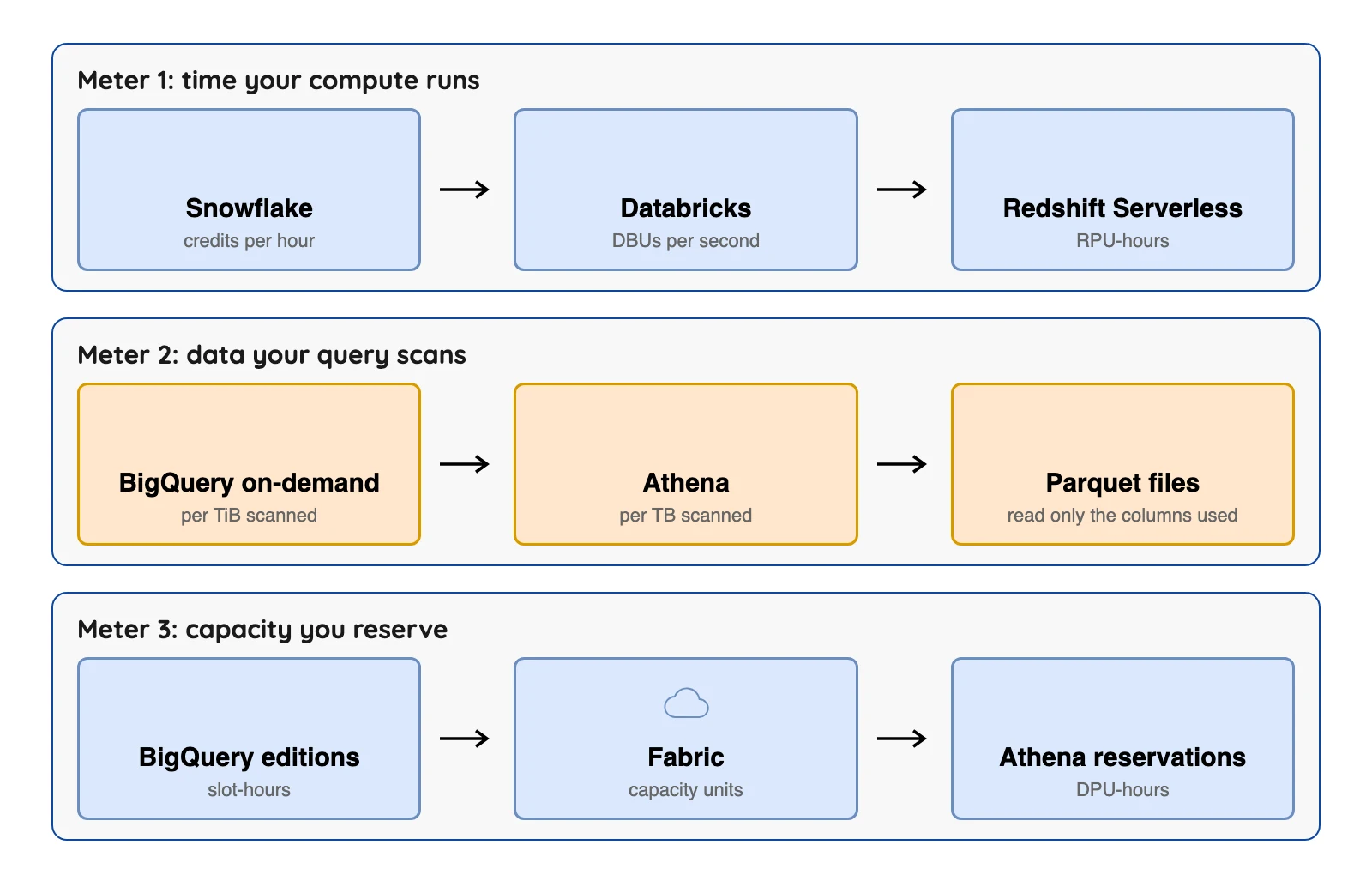
Our summary of the vendor pricing pages cited above (checked Oct 2026).
Apache Iceberg and the cost of leaving
Apache Iceberg is an open table format: a set of metadata files that tells any engine which Parquet files make up a table. If your tables sit in your own bucket in Iceberg format, several engines can read them. Trying a competitor gets cheaper because you don't copy the data first.
Snowflake's Iceberg docs (checked Oct 2026) say it supports Iceberg tables with Parquet files and externally managed writes on v2 or v3 of the spec. Its release notes list partition evolution for Iceberg tables as generally available on September 18, 2026. When the account and the storage sit in different regions or clouds, egress charges can apply.
Most options above document Iceberg support, but the depth varies.
Databricks, BigQuery and Fabric document managed or bridged tables. Redshift and Athena lean on the Glue catalog, and ClickHouse warns about limits. Test your exact table, catalog and engine pair before you promise anyone a quick move.
Where Snowflake fits
Choose Snowflake if you need one of these, per its own docs.
- Sharing data between accounts. Snowflake's data sharing docs say that with Secure Data Sharing, no actual data is copied or transferred between accounts.
- AI functions inside the warehouse. Its Cortex AI functions offer models from OpenAI, Anthropic, Meta, Mistral AI, DeepSeek and xAI, and its Cortex docs say the models are deployed within the Snowflake Service perimeter.
- Three clouds. It lists AWS, Azure and Google Cloud in its Service Consumption Table (checked Oct 2026). BigQuery, Redshift and Fabric each come from one cloud owner.
On cost, Select's run (a single third party's test; Select sells cost tools for Snowflake and Databricks) used 22 queries on a standard benchmark data set at scale factor 1000. At $2 per credit, Snowflake was 34 percent faster and 17 percent cheaper than Databricks at $0.70 per DBU. At $3 per credit, Databricks was 20 percent cheaper in that same sequential test, per Select, April 10, 2026. The result followed the credit price.
What usually needs rework when you move
The table data is the easy part. The work sits in the Snowflake-specific code and settings on top.
- Semi-structured columns. Snowflake's
VARIANTtype stores a value of any other type, including objects and arrays, up to128 MBuncompressed, per its data types docs (checked Oct 2026). Every target has its own JSON or struct type, so list the queries that readVARIANTcolumns first. - SQL dialect. Databricks tells migrating teams to convert SQL "from dialects such as T-SQL, Snowflake, and Oracle" with its agentic code converter, per its migration docs. Treat any converter output as a first draft.
- History and recovery. Snowflake keeps one day of Time Travel by default, and Enterprise can raise it up to
90 dayson permanent tables, per its docs (checked Oct 2026). Check what each target offers for recovering a dropped table. - Scheduling and permissions. We did not find a vendor page that maps these across tools, so plan a manual review. We found no standard migration time either, so we won't quote one.
What to test before you switch
- Run your real queries. Take a week of your actual query log and price it in each vendor's unit.
- Check your SQL. Dialects differ, so run your ten most important queries and compare the results.
- Test Iceberg on your own tables. Use your catalog and your engine, and try an update and a delete as well as a read.
- Read the exit costs. Look for egress fees between regions or clouds, and for minimum commitments.
- Run both side by side for one billing cycle. Compare the invoices before you cancel anything.
Where OLake Go fits
OLake Go is an open-source tool (Apache 2.0) that copies data from databases such as Postgres, MySQL, MongoDB, SQL Server, Oracle and Db2 into Apache Iceberg tables or Parquet files on storage you control. You run it yourself, and the quickstart shows how.
Change data capture covers Postgres, MySQL and MariaDB, MongoDB and SQL Server. Snowflake has two routes. From v0.11.0, OLake Go can write Iceberg tables into a Snowflake database through the Snowflake Horizon Catalog, using a programmatic access token, key-pair authentication or External OAuth. Or OLake Go writes to another catalog, such as AWS Glue, and Snowflake reads those tables from an external catalog as read-only. Our compatibility page also lists Databricks, BigQuery, Redshift, Athena, Trino and Dremio among the engines that query the tables OLake Go writes. OLake Go's destinations are Iceberg and Parquet.
FAQs
Q1. Who are Snowflake's biggest competitors?
Q2. Is there a cheaper alternative to Snowflake?
Q3. What is an open-source alternative to Snowflake?
Q4. Can Apache Iceberg help me avoid lock-in?
Q5. Why can't I compare Snowflake and Databricks prices directly?
Q6. What is hardest to move off Snowflake?
Q7. How do I get my database data into a warehouse like these?
Conclusion
There is no single Snowflake replacement. Price your own queries in each vendor's unit and test Apache Iceberg on your own tables before you move. Recheck the vendor pages, because every price here was checked in October 2026.