What Is Matillion? Plans, Credits and Fit (2026)
24 min read
Key takeaways
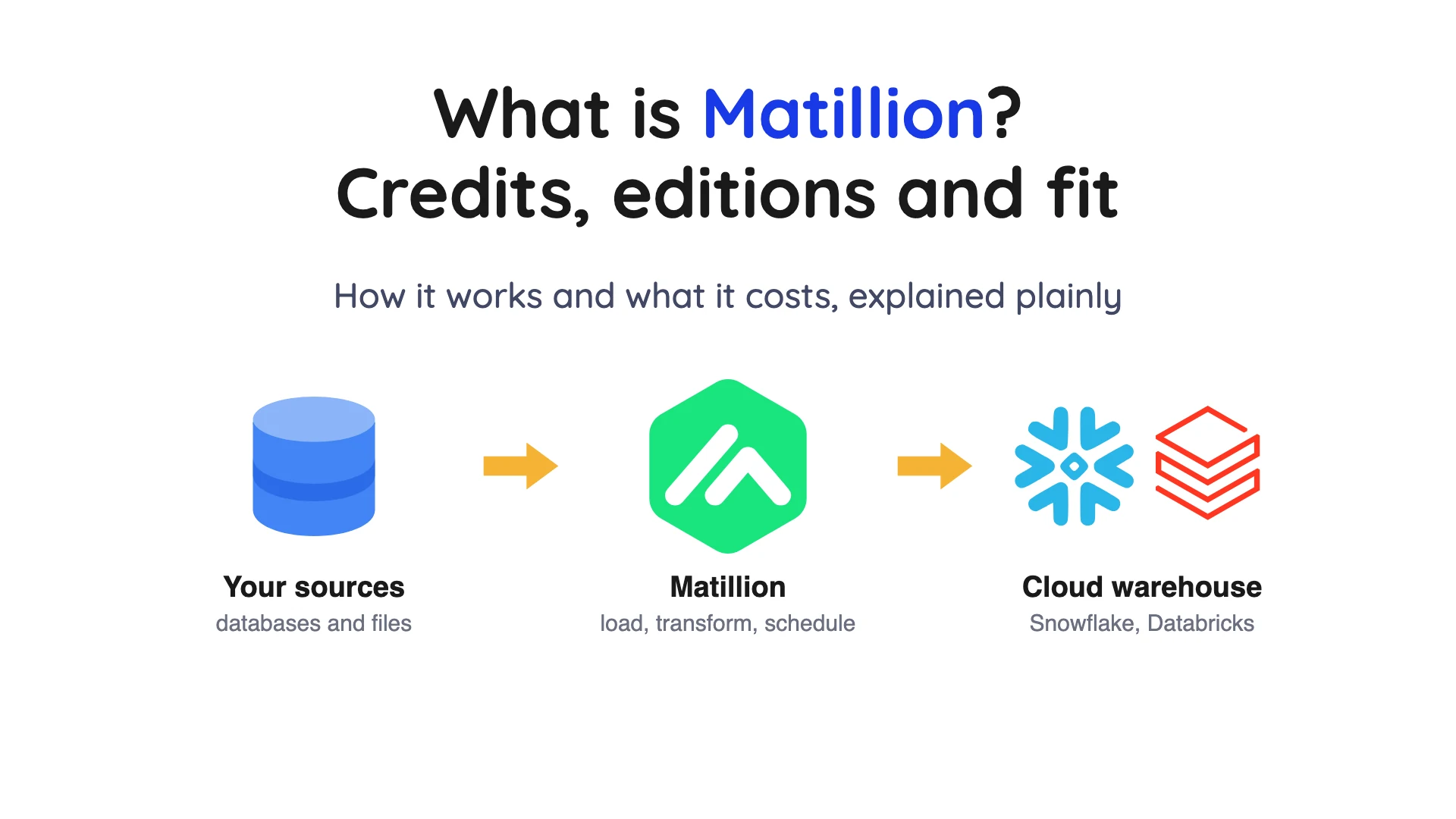
Matillion is a paid platform that loads your data into a cloud data warehouse, reshapes it with SQL that runs inside the warehouse, and schedules the whole job.
Here's the catch: you pay in credits, not dollars. Matillion publishes the credit rules, but no price per credit and no dollar price for any plan. It does offer a 14-day trial with 500 free credits.
Matillion's pages position it for teams that build and transform pipelines in a warehouse. Want open source code, a public price list or Apache Iceberg tables as output? Look elsewhere.
- Matillion does three jobs on one platform: it loads data, transforms it, and schedules the work. The transforms run as SQL inside your warehouse, which is called push-down.
- "Matillion" is now a family of products, not one thing. Maia Foundation is the current platform (formerly Data Productivity Cloud). Matillion ETL is an older product you run in your own cloud account. Each has its own credit meter.
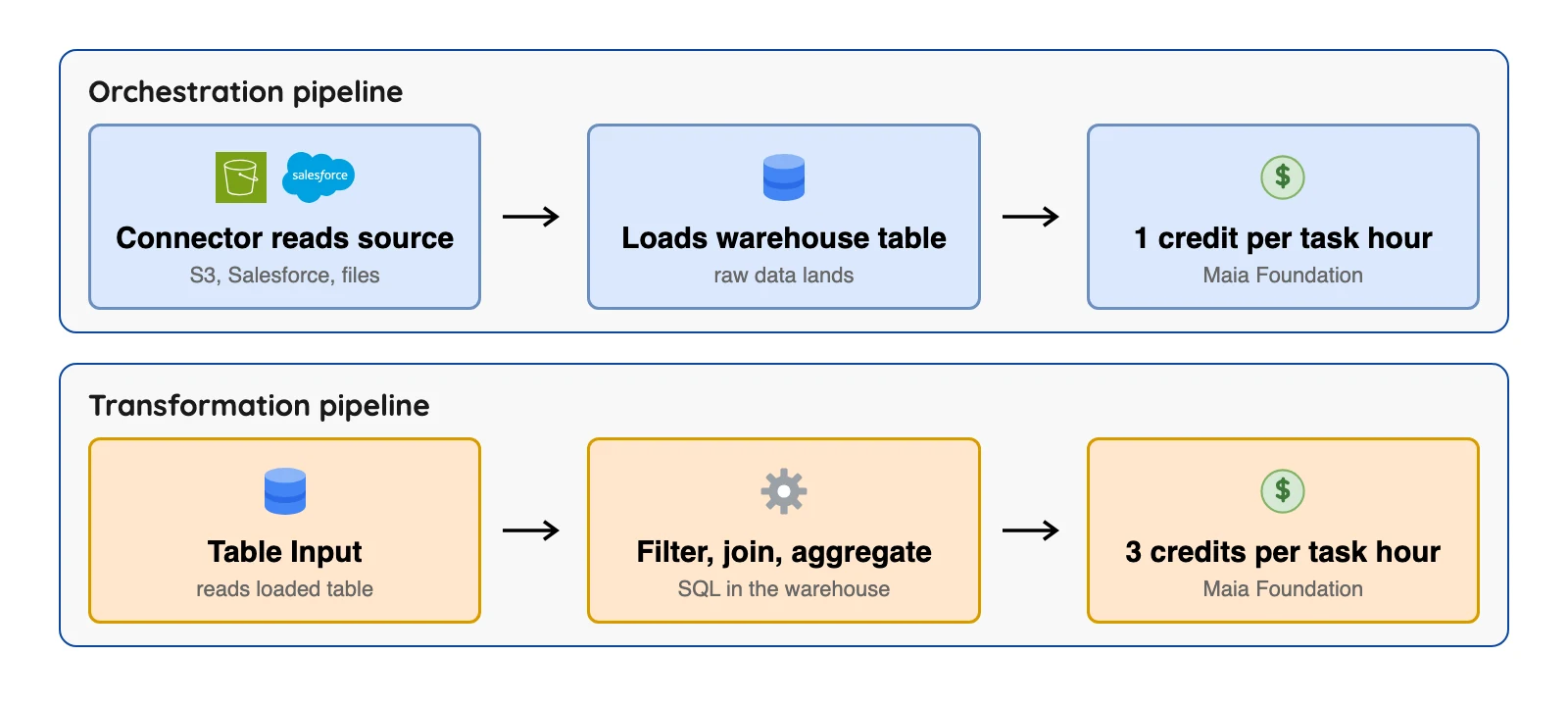
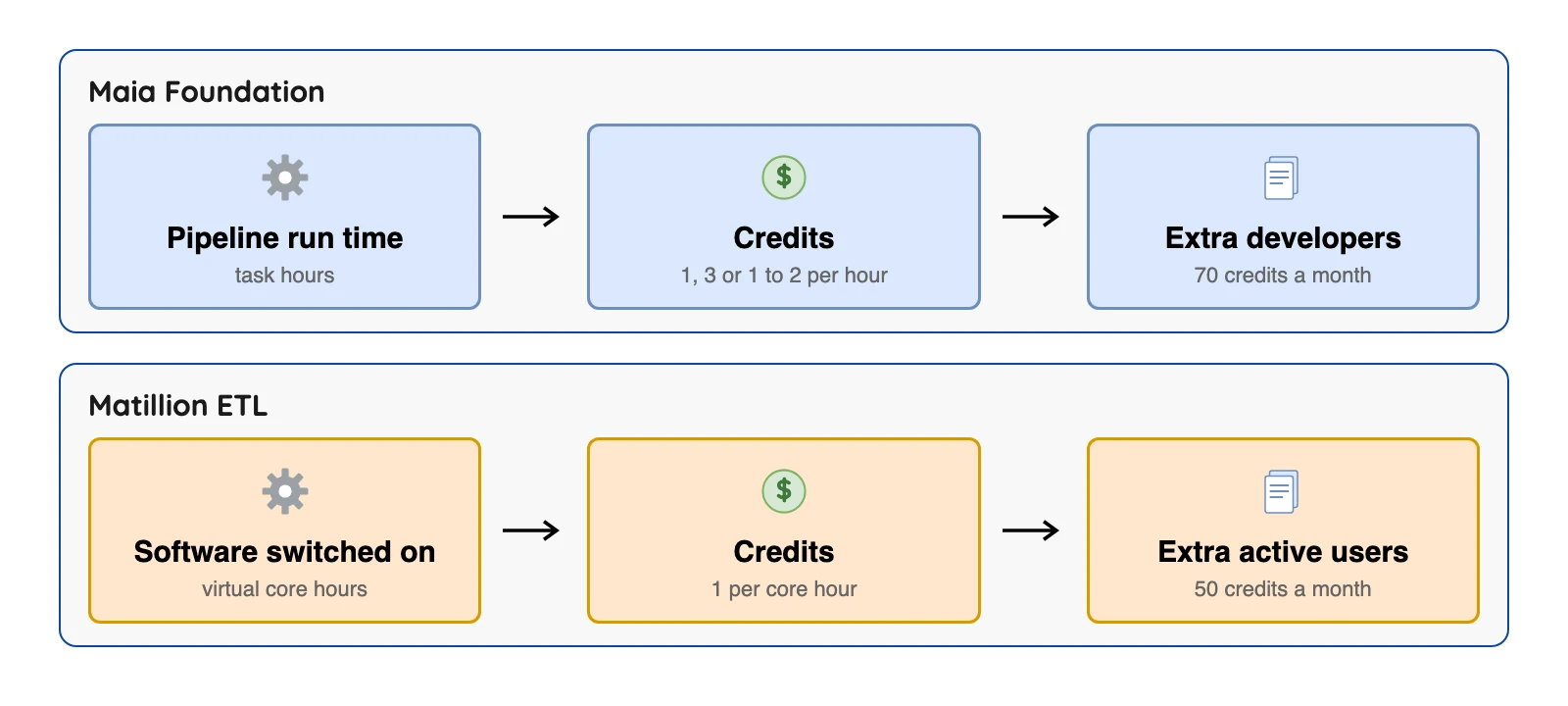
- Maia Foundation uses credits per task hour: 1 for orchestration pipelines (which load data), 3 for transformation pipelines, and 1 or 2 for streaming change capture. Extra developers cost 70 credits a month each.
- Matillion ETL uses 1 credit per virtual core hour while the software is switched on, plus 50 credits a month per extra active user.
- Maia's docs say new accounts get a 14-day free trial with 500 credits. What you won't find: any dollar price, the price of a credit, or a connector count on the connector page.
- Budgets and alerts only warn. Maia's docs say budgets "do not restrict or block usage", so a runaway job can overspend a credit pack.
Every fact below comes from Matillion's own pages, read from saved copies dated October 8, 2026, with the page linked beside the claim.
When Matillion doesn't publish a number, we say "not published". We did not run Matillion. This is a careful read of its documents, not a hands-on test.
What is Matillion?
Matillion home page, October 2026.
Matillion describes itself as born in Manchester, with headquarters in Denver and Manchester. Its about page lists Matthew Scullion as a founder and says "Empowering data teams since 2011".
These days the lead message is Maia. The home page calls Matillion "the company behind Maia, the agentic data team", and the Maia docs call Maia "the AI Data Automation platform by Matillion".
The short version: Matillion is software that moves data into a cloud data warehouse and gets it ready for analysis. Snowflake and Amazon Redshift are two examples of a data warehouse, a database built for reports. Teams save their steps as a pipeline, a series of steps that moves or reshapes data.
You'll often hear this kind of tool called ETL, short for extract, transform, load. Extract means read data from a source. Load means write it to a destination, and transform means clean it up and reshape it along the way.
Matillion's own comparison post describes the same idea: load data into a cloud data platform, then run the transformations there as SQL.
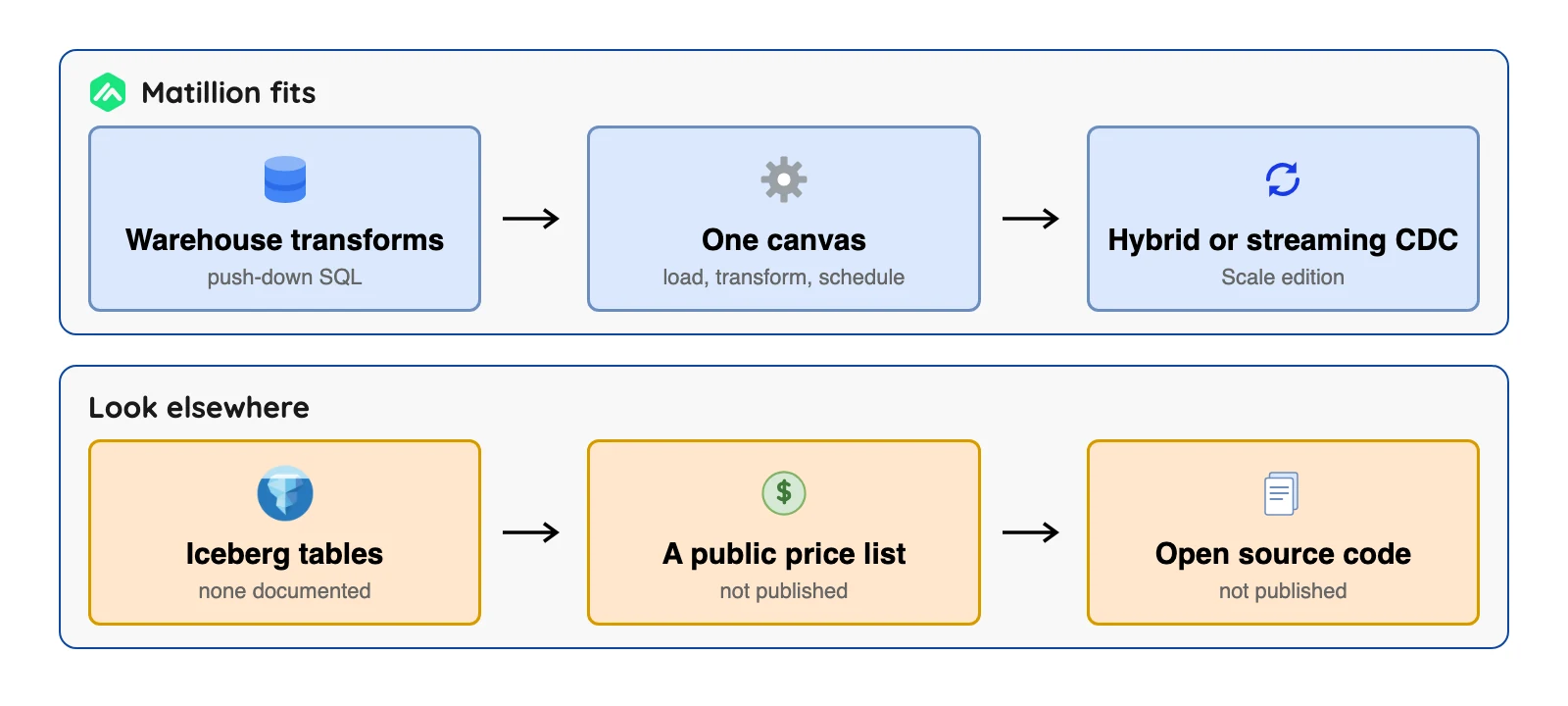
The four names you will meet
The product names overlap, and they changed in 2026.
| Name | What it is | Where it runs | Billing meter |
|---|---|---|---|
| Maia Foundation | The current platform, with pipelines, connectors and streaming change capture | Full SaaS (Matillion runs it) or Hybrid SaaS (you run the runner) | Credits per task hour, plus extra developers |
| Data Productivity Cloud | The old name of Maia Foundation | Same as above | Same as above |
| Matillion ETL | An older, separate product with its own docs | Instances in your own AWS, Google Cloud or Azure account | Credits per virtual core hour, plus extra active users |
| Matillion Data Loader | A loading tool, billed on rows, for customers not on Maia Foundation | Not stated in the pages we read | Credits per band of rows per month |
Sources: deployment options, credit terms, Matillion ETL docs.
Matillion's terminology page says that in early 2026 it decided to rebrand Data Productivity Cloud as Maia. It also renamed "agents" to "runners" and the "Enterprise edition" to the "Scale plan". The pricing page still says Data Productivity Cloud in places, so expect to see both names.
The Matillion ETL docs now say they only host Matillion ETL documentation, because the Maia docs moved. They have Create Project pages for Snowflake, Amazon Redshift, Google BigQuery, Azure Synapse Analytics and Delta Lake on Databricks. For Maia Foundation, the home page says its connectors span Snowflake, Databricks, BigQuery and Redshift.
How Matillion works
So what does a Matillion pipeline actually do? It has up to three parts, and Matillion bills them differently.
- Load. Pre-built connectors copy data from a source into your warehouse. In Matillion's words, these sit in orchestration pipelines, meaning the load-and-flow-control kind, which "handle the loading of data from source systems to a target data warehouse" (docs). A connector is just a ready-made piece of software for one kind of source. The Matillion ETL product page says "over 150 pre-built connectors".
- Transform. Transformation pipelines work on tables already in the warehouse, with steps such as Table Input, Filter, Aggregate and Rank (docs). You build them on a visual canvas, or in SQL or Python. Matillion's own comparison post says Maia Foundation runs transformations as native SQL pushed down into Snowflake, Databricks or AWS Redshift. So the warehouse does the heavy lifting, and yes, your warehouse bill grows with it.
- Chain and schedule. A pipeline can run on a schedule and call other pipelines. Each component has green, gray and red paths, so you can branch on success or failure. And a transformation pipeline slots into a load pipeline through a Run Transformation component.
On top of that, Matillion says Maia has an AI helper that builds pipelines from plain-language requests. We did not test it, and the next line matters.
Per the credit terms, the Maia AI product is an add-on, priced as a separate annual fixed fee.
What about the free trial? The pricing page calls it "time-bound, fair-use" and gives no length.
Matillion's free trial doc says new accounts get 14 days and 500 complimentary credits, with every feature open.
When the trial ends, the runner is suspended until you subscribe. If you started from a marketplace or added payment details, a Pay-Go plan kicks in instead.
Connector counts do not agree
Count the connectors and you get different answers. The home page says Maia Foundation has 150+ connectors and the ETL product page claims over 150. Matillion's comparison post, dated July 16, 2025, says 130+ in its table and 150+ in its text, and its connector page states no count in the text we read.
Our advice: quote the page you used, with its date. And if one source matters to you, check that it's on the live list before you plan around it.
Change data capture and its limits
Change data capture (CDC) means reading the log where a database records every change, so you copy only what changed instead of the whole table.
Matillion calls its CDC feature streaming pipelines. Per the streaming docs, they only support relational databases: the International Business Machines (IBM) database Db2 for IBM i, Microsoft SQL Server, MySQL, Oracle and PostgreSQL. The pages say nothing about MongoDB or other non-relational sources, so don't assume.
Streaming is near-real-time, and change records are written in batches as Avro files to Amazon S3, Azure Blob Storage or Google Cloud Storage, or loaded to Snowflake. Each streaming pipeline needs its own runner. One more catch: the pricing page lists streaming change data capture only under the Scale plan.
How Matillion is priced
Matillion sells annual packages of credits. A credit is its smallest unit of charge, and the pricing page says credits are used up by pipeline run time (called task hours) and by extra developer users. The page lists three plans and shows no dollar amount for any of them.
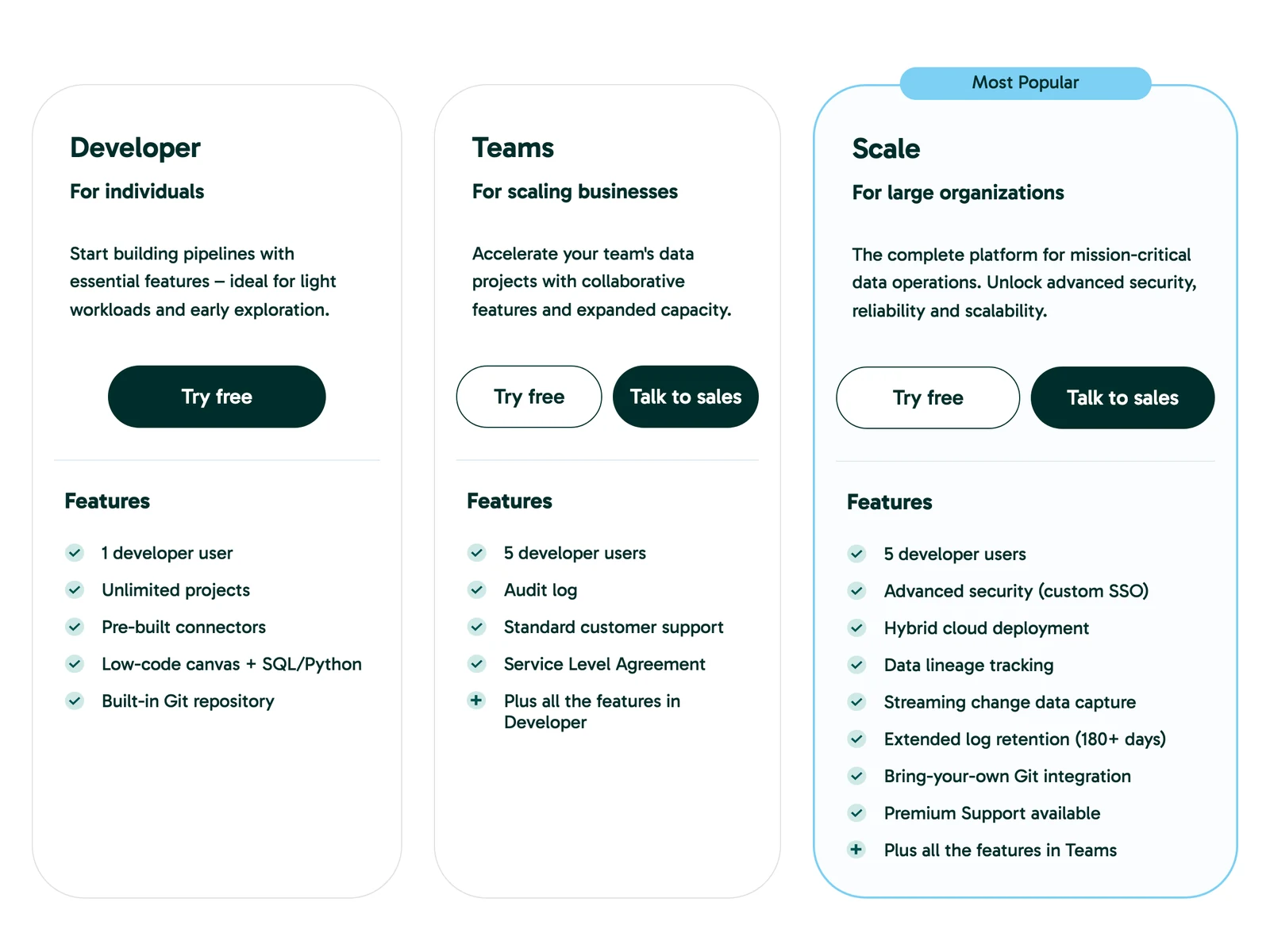
Matillion's pricing page, October 2026.
| Plan | Developer users included | What the page lists | Price |
|---|---|---|---|
| Developer | 1 | Unlimited projects, pre-built connectors, low-code canvas with SQL and Python, built-in Git | Not published |
| Teams | 5 | Audit log, standard support, Service Level Agreement (with an annual subscription), plus all Developer features | Not published |
| Scale | 5 | Custom single sign-on, hybrid cloud deployment, data lineage, streaming change data capture, 180+ day log retention, premium support available | Not published |
Source: Matillion pricing page, saved October 8, 2026.
An account can hold one active subscription, so you're on one plan at a time. You can buy directly or through the AWS, Azure or Snowflake marketplace. (A Service Level Agreement is a written promise about uptime or response times.)
The Maia Foundation meter
The credit consumption terms set the rates for Maia Foundation. A task hour is the combined run time of each task, counted in 2-second steps, and only while a pipeline runs. Per the terms, validation and sampling are not billed.
| What you run | Credits per task hour |
|---|---|
| Orchestration pipelines (loading and flow control) | 1 |
| Transformation pipelines | 3 |
| Streaming change capture, "essential" | 1 |
| Streaming change capture, "premium" | 2 |
| Each developer user beyond those included | 70 credits a month |
The terms say these rates are "fixed across the customer base and non-negotiable". But they don't define "essential" and "premium", and they don't say how an always-on streaming pipeline is counted. Ask Matillion both questions before you plan a streaming budget.
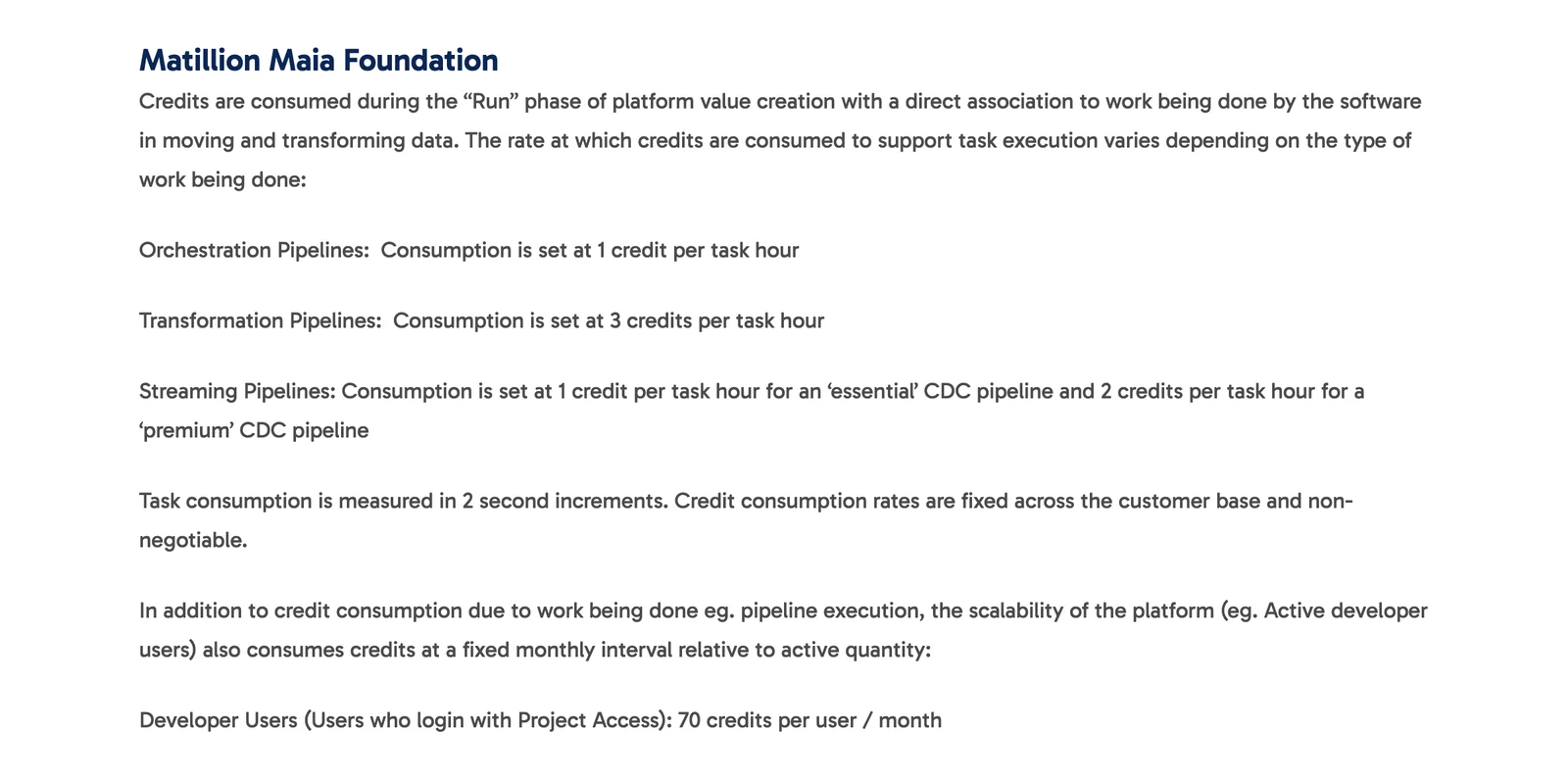
Matillion's credit consumption terms, October 2026.
The Matillion ETL meter
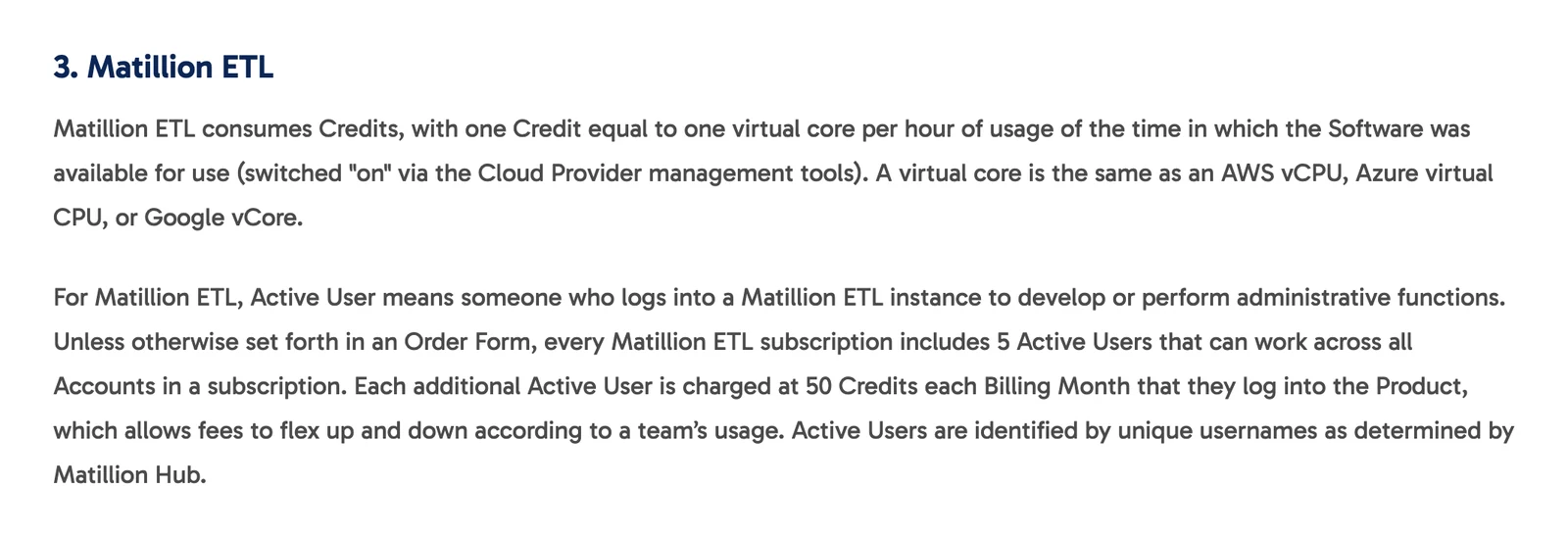
Now flip to the older product. The same terms page sets a different meter for Matillion ETL: one credit equals one virtual core for one hour, counted while the software is switched on in your cloud account. Each subscription includes 5 active users, and each extra one costs 50 credits in any month they log in.
Matillion's credit consumption terms, October 2026.
Matillion ETL editions are listed as Basic, Advanced and Enterprise.
Data Loader is metered by rows: in its first band, 1 to 5,000,000 rows a month, one credit buys 20,000 batch rows or 7,000 CDC rows. Matillion's own comparison post says "There's no per-user charge", yet the terms charge developer users. Our read: trust the terms over the blog post.
A worked example, with invented usage
These numbers are illustrative: the usage is our own pick, while the rates come straight from the terms. No dollar value appears, because Matillion doesn't publish one.
Maia Foundation. Say a team on Teams has 7 developers, so 2 are beyond the 5 included. Their nightly load pipelines run 1.5 task hours a day, and their transformation pipelines run 0.5 task hours a day, for 30 days.
- Load (orchestration): 1.5 hours x 1 credit x 30 days = 45 credits.
- Transformation: 0.5 hours x 3 credits x 30 days = 45 credits.
- Extra developers: 2 x 70 credits = 140 credits.
- Total: 230 credits for the month.
The seats are the biggest slice, and a transformation hour costs 3 times a load hour.
For a 14-day trial, scale the run time: (45 + 45) x 14 / 30 = 42 credits. Even if the seat credits were also scaled, 230 x 14 / 30 is about 107. Both are far under the 500 trial credits, so they can cover a real test.
Matillion ETL. Say one instance has 4 virtual cores. Left on all month, it uses 4 x 24 hours x 30 days = 2,880 credits. Switched off outside 8 working hours a day, it uses 4 x 8 x 30 = 960 credits.
Same software, 3 times the bill. Matillion ETL bills for time switched on, not for work done.
What Matillion does not publish
| Item | Status |
|---|---|
| Dollar price of Developer, Teams or Scale | Not published on the pricing page |
| Price of one credit | Not published on official pages; the overage rate is on the Order Form only |
| Free trial length | Pricing page: "time-bound, fair-use" with no length. Docs: 14 days, 500 credits |
| A cost calculator | None found on the pricing page we read; the Maia docs describe a usage dashboard |
| Definition of "essential" and "premium" streaming | Not in the credit terms |
Sources: pricing page, credit terms, free trial doc.
What third parties report
Mammoth reports $20,000 to $35,000 a year for small teams and $100,000 to $300,000 or more for enterprises. It says these figures come from Reddit and G2 posts, not from Matillion. Estuary, a rival, said in a post updated September 11, 2026 that Matillion does not publish simple starting prices.
Treat those dollar ranges as unverified reports, not quotes. Your own quote may look very different.
Costs outside the credits
Credits are not the whole bill. Because transformations are pushed into your warehouse, the warehouse provider bills you for that compute too. Then add any marketplace terms and the Order Form overage rate.
Maia has a Budgets and alerts page. Its docs say budgets "do not restrict or block usage", so pipelines keep running past a threshold and you only get an alert (docs). A runaway job can overspend a credit pack and nothing stops it.
And watch the end of the contract. The terms allow Pay-Go for up to 60 days with no support, then access is lost unless you sign a new term.
Where Matillion fits and its limits
What's good
- One canvas, three ways to build. The Developer plan lists a low-code canvas with SQL and Python, pre-built connectors, unlimited projects and a built-in Git repository, and Scale adds bring-your-own Git. Matillion says a no-code designer builds custom REST API connectors.
- Scheduling and error handling are built in. Basic mode sets schedules in a graphical screen, and advanced mode takes Quartz cron expressions. The Retry component reruns a step until it succeeds or hits a maximum number of attempts, with no delay by default or a delay of about 2 seconds.
- You choose where the runner lives. In Hybrid SaaS you deploy the runner inside your own private cloud, and the docs recommend TLS 1.2 or higher between Matillion and your runners. The pricing page lists hybrid deployment under Scale.
- Usage is metered in small steps and is easy to see. The credit terms count task time in 2-second steps, and validation and sampling are not billed. The usage dashboard refreshes every 3 hours, splits credits by Orchestration, Transformation, Streaming and Additional Users, and exports to CSV. Budgets take up to two percentage thresholds and send alerts by email, Slack or webhook.
- Streaming change capture is near-real-time. The PostgreSQL source uses the Debezium PostgreSQL connector and supports versions 12 to 16. The streaming docs call the pipelines "self-healing" because they adapt to source schema changes.
- Audited security. The security page lists SOC 1 Type II, SOC 2 Type II and SOC 3 accreditation with ISO 27001 certification, and says its ISO 27001 surveillance audits finished "with no reported non-conformities".
Where it falls short
- Streaming change capture is narrow and plan-gated. The docs say streaming pipelines "only currently support relational databases as sources": Db2 for IBM i, SQL Server, MySQL, Oracle and PostgreSQL. They are "only available to customers on specific Maia plans" and the pricing page lists them under Scale. Each pipeline needs its own runner, and a MySQL source needs a driver you provide.
- Schema changes follow the data, not the source DDL. Per the same docs, a source schema change does not reach the target until the data changes, a dropped column stays in the target with NULL values, and an incompatible type change renames the column with a timestamp suffix (
_yyyymmddhhmmss). A new source table needs a new streaming pipeline. - Output is warehouse tables or files, and the platform is closed source. The connectors page says its connectors are "built to load into Snowflake, Google BigQuery, Databricks or Redshift", and streaming writes Avro files to Amazon S3, Azure Blob Storage or Google Cloud Storage, or loads to Snowflake. No Apache Iceberg destination appears in the Maia docs index or the 2026 changelog as of October 8, 2026, and Matillion publishes no open-source licence for its platform.
- Spend is hard to predict and hard to cap. A transformation hour costs 3 credits against 1 for a load hour, the warehouse bills you separately for push-down compute, and the Retry component's backoff delays can add to billable task time. Budgets only alert, the price per credit is not public, and the overage rate is on the Order Form only (credit terms).
- Names and components keep changing. Early 2026 brought the Maia rebrand, the Enterprise edition became Scale and agents became runners. The 2026 changelog renames the Runner role to Operator and deprecates the Google Cloud Storage Load component. The MongoDB Query component is deprecated too: it "can no longer be added to new pipelines", and each run drops and recreates its target table.
- Matillion ETL runs on a support clock and bills while on. It uses 1 credit per virtual core hour while the software is switched on, whatever work it does. The supported releases page lists 1.78 LTS ending support in November 2026 and 1.80 LTS with the end date to be confirmed, and each LTS version gets 18 months of support.
Running Matillion ETL today? Check which version you're on and plan the upgrade now, not in November.
PeerSpot shows Matillion Data Productivity Cloud at 4.2 out of 5 from 28 reviews. Reviewers mention the drag-and-drop interface, limited concurrency and documentation gaps, though one calls the docs "top-notch". It's a small sample, so take it as a hint, nothing more.
What practitioners say
Independent talk about Matillion lives mostly on review sites. We found no substantive Reddit thread, and G2, Capterra and Gartner Peer Insights block automated readers, so we didn't use them directly. Each quote below is verbatim and was checked against a saved page copy dated October 8, 2026.
Reviewers mention support and ask for clearer prices. A reviewer on the AWS Marketplace review list, which republishes G2 reviews, wrote in June 2026: "My main concern is around pricing. I'd really like more transparency and predictability on cost".
Other complaints are about setup and the older product.
An AWS Marketplace review from September 2026 said: "The onboarding documentation could be stronger. We ended up having to figure out certain workflows through trial and error".
On the older VM-based Matillion ETL, a PeerSpot reviewer wrote in April 2023: "Before considering the licensing cost of Matillion itself, you need to consider the cost of hosting the virtual machine" (PeerSpot, Matillion ETL pricing thread). That quote is old, so it doesn't describe the current Maia product.
Security and deployment
Matillion's security page lists System and Organization Controls (SOC) 1 and SOC 2 audit reports, both Type 2, plus International Organization for Standardization (ISO) 27001, an information security standard. It says it meets the EU General Data Protection Regulation (GDPR). The text doesn't mention the US health privacy law, the Health Insurance Portability and Accountability Act (HIPAA), so ask if you need it.
Maia runs in two modes (docs). In Full SaaS, Matillion manages the runner for you. In Hybrid SaaS, you run it in your own private cloud, which gives you control over network isolation.
One catch: the runner still needs outbound internet access to Matillion's control plane.
Who Matillion suits, and who should look elsewhere
Matillion fits teams that:
- Want load, transform and schedule on one canvas, with transformations running as SQL pushed down into Snowflake, Databricks or Amazon Redshift.
- Need an audit log and a Service Level Agreement (Teams), or custom single sign-on, data lineage tracking and 180+ day log retention (Scale).
- Must keep the runner inside their own private cloud, which the Scale plan lists as hybrid deployment.
- Want change capture from Db2 for IBM i, SQL Server, MySQL, Oracle or PostgreSQL into cloud storage or Snowflake, and can budget for the Scale plan.
Look elsewhere if you need:
- Apache Iceberg tables as output. No Iceberg destination appears in Matillion's docs index as of October 8, 2026.
- Change capture from MongoDB or other non-relational sources. The streaming docs list five relational databases only.
- A hard spending cap. Matillion's budgets only alert, and the price per credit is not public.
- A vendor-run loader: Fivetran describes its service as managed.
- Free software you run yourself: Airbyte Core (Elastic License 2.0, which restricts offering it as a hosted or managed service) or Debezium (Apache License 2.0), per their own pages.
- A published price list: compare each vendor's own pricing page.
Questions to ask Matillion before you sign
- Plan. Is streaming change capture in my plan, and what do "essential" and "premium" mean?
- Trial. Can I test streaming and my real sources inside the 500 trial credits, and can the trial be extended?
- Credits. What is my price per credit, my overage rate, and how are always-on pipelines counted?
- Sources. Is each of my sources on the live connector list today?
- Version. If I use Matillion ETL, when does support for my version end?
- Exit. What happens at renewal, and how long does Pay-Go last?
Conclusion
Matillion is a warehouse-focused platform for loading, transforming and scheduling data, sold by credit. Before you sign, get the price per credit in writing, run your real usage through the meter tables above, and compare at least one other quote.
Test your Matillion basics
Question 1 of 5
In one sentence, what does Matillion do?