Data Lake vs Data Warehouse: Differences Explained
20 min read
Key takeaways
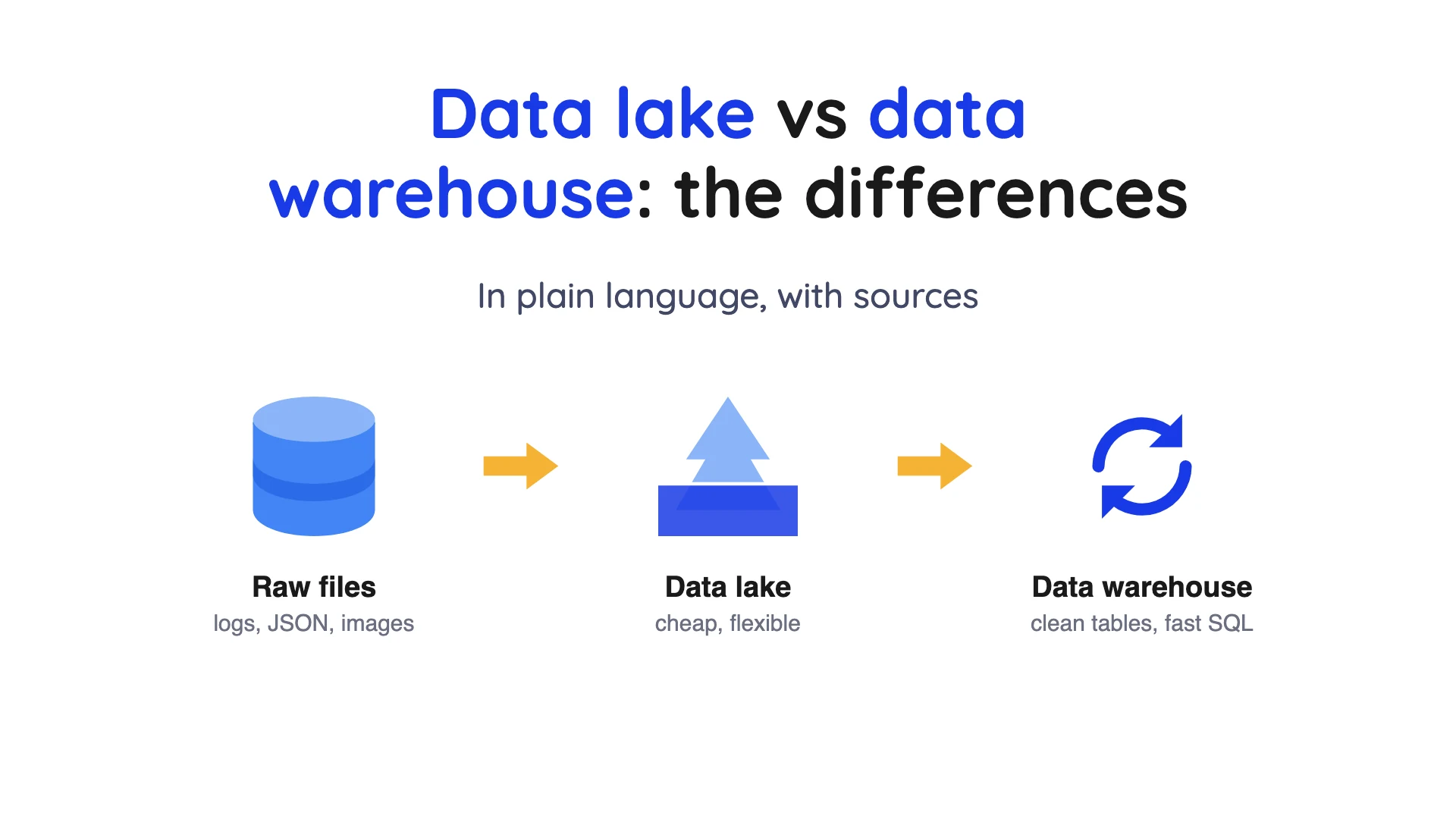
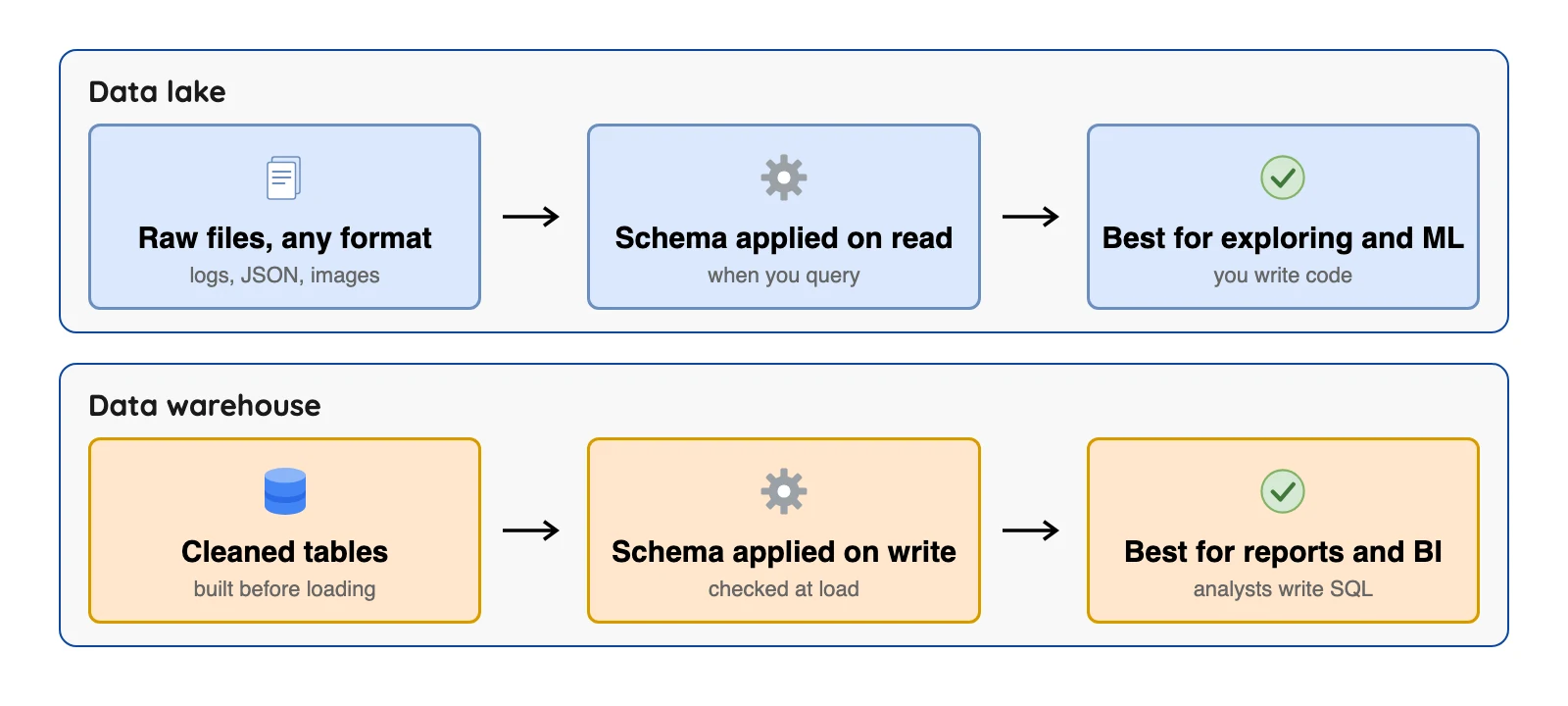
A data lake keeps your data exactly as it arrives, in any format, and works out the structure later, when someone reads it. A data warehouse cleans and shapes everything first, so analysts can run fast SQL reports on tidy tables. Raw, mixed or machine learning data?
Pick a lake. Trusted reports and dashboards? Pick a warehouse.
Plenty of companies run both, and newer table formats now let the two share the same files. To fill a lake from your databases, OLake Go is our free, open-source tool for PostgreSQL, MySQL and MariaDB, MongoDB and SQL Server.
- The core difference is timing. A lake keeps data raw and applies structure when you read it (schema-on-read). A warehouse applies structure before it stores the data (schema-on-write). That's the whole trick.
- Different crowds tend to use each one. Google Cloud lists data scientists and data engineers as lake users, and data analysts and business intelligence analysts as warehouse users.
- "Warehouses only hold structured data" isn't a safe rule any more. Snowflake and BigQuery both document storing JSON in a warehouse table.
- The line is getting blurry. Warehouses can read files in a lake, and lake query tools can read the same Apache Iceberg tables that a warehouse reads.
- You rarely have to pick just one. Microsoft Azure says it's common for a large organisation to have both.
Every fact below comes from a vendor's own documentation or a named reference page, read on October 1, 2026, and each one is linked right next to the claim. We didn't run any of these systems ourselves, so you won't find test results here. The little shop example further down is made up to show the idea, and we label it as an illustration.
What is a data lake?
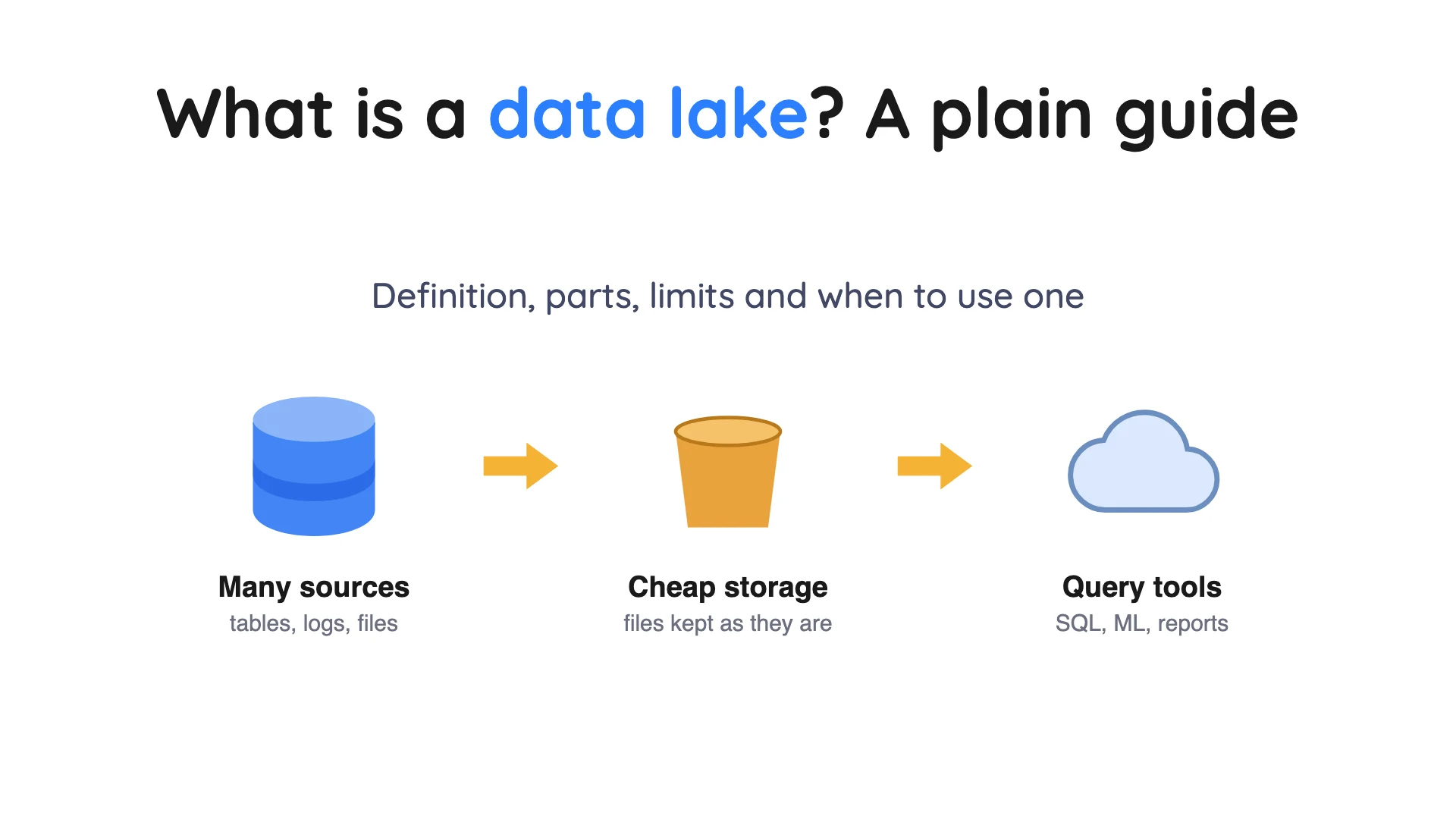
Ever shoved everything into one big drawer because sorting it felt like a job for later? That's the basic idea. A data lake keeps large amounts of data in its original form, and Amazon Web Services (AWS) says in a data lake the structure isn't defined when the data is captured, so you can store it as is.
Picture a big storage room. Website logs, app events, sensor readings, exports from business systems and photos can all go in the same place. Nobody has to decide up front what each item is for.
In practice, a lake is usually files in cloud object storage, such as Amazon S3 (Amazon's cloud file storage). IBM (the technology company) describes a data lake as a repository for large volumes of raw data, typically on low-cost cloud object storage.
What is a data warehouse?
Now flip it. A warehouse is the tidy desk where nothing gets in until it has a label.
It's a system built for analysis and reporting, and the data is cleaned and shaped before it lands in tables with a set structure. AWS says the structure and schema are defined in advance to make SQL queries fast, and the data is cleaned, enriched and transformed.
A schema is just the list of columns and their types, such as order_id being a number and order_date being a date. Think of a library where every book is catalogued and shelved before anyone borrows it. Google Cloud uses the same picture: a lake is a large pool of raw data, a warehouse is a library of organised data.
All that early work is meant to buy speed and trust. In theory analysts can write SQL (the standard language for querying tables) and get consistent answers, because the data was checked on the way in. How well that holds depends on how carefully the loading is done.
Data lake vs data warehouse: the differences
Google Cloud, AWS and Azure describe much the same set of differences, so here they are side by side. Each source is credited right next to its claim.
One bit of jargon first. ETL means extract, transform, load, and ELT (extract, load, transform) swaps the last two steps. The last row marks where each system wins.
| Question | Data lake | Data warehouse |
|---|---|---|
| What goes in? | Data as it arrives, raw, in any format (AWS) | Data that is cleaned and transformed first (AWS) |
| When is structure applied? | When you read it (schema-on-read) | Before it is stored (schema-on-write) (Azure) |
| Who uses it? | Data scientists and data engineers (Google Cloud) | Data analysts and business intelligence analysts (Google Cloud) |
| Typical work | Data whose purpose is not yet defined, AI and machine learning (Google Cloud) | Defined business questions, reports and fast SQL (Google Cloud) |
| How is data loaded? | Usually load first, transform when needed (ELT) (AWS) | Usually clean and shape first (ETL) (AWS) |
| Data quality | Duplicates or unverified data can end up in it if nobody checks (AWS) | More reliable, as de-duplication and verification happen in advance (AWS) |
| Query speed | Puts storage volume and cost ahead of performance (AWS) | Designed for the fastest query performance (AWS) |
| Changing it | Flexible, easy to change (Google Cloud) | More rigid, harder to change (Google Cloud) |
| Main risk | Turning into a "data swamp" without care (IBM) | Higher cost and less flexibility (IBM) |
| Where it wins | Cheap storage of big, mixed data | Fast, trusted SQL answers |
Handle the cost claims with care. IBM says warehouses tend to offer strong performance, but at a higher cost and with less flexibility than lakes.
None of those pages gives a price per terabyte, which is a bit annoying. So the section on how the bills differ uses one vendor's own price list instead.
Data lake or data warehouse: how to choose
Start from the question you need to answer, not from the tool. Here's a quick map of common situations to a first choice. Fair warning: it's our reading of the sources above, not a rule from any vendor.
| Your situation | Likely first choice | Why |
|---|---|---|
| Weekly sales report from clean order data | Data warehouse | Defined questions, SQL users, trusted tables |
| Keep every app event and decide use later | Data lake | Storing raw data without structuring it first |
| Train a machine learning model on logs and files | Data lake | Raw data, code-based tools |
| Finance numbers that must match exactly | Data warehouse | Cleaned data, checked at load |
| Both reports and raw exploration | Both, or a lakehouse | Azure says using both is common |
| Small team, no one to manage a lake | Data warehouse | A lake needs governance work to stay useful |
| Copy PostgreSQL, MySQL, MongoDB or SQL Server into a lake | A lake filled by OLake Go (ours) | Full load, then change capture, into Iceberg or Parquet |
Our read, as a rough rule: if you already know your questions and your data is tidy, start with a warehouse. If your data is varied and the questions aren't clear yet, start with a lake.
Still unsure? The safest move is to keep the raw data somewhere cheap and build tidy tables on top as questions appear.
What about a data mart?
You'll bump into a third word on these pages, so let's deal with it. AWS says a data mart is a smaller store with a single-subject focus, which often filters and summarizes information from an existing warehouse. It puts a data mart at generally up to tens of gigabytes, against hundreds of gigabytes to petabytes for a warehouse.
Think of it as one department's shelf from the library. A finance team might get its own mart, and the marketing team gets another.
How do companies use both together?
So do you really have to choose? Usually, no. The common answer is both, in order.
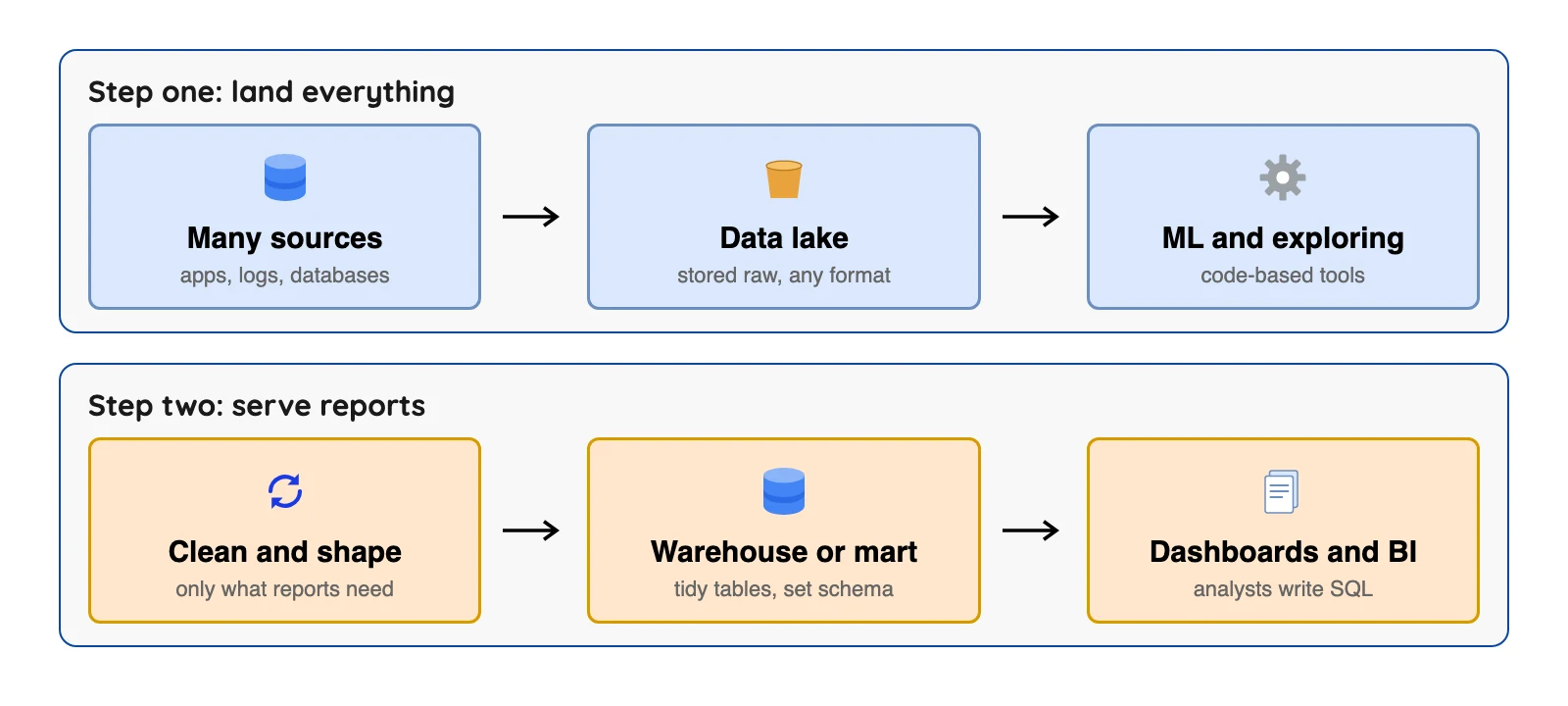
AWS says most large organisations combine lakes, warehouses and marts, typically ingesting all data into a lake and then loading it into warehouses and marts for different uses.
Databricks gives the same advice for a lake: use it as a landing zone for everything. The lake keeps the raw copy, and the warehouse serves the trusted reports. To land database data in a lake as Apache Iceberg tables, OLake Go (Apache 2.0) reads PostgreSQL, MySQL and MariaDB, MongoDB and SQL Server and writes Iceberg or Parquet (our docs).
What is schema-on-read vs schema-on-write?
Yes, the names are clunky. But this one idea sits behind most of the other differences, so it's worth five minutes.
Under schema-on-write, the data must fit the table's structure before it's saved. If a value doesn't fit, it's rejected or fixed at load time. Azure ties this approach to the warehouse, and ties schema-on-read to the lake.
Schema-on-read flips it: you save first and decide the structure when you query. Messy data is allowed, and the reader deals with the mess. Store now, decide later.
Here's a small illustration, made up for this page.
Imagine a shop that saves 10 million order records and 50 million website click events. A warehouse team defines an orders table first and loads only clean rows, so the weekly sales report runs on tidy data. A lake team drops the order files and the raw click logs into storage as they are, and works out the columns later, when an analyst asks a question.
The warehouse route gets you the sales report fast. The lake route lets the team keep the click logs for a question nobody has asked yet.
Is "warehouses only hold structured data" still true?
Short answer: no, not as a rule. Some pages still describe a warehouse as holding only structured, processed data.
Google Cloud's page says a warehouse only holds data that has already been cleaned and processed. That's a fair picture of the classic warehouse, but the vendor docs show a wider reality.
Snowflake documents semi-structured data stored in array, object and variant column types. BigQuery's docs say its JSON type lets you load semi-structured JSON without giving a schema upfront, and describe a schema-on-read approach inside the warehouse.
A warehouse is still where you go for shaped, trusted tables. It just doesn't have to turn JSON away at the door any more. And a lake still wins when you need images, raw logs or files that don't fit in a table.
How warehouses and lakes now overlap
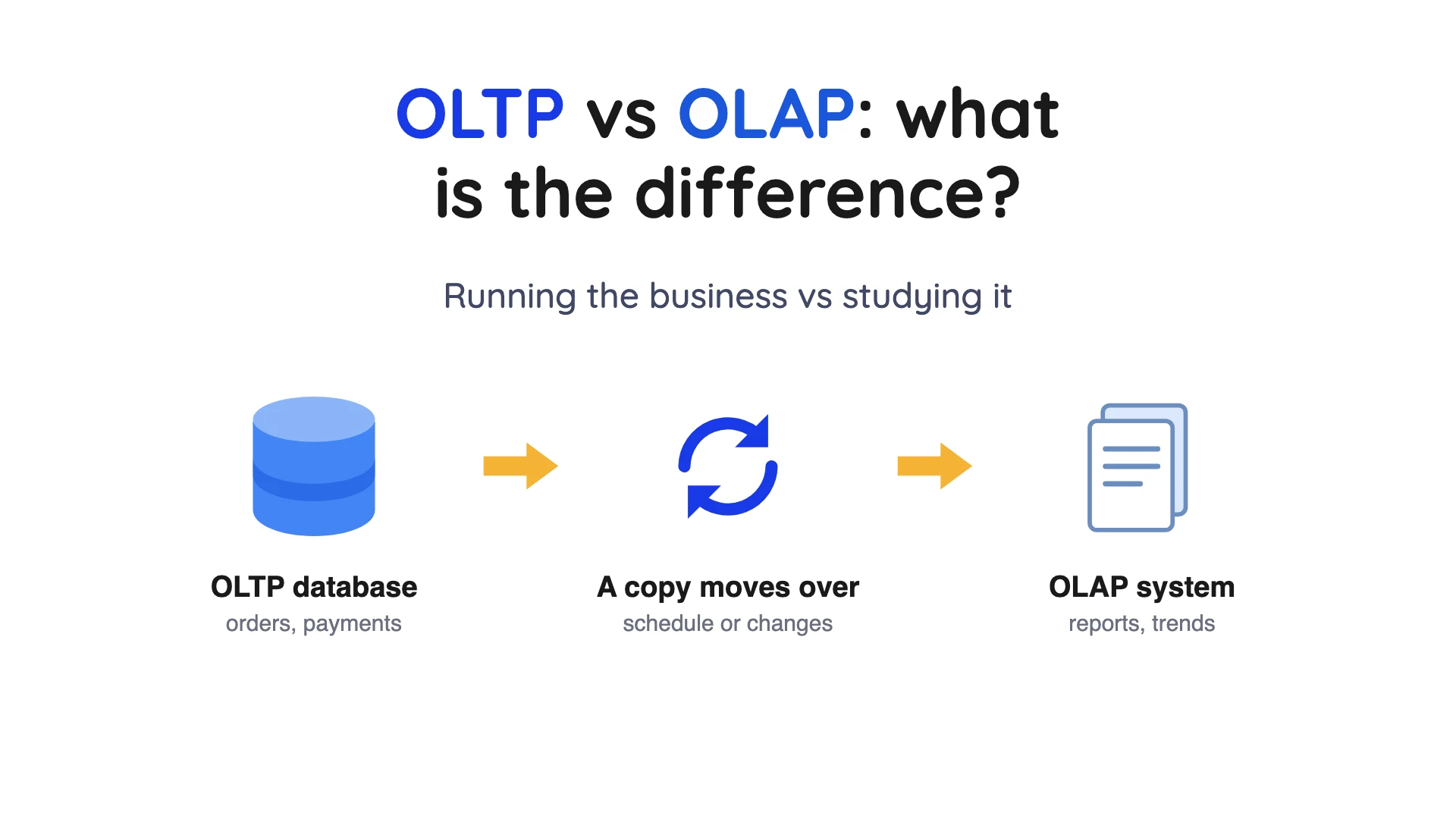
Lakes and warehouses used to be separate worlds with a copy job in between. That's less true now, because each side can read what the other stores.
Amazon Redshift's docs say Redshift Spectrum can query structured and semi-structured data in files in Amazon S3 without loading it into Redshift tables. On the lake side, Amazon Athena lets you analyse data in place using SQL, and bills queries by the data they scan.
Open table formats push this further. Apache Iceberg's site says it lets engines like Spark, Trino, Flink, Presto, Hive and Impala safely work with the same tables at the same time. Snowflake's docs say its Iceberg tables combine the performance and query semantics of typical Snowflake tables with cloud storage that you manage.
Those are the vendors' own claims, and we did not test them. Support differs by engine, so check each engine's own Iceberg page before you rely on a shared table.
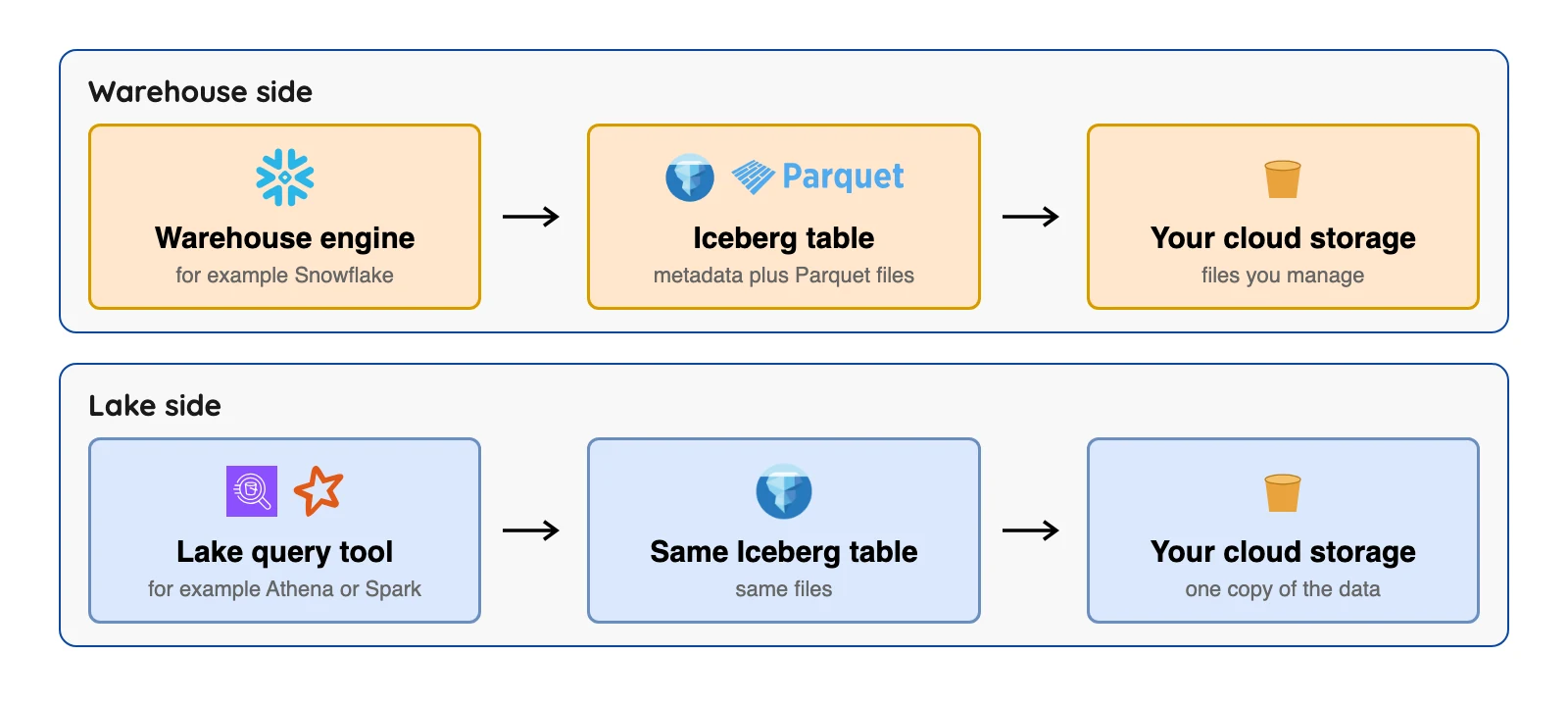
Here's the catch in the Snowflake docs. For tables built from Iceberg metadata files in object storage, Snowflake says it does not assume any life-cycle management on the table. When Snowflake manages the table itself, the same page says it handles lifecycle work such as compaction (merging many small files into fewer big ones).
How the bills differ: a worked example on one price list
Nobody enjoys opening a cloud invoice. So let's look at real numbers. AWS publishes both sides, so we can compare them on one price list.
S3 Standard, a common lake store, costs $0.023 per GB a month for the first 50 TB (checked Oct 2026). Redshift, AWS's warehouse, lists managed storage at $0.024 per GB a month in US East (N. Virginia) (checked Oct 2026). Rates vary by region, so check yours.
| Storing 1,000 GB for a month (our arithmetic) | Rate (checked Oct 2026) | Cost |
|---|---|---|
| Lake files in S3 Standard | $0.023 per GB (checked Oct 2026) | $23.00 |
| Warehouse storage in Redshift | $0.024 per GB (checked Oct 2026) | $24.00 |
On these two lists, storage is about a dollar apart. Not much.
The real gap is in how you pay to read the data. Athena, the lake query tool, charges $5 per TB scanned (US East, Ohio; checked Oct 2026), and Redshift Spectrum lists $5.00 per TB on the Redshift pricing page (US East, N. Virginia; checked Oct 2026).
Athena's own example shows why file format matters so much. A 3 TB uncompressed text table queried for one column costs $15. The same data compressed and stored as Parquet (a column-based file format) scans 0.25 TB and costs $1.25 (checked Oct 2026).
A warehouse bills compute on a different meter. Redshift says Provisioned starts at $0.543 per hour and Serverless begins at $1.50 per hour (checked Oct 2026).
So which is cheaper? Neither, in general.
Our read: a lake rewards tidy file formats and rare queries, and a warehouse rewards steady, shared use. This is one vendor's list, so prices on Snowflake, BigQuery or Databricks will differ. When any vendor says it is cheaper or faster, ask which file format, data size and query mix the claim assumes.
What practitioners say about the big warehouses and lake engines
Vendor pages tell you what a product can do. People who run it tell you what it feels like, so here's a small sample. Each line below is a short quote from a public page we opened on October 1, 2026, and it's one person's view, not a survey.
- Snowflake: New Relic's own engineering blog (April 2026) says Snowflake "had served us well early on", but that "the cost curve was moving in the wrong direction".
- Amazon Redshift: A reviewer on PeerSpot's Redshift reviews (June 2025) praises that "Redshift handles scalability automatically", while another (April 2024) says its costs "tend to increase significantly".
- Google BigQuery: A DEV Community article from July 2025 welcomes a new default cap but notes it is still "around $1000 per day". That figure used the $5 per TiB rate of 2025, and the pricing page now shows $6.25 per TiB (Iowa) (checked Oct 2026).
Spot the pattern? Cost keeps coming up, which fits the point above that a warehouse bills on a different meter than a lake.
We didn't find public discussion we could verify for Databricks, so we leave it out rather than guess. Peer sites and forums skew toward people with strong opinions, so read these as signals, not scores.
Where a data lake falls short
Skipping the early checks sounds freeing, until it isn't. IBM warns that without a management layer, data lakes can deteriorate into data swamps, which it describes as messy mires where good data is inaccessible. Ouch.
Azure says traditional lakes can suffer quality-control problems, data corruption and improper partitioning. It presents the data lakehouse as an answer to those problems.
Databricks, which sells a lakehouse product, lists what it sees as the weak spots of a traditional lake: no support for transactions, no enforcement of data quality or governance, and slow performance as data grows.
It adds that lakes are hard to secure and govern because data is hard to delete or update, which makes regulatory rules difficult to meet. Treat that as a vendor view, but the points are fair questions for any lake.
One of its practical tips is to mask personal data, called PII (personally identifiable information), before it enters the lake. Another is to keep a lake as a landing zone where data is saved without changes.
The lesson, honestly, is simple. A lake needs owners, names and rules, or it fills up with data nobody trusts.
Where a data warehouse falls short
A warehouse wants its homework done before the data shows up. Someone has to design the tables, load them on a schedule, and change them when the source changes. Google Cloud's page calls this side harder to change and more rigid.
IBM's data warehouse page adds that warehouses are typically not ideal for massive amounts of raw, unstructured data, and that cost and complexity grow as the data does. So if most of your data is logs, images or other files, a warehouse is the wrong first stop.
Is there a third option, the data lakehouse?
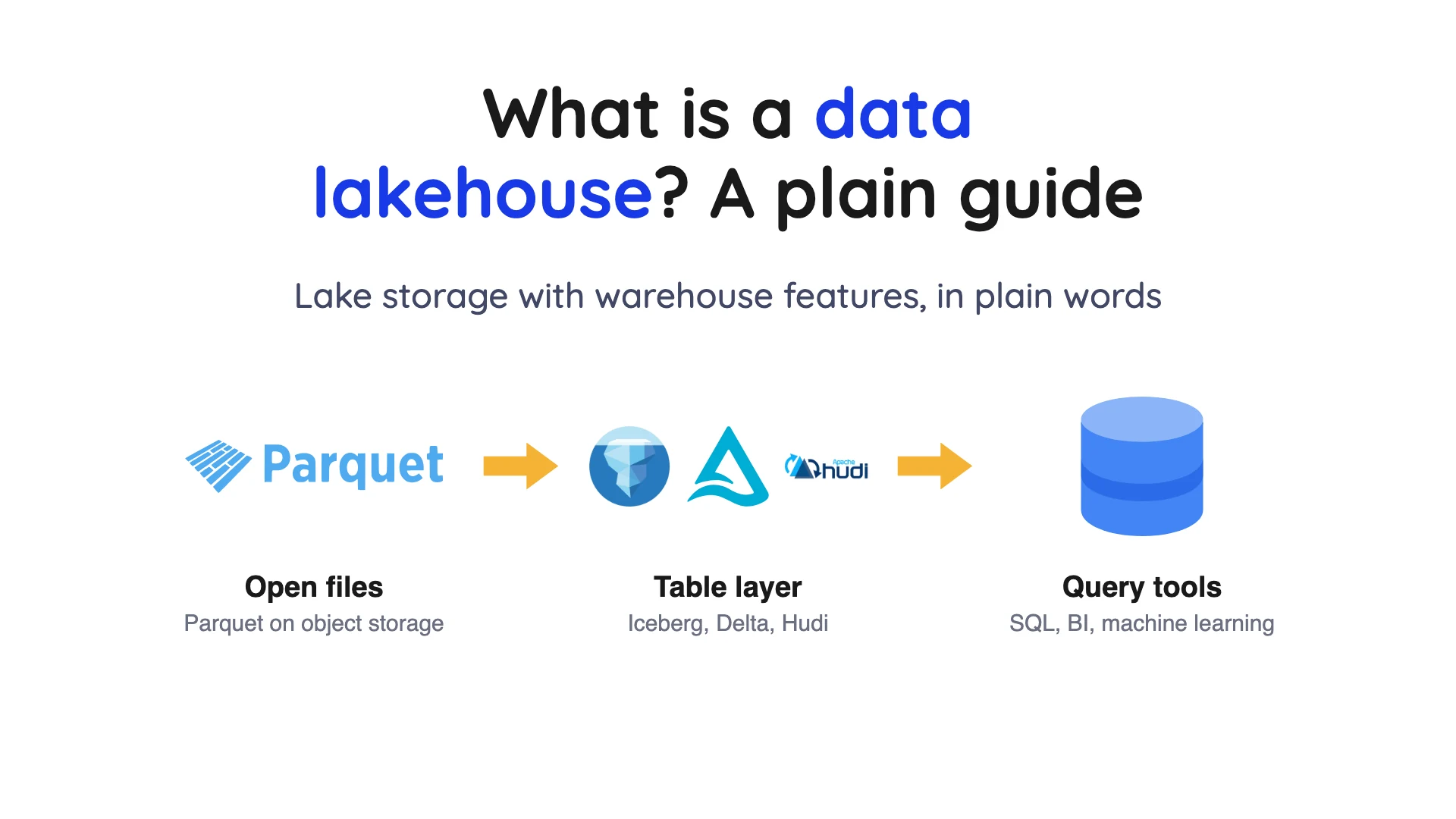
Yes, and it's the one everyone's talking about. A data lakehouse tries to give lake storage the table features of a warehouse. IBM calls it a platform that combines the low-cost, flexible storage of a lake with the performance and management of a warehouse.
Databricks publishes its own three-way table. Read it as a vendor's view: it sells a lakehouse, and it rates a warehouse as structured data only, which doesn't match the Snowflake and BigQuery docs above. It also rates a warehouse $$$ against $ for a lake, which is a rating, not a price.
A lakehouse doesn't make the other two obsolete (see lake vs lakehouse and warehouse vs lakehouse). The vendors we read still describe lakes and warehouses as in use side by side, and IBM says the low-cost flexibility of lakes continues to prove advantageous.
Want to see what stuck? Try this quick check.
Lake or warehouse? Test yourself
Question 1 of 5
Which picture is closest to a data lake?
FAQ
Q1. What is the main difference between a data lake and a data warehouse?
Q2. Which is better, a data lake or a data warehouse?
Q3. Can a data warehouse store JSON or semi-structured data?
Q4. Is a data lake cheaper than a data warehouse?
Q5. Does a data lake replace a data warehouse?
Q6. What is a data lakehouse?
Q7. What is a data swamp?
Q8. Is a data warehouse ETL or ELT?
Q9. What is a data mart?
Q10. Should a small team start with a lake or a warehouse?
Conclusion
So, in one line: a lake keeps data raw and a warehouse keeps it tidy. Google Cloud and IBM describe lakes as lower cost and more flexible, though a lake needs discipline to stay useful. Warehouses take more work up front, and in return they aim for faster, more trusted SQL answers.
The gap is smaller than some pages make it sound. Warehouses hold JSON, lakes can be queried with SQL, and Iceberg tables can be read by both. Pick by the question you need answered first, and don't be surprised if you end up with a bit of both. If your lake starts with database tables, OLake Go can fill it with Iceberg or Parquet.
Facts last checked on October 1, 2026. Vendor pages change, so open the linked page before you decide. For the basics, read what is a data lake, and for tools by layer, best data lake tools.