What Is a Data Lakehouse? A Plain-Language Guide
21 min read
Key takeaways
A data lakehouse keeps your data as cheap, open files, just like a data lake. Then it adds a management layer on top, which is where the warehouse features come from, such as safe updates and past versions of a table. Vendors define it a little differently, so the exact parts vary.
And no, it won't clean your data for you, and it needs regular upkeep. To fill one from your databases, OLake Go is our free, open-source tool for Iceberg or Parquet.
- A lakehouse adds warehouse features to cheap file storage. A 2021 research paper on the term, by Databricks authors, defines it as a system on low-cost, directly accessible storage that also gives ACID transactions, data versioning, auditing, indexing, caching and query optimisation.
- The key part is a table layer, not a new database. A metadata layer tracks which files belong to a table, so a change either fully happens or doesn't happen at all.
- It's a general idea, not one product. AWS, IBM and Databricks all define it as an architecture, and Delta Lake, Apache Iceberg and Apache Hudi are all named as ways to build it.
- Sources disagree on the details. Counts of layers range from five to six, and the original paper describes three ideas instead.
- Data has to get in somehow. OLake Go copies PostgreSQL, MySQL and MariaDB, MongoDB and SQL Server into Apache Iceberg or Parquet on storage you choose.
- It won't do the work for you. You still write the cleaning logic, and tables need regular upkeep.
Picture a company that keeps raw files in cheap storage, and also keeps a second, tidier copy in a database built for reports. Two copies means two things to keep in sync, and a copy job in the middle that somebody has to babysit. A lakehouse is the idea of keeping just one copy, and making that copy trustworthy enough for reports.
Every fact comes from a named page, read on October 1, 2026, with the link right next to the claim. Where a source gives no number, we say so. We read vendor documents and one research paper, and we did not build or test a lakehouse or any product named here.
What is a data lakehouse?
A data lakehouse stores your data as open files in cheap cloud storage, then adds a layer on top that gives it warehouse features.
One well-known short definition comes from a paper by four Databricks authors, presented at a database research conference in January 2021 (CIDR 2021 paper). It calls a lakehouse "a data management system based on low-cost and directly-accessible storage". That system also provides ACID (all-or-nothing) transactions, data versioning, auditing, indexing, caching and query optimisation.
ACID stands for atomicity, consistency, isolation and durability. Strip away the jargon and it means a change is all-or-nothing, so other people reading the data never see a half-finished change. Delta Lake's documentation puts it as readers never seeing inconsistent data.
Cloud vendors give plainer versions. AWS calls it a unified data architecture that combines data warehouses and data lakes, with a shared metadata layer (AWS). International Business Machines (IBM) says it combines the low-cost, flexible storage of a data lake with the high-performance analytics and data management of a data warehouse (IBM).
The word is not new. A Databricks blog post dated January 30, 2020 uses it and says the architecture emerged independently across many of its customers (Databricks blog).
Why the lakehouse idea exists
The paper walks through three generations of platforms, and seeing them shows what the lakehouse is trying to fix.
- Warehouses first. Companies copied data from their business databases into a central warehouse for reports. The paper says these coupled compute and storage in an on-premises appliance, which got costly as data grew, and they couldn't store video, audio or text documents at all.
- Lakes second. A data lake is a low-cost store with a file interface that holds data in open formats such as Apache Parquet. Parquet is a column-oriented file format, so values from one column are stored together. Lakes made storage cheap, but the paper says they pushed data quality and governance problems downstream.
- Both together. Many companies ended up running a lake and a warehouse side by side. The paper says this two-tier design was dominant in the authors' experience and used at virtually all Fortune 500 companies, which is a claim by Databricks authors in 2021.
The paper names four problems with the two-tier setup: reliability, stale data, limited support for machine learning (ML), and higher total cost because data is stored twice. A survey by Dimensional Research and Fivetran, cited in the paper, says 86% of analysts use out-of-date data. Treat that as a reported figure, since we didn't read the survey.
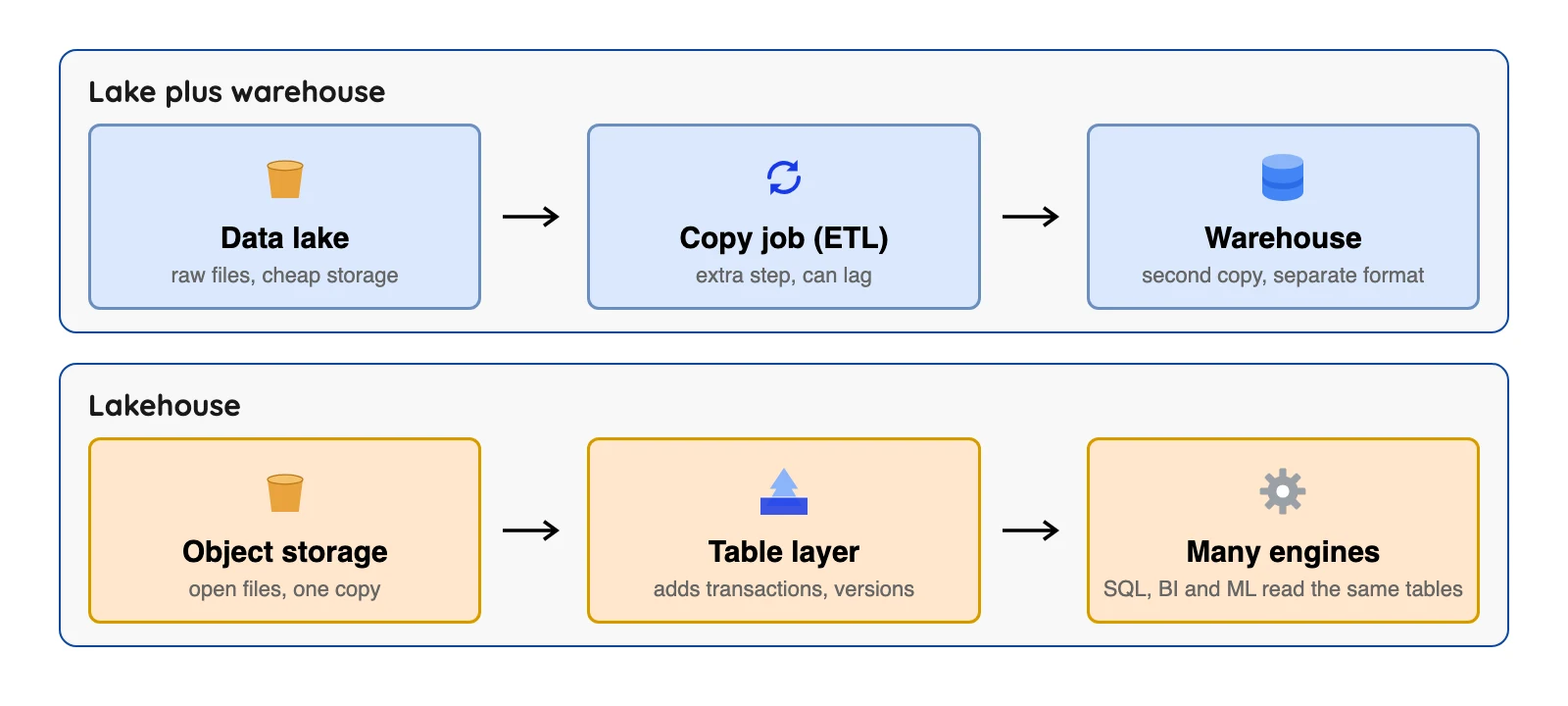
The lakehouse answer is simple: keep the lake, and make it behave more like a warehouse. Still, the paper is clear that this is an argument, not a settled fact. Its authors predict that the classic warehouse design will wane, and the same authors work at a company that sells a lakehouse.
How does a data lakehouse work?
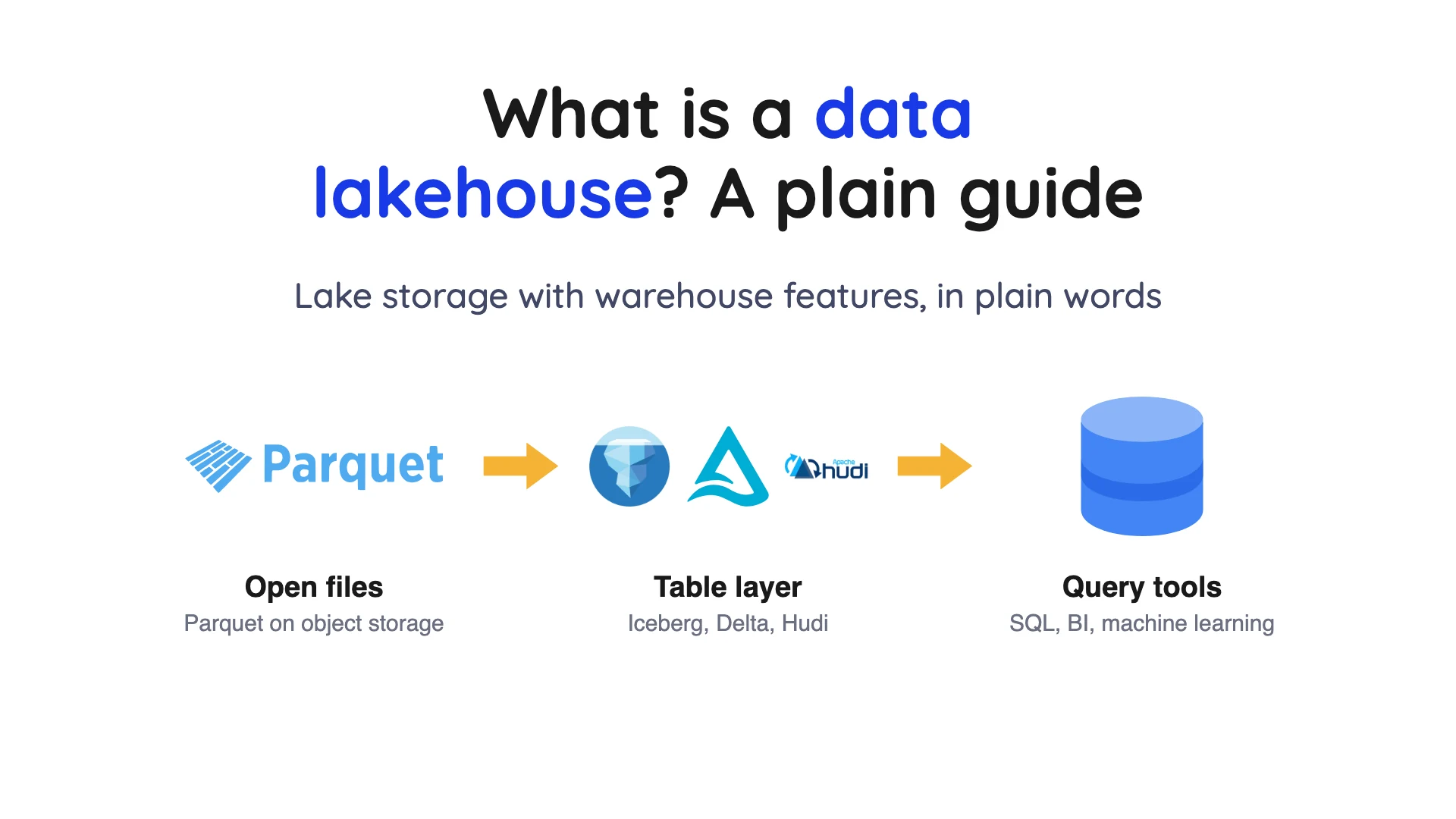
A lakehouse puts a table layer over files in cloud storage. Hudi's explainer describes the same idea as layering an open table format over cloud object storage (Apache Hudi, July 2024 blog, hudi.apache.org/blog/2024/07/11/what-is-a-data-lakehouse). The pieces, bottom to top:
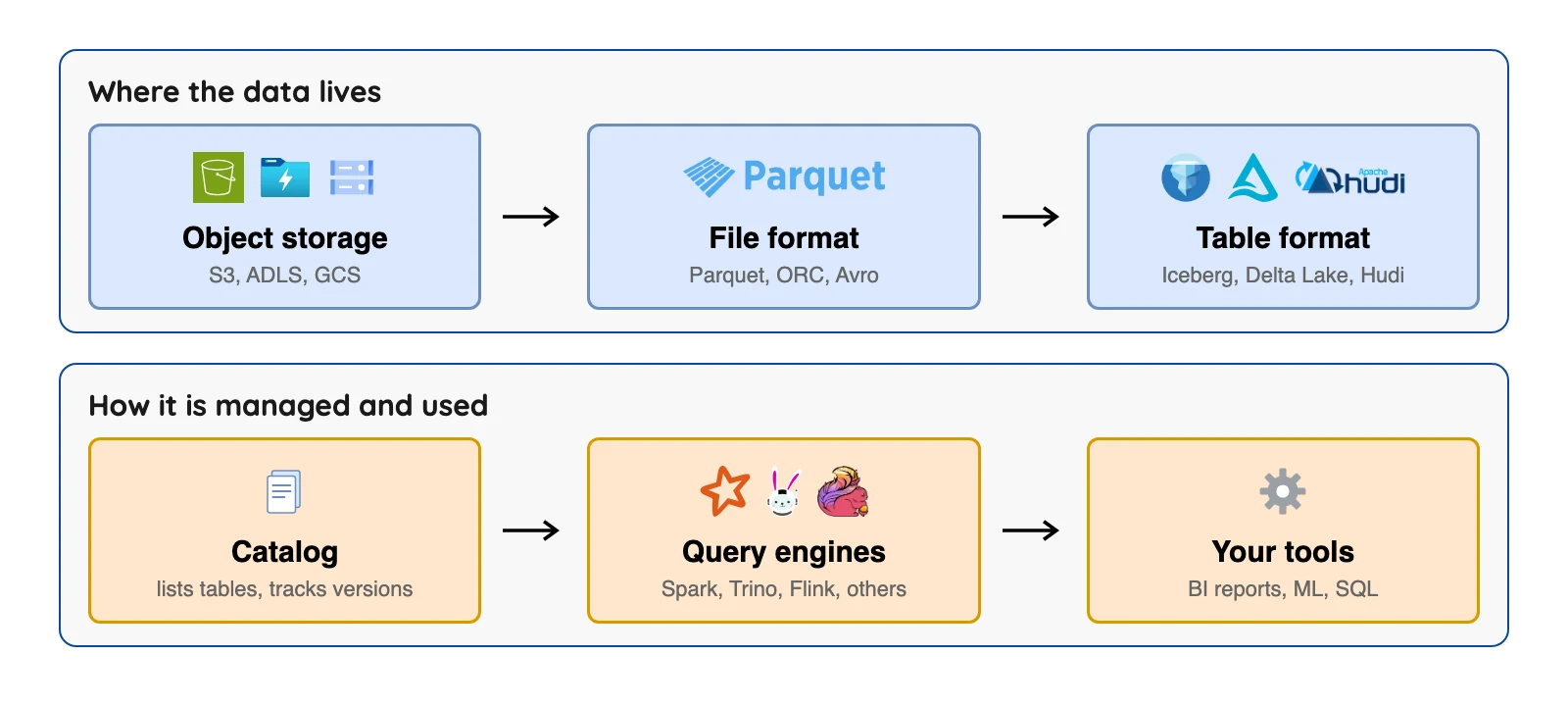
- Object storage. The cheap bottom floor, such as Amazon S3, Azure Data Lake Storage (ADLS) or Google Cloud Storage (GCS). Delta Lake's docs list S3, ADLS, GCS and HDFS as places it runs.
- File format. Usually Parquet, as covered above. The Apache Iceberg specification lists Parquet, Avro and ORC as file formats an Iceberg table can use.
- Table format. This is the clever bit: rules and metadata files that say which files make up a table at a given moment. Delta Lake, Iceberg and Hudi are the three named by Databricks and IBM.
- Catalog. Think of it as a directory of tables. The Iceberg specification says the table location is intended to be managed and supplied by a catalog.
- Query engines. The programs that actually run your SQL or machine learning code. The Iceberg site lists Spark, Trino, Flink, Presto, Hive and Impala as engines that can work on the same tables.
Why a table layer is needed
The CIDR paper says storage like S3 offers only a low-level interface, where even updating a table that spans many files is not atomic. So the system adds a metadata layer that defines which objects are part of a table version.
Iceberg shows how it works. Its specification says every change creates a new metadata file, which replaces the old one with an atomic swap. Readers keep using the version they loaded, so nothing changes under them until they refresh.
That means two people can read and write the same table without seeing half-finished changes. Old versions also stay available for "time travel", which the Iceberg docs list as a feature.
The paper says the table layer isn't enough
The same paper says a metadata layer alone is not enough for good SQL speed. Warehouses use tricks such as caching, statistics and indexes, and a lakehouse needs equivalents. Pages that only list "ACID plus open formats" skip the part that makes queries fast.
What do the main sources say, side by side?
The sources agree on the headline and differ on details.
| Source (read 2026-10-01) | How it describes a lakehouse | Parts it names |
|---|---|---|
| CIDR 2021 paper | Low-cost direct-access storage plus warehouse management features | Three ideas: a metadata layer, performance tricks, and ML access |
| AWS | Unified architecture with a shared metadata layer | Five layers: ingestion, storage, metadata, API, semantic |
| IBM | Lake storage plus warehouse analytics, usually on open table formats | Five layers: ingestion, storage, metadata, API, consumption |
| Apache Hudi | Open table format over cloud storage | Six parts, including a storage engine and a catalog |
| Microsoft Learn | A data management system combining lake and warehouse benefits | Delta Lake plus Unity Catalog, on Azure Databricks |
Two points follow. First, nobody agrees on a single count of layers, so don't repeat "the five layers" as if it were a standard. Second, Microsoft's page describes the Databricks way of building one, not the only way.
How is a lakehouse different from a lake or a warehouse?
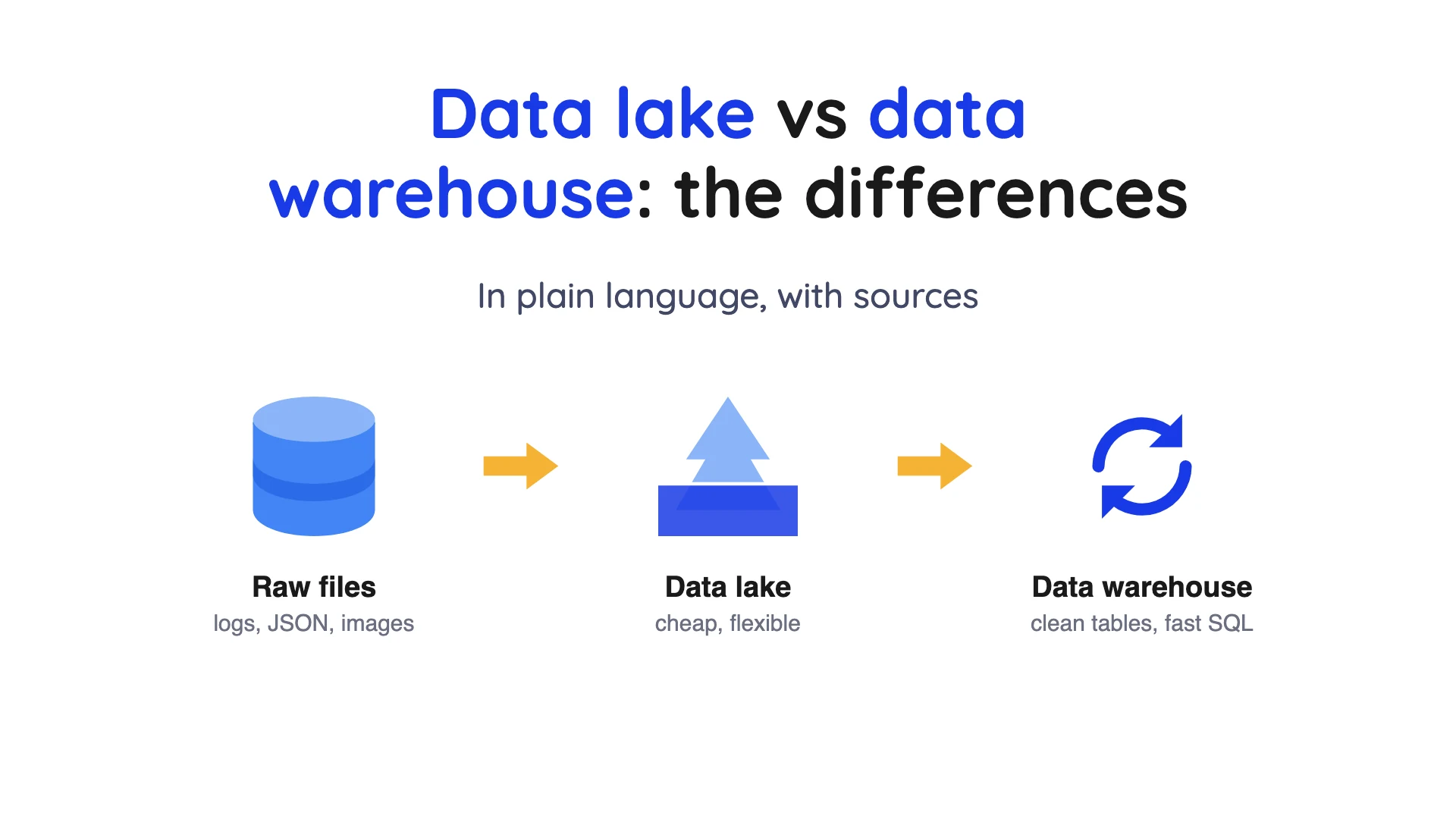
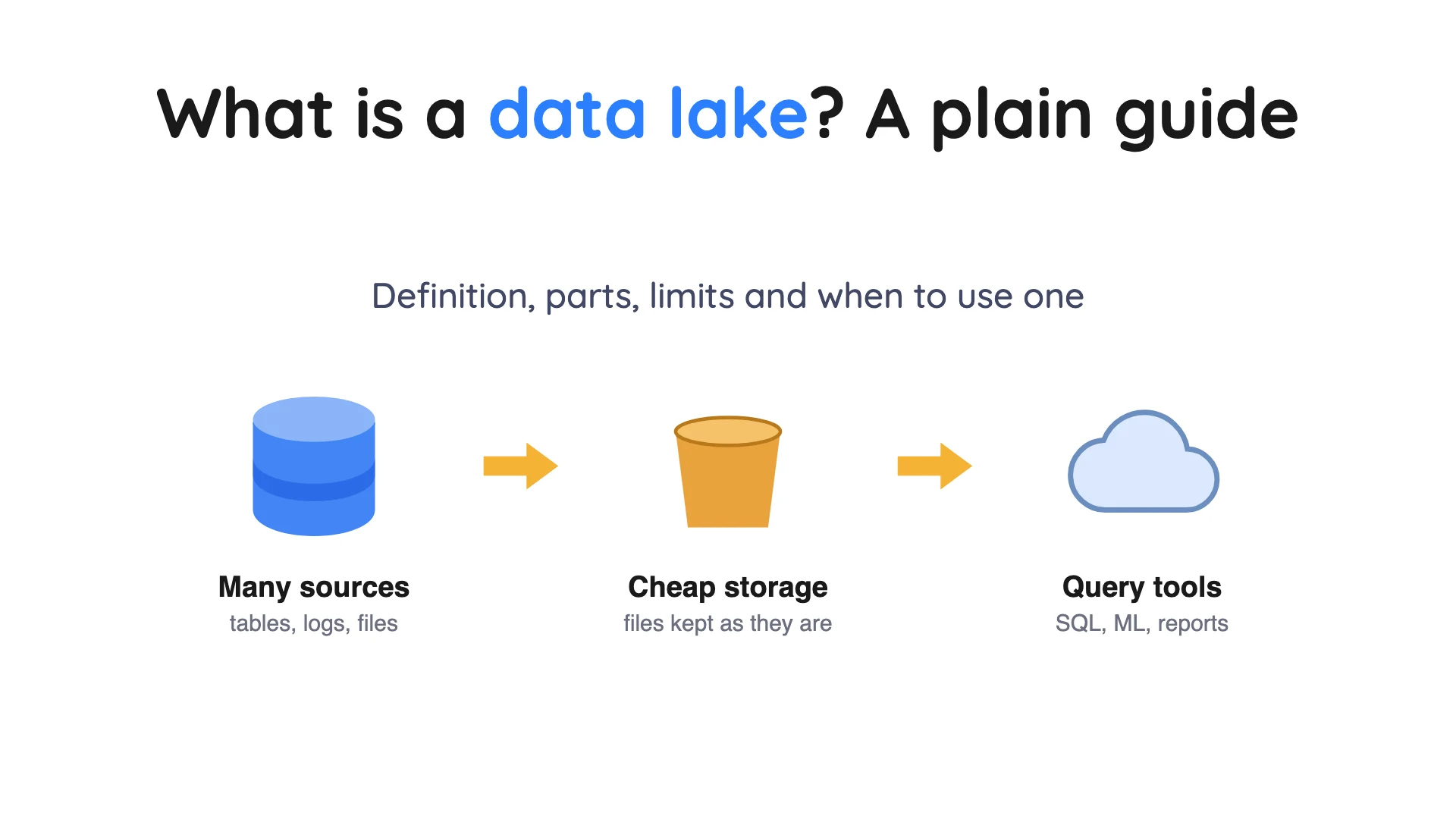
A lake is cheap and flexible, a warehouse is tidy and fast for reports, and a lakehouse adds a table layer to a lake to get some of both. The side-by-side comparisons are in our guides to data lake vs data lakehouse and data warehouse vs lakehouse. The basics of the first piece are in what is a data lake.
Is a lakehouse the same as Delta Lake, Iceberg or Hudi?
No. Those three are table formats, which is the layer that makes a lakehouse possible.
Databricks says companies can build a lakehouse with Delta Lake, Apache Iceberg or Apache Hudi on top of open formats such as Parquet (Databricks glossary page). IBM says most lakehouses use one of those three.
Each project describes itself a bit differently. Delta Lake says it is an open source project for building a lakehouse on top of data lakes (Delta Lake docs). Hudi calls itself an open data lakehouse platform.
Iceberg's spec says versions 1, 2 and 3 are complete and version 4 is under active development and not yet formally adopted (Iceberg spec).
Because the formats are open, the vendors say their platforms can read each other's tables, within limits. We did not test any of it. Here's what each vendor says, and the limit it states.
| Platform | What its docs say about Iceberg tables | Stated limit (checked Oct 2026) |
|---|---|---|
| Databricks | Supports Iceberg tables that use Parquet, spec versions 1, 2 and 3 | Needs Unity Catalog and Runtime 16.4 LTS or above; managed tables also need serverless compute (checked Oct 2026) |
| Snowflake | Supports Iceberg tables that use Parquet, with externally managed writes on spec v2 or v3 | Streams are not supported for Iceberg tables made from Delta files with partition columns; for Snowflake-managed tables on storage you manage, cross-region writes incur egress charges (checked Oct 2026) |
| BigQuery | Says Iceberg managed tables are the foundation for open-format lakehouses on Google Cloud | Lists limits, such as no table renames or copies, no materialized views, and one mutating DML statement at a time per table (checked Oct 2026) |
Put simply, the same open table can often be read by more than one vendor's engine. Each vendor still sets its own conditions, though, so check the page for your cloud before you plan around it.
What do practitioners say about these platforms?
We read community threads and engineering blogs on October 1, 2026, and kept only dated quotes we could open. Each line is one person's view, not a survey.
- Delta Lake. A December 2024 blog post by a Microsoft Fabric practitioner praises the Python library for maintenance jobs, saying they "were significantly faster compared to Spark". The same post warns about "potential Delta compatibility issues which may block the ability to use newer/optimal Delta features".
- Apache Hudi. In a January 2025 Hacker News thread on Apache Hudi, one commenter says real time is why their team picked it at Notion. The same commenter says it "feels like the 3rd place finisher in the popularity contest (Iceberg #1, Delta #2)".
- Databricks. In a May 2025 Hacker News thread on Databricks acquiring Neon, one commenter says it saves setup time but is "expensive and opinionated".
- Snowflake. New Relic's own engineering blog (April 2026, a company case study, not neutral peer talk) says Snowflake "had served us well early on". It then says the "cost curve was moving in the wrong direction" and the team was locked into one vendor.
We found no substantive independent threads worth quoting for BigQuery's Iceberg tables, so we left them out rather than guess. Two of these quotes come from commenters who may work for the company they discuss, so weigh them as company experience.
What do people use a lakehouse for?
Databricks lists four benefits on its glossary page, and each one answers a problem of the two-copy setup. These are Databricks's own claims, and we did not test them.
- One copy of the data. There is no separate system to maintain and no duplicate data.
- Fresher data. Fewer copy jobs means fewer chances for data to go stale.
- Open access for data science. Open formats such as Parquet work with tools like pandas, TensorFlow and PyTorch.
- Past versions. Time travel lets you query older versions without a separate backup system.
AWS adds streaming ingestion for near-real-time data, and says its integrations can automate parts of the copy work. IBM names business intelligence (BI), analytics and artificial intelligence or machine learning as the workloads a lakehouse supports. These are vendor claims, so test them on your own data before you believe them.
A worked example: one change, step by step
This is an illustration built from the Iceberg specification, not a test we ran. Say a table of orders holds 10 data files, and a customer changes an address.
- The writer saves the new or rewritten data files in cloud storage. At this point readers see nothing new.
- The writer creates a new metadata file that lists which files make up the table now.
- The table swaps the old metadata file for the new one in a single atomic step. The spec says this swap is the basis for serializable isolation.
- A report that started before the swap keeps using the version it loaded. A report that starts after it sees the change.
So the change is all or nothing. The old version sticks around until it's expired, which is why upkeep matters, and why the next section lists it.
What a lakehouse does NOT fix
Limits the sources themselves state:
- You still write the cleaning logic. The CIDR paper says organisations still have to write ETL or ELT logic to create curated datasets, though there are fewer ETL steps overall. ETL means extract, transform, load, the copying and reshaping of data between systems.
- Tables need upkeep. Like any house, a lakehouse needs housekeeping. The Iceberg maintenance page says each write creates a new snapshot and that snapshots build up until expired. It also says streaming queries may produce small data files that should be compacted, because small data files mean extra metadata and less efficient queries (Iceberg maintenance).
- Setup and governance are hard. IBM lists complex implementations, balancing governance and security with unified data access, and keeping query performance good as data grows as challenges. It also says avoiding a data swamp, where good data is inaccessible due to poor management, takes strong governance, data quality and security practices.
- Quality control isn't automatic. Microsoft Azure says that because lakes accept all types of data, issues with quality control, data corruption and improper partitioning can occur (Azure). Ask what your table layer enforces before you rely on it.
- Performance claims need a grain of salt. The CIDR paper reports a Parquet-based system competitive with cloud warehouses on a standard benchmark, but the authors work at the vendor. So we don't repeat a speed number here.
When is a lakehouse the right choice?
The sources give reasons to pick one but stop short of a size cut-off. Find your situation in the table below. Where the sources are silent, the table says so.
| Your situation | What the sources say | Fit |
|---|---|---|
| You keep video, audio, text or other unstructured data | The CIDR paper says warehouses cannot easily manage it and lakehouses can; AWS says warehouses struggle with it | A lakehouse may fit |
| You run machine learning on large datasets | The paper says ML tools read open files directly, while pulling data out of a warehouse is inefficient | A lakehouse may fit |
| You pay to keep two copies and a copy job | The paper names double storage and extra ETL as costs of the two-tier design | Worth testing a lakehouse |
| You only run reports on clean, structured data | None of the pages we read gives a size or workload where a warehouse stops being enough | A warehouse may be enough; not a source-backed answer either way |
| You want to avoid one vendor's format | Hudi and Databricks both point to open formats as the benefit | Lakehouse with an open table format |
| You have no one to run table upkeep | Iceberg's docs list compaction and snapshot expiry as ongoing tasks | A managed warehouse may be easier |
| You need to copy databases into the lakehouse | Our docs: OLake Go does a full load, then change capture, into Iceberg or Parquet | Ingestion with OLake Go (ours) |
Azure also says it is common for large organisations to have both a lake and a warehouse. So you don't always have to pick one or the other.
What is the medallion pattern?
Bronze, silver and gold are layers of tables, which Microsoft Learn calls a medallion architecture. It says data improves step by step as it moves through staging and transformation.
IBM describes the three levels this way: bronze holds raw data, silver holds cleansed data, and gold holds business-ready data. None of the sources we read make it a requirement. Our read: treat it as a naming habit for organising tables.
How does data get into a lakehouse?
A lakehouse starts out empty. Data has to be copied in from business databases, event streams and files. The AWS page lists ingestion as the first of its five layers, and IBM does the same.
One common way to copy a database is change data capture (CDC), which reads a database's change log and copies each insert, update and delete.
OLake Go is one open-source tool (Apache 2.0) for this job. It does a full load and then log-based change capture from PostgreSQL, MySQL and MariaDB, MongoDB and SQL Server, and writes Apache Iceberg or Parquet to storage you choose (our docs).
Five myths about lakehouses
- "A lakehouse is a Databricks product." No. AWS and IBM define it as a general architecture, and Databricks itself lists Iceberg and Hudi as options.
- "A lakehouse needs Delta Lake." No. IBM lists Hudi, Iceberg and Delta Lake as the usual formats.
- "Lakehouses have killed warehouses." Not shown by any source we read. The CIDR paper only predicts that the warehouse design will wane, and Azure says organisations commonly use both.
- "A lakehouse removes ETL." No. The CIDR paper says you still write the logic, with fewer steps.
- "A data lake house and a data lakehouse are different." They're not. The spelling varies in search, and the sources we read use the one-word form for the same idea.
Questions to ask before you build one
- What is your data like? Mostly clean tables, or files, text and sensor data too?
- Who will run table upkeep? Compaction and snapshot cleanup are ongoing jobs in Iceberg's docs, unless a vendor does them for you.
- Which engines must read the data? Check that each one supports your table format and version, using the vendor pages above.
- Which catalog will you use? The catalog decides what tools can see your tables, and each platform has its own conditions.
- What does keeping two copies cost you today? Get a real figure for your storage and your copy jobs before you decide a change is worth it.
Test your lakehouse basics
Question 1 of 5
In plain words, what is a data lakehouse?
FAQs
Q1. What is a data lakehouse in simple terms?
Q2. What is the difference between a data lake and a data lakehouse?
Q3. What is the difference between a data warehouse and a data lakehouse?
Q4. Is a data lake house the same as a data lakehouse?
Q5. Do I need Delta Lake, Iceberg or Hudi to have a lakehouse?
Q6. Does a lakehouse replace a data warehouse?
Q7. What are the downsides of a data lakehouse?
Conclusion
A data lakehouse is open files in cheap storage plus a table layer that adds warehouse features. The big sources agree on that, and they differ on the number of layers and on how far it should replace a warehouse. Treat claims that it replaces warehouses as a forecast, not a fact.
Before you decide anything, write down what kind of data you hold, who will run upkeep, and which engines must read your tables. Then work through the decision table above, and check the vendor page for each tool you're eyeing. To fill the lakehouse from PostgreSQL, MySQL, MongoDB or SQL Server, OLake Go is a free option. Our guides to lake vs lakehouse, warehouse vs lakehouse and best data lake tools go further.